5 Arguments Against Reincarnation 1) A proof in the converse from...

𝘢𝘳𝘳𝘶𝘴@_bonaventurian
19 views
Sep 23, 2025
~16 min read
Advertisement
1
5 Arguments Against Reincarnation
1) A proof in the converse from the truth of hylomorphism
2) An argument from soteriology
3) St. Maximus the Confessor
4) Contra Buddhism qua the operation & nature of consciousness
5) Contra Vedanta qua absolute monism



1) A proof in the converse from the truth of hylomorphism
2) An argument from soteriology
3) St. Maximus the Confessor
4) Contra Buddhism qua the operation & nature of consciousness
5) Contra Vedanta qua absolute monism
𝙈𝙖𝙧𝙞𝙜𝙤𝙡𝙙 𝘼𝙧𝙘𝙝𝙞𝙫𝙚@anticomTW
@Pheyniix Whether or not you believe in the cycle of suffering or the Buddhist truths, you can't disprove reincarnation. Being reincarnated with no memories is the most terrifying prospect for what's after death. That's something I would prepare for.
2
1) Hylomorphism
======
We are going to proceed as follows:
a) outline of doctrine
b) proof of the doctrine
c) argument
======
We are going to proceed as follows:
a) outline of doctrine
b) proof of the doctrine
c) argument
3
1.a) Outline
----------
The doctrine of hylomorphism runs as such: that an individual is a substantial unity of form specified through matter. Matter takes its determination through form. Form takes some kind of designated matter as the site of its activity.
----------
The doctrine of hylomorphism runs as such: that an individual is a substantial unity of form specified through matter. Matter takes its determination through form. Form takes some kind of designated matter as the site of its activity.
4
All material substances, even if their formal constitution persists after the material principle corrupts and perishes, are united as such. Ergo it follows that all hylomorphic compounds come to be as formed matter, at the same time when they are generated.
5
As such, the body and soul are not two utterly distinct substances unto themselves.
The reason for this shall be the proof of our doctrine:
The reason for this shall be the proof of our doctrine:
6
1.b) Proof of hylomorphism concerning the human person
----------
The human is the rational animal - the creature with sensitive and rational faculties. The constitutive activity of human nature is reasoning. That the human comes to know anything is, first, by way of the senses.
----------
The human is the rational animal - the creature with sensitive and rational faculties. The constitutive activity of human nature is reasoning. That the human comes to know anything is, first, by way of the senses.
7
This means that reasoning requires the senses. And the senses are due unto the body. If then, reason requires the senses, reason requires the body as its site of activity. That the human comes to know anything is, first, by way of the body's senses.
8
Ergo, the constitutive activity of human nature, reasoning, in requiring the senses, requires the body. Thus, the human, the rational animal, is necessarily a compound of rational soul and body. The natural perfection of human reason requires union with the body.
9
But for this to be such: a substantial unity of rational soul and body, is for hylomorphism concerning the rational animal to be true.
Therefore hylomorphism concerning the rational animal is true.
To be such-and-such human is to be "this" soul united with "this" specific body.
Therefore hylomorphism concerning the rational animal is true.
To be such-and-such human is to be "this" soul united with "this" specific body.
10
Remove the rational soul, and we have a mere animal. Remove the soul per se (that is, the intrinsic principle of self-motion) and we have an inanimate object.
Keep the rational soul and remove matter and we lose the human person we are speaking of.
Keep the rational soul and remove matter and we lose the human person we are speaking of.
11
Without his designated matter, a given human individual is no longer "that human born at this time, in this cultural/national/ethinic group, to these parents" and so we lose what makes him "this" human individual and not another.
12
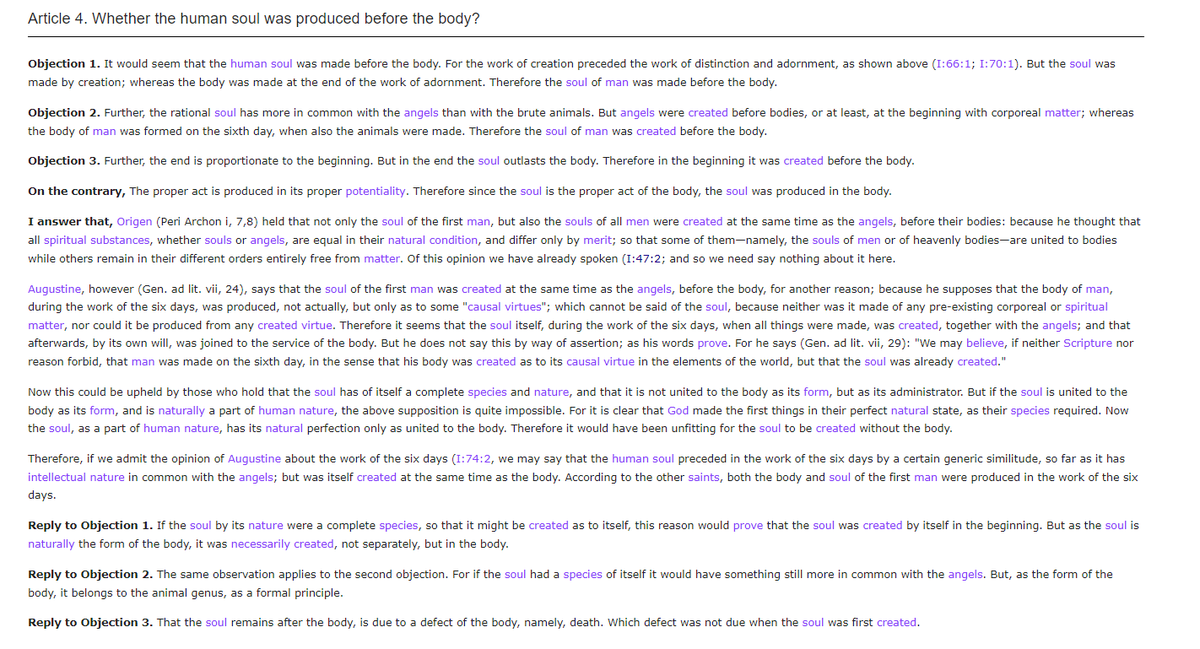
Sure, the rational soul as having been specified by said human body it is connatural to can outlive it. And if you use this as an objection, St. Thomas Aquinas has already accounted for it (Obj/Re. 3):
13
Further: If the body had its own existence and the soul likewise its own, body and soul would necessarily be two subsisting things. Now, two subsisting things, no matter how closely they approach to each other or how intimate be their actionsー
14
ーyet ever remain two beings and never become one substantial unit. Every dualistic theory, then, which does not regard the body as a first or primary matter to which the soul communicates its own existenceー
15
ーmust fail to account for the substantial unity of man and the intrinsic union of matter and mind that is to be found within him.
As such, only the hylomorphic account of the human person can actually account for given human beings and the substantial unity of body and soul.
As such, only the hylomorphic account of the human person can actually account for given human beings and the substantial unity of body and soul.
16
As such our minor premise is proven: Hylomorphism is true.
Now to our major: That if hylomorphism is true, reincarnation is impossible and unfitting
Now to our major: That if hylomorphism is true, reincarnation is impossible and unfitting
17
Reincarnation holds that the soul or constitutive identity of a thing was at some point independently existing without the material construction it now presently resides in. This runs afoul of hylomorphism on two accounts:
18
1.α) Reincarnation holds that the soul pre-exists the body. Hylomorphism holds that they are cogenerated or at least that the soul cannot pre-exist without the site of its activity, and thus, its natural perfection: its specific body. Reincarnation is thus impossible.
19
1.β) Reincarnation foists individual identity into the immaterial constitution. But as we have demonstrated, this quickly becomes nonsensical when trying to account for the individual identity of a human subject, which requires both matter & form. Reincarnation is thus unfitting.
20
Thus our major is proven: if hylomorphism is true, reincarnation is unfitting and impossible.
Our argument thus, now with its premises proven, runs as follows:
Our argument thus, now with its premises proven, runs as follows:
21
1.c) Argument
----------
i) If Hylomophism is true, reincarnation is impossible and unfitting.
ii) Hylomorphism is true.
∴ Reincarnation is impossible and unfitting.
Q.E.D.
----------
i) If Hylomophism is true, reincarnation is impossible and unfitting.
ii) Hylomorphism is true.
∴ Reincarnation is impossible and unfitting.
Q.E.D.
22
2) An argument from soteriology
======
We will proceed as before:
a) outline of doctrine
b) proof of the doctrine
c) argument
======
We will proceed as before:
a) outline of doctrine
b) proof of the doctrine
c) argument
23
2.a) Outline
----------
Much of the leg work for this argument has already been done. The human individual is necessarily, and fittingly, a holomorphic compound of body, and rational soul. Much has been said about the body and the senses, let us now turn to the rational soul.
----------
Much of the leg work for this argument has already been done. The human individual is necessarily, and fittingly, a holomorphic compound of body, and rational soul. Much has been said about the body and the senses, let us now turn to the rational soul.
24
A question arises: if the human requires the body, but the body perishes, how does the human persist thereafter? The answer, with caveats, lies in the rational soul.
First, the rational soul is incorruptible. This can be proven as such:
First, the rational soul is incorruptible. This can be proven as such:
25
2.b) Proof of the doctrine
----------
When one things of such-and-such thing (whether individual, species, genus, essence, nature or what have you), what it is to be that thing which is thought of (essence) is attained to in some fashion by the mind.
----------
When one things of such-and-such thing (whether individual, species, genus, essence, nature or what have you), what it is to be that thing which is thought of (essence) is attained to in some fashion by the mind.
26
But when the mind comes to know of things, that is attain to the essence of things, that are other than itself that are material, it comes to it by way of the senses - that is: material organs.
27
The mind however, knows itself. And it necessarily knows of itself without necessary recourse to the senses. To doubt this is to doubt that one is thinking. But to doubt is to think, thus the mind necessarily knows itself.
28
And it does so without recourses to the senses. But knowledge of essences by way of the senses is proper to material things. Thus in the converse, knowledge of essences without the senses is proper the immaterial things.
29
But such is the mind's knowledge of itself. Therefore the mind is immaterial.
If the mind is immaterial, it is not a body. If it is not a body it is not divisible in space. Only things which are divisible in space are corruptible, such as bodies.
If the mind is immaterial, it is not a body. If it is not a body it is not divisible in space. Only things which are divisible in space are corruptible, such as bodies.
30
Therefore, the mind, qua the faculty that knows essences, is incorruptible. But the body is corruptible. Thus the mind persists after the corruption, that is the death of, the body. This is what we know as the "immortality of the soul".
31
Thus we have our minor premise proven: it is uniquely by way of man's rational faculties that his soul outlives the body.
32
Now both the hylomorphic theory and reincarnation share the premise that the soul as such outlives the body. Where they differ is in that the general accounts of reincarnation hold that the soul assumes a new body, often times of a new speciesー
33
ーsuch as that of a man transmigrating into an animal nature (Plato and Plotinus) or from the animal to man or angel/god/demon (most Hindu sects and all Buddhism), specifically citing examples of a dog (Pythagoreanism), or a swan (Orphism) or an insect (Jainism).
34
But this raises a crucial question which the Neoplatonists after Porphry all asked: if the principle by which man's soul outlives his body is his rational soul, but animal do not have rationality (cannot abstract from sense data or know essences/universals, nor have free will)ー
35
ーhow is it that the rational soul enters the animal? Does this not make the sensible matter unified with a rational soul? Is this not what a man is? Therefore even if a disincarnate rational soul were to enter an animal body, it would cease being a mere animal.
36
Thus it makes no sense to speak of a man reincarnating as an animal. Even less sense does it make for an animal to reincarnate as a man or an angel/god/demon given that the animal of itself as no rational faculties & thus no native means to persist after the death of its body.
37
Thus we have our major premise proven: To be true, reincarnation requires an account of immortality that does not appeal to the immortality of the rational soul.
Thus we have the materials for our argument:
Thus we have the materials for our argument:
38
2.c) Argument
----------
i) To be true, reincarnation requires an account of immortality that does not appeal to the immortality of the rational soul.
ii) It is uniquely by way of man's rational faculties that his soul outlives the body.
∴ Reincarnation is not true.
Q.E.D.
----------
i) To be true, reincarnation requires an account of immortality that does not appeal to the immortality of the rational soul.
ii) It is uniquely by way of man's rational faculties that his soul outlives the body.
∴ Reincarnation is not true.
Q.E.D.
39
Corollary 2.α)
Many accounts of reincarnation appeal to the transmigration of souls as an explanation of a encosmic justice system. "The soul's life and habits were evil as such to warrant being reincarnated as an animal" is usually how such explanations run.
Many accounts of reincarnation appeal to the transmigration of souls as an explanation of a encosmic justice system. "The soul's life and habits were evil as such to warrant being reincarnated as an animal" is usually how such explanations run.
40
But pray tell, how does the transmigrationist explain how the dog is supposed to repent of its previous crimes as a human? How according to any kind of redistributive justice can the one accord to the other? How about the manta ray or the fruit fly?
41
All of this is incongruous. Yet, justice requires congruity as justice lies in he who is due being given what he is due. But no amends for said crimes can be given by man the reincarnated as an animal. Thus there is no justice in transmigration.
42
Corollary 2.β)
To mortally sin is to sin against God. But to sin against God is to sin against the infiniteーwhich is to sin infinitely. But satisfaction for such is cannot be made in the finite.
To mortally sin is to sin against God. But to sin against God is to sin against the infiniteーwhich is to sin infinitely. But satisfaction for such is cannot be made in the finite.
43
Reincarnation only concerns the finite (such and such creature becoming such and such other thing). Thus reincarnation offers no satisfaction for sin. As such, only something which is both finite and infinite offers adequate satisfaction.
44
Such is the vicarious atonement of Our Lord Jesus Christ who is both man (finite) and God (infinite). Thus only the vicarious atonement of Our Lord offers adequate satisfaction for sin. Reincarnation does not.
45
3) St. Maximus the Confessor's Argument
======
As above:
a) outline of doctrine
b) proof of the doctrine
c) argument
======
As above:
a) outline of doctrine
b) proof of the doctrine
c) argument
46
3.a) Outline of the doctrine
----------
St. Maximus's argument can be summarised in the following axiom:
"Genesis preceeds kinesis."
That is to say, something can only be in motion if it has come to be.
What preceeds motion is the coming-to-be of what is in motion.
----------
St. Maximus's argument can be summarised in the following axiom:
"Genesis preceeds kinesis."
That is to say, something can only be in motion if it has come to be.
What preceeds motion is the coming-to-be of what is in motion.
47
Why the need for this additional argument? We noted that later Neoplatonists rejected transmigration of souls from one species or nature to another. But they did not reject the pre-existence of the human soul and thus it being able to enter into another human body.
48
While St. Thomas's disproof and the truth of hylomorphism demonstrated above are sufficient to refute this account - which lies in assuming that the soul can pre-exist the body - this further argument serves as a supplement.
49
3.b) Proof of kinesis being preceded by kinesis
----------
Something that is in rest has reached perfection and fulfilment of what it was in motion towards. Thus, barring some kind of extrinsic force, that which is in rest does not come about to enter back into motion.
----------
Something that is in rest has reached perfection and fulfilment of what it was in motion towards. Thus, barring some kind of extrinsic force, that which is in rest does not come about to enter back into motion.
50
The soul, in its disincarnate state and freed from matter, is bereft of its site of activity: the body, by which it could come to new knowledge and thus desire and be moved by new things. Activity, in this case, is what we mean by motion.
51
If one objects that the soul-hypostasis generates the sensible world I respond that to equate this with the particular soul is to equivocate between universal and particular and so is no argument.
52
With no site for activity, there is no motion. But the soul entering a new body is motion. But rest that which is at rest does not of itself re-enter motion. Thus the soul will not and cannot of itself enter a new body.
53
Now for there to be the disincarnate soul prior to embodiment, we would have to posit the soul as remaining somehow undescended while having proceeded through re-incarnating into a body.
54
Motion as realising the ability to be "other" is aimed at a state of being other than the motion & fatal to it. Motion does not just merely happen to cease; its essential activity is devoted to rest. Its being is autosubversive: its whole project is one of self-annihilation.
55
Motion has no being of itself as it is utterly dependent upon that-which-is-in-motion. We only ever talk of "the motion of such-and-such". Yet, when we consider motion simpliciter, its nature is such that it finds fulfilment in repose.
Consider learning Latin:
Consider learning Latin:
56
The motion from the man who has the capacity to learn Latin but cannot do so, to the man who can engage in the activity is such that the fulfilment of the motion of learning terminates in development into the capacity to successfully engage in the activity of the Latin language.
57
That given man who has learned and mastered Latin needs no longer to “learn Latin” because he already has the capacity to exercise that linguistic activity. He no longer needs to plunge into that activity.
58
Motion by nature is thus auto-subversive, teleologically speaking, to terminate itself.
59
The key conclusion drawn by St. Maximus then is that; “Rest is a relative concept, which is not relative to origin but to motion, with respect to which it stands in contradistinctionー
60
ーwith no reference whatsoever to origin, with respect to which it does not stand in contradistinction. Thus when the word “rest” is spoken, I understand it to mean solely the cessation of motion.”「Ambigua, Vol. 1, 15:7-11」
61
With this we have our major: The same cannot be simultaneously at rest and in motion.
But to be in motion and be at rest is to be both A and not-A at the same time.
But to be in motion and be at rest is to be both A and not-A at the same time.
62
Ergo, the Plotinian doctrine that holds the undescended soul at rest simultaneously with the descended discursive [the motion] soul (cf. Enn. IV.8.1), has violated the principle of noncontradiction
63
The only way to solve this problem is either to make the identity of the true-self at rest disjunct from the descended self or to erase the dualism entirely. The resolution to this aporia either way in concluding that the soul doesn’t pre-exist.
64
Likewise the late Neoplatonists following Proclus account for the soul as “eternal substance but temporal activity” (ET prop. 191). The same problem: with the identity at rest (eternal substance) being simultaneously in motion (temporal activity).
65
If it doesn’t pre-exist and descend from without into embodiment, then the soul doesn’t reincarnate. Becoming must be the first moment of the creative process when concerning the individual soul in itself.
66
With this we minor: Neoplatonic accounts of the soul hold it as simultaneously at rest and in motion.
67
3.c) Argument
----------
i) The same cannot be simultaneously at rest and in motion.
ii) Neoplatonic accounts of the soul hold it as simultaneously at rest and in motion.
∴ Neoplatonic accounts of the soul cannot be true.
Q.E.D.
----------
i) The same cannot be simultaneously at rest and in motion.
ii) Neoplatonic accounts of the soul hold it as simultaneously at rest and in motion.
∴ Neoplatonic accounts of the soul cannot be true.
Q.E.D.
68
4) Buddhism and the operation & nature of consciousness
======
These next two arguments concerning Buddhism and Vedanta will be short work, given that these philosophies were bereft of the keenness of mind that the Greeks possessedー
======
These next two arguments concerning Buddhism and Vedanta will be short work, given that these philosophies were bereft of the keenness of mind that the Greeks possessedー
69
ーand thus required adequately lengthier refutations.
70
i) One’s stream of consciousness is an operation of the mind.
ii) Buddhism derives its concept of no-self in identifying the self with the stream of consciousness.
∴ As the self is neither reducible to the mind nor its operations, Buddhist psychology is false.
ii) Buddhism derives its concept of no-self in identifying the self with the stream of consciousness.
∴ As the self is neither reducible to the mind nor its operations, Buddhist psychology is false.
71
Proof of the major (i): ones stream of consciousness is a collection of internal thoughts and images. Said images and thoughts first comes from the senses in some way and are processed by the intellect.
72
But this is merely reducible to the faculty of the imagination and the self-representing of images to one self.
73
That these images are intelligible owes also the the agent intellect being able to discern what such-and-such and image is a representation of because it knows the thing-in-itself.
74
For an example one’s stream of consciousness represents a horse. The agent intellect in attaining to what-it-is-to-be-a-horse thus allows mind using the imagination to identify said image to be of a horse and not something else.
75
The agent intellect did not imagine the essence of a horse, but this was rather abstracted from sense data. But sense data and the imagination deal with particular horses and the agent intellect deals with essences and universals.
76
Thus the agent intellect and the imagination are separate faculties, the latter dependent for its operation upon the former. It is proven above with hylomorphism that the mind, the rational soul, is not what individual identity is reducible toー
77
ーand how much less then is it reducible to an operation dependent upon it!
78
5) Hinduism (specifically Vedanta) and monism.
======
As said in the last argument, this will be brief because the absurdity is palpable it is evident and requires no further demonstration for the argument to have sufficient force.
======
As said in the last argument, this will be brief because the absurdity is palpable it is evident and requires no further demonstration for the argument to have sufficient force.
79
i) Reincarnation requires an account of difference - between what which subsists through incarnations and that which is incarnated into.
80
ii) Monist Vedantism allows no form of substantial difference.
∴ Monist Vedantism cannot allow for reincarnation to be true. If it does, it is false.
∴ Monist Vedantism cannot allow for reincarnation to be true. If it does, it is false.
81
To conclude: hylomorphism is true and thus reincarnation is false. The principle by which personal immorality is accounted for would be destroyed by reincarnation, rendering it impossible.
82
Rest and motion cannot be simultaneous but the former consummates the latter.
83
Buddhist psychology errs in identifying the self in, and deducing its lack of subsistence from, an operation of the mind.
84
Any account that holds absolute monism and reincarnation to be true contradicts itself.
85
Reincarnation is a kind of psychology. But this kind of psychology is undone by a proper account of metaphysics. Do metaphysics first before asking questions of reincarnation. It will save you some time.
86
And ultimately, reincarnation, transmigration, the self as having no subistence, the soul existing in an undescended state and in the body, absolute monism, are all propositions contrary to the Catholic faith.
87
And so we should expect them to be riddled with errors and or lies. The former from the weakness of the human intellect that does not attain to truth qua reason or faith, the latter from their father, the Devil.
88
That we may be preserved from so errors of the mind, and lies in our heart, O so help us God.
Amen.
Amen.
89
/fin
90
@threadreaderapp unroll


