Flooded with releases, AI users are riding the wave

by @DawidGalarowicz
On October 19, 2026, Meta’s Muse Wonder Full, MiniMax’s M3.1-Flash and NVIDIA’s Nemotron 3.5 Super all landed on Code Arena. Four days later, Moonshot’s Kimi K3.1 Pro joined them, rounding off the busiest stretch we’ve tracked. Starting in late September, 19 new models from 12 labs arrived on the leaderboard in just over four weeks. Is this pace an anomaly, or the new norm? And what does it mean for the AI race?

We analyzed every model listed on Code Arena: WebDev, Arena’s main coding leaderboard, since December 2025 (105 models from 24 labs across 44 weekly leaderboards), and what every answer cost since April 2026. Our verdict: this accelerated pace is the new norm, and while the labs are the ones racing, users are the ones winning.
Key findings
A new model almost every other day

Labs no longer ship a model and wait months to release the next one.
Last winter, about five new models entered Code Arena each month. By spring it was about 10, and from July to September, 12 to 14. October is keeping up, with 11 new models by the 23rd. That’s a new model almost every other day.
Unsurprisingly, four labs account for 43% of new models. OpenAI listed 12, and Anthropic, Alibaba and Google 11 each.
Yet the long tail is growing. Nine labs have shipped exactly one model over the period, most of them since May, and July's 14 models came from 10 different labs.
The frontier is growing taller and wider

The frontier is growing taller and wider
From the user’s perspective, a longer list of releases only matters if they bring something new: better answers, or similar answers for less.
To measure quality, Code Arena lets users compare two answers to the same prompt in anonymous head-to-head votes called battles. These votes produce each model’s score, and that score can be contrasted with what each answer cost. Putting these two dimensions together yields the price-performance Pareto frontier: the highest-rated model at each price.
So is the acceleration of release cadence making a difference? Our data shows it does.
Since April, the frontier has grown taller and wider. April’s best model, Claude Opus 4.7, scores 1558 on today’s leaderboard; today’s best, Claude Opus 5.5, scores 1807. And the price range now runs from under a cent to $10 an answer, against 2 cents to about $1 in April.
Below $1, models are getting better and cheaper. At each price in that range, today’s best available model has an estimated 65-80% win rate against April’s best at the same price. And Xiaomi’s MiMo-V2.6-Flash now outscores Claude Opus 4.7, April’s top model, at less than a twentieth of the price.
At the same time, a new, pricier tier has emerged at the top. Today’s leading model, Claude Opus 5.5 (Max), has an estimated 81% win rate against April’s leader, yet it costs about $10 an answer, against $1.06 for April’s best. That may explain why AI power users don’t feel the falling costs: switching to the best model now means a bigger bill per answer.
This very top is also where acceleration is clearest. From December to April, the best score rose about 13 points a month. Since May it has risen about 41 points a month, three times the pace.
Below #1, the ranking never settles

One consequence of a frontier that moves this fast is that the lab rankings keep reshuffling.
From December to April, about a third of the top 10 labs changed position each week. Since May it has been nearly half, and over the latest four weeks more than half.
The climbs are bigger too. A lab that moves up now climbs 3.4 places on average, against about two over the winter, nudging several others down a step each.
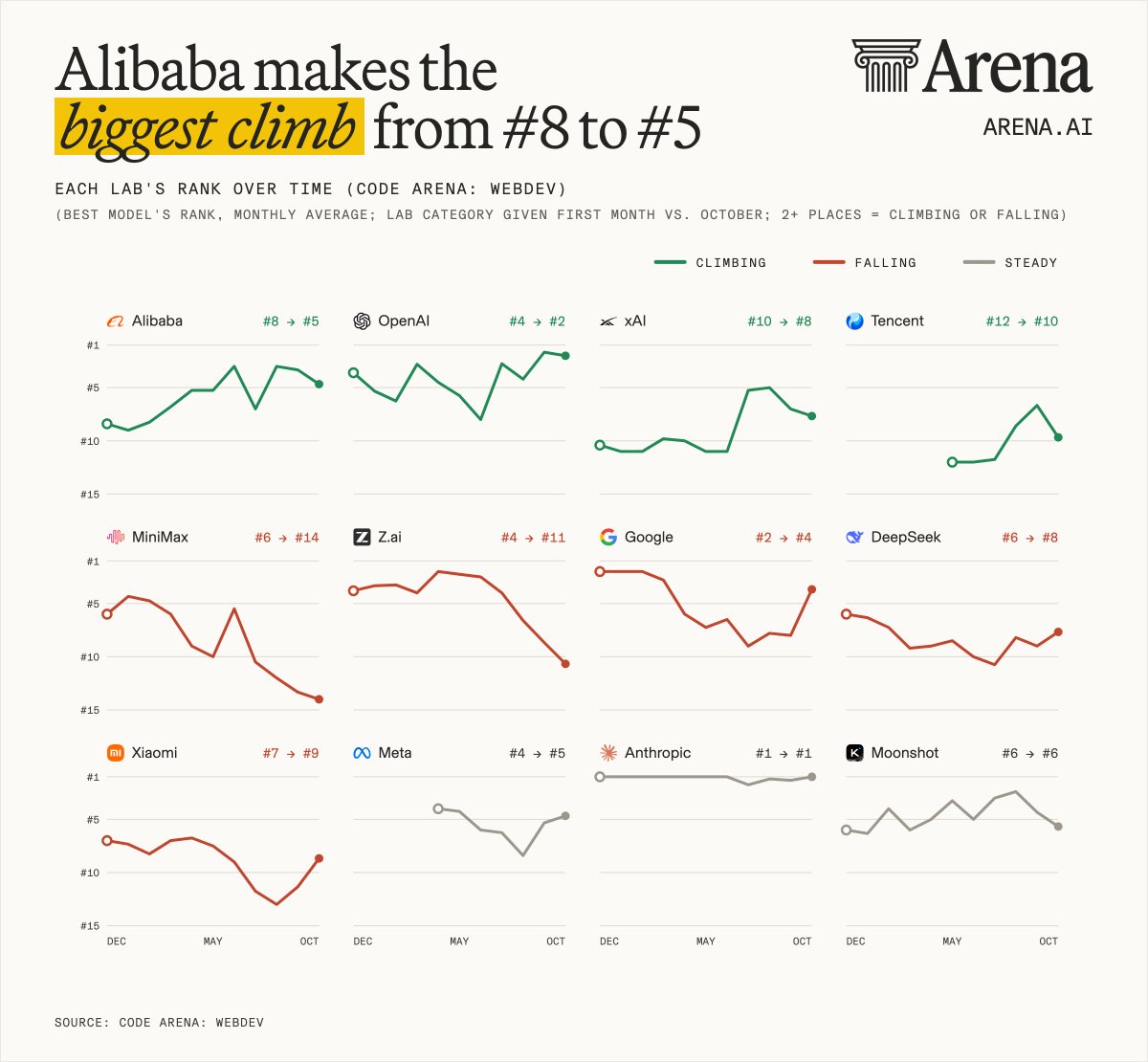
Individual trajectories show this volatility well.
Alibaba saw the largest improvement, from #8 in December 2025 to #5 in October, having peaked at #3 in June, August and September. At the other end, Z.ai fell from #4 to #11 and MiniMax from #6 to #14.
At the top, the gap is narrowing

The competition is also crowding the very top of the leaderboard.
The #10 lab has cut its gap relative to the #1 spot by 38%, from 282 points to 176, and the average gap between neighboring labs has shrunk from 31 points to 20.
The gap between #1 and #2 has also nearly halved: it has averaged 35 points since May, against 64 over the winter. Over the same periods, a new top score has lasted about three weeks instead of two months.

Rank isn’t the only battleground

But the race is not only for the top spot. Rather than chasing #1, many labs are competing to offer the best model at their price. That shows up on the Pareto curve: the labs are spreading out along it.
At the expensive end, Anthropic, which has held #1 on 39 of the 44 weekly boards, also has more frontier models than any other lab: nine, all priced above $1 an answer.
At the cheaper end, Xiaomi is the clearest case of falling in rank while winning on price. It slipped from #7 to #9, yet had a model on the frontier every month from April to October, all under 7 cents an answer.
DeepSeek did the same in the middle of the price range: it fell from #6 to #8, but was on the frontier in six of the seven months, at 5 to 14 cents.
Both are part of a wider regional split. Below $1 an answer, 18 of the 24 frontier models are Chinese. Above $1, 13 of the 15 are American; the two exceptions are Moonshot’s Kimi K3 and Alibaba’s Qwen3.8-Max.
Counting frontier models at all prices, most Chinese ones also have open weights: 17 of the 20, against two of the 19 American ones.
What this means for the AI race
Nothing in the data suggests the pace is slowing. In October, a new model entered Code Arena every other day. And since May, the top score has climbed three times faster than it did last winter. Here’s what follows from that:
Methodology
Data
Approach