The hidden AI price war: your agent would cost 260% more without the cache

by @DawidGalarowicz

Last week, OpenAI's Tibo Sottiaux announced 12-hour prompt caching in the API and caches that never expire in Codex and Work. The replies were mixed: some users celebrated, others were confused. Why is caching such a big deal?
To see what is at stake, and why labs are so focused on the cache, we analyzed Agent Arena traces from 12 September to 23 October 2026 across 26,225 sessions, 30 agents and 13 labs. In addition, we looked at six labs' cache-price history since January 2024.
Key findings
Labs are racing to cut cache prices

Cache discounts are a relatively recent invention. In early 2024, no lab offered one.
The first labs introduced them between June and October 2024, and by 2026 Anthropic, OpenAI and Google had settled on a tenth of the input price. Since mid-2026, all three have moved their frontier models to 5% or less, while DeepSeek has charged just 2% since the spring.
This race is what underpins the economics of agents today.
Cache makes your bill up to 7x cheaper

If every cached token was billed at the full input price, a typical task Agent Arena users give to one of the top-10 agents would cost 3.6 times as much. Across the models, the users would pay from 92% more for Gemini 4 Argon to 592% more for MiMo V2.6 Pro.
The impact of this change is most tangible among the most capable LLMs, especially once translated into monetary terms.
A typical Claude Fable 5.1 task costs $7.44 today; without caching the cost would be $27. That means being able to delegate more than 3.5x as many tasks to Fable with cache enabled.

The heavier the task, the more the cache matters. Without it, the heaviest 5% of tasks would cost:
But why does caching matter so much? It's because of how agents use tokens.
Agents mostly re-read, and re-reads drive most bills
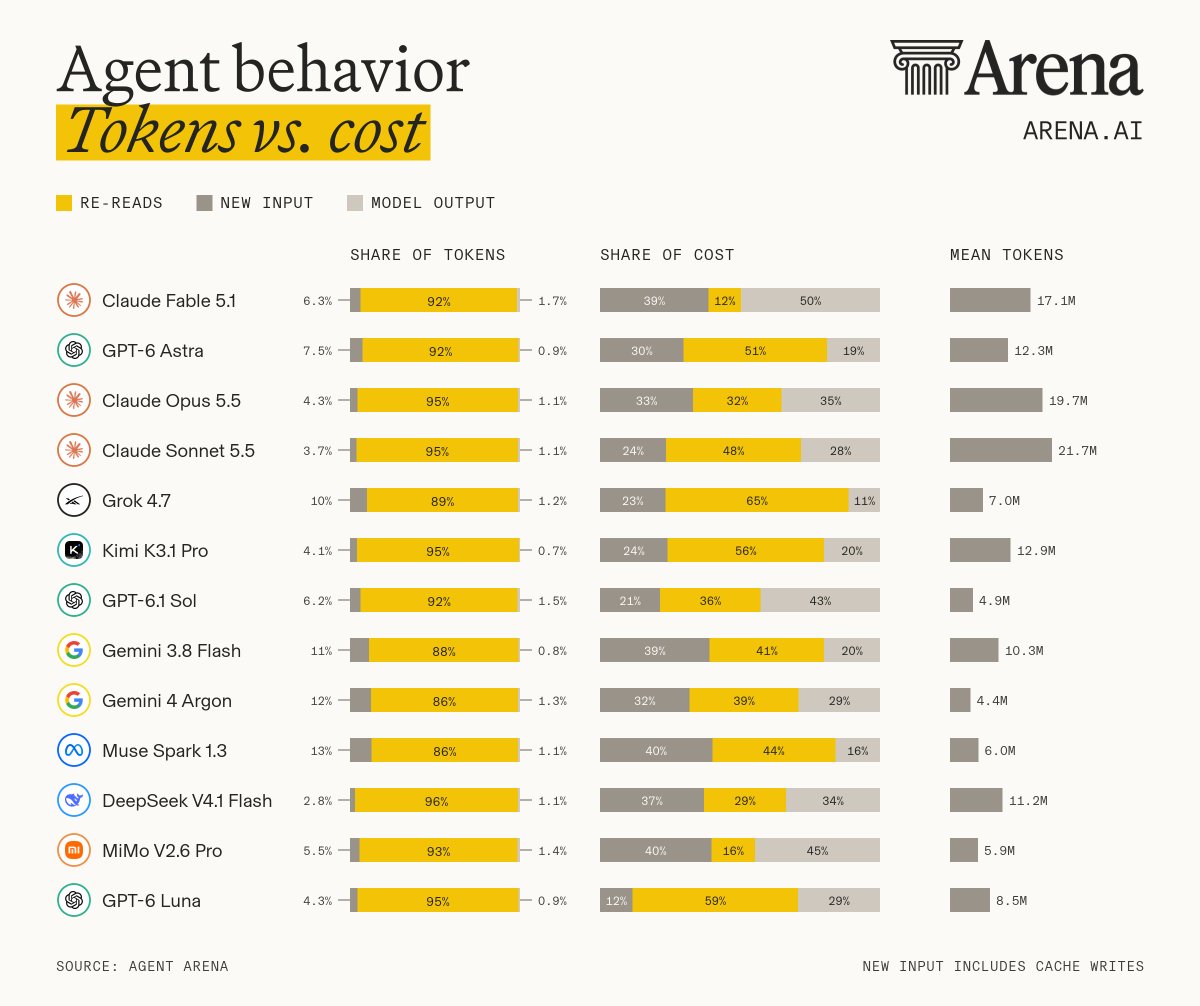
How agents use tokens can be put into three buckets. Output is what the model writes, and includes reasoning. New input is the material it sees for the first time, including cache writes. Re-reads, or cache reads, are context it has already seen and reads back on a later call.
For these agents, re-reads are 86% to 96% of tokens, while output is 1% to 2%. Across the top 10, agents re-read about 93 tokens for every one they write.
This is because a model keeps no memory between calls. Every step of an agent loop sends the whole conversation back, and the provider serves what it has already seen from the cache. What follows is a reply that every later step reads again, so the pile snowballs (for a quick explainer, see the video below).
That mechanism makes re-reading the earlier conversation far cheaper than sending it fresh, often a tenth or a twentieth of the price. But it only works while the provider still has the conversation saved. What happens when it doesn't?
Every cache invalidation adds a fee
The first two cost charts above show the extreme case, where nothing is ever saved and there's no cache at all.
In practice, caches behave as expected most of the time, but invalidation does happen. As a result, the agent has to send the whole conversation again at full price. This is a normal part of using agents, and we see cache invalidation when:
To see what one of these breaks cost, we took real Agent Arena conversations and, at every point where the agent picks up between turns, priced what it would cost to re-send the conversation so far at the full input price instead of the cheaper cache price. Averaging those points gives an approximate cost of cache invalidation at a random moment in the task.

The results show a single invalidation adds up to about 5% to the cost of a typical task. In some sessions it hurts far more: in 1 in 10, it raises the bill by more than 13-21%, depending on the model, and in 1 in 20 by more than 25-38%. The cheaper the cache, the bigger the jump: on MiMo V2.6 Pro, whose cache reads cost under 1% of its input price, those figures rise to 44% and 69%.
In long conversations, these costs add up, as each subsequent invalidation means resending more context. For instance, in one Claude Fable 5.1 session on Agent Arena, six invalidations after short breaks added 42% to the bill.
That is exactly the gap OpenAI's latest change is closing. If you were unsure about what to make of Tibo’s post - there are real reasons to celebrate.
Methodology
Data
The models cover the agent leaderboard's top 20 as of 8 October and 10 others to provide both a diverse sample as well as show implications for the frontier.
Mentions of the top-10 agents refer to the top 10 on the 8 October leaderboard.
Only a sample of models is shown in the figures.
The price history covers data from January 2024.
Approach
Every model is priced the way an API customer is billed.
The token chart shows shares and mean tokens across all sessions.
At each turn, we took the conversation so far and calculated the difference between sending it at the full input price and reading it from the cache.
Averaging across a session's turns gives the extra cost of a restart at a random point.
We then divided by the session's cost per task to obtain the % version.
For each model, we took the median across sessions as the typical cost, along with the 75th, 90th and 95th percentiles.
