How to Develop Trading Strategies 24/7 with Fable 5.2

I will break down the exact framework to develop, test and validate trading strategies 24/7 with Fable 5.2, the most powerful AI model on the planet right now.

Let's get straight to it.
Bookmark This -
The whole system runs on QuantPilot at quantpilot.com, an AI trading research terminal that plugs straight into Claude through MCP, so Fable 5.2 can backtest every idea on real market data.
If you are building trading strategies with AI right now, DM me your setup and i will personally review the first 20. MOVE FAST.
Two days ago, Anthropic released Claude Fable 5.2 and the leaderboard changed overnight.
It now beats Opus 5.5, GPT-6 Astra and Gemini 4 Carbon on most of the benchmarks that measure real, long-running work.
On the Remote Labor Index, which tests actual paid projects end to end, it scores 41.3%. Opus 5.5 scores 21.3%. GPT-6 Astra scores 20.8%.
That is not a small upgrade. That is nearly double the best models in the world on the kind of work that takes hours, not seconds.
But the first thing serious builders noticed was not the benchmarks. It was the effort setting.
Most people will select Max and assume they are getting the best version of the model. They are not.
On Anthropic's own coding benchmark, Fable 5.2 at Xhigh scores 49.1%. At Max it scores 45.7%, and costs about three times more per task.
More thinking is not always better thinking.
Here is what almost nobody is talking about.
A model that can work for days without losing the thread is the first model that can actually run a strategy research process on its own.
Generate an idea. Backtest it. Ask whether the result came from a real pattern or from luck. Repeat all night.
That last question is where almost every AI trading system fails.
Optimize anything hard enough and it will look good on historical data, even random noise.
The professional answer is a permutation test.
Shuffle the price history into random paths with the same statistics but no real patterns, then rerun your optimization on each one. If your strategy does just as well on noise, it never had an edge.
An AI can only run this inside a real lab and that is exactly what QuantPilot gives it. One MCP connection and Fable 5.2 gets real data, realistic backtests and real execution.
By the end of this article you will know:
Let's get into it.
Part 1: The Right Way to Use Fable 5.2

Fable 5.2 launched on November 9. It is the same underlying model as Mythos 5.2. Fable is the version everyone can use, with extra safeguards for cybersecurity and biology.
Here is where it lands, using Anthropic's published numbers.
BENCHMARK                        FABLE 5.2   OPUS 5.5   GPT-6 ASTRA
Remote Labor Index                 41.3%       21.3%       20.8%
FrontierSWE v2 (agentic coding)    69.9%       62.3%       65.5%
Terminal-Bench-Science             74.6%       58.7%       68.1%
Humanity's Last Exam (tools)       74.2%       67.7%       57.2%
SWE-bench Pro                      93.0%       89.9%         -
Powerful models get wasted in the same three ways. Here is how to avoid all three.
Rule 1: Pick the effort level by the job, not by the ego.
Fable 5.2 has five effort levels: Low, Medium, High, Xhigh and Max.
SETTING   FRONTIERCODE 2.0   COST PER TASK
High           45.3%              $6.72
Xhigh          49.1%             $14.19
Max            45.7%             $44.70
High already matches Opus 5.5 at its best, for about half the cost. Xhigh is the peak. Max costs three times Xhigh and scores lower.
Anthropic's own guidance says the same thing. Most of the gain is already present at High. Use Xhigh for the hardest long-running work. Keep Max for measuring the ceiling.
For strategy research, the rule is simple:
High    daily research, single backtests, quick idea checks
Xhigh   overnight research loops, validation, complex strategies
Max     never, unless you are benchmarking the model itself
Rule 2: Give it a process, not a question.
"Find me a profitable strategy" is a bad prompt for any model. It invites a confident answer with nothing behind it.
Fable 5.2's real strength is long-horizon work. It can hold a multi-step plan for hours, delegate sub-tasks and check its own progress. So give it a process with gates, rules and a definition of failure and let it run.
People are already pushing it on full builds with no human in the loop.
Now point that same stamina at one question, every night: does this trading idea actually work?
Rule 3: Never let your most expensive model do arithmetic.
Fable 5.2 costs $8 per million input tokens and $40 per million output, double Opus 5.5.
You do not want it calculating a Sharpe ratio line by line, or estimating slippage from memory. A model that computes its own backtest can also hallucinate one.
The right design is a split. The model makes the judgments.
A deterministic engine does the math. It should return the same answer every time and the model should never be able to talk it into a better number.
Which brings us to the lab.
Part 2: Give Your AI a Real Trading Lab

Your AI is the researcher. It still needs a lab.
QuantPilot is an AI trading research terminal.

You describe a strategy idea in plain English.
It researches the market, writes the strategy in QuantScript, backtests it and can run it in paper or live mode.
I built a regime trading strategy with QuantPilot.
What it gives your AI:
LAYER        WHAT THE LAB PROVIDES
data         price, on-chain, DeFi and news data in one place
backtests    1-minute candles with order book snapshots, so
             slippage and liquidity are modeled, not ignored
strategies   ready-made templates with return, drawdown,
             win rate and Sharpe already shown
code         every strategy as readable QuantScript
charts       TradingView charts built in
execution    paper trading and live execution
venues       Hyperliquid by default, plus Binance and Bybit
And the part that changes everything: QuantPilot has its own MCP server.
That means Fable 5.2 does not just talk about backtests. It runs them.
Connect it in two minutes.
In Claude Desktop or claude.ai:
https://mcp.quantpilot.com/mcpIn Claude Code, one line:
claude mcp add --transport http quantpilot https://mcp.quantpilot.com/mcpThen select Fable 5.2 as your model and set effort to High.
Test it immediately:
Backtest this strategy on QuantPilot:

Market: BTC perpetual on Hyperliquid (BTC/USDC:USDC)
Timeframe: 4h
Direction: long and short, flip on every signal
Entry/exit rules: EMA 20 crosses above EMA 50 -> go long;
EMA 20 crosses below EMA 50 -> go short
Leverage: 2x
Position size: 95% of free balance
Stop-loss / take-profit: none
Capital: 1000 USDC
Window: last 12 months

Report total return, max drawdown, win rate, Sharpe,
profit factor, number of closed trades and fees.
If real numbers come back, your AI is armed.
The division of labor that makes this work.
This is the single most important design decision in the whole setup.
QuantPilot runs the backtests. Fable 5.2 runs the research process.
THE LAB DOES                     FABLE 5.2 DOES
executes every backtest          plans every parameter sweep
models fees, slippage, liquidity decides which ideas to test
stores strategies as QuantScript runs robustness validation
runs paper and live execution    rejects lucky results
                                 builds the dashboard that
                                 explains what was tested
The engine stays deterministic and boring. The judgment, which ideas to try, which settings to sweep, which results to throw away, stays with the model. Neither one does the other's job.
One trick for picking assets.
QuantPilot does not have a tool to list every tradable ticker.
So let Fable build one.
Set up a sub-agent that keeps a registry of tradable assets from the
Binance public API for the chains I care about. Before any backtest,
validate that the ticker and exchange combination exists, then pass
it to QuantPilot. Refresh the registry every night.
Now your research never wastes a backtest on a ticker that does not exist.
Part 3: The 4-Gate Validation Framework
Here is the uncomfortable truth.
Optimization always works.Test enough versions of any idea and one will look amazing, even on pure noise.
An AI that tests ideas all night will find more of these false winners than any human ever could.
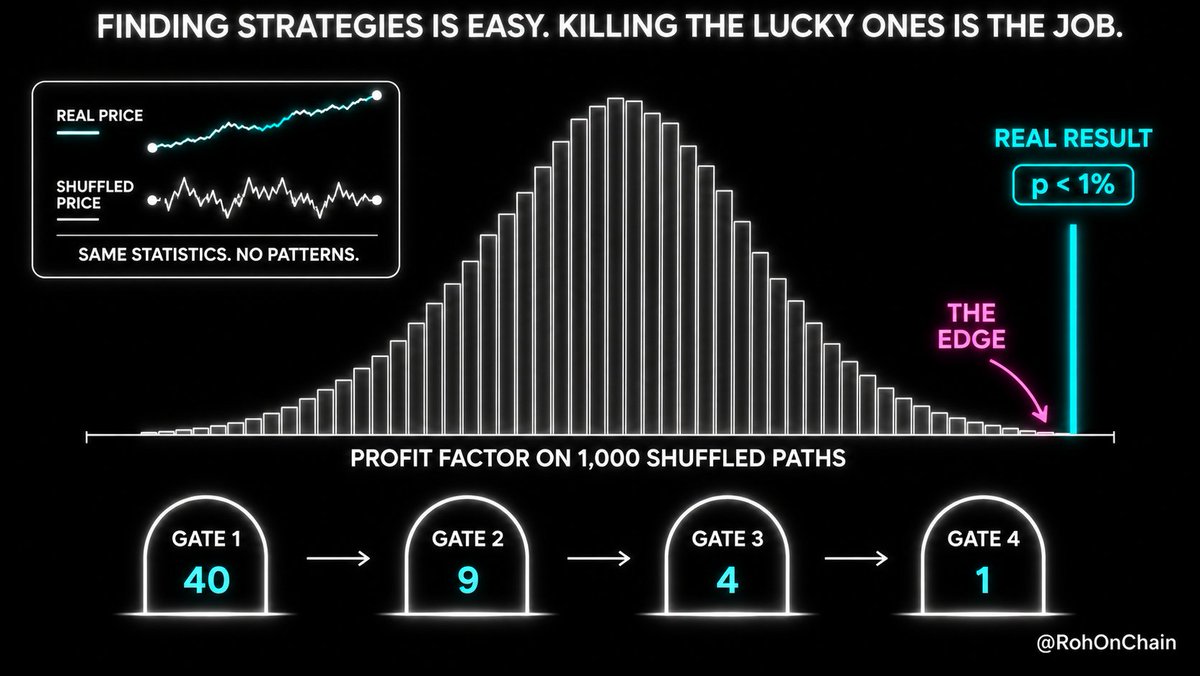
So the real job is not finding strategies. It is killing the lucky ones.
Four gates. A strategy must pass all four, in order.
First, measure every bar, not every trade.

Position is 1 for long, -1 for short, 0 for flat. A return on every bar means far more data and far more stable results.
Gate 1: In-sample excellence.
Optimize on four years of data and ask two questions. Is it excellent? Is it obviously overfit?
Mediocre here means worse everywhere else. Too perfect here means a future leak or memorized noise.
Gate 2. The permutation test.
The gate most traders have never heard of.
Shuffle the price history into a random path. Same start, same end, same statistics, but every real pattern destroyed. Optimize your strategy on it. Repeat 1,000 times.

If your strategy does just as well on noise, it never had an edge. Trash it.
Gate 3. Walk-forward.
Trade it like reality. Optimize on the past four years, trade the next 30 days, re-optimize, roll forward.
Results will be worse than in-sample. That is normal. What matters is whether they are still worth trading.
And protect this data. Test 100 ideas on the same year and keep the best, and you have overfit the "unseen" data anyway. That is why Gate 2 comes first.
Gate 4. The walk-forward permutation test.
The final boss. Shuffle only the data after the first training window and run the full walk-forward on each version.
pass if p < 5% on one year
pass if p < 1% on two or more years
This is where most strategies die. Passing Gate 2 and failing here is common, and a p-value around 20% means a one-in-five chance it was pure luck.
Start this one before you go to sleep. It is slow.
The lesson that saves the most money:
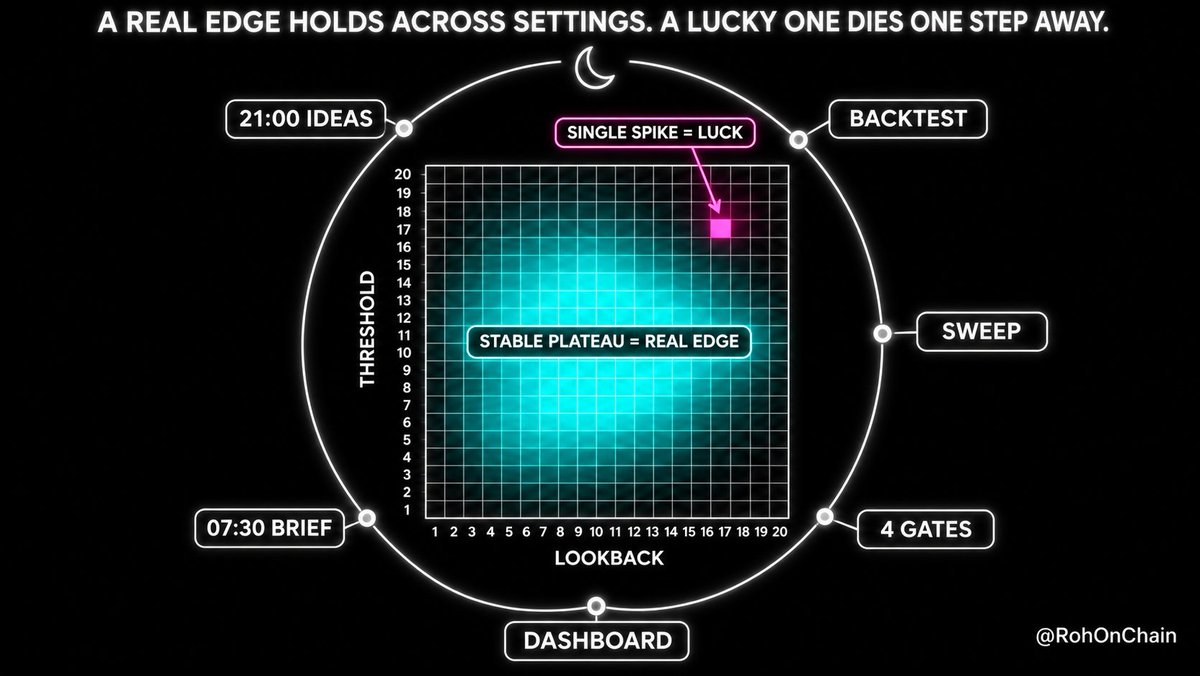
A real edge holds across a whole range of settings. A lucky one dies one step away.
Part 4: Build the 24/7 Strategy Factory
Now we put it together.
Step 1: Give Fable the factory rules.
Open a new Claude Code session with Fable 5.2 at Xhigh effort and paste this:
You are my strategy research lead. QuantPilot is connected through MCP.

Your job: develop, test and validate trading strategies every night.

RULES
- QuantPilot runs every backtest. You never calculate results yourself.
- Default venue is Hyperliquid. Validate every ticker against the
  asset registry before testing.
- Measure strategy returns per bar: position times next-bar log return.
- Every strategy must pass 4 gates in order:
  1. In-sample excellence on a 4-year development window
  2. In-sample permutation test, 1,000 permutations, p < 1%
  3. Walk-forward test, re-optimize every 30 days
  4. Walk-forward permutation test, 200+ permutations,
     p < 5% for 1 year, p < 1% for 2+ years
- Never reuse out-of-sample data to choose between strategies.
- Log every idea, result and rejection with the reason.
- Never invent a number. If data is missing, say so.
Step 2: Generate ideas with a reason behind them.
Propose 10 strategy ideas for BTC, ETH and SOL perpetuals. For each,
name the edge in one sentence and who loses on the other side of the
trade. Use QuantPilot's market data to check each idea is testable.
Step 3: Let QuantPilot run the backtests, let Fable plan the sweeps.
For each idea, build it in QuantScript through QuantPilot and run the
in-sample backtest. Then plan a parameter sweep across a wide range of
lookbacks and thresholds. Tell me whether performance is a stable
plateau or a single lucky spike. Reject anything that only works at
one exact setting, and for survivors pick a value from the middle of
the plateau.
Step 4: Run the permutation gates.
For every survivor, run the in-sample permutation test: build 1,000
bar permutations of the same candles in your sandbox, shuffling
intrabar values and gaps separately, re-optimize on each, and compute
the p-value. Then run the walk-forward test through QuantPilot and the
walk-forward permutation test on 200+ permutations of the data after
the first training window. Show a histogram of permuted results with
the real result marked.
Example: take the EMA 20/50 crossover we backtested on BTC earlier. Ask Fable to sweep both EMA lengths through QuantPilot and check whether the profit factor forms a wide plateau or a single spike. Then run 1,000 shuffled versions of the same BTC candles and count how many beat the real result. If 4 beat it, p = 0.4% and it moves on to walk-forward. If 37 beat it, p = 3.7%, which means the crossover finds the same “edge” in random noise, so it gets thrown out.
Step 5: Make it explain itself.
Build me a dashboard that shows every strategy tested tonight: the
idea, the parameter sweep, each gate passed or failed with its p-value,
walk-forward performance, and the final verdict. Plain language.
This is the part that turns an AI into a research partner. You see exactly what was tested, and exactly why it lived or died.
Step 6: Run it every night.
Every night at 21:00: refresh the asset registry, generate new ideas,
run the full 4-gate process, update the dashboard, and send me a
morning brief with survivors, rejections and one decision for me.
Start the long walk-forward permutation tests before you go to sleep.
Fable 5.2 can carry a multi-step job for hours without losing the thread and by morning the results are waiting.
Part 5: From Validated Strategy to Live
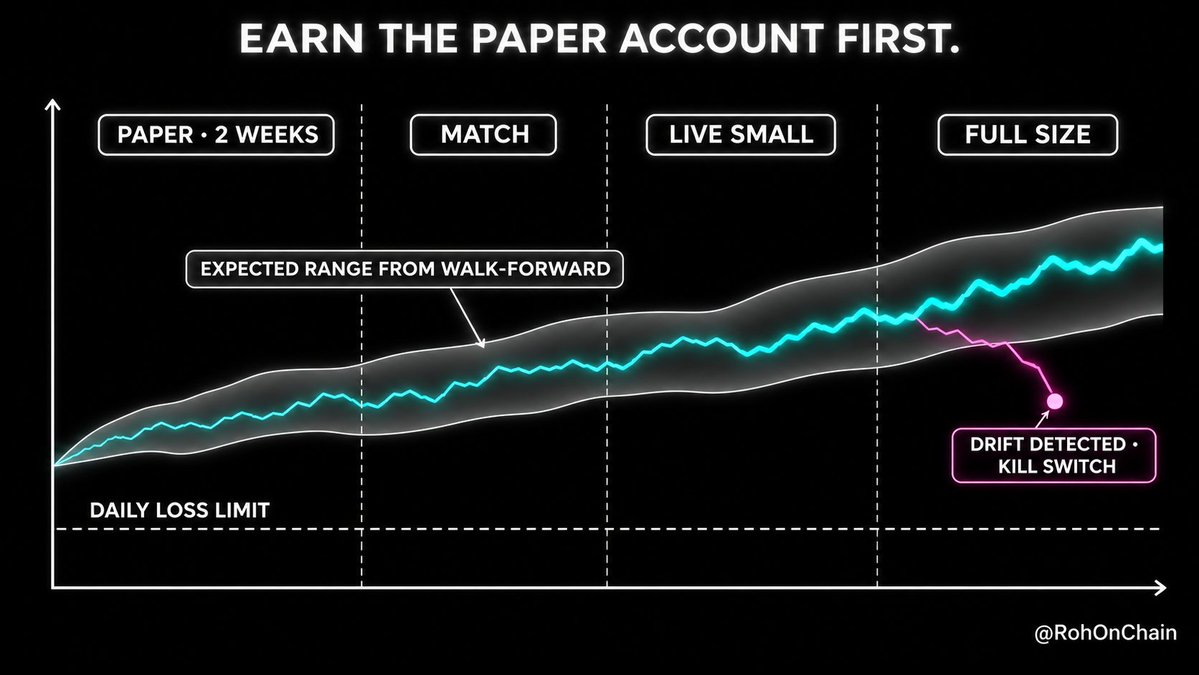
A strategy that passes all four gates has earned one thing: a paper account.
Not your money. Not yet.
The promotion path.
PAPER        2 weeks in QuantPilot paper mode, every trade logged
MATCH        paper results consistent with the walk-forward test
LIVE SMALL   real execution at a fraction of planned size
FULL SIZE    only after weeks of clean, matching results
The risk layer.
Before anything goes live, ask Fable to write the rules down and check them every day:
Before live trading, define: max risk per trade, max daily loss,
max open positions and a kill switch. If daily loss hits the limit,
or live results drift far from the walk-forward test, stop the
strategy and alert me.
The weekly re-check.
Markets change. Edges decay.
Every week, have Fable re-run the walk-forward permutation test on the newest data for every live strategy. Anything that starts to fail goes back to the lab.
The Honest Contract. Screenshot This.
This setup CAN:
This setup CANNOT:
That second list is not hedging. It is the reason the first list is believable.
Closing
For years, AI trading meant asking a chatbot for a strategy and hoping.
Fable 5.2 changes the shape of the problem. It can run a real research process for hours, plan the tests, read the results and throw away what does not hold up.
But a model is only as good as the lab it works in, and the discipline it follows.
QuantPilot gives it the data, the backtests and the execution. The four gates give it the discipline.
Together, that is a strategy research desk that works while you sleep.
So here is the question.
Is your AI still writing strategies you never test, or is it already killing the lucky ones before they cost you money?
There is no wrong answer. But there are very revealing ones.
Start at quantpilot.com.

