Found it. I think the 35% COP number probably does come from...

Aidan Morrison@FootnotesGuy
13 views
Oct 12, 2026
~5 min read
Advertisement
1
Found it. I think the 35% COP number probably does come from @DCCEEW analysis prior to it turning up elsewhere.
This from the Net Zero Plan produced when we announced the 2035 targets of our own in Sept 2025.
Yes, it hangs on all the most outrageous assumptions.
Including loads of green hydrogen. Remember the hype that Bowen "never bought"? Well the scenario that President Bowen has now set for the target for the rest of the world through certainly still buys it.
What will happen when everyone else finds out? No wonder the department was coy about claiming credit.
Long 🧵1/

This from the Net Zero Plan produced when we announced the 2035 targets of our own in Sept 2025.
Yes, it hangs on all the most outrageous assumptions.
Including loads of green hydrogen. Remember the hype that Bowen "never bought"? Well the scenario that President Bowen has now set for the target for the rest of the world through certainly still buys it.
What will happen when everyone else finds out? No wonder the department was coy about claiming credit.
Long 🧵1/
Aidan Morrison@FootnotesGuy
Can’t wait to come back for a deep dive here. Looks like Australia has just locked in a global goal based on CSIRO report that assumes the success of Australia’s targets that we’re going to fail spectacularly to meet.
No wonder Bowen is coy. I smell some funky footnotes.
No wonder Bowen is coy. I smell some funky footnotes.
2
The official projections available at the time for global figures (rather than Australia's), such as from IEA's World Energy Outlook 2025 had 36% for 2035 as the Net Zero Emissions (by 2050) scenario's outcome.
So rounding that to a catchy "35 by 35" would be... an idea. 2/
So rounding that to a catchy "35 by 35" would be... an idea. 2/
3
It was on the 8th of June at the Subsidiary Bodies meeting in Bonn this year that 35% by 2035 became the major headline target. 3/


4
And Chris Bowen's speech was at the opening plenary - one day earlier.
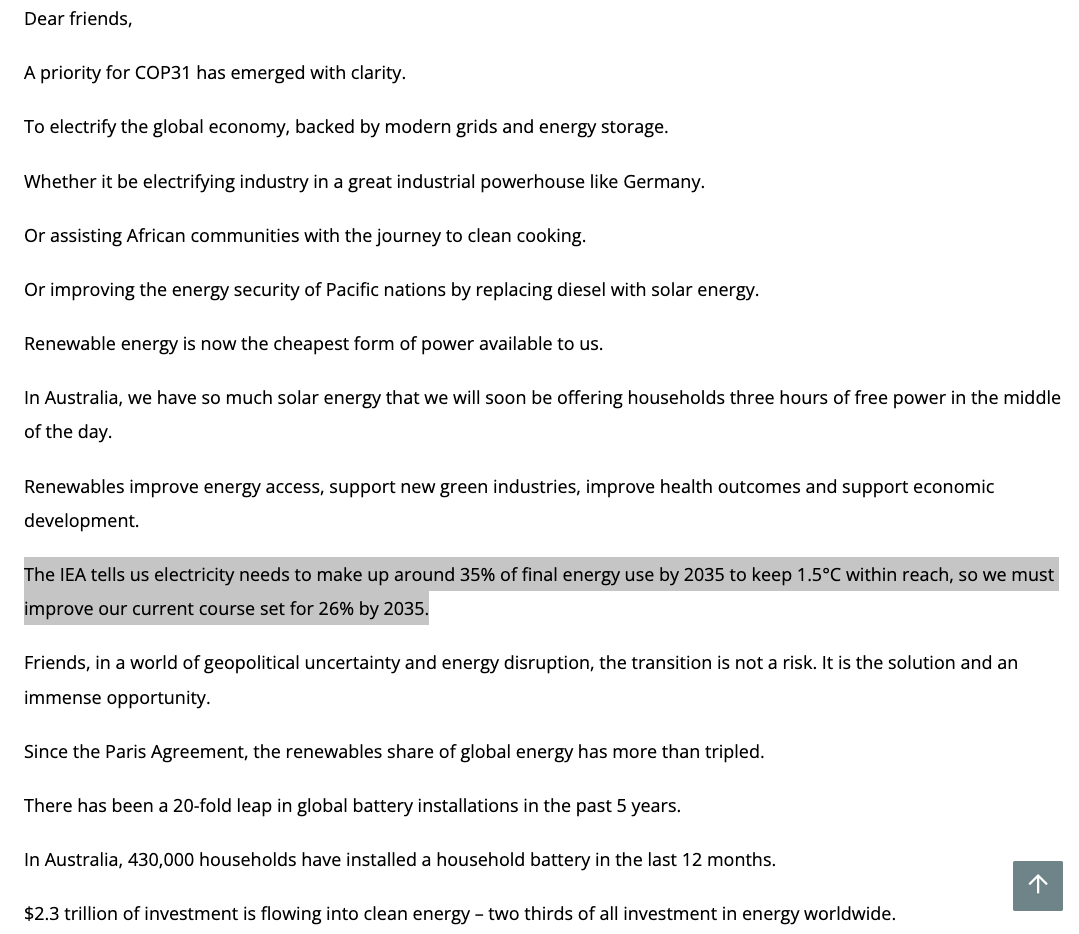
Here he announces "A priority for COP31 has emerged with clarity."
And goes on to mis-quote the IEA to say that 35% is required by 2035.
I'm pretty sure the source says 36%. So there's creative lisence taken right there, by our very own Chris Bowen, to blur the boundaries to claim the catchy phrase.
Given that 35% was exactly what our earlier analysis said we were committed to, this makes a lot of sense that the President of negotiations and his team would have rallied around target that they could say was completely consistent with their own country's commitments.
Or... was it?
4/
Here he announces "A priority for COP31 has emerged with clarity."
And goes on to mis-quote the IEA to say that 35% is required by 2035.
I'm pretty sure the source says 36%. So there's creative lisence taken right there, by our very own Chris Bowen, to blur the boundaries to claim the catchy phrase.
Given that 35% was exactly what our earlier analysis said we were committed to, this makes a lot of sense that the President of negotiations and his team would have rallied around target that they could say was completely consistent with their own country's commitments.
Or... was it?
4/
5
Now at the opening we have a statement that DCCEEW did analysis of Treasury's modelling.
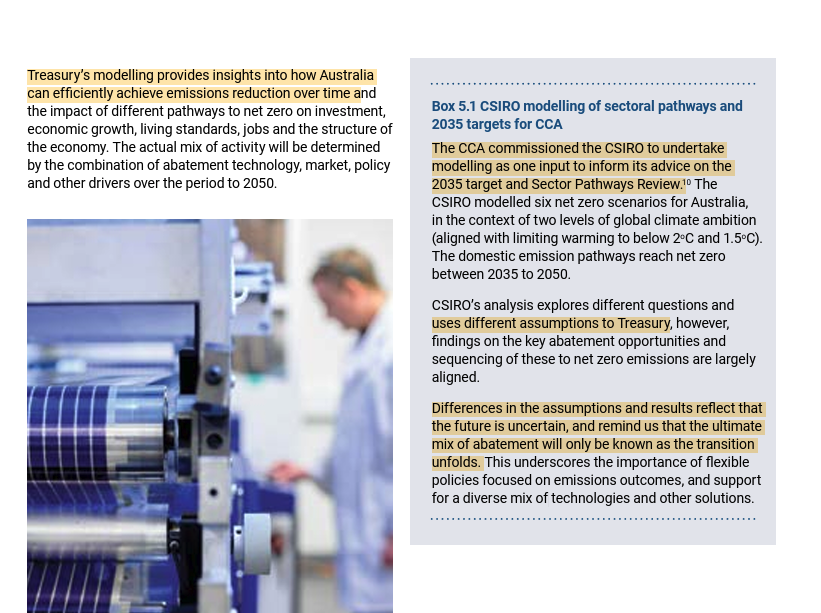
There's this slightly awkward section in the Plan where they admit that the CCA commissioned modelling from CSIRO... But Treasury's modelling is best. 5/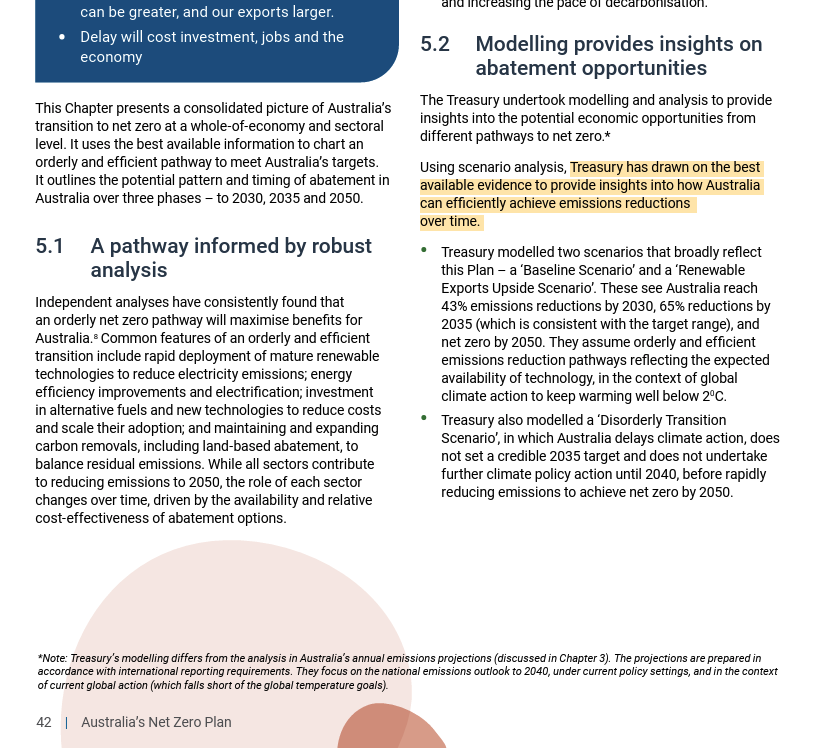
There's this slightly awkward section in the Plan where they admit that the CCA commissioned modelling from CSIRO... But Treasury's modelling is best. 5/
6
I think this is actually a very interesting wardrobe malfunction in the whole effort to dress targets up as expert-supported and credible.
Because CSIRO modelled net-zero in 2050 as the least-ambitious option. They modelled net-zero from 2035 onwards!
I think maybe DCCEEW this was kinda laugh-out-loud stuff that wasn't the ideal clothing for the analysis of how hard we should push for 2035. 6/
Because CSIRO modelled net-zero in 2050 as the least-ambitious option. They modelled net-zero from 2035 onwards!
I think maybe DCCEEW this was kinda laugh-out-loud stuff that wasn't the ideal clothing for the analysis of how hard we should push for 2035. 6/
7
Now i think this where Peter Hannam from @RenewEconomy might have got a bit of a bum steer. He points to CSIRO work, and a 32-36% range. Which I think is possibly what the modelling says according to some ai-quick-research. 7/

8
But this analysis of Treasury work that clearly lands on a single number right at 35%... or so it appears to me.
I wonder if someone Australian could have been scheming that far back to poduce a convenient outcome? Impossible to know without a lot of FOI work. 8/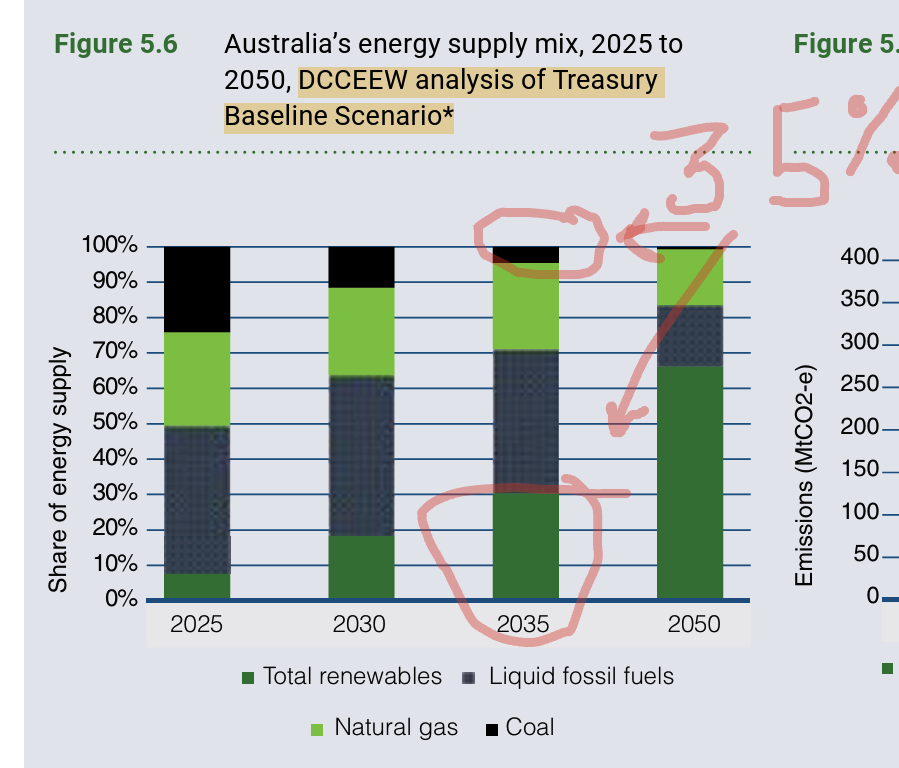
I wonder if someone Australian could have been scheming that far back to poduce a convenient outcome? Impossible to know without a lot of FOI work. 8/
9
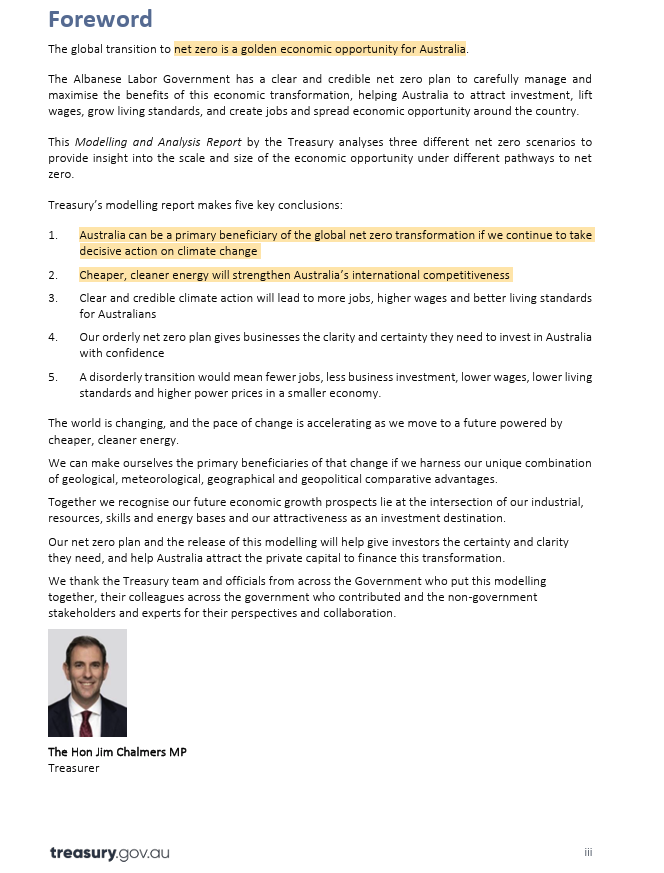
Now the Treasury work from Jim Chalmers comes with this
"net zero is a golden economic opportunity for Australia"
opening line. This is ageing badly.
And it all hinges on the world doing the same as us, whatever the cost. 9/
"net zero is a golden economic opportunity for Australia"
opening line. This is ageing badly.
And it all hinges on the world doing the same as us, whatever the cost. 9/
10
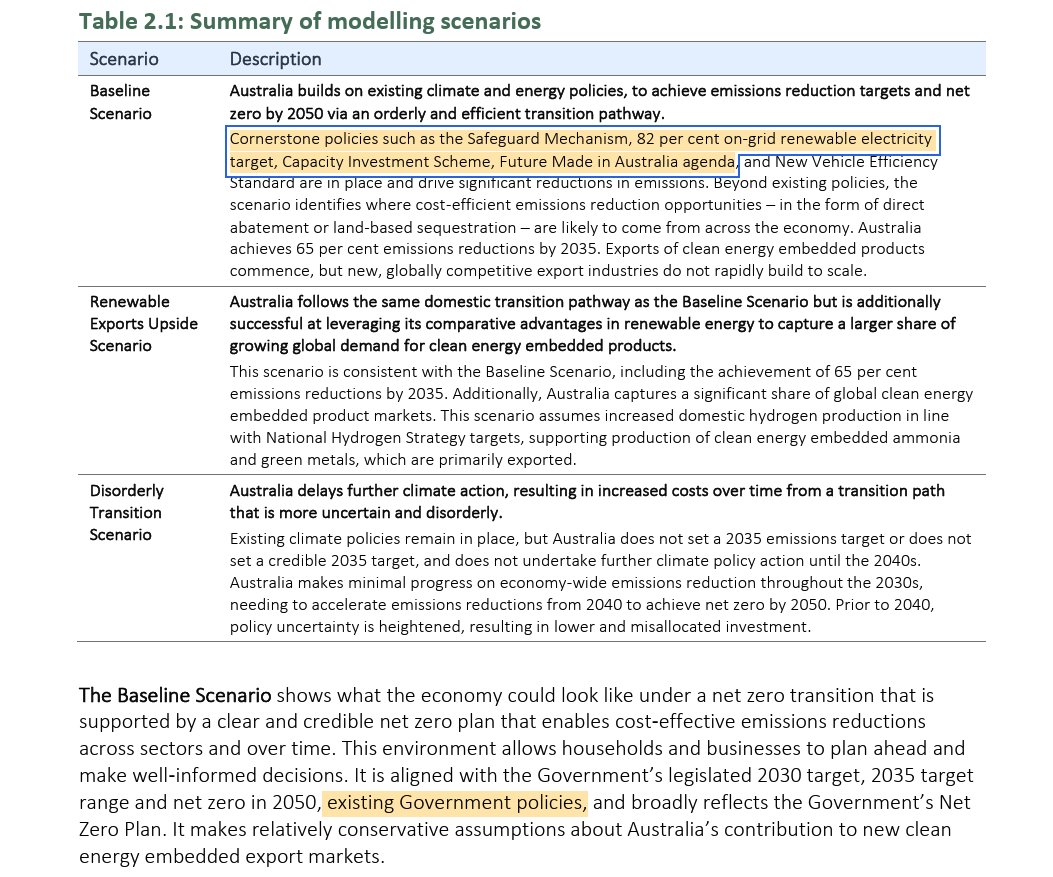
So DCCEEW (Bowen's deparatment) is named as a collaborator on scenarios and assumptions.
And the scenario that Treasury uses for their 35% figure includes... of course...
All government policies, such as 82% renewables by 2030. 10/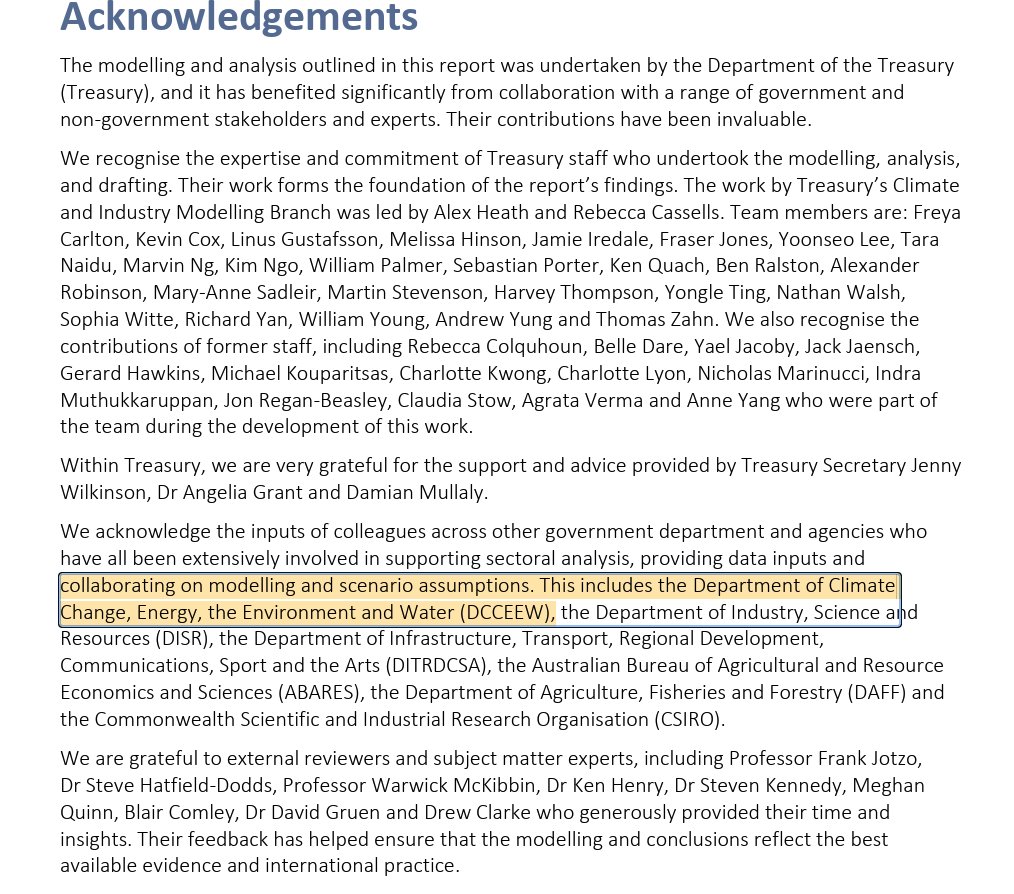
And the scenario that Treasury uses for their 35% figure includes... of course...
All government policies, such as 82% renewables by 2030. 10/
11
But here's the kicker... They basically assume that the rest of the world all decarbonises, in ALL scenarios.
This is the secret trick they use to argue that going slowly is bad for us economically... because the rest of the world is paying whatever it takes, our exports get punished if we don't keep up with their standards.
This is so far from emergent reality it's not funny. 11/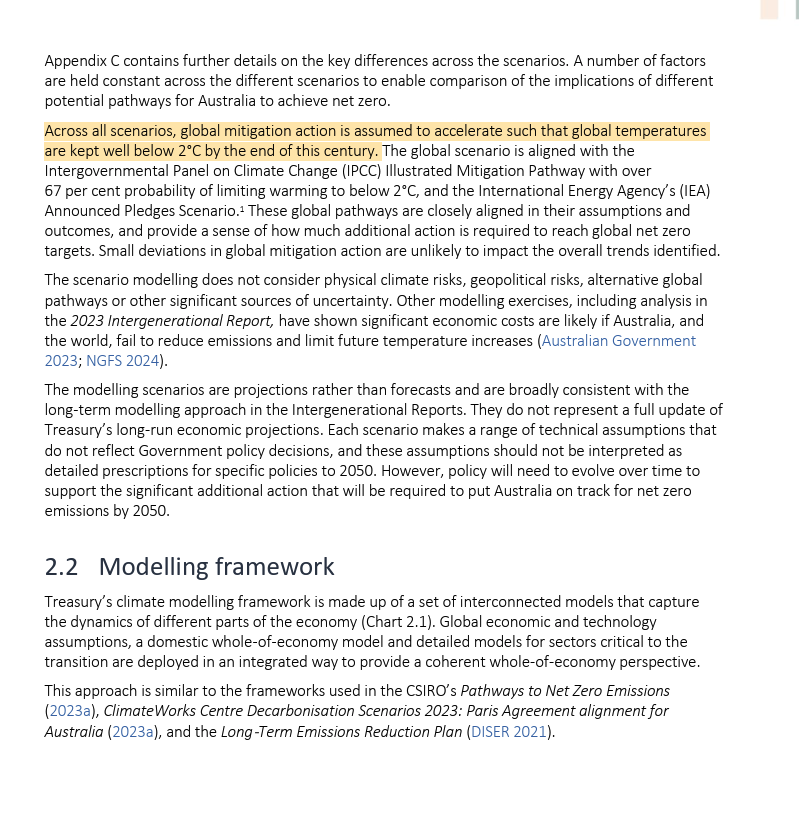
This is the secret trick they use to argue that going slowly is bad for us economically... because the rest of the world is paying whatever it takes, our exports get punished if we don't keep up with their standards.
This is so far from emergent reality it's not funny. 11/
12
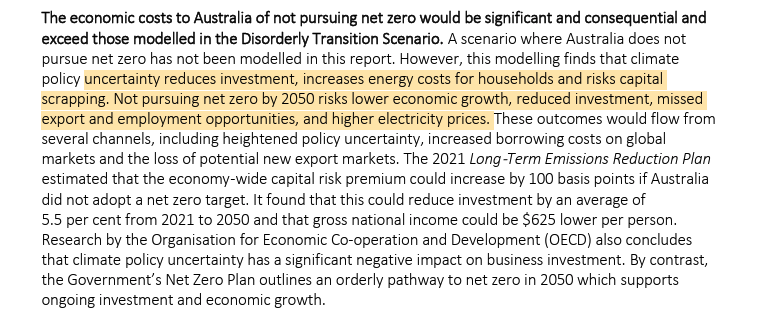
Here's the crucial statement that backs that up in their own words. Read this, and just ask yourself if you believe this is actually credible. 12/
13
There's an appendix of course. Which re-affirms that the whole world is locked into decarbonisation even if we aren't.
And there's a Model of Industrial and Resources Abatement (MIRA). With another appendix... 13/
treasury.gov.au/sites/default/…

And there's a Model of Industrial and Resources Abatement (MIRA). With another appendix... 13/
treasury.gov.au/sites/default/…
14
Oh look... "abatement incentive" (aka carbon tax, or value on emissions reduction) has to rise to $329/tonne for this to take place.
And that's meant to be good... because otherwise it would be higher?
This is whatever-it-takes, at-any-cost net zero plans buried in institutional fine print, and the bizarre assumption that the world will also pay whatever it takes, and keep growing economically too. 14/
And that's meant to be good... because otherwise it would be higher?
This is whatever-it-takes, at-any-cost net zero plans buried in institutional fine print, and the bizarre assumption that the world will also pay whatever it takes, and keep growing economically too. 14/
15
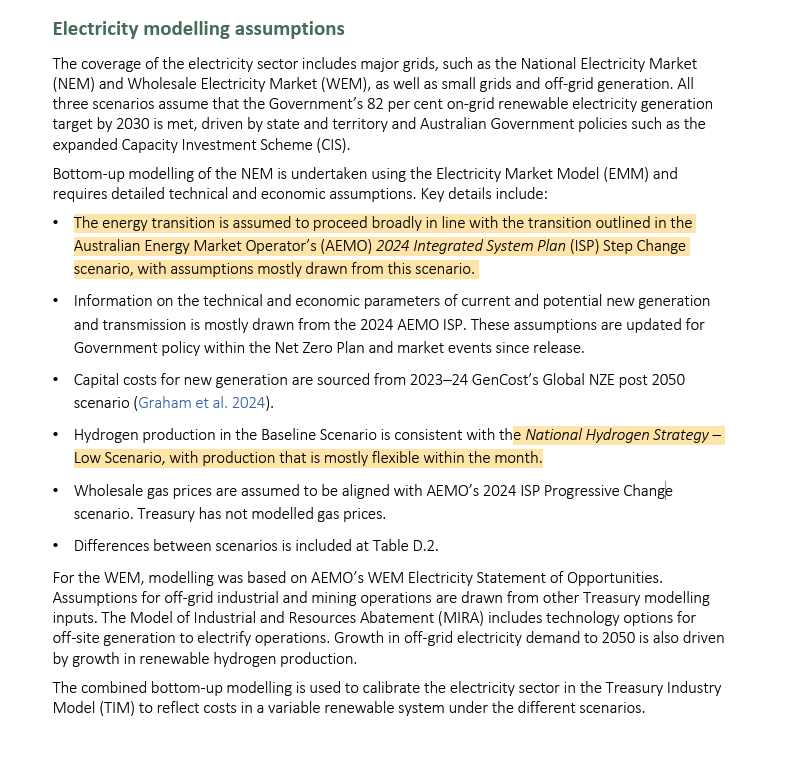
Oh look... The explicit statement that they assume everything in the Step Change Scenario for 2024 ISP happens.
2024 was the high-water-mark for the ISP's credulous acceptance of policy madness, including 15GW of flexible hydrogen production. 15/


2024 was the high-water-mark for the ISP's credulous acceptance of policy madness, including 15GW of flexible hydrogen production. 15/
Aidan Morrison@QuixoticQuant
Yes, the Integrated System Plan assumes 15GW of ultra-flexible hydrogen loads in 2050, to be funded by private industry (not a cost to the system), to soak up the sunshine. 2/
16
And here is where most of the heavy-lifting happens. A whole bunch of green hydrogen and electrification nonsense.
This is so 2025. Unthinkable today. Remember Bowen saying he never bought the hype?
Well this kind of hype is still in his COP targets. 16/
This is so 2025. Unthinkable today. Remember Bowen saying he never bought the hype?
Well this kind of hype is still in his COP targets. 16/
17
Let's just drive home that "amonnia production shifts to renewable hydrogen-based production PRIOR to 2030.
We have a live case study in Orica going on right now in what that costs. A subsidy-driven token effort if ever there was one. 17/
We have a live case study in Orica going on right now in what that costs. A subsidy-driven token effort if ever there was one. 17/
Aidan Morrison@FootnotesGuy
I had missed this. Bowen mentioned it today.
This is yet another absolutely absurd cash splash, half a billion dollars in subsidies to decarbonise 7.5% of single plant's production.
Just obscene.
orica.com/en/resource-hu…
This is yet another absolutely absurd cash splash, half a billion dollars in subsidies to decarbonise 7.5% of single plant's production.
Just obscene.
orica.com/en/resource-hu…
18
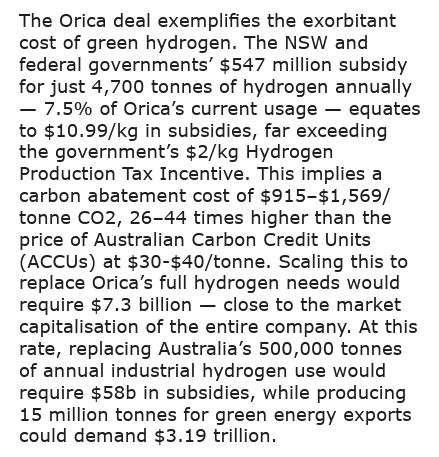
We wrote an entire paper here to unpack why hydrogen never could or would work... And also used that Orica case-study, which showed it would cost around the market cap of the whole company to scale up their token effort. 18/
Aidan Morrison@FootnotesGuy
And the latest hydrogen subsidy offer, for @OricaLimited to make explosives, blows all hope out of the water.
This is INSANE.
Just the subsidy is more than $10/kg of hydrogen.
Every executive, politician, or bureaucrat should recoil in disgust at this proposal. 6/
This is INSANE.
Just the subsidy is more than $10/kg of hydrogen.
Every executive, politician, or bureaucrat should recoil in disgust at this proposal. 6/
19
So anyway, Bowen probably did have a serious hand in figuring out the 35% by 2035 headline target for COP.
And the department is coy about it, because they don't want anyone to notice it all hangs on hype that he now says he never bought.
Hilarious. 19/19
And the department is coy about it, because they don't want anyone to notice it all hangs on hype that he now says he never bought.
Hilarious. 19/19
