LOOP vs GRAPH vs HARNESS ENGINEERING

The 3 AI Agent Systems Every Builder Must Understand

Agent failures
Most agent systems do not fail because the model is too weak
They fail because the system around the model was never designed as a system
The tools are unreliable
The state disappears between runs
The agent retries without learning anything
The workflow branches in ways nobody can inspect
Then every failure gets blamed on the model
That is the wrong diagnosis
There are three different engineering layers behind a serious agent:
They overlap
They can contain one another
But they solve different problems
A model decidesA harness lets it actA loop makes it prove the resultA graph controls what is allowed to happen next
The 30-second version
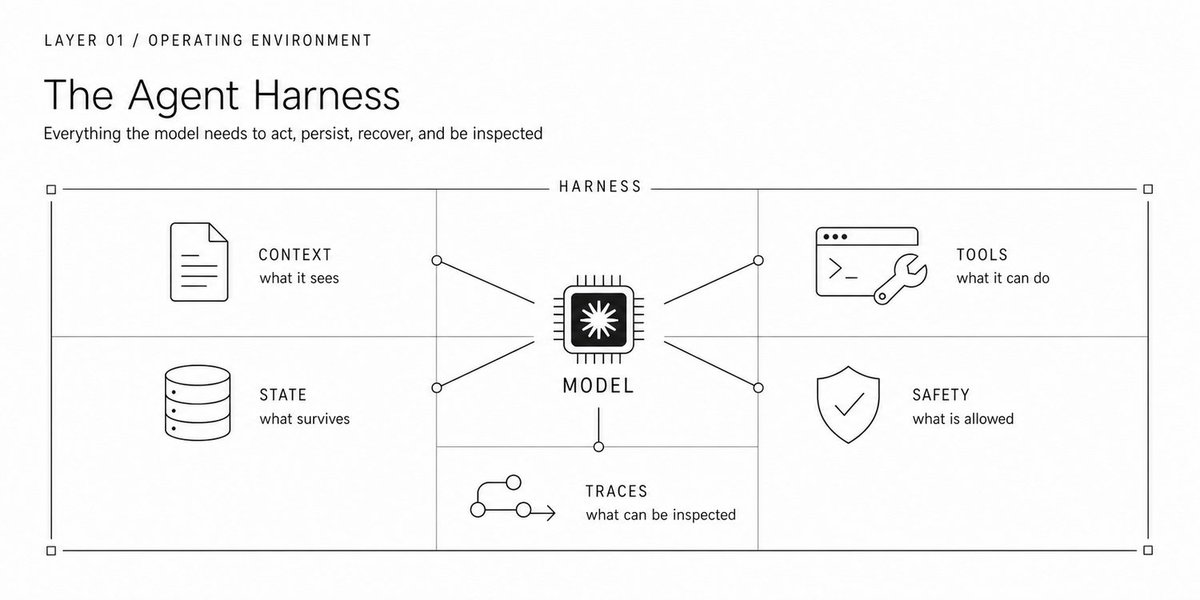
Harness engineering builds the operating environment around the model
Tools, memory, files, permissions, sandboxes, routing, checkpoints, traces and human approvals all live here
Loop engineering designs repeated work and feedback
The agent produces something, checks it against evidence, receives a useful failure signal and tries again under a bounded rule
Graph engineering makes control flow explicit
It defines the nodes, branches, joins, parallel work, legal cycles, state transitions and exit paths
The easiest way to remember the difference is:
HARNESS = ENVIRONMENT
LOOP    = FEEDBACK
GRAPH   = FLOW
This distinction matters as soon as an agent leaves a demo and starts touching real files, APIs, customers, money or production code
Why people keep mixing them together
All three layers sit around the same model
All three affect reliability
All three may include something that looks like a loop
And in a small prototype, all three are usually buried inside one script
That makes them feel interchangeable
They are not
Consider a basic tool-using agent
ask model
receive tool call
run tool
return observation
ask model again
stop when finished
That small cycle is part of the runtime
But the tool definitions, filesystem and state store belong to the harness
The test-and-retry policy is a loop design decision
The choice between researcher, reviewer and publisher is a graph design decision
One piece of software can contain all three layers at once
The cleanest architecture starts by naming them separately
Layer 1: Harness Engineering
A raw model can transform input into output
It cannot independently maintain project state, run a test suite, inspect a browser, write files safely, enforce permissions or resume tomorrow where it stopped today
The harness supplies those capabilities
The simplest definition is:
The model is the intelligence The harness is the machinery that makes that intelligence useful
Remove the model from your architecture diagram
Everything still visible is probably part of the harness
This is the production shift Boris Cherny keeps pointing at through Claude Code: hooks, scheduled runs, isolated worktrees, custom agents and parallel execution are not prompt tricks
They are harness primitives
What belongs inside a serious harness
Context
Action surfaces
Persistence
Execution control
Safety
Observability
Where harness engineering earns its keep
Harness work becomes critical when tasks last longer than one context window
A coding agent that works for hours cannot rely on chat history alone
It needs durable artifacts that another session can understand
A useful setup might include:
This is not a better prompt
It is a better working environment
Start with harness engineering when the agent:
Layer 2: Loop Engineering
Every tool-using agent already has a small internal loop
model -> action -> observation -> modelLoop engineering begins when you intentionally design the cycles around that behavior
The goal is not to make the agent repeat itself forever
The goal is to turn a one-shot attempt into a managed process
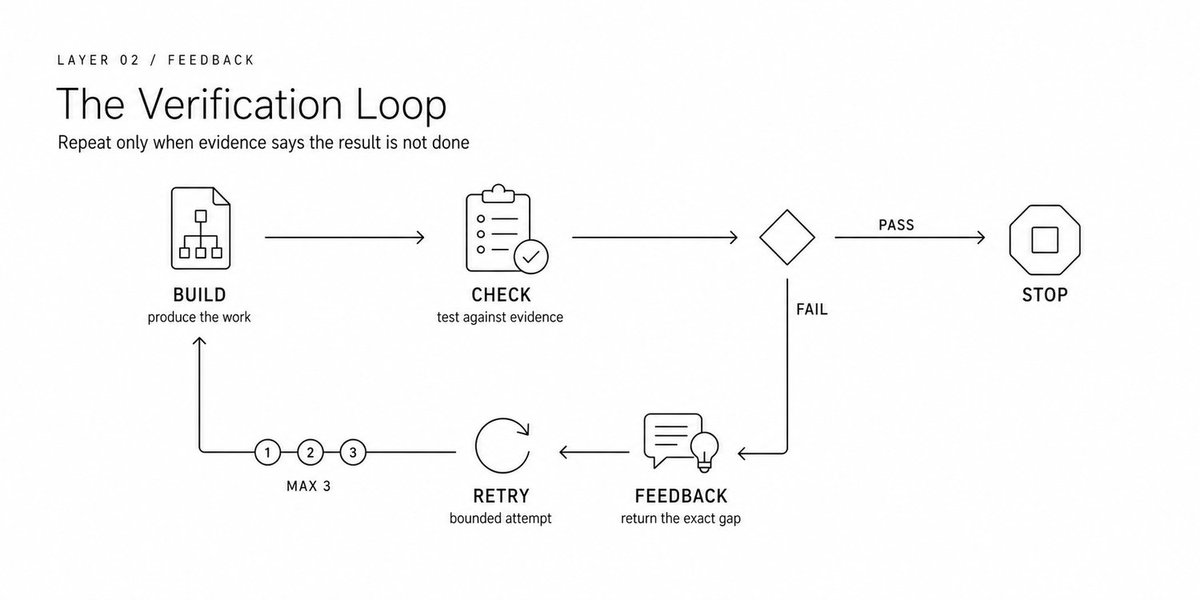
The verification loop
The most useful outer loop is simple
BUILD
  ↓
CHECK AGAINST EVIDENCE
  ↓
PASS? ── yes ──> STOP
  │
  no
  ↓
RETURN SPECIFIC FEEDBACK
  ↓
RETRY WITH A LIMIT
The check may be deterministic:
Or it may require a reviewer:
The rule is the same
Do not loop on confidence
Loop on evidence
"The agent says it is finished" is not proof
"The tests pass, the sources resolve and the reviewer approved the diff" is proof
The leverage comes from building the cycle once and letting the system run it for you
Claude's scheduled tasks are the visible product version of the same shift: define recurring work once and let the system re-enter it without another manual prompt
Scheduling is only the trigger
The checks, feedback and exit condition are what turn the recurring task into an engineered loop
The anatomy of a useful loop
Every production loop needs seven things
1. Trigger
What starts another cycle: a request, schedule, webhook, failed test, new document or evaluator result
2. Goal
A measurable state to reach, not "keep improving"
3. State
What the next attempt must know without replaying the entire history
4. Action policy
What the agent may change, call, delegate or spend
5. Evidence
Tests, citations, diffs, metrics, schemas or human review
6. Feedback
A compact explanation of what failed and what must change
7. Stopping rule
Success, maximum attempts, budget exhaustion, timeout, hard error or human escalation
Loops can stack
The agent loop performs the work
The verification loop checks the work
An event loop wakes the system when new work arrives
An improvement loop studies production traces and changes the harness itself
EVENT LOOP
└── VERIFICATION LOOP
    └── AGENT LOOP

TRACE IMPROVEMENT LOOP
└── updates prompts, tools, policies and graders
This is why loop engineering is larger than prompt engineering
A prompt defines what should happen during one model call
A loop defines what the system does after that call
The cost is obvious
Every retry, grader and reviewer adds latency and spend
Add a loop when the expected cost of failure is higher than the cost of verification
Layer 3: Graph Engineering
Graph engineering asks a different question
Not "how should the agent work"
But "what is allowed to run next"
Work becomes nodes
Allowed transitions become edges
State moves through the graph
That structure can represent:
What graph engineers actually decide
Node boundaries
Which work belongs in normal code, an LLM call, a specialist agent or a human review step
State schema
What each node may read or update and how parallel results are merged
Routing conditions
Which evidence moves work forward, backward, sideways or into escalation
Concurrency
What can run in parallel and what must wait for a join
Cycles and exits
Where retries are legal, how many attempts are allowed and what makes the cycle safe
Durability
Where execution is checkpointed and how it resumes after interruption
When a graph is worth the ceremony
Use a graph when the process contains meaningful branches, parallel specialists, approvals, recovery routes or stateful handoffs
Do not start with a graph only because the workflow has multiple steps
If one capable agent with three tools can solve the task, a graph may add structure without adding value
There is another failure mode
Teams formalize the workflow before they understand the work
The result is a beautiful diagram that encodes the wrong assumptions
Start with a simple harness
Study real traces
Formalize the paths that remain stable
The next step after loops is making the execution topology explicit
OpenAI packaged the same idea into Agent Builder: a visible workflow canvas for multi-agent execution with guardrails and evals around the graph
How all three layers work in one real system
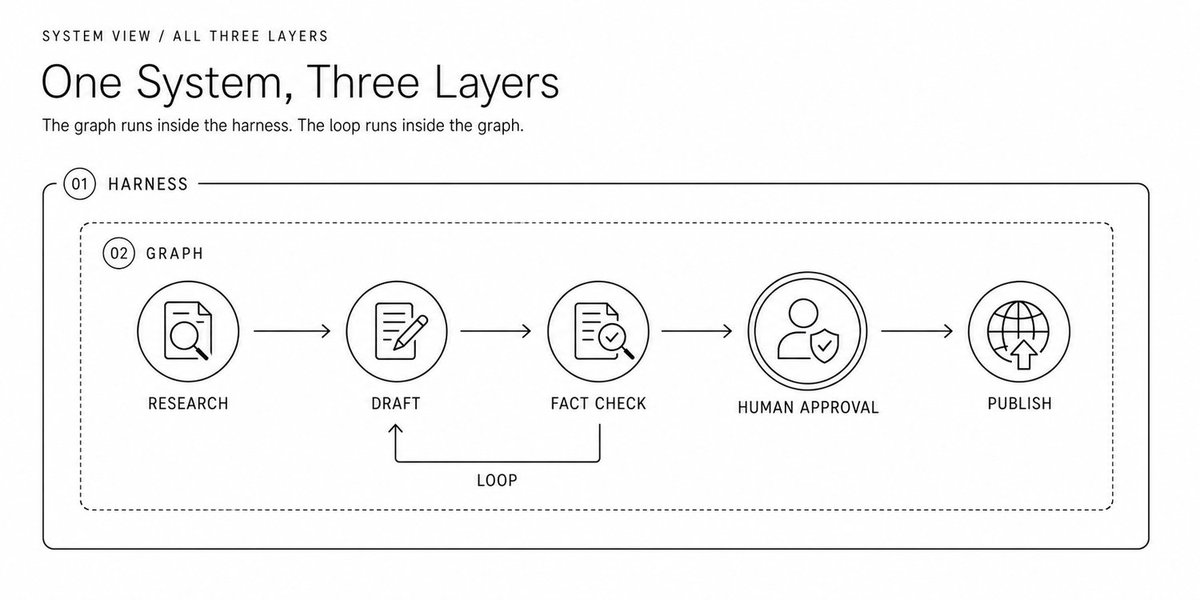
Imagine a research-and-publishing agent that produces a factual industry briefing
The harness provides:
The graph controls the route:
RESEARCH
   ↓
DRAFT
   ↓
FACT CHECK ── fail ──> RESEARCH
   │
  pass
   ↓
EDITORIAL REVIEW ── fail ──> DRAFT
   │
  pass
   ↓
HUMAN APPROVAL
   ↓
PUBLISH
The loops live inside that route
The research node may search until source coverage is sufficient
The drafting node may revise until the style grader passes
The fact-check node may return exact unsupported claims instead of a vague rejection
The nesting is the important part
The graph runs inside the harness
The loops run inside parts of the graph
The harness supplies the tools, state and evidence those loops need
The layers overlap because real software layers overlap
They still give you three different levers when the system fails
Diagnose the failure before changing the architecture
| Symptom | Start with | Likely fix |
| --- | --- | --- |
| The agent cannot access the right data safely | Harness | Better tool contract, permissions, sandbox and context injection |
| The agent forgets progress between sessions | Harness | Durable state, checkpoints, progress artifacts and compaction |
| The first attempt is close but unreliable | Loop | External grader, deterministic tests, actionable feedback and bounded retry |
| The agent continues after success or stops before proof | Loop | Evidence-based terminal states and budget-aware stop rules |
| Specialists must run in a controlled order | Graph | Explicit nodes, edges, routing conditions and joins |
| A multi-step failure is impossible to locate | Graph + harness | Stateful traces aligned with nodes and transitions |
| The process changes too quickly for a fixed diagram | Simpler harness | Keep planning model-driven and delay graph formalization |
This table is more useful than arguing about terminology
Find the layer that owns the failure
Fix that layer first
The expensive mistakes behind weak agent systems
Building the graph too early
Do not convert an imagined business process into forty nodes before watching a strong agent perform the work
Trace first
Formalize second
Letting the maker grade itself
Self-review is useful but shares the same blind spots as the original attempt
Prefer deterministic checks where possible
Use an isolated reviewer context for subjective checks
Require human approval for high-impact actions
Defining the loop as "keep trying"
An unbounded retry is not reliability
It is a cost leak
Every cycle needs fresh evidence, a maximum attempt count and a named escalation path
Turning the harness into a warehouse
More tools do not automatically create a better agent
A crowded toolset increases selection errors
Noisy context increases confusion
Broad permissions increase risk
Give the agent the smallest environment that can complete the job
Blaming the model for orchestration failures
A stronger model cannot reliably repair stale state, broken APIs, ambiguous tool schemas or missing exit conditions
Do not upgrade the model before proving the model is the problem
A production-ready checklist
Harness
Loop
Graph
Evaluation
Operations
The simplest way to remember the difference
Harness engineering makes the model operational
Loop engineering makes the work iterative and verifiable
Graph engineering makes complex execution explicit and controllable
None replaces the others
A perfect graph cannot save an agent that loses its state
A perfect harness still wastes money if the loop has no evidence or stop rule
A strong loop becomes difficult to operate when branches, parallelism and approvals are hidden inside ad hoc code
Reliable agents appear when all three layers are designed together
And when every layer has one clear job
ENVIRONMENT -> HARNESS
FEEDBACK    -> LOOP
FLOW        -> GRAPH
That is the whole framework
Sources and further reading
If you read this far
Bookmark the article and follow @0xwhrrari for more practical agent engineering
Also you can read other articles: