Graph Engineering: How to Build AI Agent Systems That Don't Break at Scale

Most builders still design AI agents as a straight line

Research first
Write second
Review third
Ship last
Each step waits for the one before it, even when half of them never needed the previous result
The system does not branch
It does not parallelize
It does not know how to recover
It just keeps feeding one context window until the agent gets slow, confused, or expensive
The problem is no longer the prompt
The problem is the shape of the work
That is what graph engineering fixes
I publish practical breakdowns of AI agents, workflows, and production systems on Substack Join the newsletter here
What graph engineering actually means
Graph engineering is the practice of turning an agentic workflow into an explicit execution map
Instead of hiding every decision inside one model loop, you define the system as nodes and edges
NODE   = one bounded unit of work
EDGE   = a real dependency between two nodes
STATE  = the data that survives between nodes
ROUTER = the rule that selects the next edge
GATE   = the check that decides whether work can continue
A node can be an agent, a tool call, a deterministic function, a verifier, or a human approval step
An edge says what is allowed to run next and what data crosses the boundary
The graph decides which loops run, in what order, with which branches, joins, and recovery paths
A loop helps one agent improve its work A graph coordinates many loops into one system
1. Stop treating every "and then" as a dependency
Most agent workflows are linear because that is how people write instructions
Do A, then B, then C
But sequence is not the same as dependency
If B does not consume A's output, there is no reason for B to wait
BAD

collect market data -> inspect repository -> check competitor pricing

BETTER

                 -> collect market data ---------
USER REQUEST     -> inspect repository ----------> SYNTHESIZE
                 -> check competitor pricing ----
The first question in graph engineering is simple
Does the next step actually read the previous step's output
If the answer is no, cut the edge
That single change usually turns a slow chain into a fast parallel graph
2. Give every node a contract
A node you cannot describe precisely is a node you cannot route, test, or replace
Every useful node needs four things
{
  "node": "source_researcher",
  "input": {
    "topic": "string",
    "source_type": "primary"
  },
  "output": {
    "claim": "string",
    "source_url": "string",
    "confidence": "high | medium | low"
  },
  "failure": "no_primary_source_found"
}
Free text forces the next node to guess what happened
Structured output turns a model response into something the graph can trust
This also makes nodes replaceable
You can swap the model, prompt, or tool without rebuilding the entire system as long as the contract stays the same
3. Treat edges as data contracts, not arrows
An edge should not mean "B comes after A"
It should mean "A produced data that B is allowed to consume"
That distinction matters because most workflow plumbing does not need another model call
Flattening arrays, removing duplicates, filtering nulls, checking a status, and joining records are deterministic operations
const usable = results
  .filter(Boolean)
  .flatMap(result => result.items)

const unique = [...new Map(
  usable.map(item => [item.source_url, item])
).values()]
No agent is needed here
Save model calls for judgment
Use code for plumbing
A graph where every edge is another agent is paying tokens for its own wiring
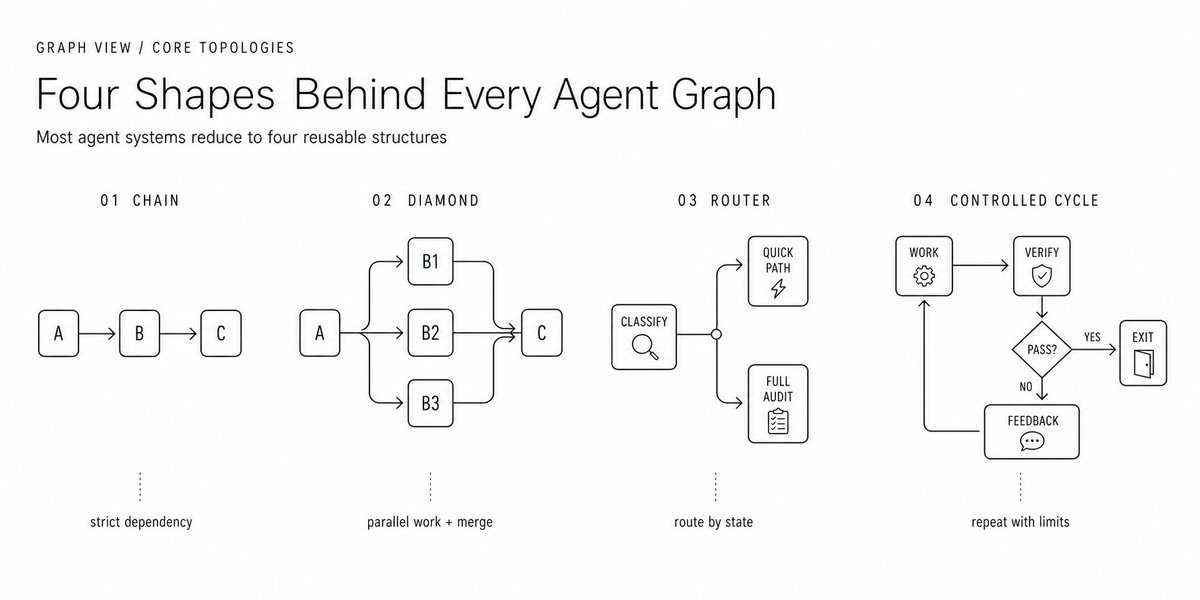
4. Learn the four shapes behind almost every agent graph
You do not need fifty patterns
Most production graphs are combinations of four shapes
The chain
A -> B -> CUse it when every step genuinely requires the previous output
It is simple, predictable, and often slower than necessary
The diamond
        -> B1 -
A ->    -> B2 --> C
        -> B3 -
Split one job into independent branches, run them together, then merge the results
This is the workhorse for research, code review, due diligence, and market scans
The router
             -> QUICK PATH
CLASSIFY  ---
             -> FULL AUDIT
Inspect state and choose only the path the task needs
Small work stays cheap
Risky work gets a deeper graph
The controlled cycle
WORK -> VERIFY -> PASS -> EXIT
          |
          -> FAIL -> FEEDBACK -> WORK
Repeat only when evidence says the result is incomplete
Every cycle needs a hard stop, a budget, and a convergence rule
5. Fan out independent work, then join it deliberately
Parallelism is the easiest graph advantage to understand and the easiest one to abuse
If five nodes are independent, run them together
const settled = await Promise.allSettled(
  sources.map(source => researchNode(source))
)

const findings = settled
  .filter(result => result.status === "fulfilled")
  .map(result => result.value)
One failed branch should not destroy the other four
But do not place a barrier after every stage
A join is worth the wait only when the next node needs the complete set
Examples include cross-source deduplication, ranking all candidates, comparing alternatives, or deciding whether coverage is complete
If each item can continue independently, keep the graph streaming
Parallel is not automatically fastYour topology decides where the system waits
6. Make routing inspectable
The model can make a judgment
The graph should enforce what that judgment is allowed to trigger
const decision = await classifyRisk(change)

switch (decision.severity) {
  case "low":
    return quickReview(change)

  case "high":
    return fullParallelAudit(change)

  default:
    return humanReview(change)
}
The classifier is probabilistic
The allowed routes are deterministic
This gives you the model's flexibility without giving it unlimited control over the system
OpenAI's visual Agent Builder makes this shift obvious: agent behavior is increasingly designed as an inspectable workflow instead of a hidden chain of prompts
7. Put verification on the edge
The highest-leverage node in a graph is often the one that produces nothing new
Its job is to stop weak work from moving downstream
A verifier can check
GENERATOR -> VERIFIER -> PASS -> SYNTHESIZER
                 |
                 -> FAIL -> REPAIR
Do not ask the same agent to generate, approve, and publish its own work in one context
Separate the roles
Separate the prompts
Separate the failure boundaries
Anthropic's production research system follows this logic at a larger scale: a lead agent coordinates parallel subagents, findings are synthesized, and a dedicated citation stage attaches evidence before the result reaches the user

8. State is the part most diagrams hide
Boxes and arrows look clean until the system has to resume after a crash
A production graph needs durable state
task_id
current_node
completed_nodes
artifacts
decisions
evidence
budgets
retry_counts
human_approvals
Do not move giant transcripts between nodes
Move references to artifacts
A research node should store its report and return a path, ID, or structured summary
A reviewer should read the artifact directly instead of receiving a compressed retelling through three agents
This reduces context loss and makes every transition auditable
The graph should be able to answer three questions at any moment
What has already happened
Why did the system choose this route
Where can execution safely resume
If it cannot answer them, the graph is still a demo
9. Add cycles only when they converge
A cycle is useful when the amount of work is unknown in advance
Bug discovery, deep research, and iterative repair are good examples
But "repeat until good" is not a stop condition
Use measurable convergence
let dryRounds = 0
let iteration = 0
const seen = new Set()

while (dryRounds < 2 && iteration < 6) {
  const findings = await discover()
  const fresh = findings.filter(item => !seen.has(item.key))

  fresh.forEach(item => seen.add(item.key))
  dryRounds = fresh.length === 0 ? dryRounds + 1 : 0
  iteration += 1
}
Notice what the system remembers
It deduplicates against everything already seen, not only the findings that passed verification
Otherwise rejected ideas keep returning and the graph pays to rediscover the same dead ends forever
Every controlled cycle needs
10. Design failure as a local event
In a chain, one broken step can freeze the whole workflow
In a graph, failure should stay inside the smallest possible boundary
Each node needs a policy
RETRY      transient tool or network failure
FALLBACK   preferred model or source unavailable
SKIP       optional branch failed
REPAIR     output failed validation
ESCALATE   risk or uncertainty crossed a threshold
STOP       budget, safety, or permission boundary reached
Checkpoint after expensive nodes
Make writes idempotent so a retry does not duplicate side effects
Give parallel workers isolated workspaces when they modify files
Record every routing decision with the state that produced it
Reliability does not come from hoping every node succeeds
It comes from deciding what the graph does when one does not
11. Topology is your cost model
A graph is not automatically cheaper than one agent
It can burn far more tokens if every task spawns a fleet
The shape controls both latency and cost
Use cheaper models for bounded extraction, classification, and formatting
Use stronger models for decomposition, synthesis, and difficult verification
Route simple tasks through a short path
Reserve the full graph for work that earns it
SIMPLE REQUEST -> SMALL MODEL -> QUICK CHECK -> DONE

COMPLEX REQUEST -> PLANNER -> PARALLEL SPECIALISTS
                              -> VERIFIERS
                              -> STRONG SYNTHESIZER
                              -> HUMAN GATE
Anthropic reports that multi-agent research can materially outperform a single agent on breadth-first work, but it also uses far more tokens
That is the tradeoff
Graph engineering is not about maximizing the number of agents
It is about spending coordination only where parallelism, specialization, or independent verification creates enough value
12. A production graph for research and publishing
Here is a practical graph for turning one idea into a cited article
                                  -> COMPANY SOURCES -----
TOPIC -> SCOPE -> DECOMPOSE       -> PAPERS --------------> DEDUPE
                                  -> EXPERT POSTS ---------
                                                             |
                                                             v
                PUBLISH <- HUMAN GATE <- FINAL CHECK <- DRAFT
                                                |          ^
                                                -> FAIL -> REPAIR
The system works like this
This is not one giant agent pretending to be a team
It is a system with explicit ownership, state, and authority

When a graph is the wrong answer
Do not turn every prompt into an architecture diagram
Keep one agent in one loop when
Move to a graph when
Start with one loop
Draw a graph only when the dependencies force you to
The graph engineering checklist
Before you ship, ask
[ ] Does every edge carry real data or authority
[ ] Does every node have one bounded job
[ ] Are inputs and outputs structured
[ ] Can independent nodes run in parallel
[ ] Are joins placed only where the full set is required
[ ] Are important results verified before moving downstream
[ ] Can failures be retried without duplicating side effects
[ ] Can the graph resume from a checkpoint
[ ] Does every cycle have a hard stop and budget
[ ] Can a human interrupt high-risk paths
[ ] Can you explain why every route was selected
[ ] Is the graph simpler than the problem it solves
If the answer to the last question is no, delete nodes
The real shift
Prompt engineering improves the instruction
Context engineering controls what the model sees
Harness engineering builds the environment around the model
Loop engineering makes one unit of work improve through feedback
Graph engineering coordinates the entire job
PROMPT -> CONTEXT -> HARNESS -> LOOP -> GRAPH
message    memory     machine    run     coordination
The model is only one node
The product is the system around it
A prompter asks the agent to do more An architect redesigns the graph so the system can do more safely
Keep reading
For shorter notes, new tools, and AI systems I am testing
For deeper breakdowns delivered directly
If you read this far
Bookmark the article so you can use the patterns later
Follow @0xwhrrari for more practical AI systems
And send this to a builder who is still forcing every agent through one long chain

