60 Claude Fable 5 Workflows That Make Money While You Sleep

Every other model makes you babysit it.
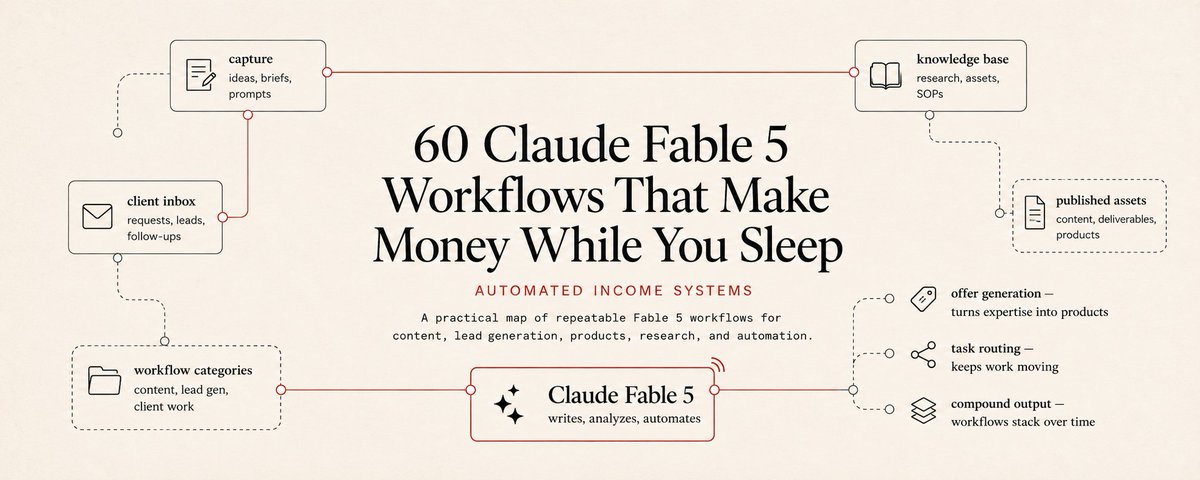
Fable 5 is the first one built to be left alone.
That is the entire difference, and it is the reason this article exists. Opus 4.8 is fast and sharp, but it is built for the response you read in a minute. Fable 5 is built for the task that takes hours, the one that plans, spawns its own sub agents, checks its own work, and reports back when it is actually done.
Anthropic said it plainly in their own guide. Fable 5 is particularly effective at end to end work that takes a person hours, days, or weeks. That is not marketing. That is a spec sheet for a night shift worker.
So while everyone else is asking Fable 5 the same quick questions they asked Opus, here are 60 workflows that use it for what it was actually made to do. Long. Autonomous. Unsupervised. Running while you sleep.
Every one is a trigger, an agent, and a verification step. Skip the verification and you wake up to expensive mistakes. Keep it and you wake up to finished work. That rule never changes, and with Fable 5 running longer and more autonomously than any model before it, it matters more, not less.
A note before the list. Fable 5 has one behavioral quirk you must handle on any long run. It can report a step as done before verifying it. Anthropic's own fix, which nearly eliminates this, goes in every autonomous prompt below:
Before reporting progress, audit each claim against a tool result from this session.

Only report work you can point to evidence for. If something is not verified, say so.

If a step failed, state that with the output. Do not report success you cannot prove.
Paste that into the system prompt of anything you leave running overnight. Now the workflows.
Content Machines
1. Overnight ingest and publish. Drop a transcript, article, or PDF into a folder. Fable 5 extracts the core ideas, drafts a thread, a post, and a newsletter blurb, and files all three. You wake up to drafts, not a blank page.
2. Competitor monitor. A daily run that checks five competitor accounts, summarizes anything new, and flags topics you have not covered yet.
3. Repurposing engine. One long piece in. Ten short variations out. Thread, three posts, a carousel script, a video script.
4. SEO cluster builder. One seed keyword. Fable 5 maps the full cluster and drafts ten interlinked articles targeting different long tail variations overnight.
5. Newsletter autopilot. Every morning it drafts your newsletter from what happened in your niche while you slept. You edit for ten minutes and send.
Trading and Market Analysis
6. Wallet pattern scanner. Point it at on chain data. It logs high win rate wallets and their entry and exit timing to a file you review each morning.
7. Overnight chart review. Queue tickers before bed. Fable 5 pulls price data, runs multi timeframe analysis, and writes a morning briefing.
8. News to thesis pipeline. Watches headlines, filters for your watchlist, drafts a thesis note on impact before the market fully prices it.
9. Earnings call summarizer. Drop in a transcript. It extracts guidance changes, tone shifts from the last call, and contradictions with prior statements.
10. Rebalancing alert. Compares current allocation to target and drafts the exact trades. It never executes. You control every dollar.
Code That Ships Itself
11. Overnight bug sweep. Point Fable 5 at your repo before bed. It finds and fixes lint errors, failing tests, and obvious bugs, then opens a pull request. This is where Fable 5's long autonomous runs pay off most. Use this prompt:
Work through this repo. Fix lint errors, failing tests, and clear bugs one at a time.

Run the test suite after each change. Only keep changes that pass.

Open one pull request with everything that passed. Before reporting done,

audit each fix against the actual test output. If tests still fail, say so with the log.
12. Dependency update loop. Weekly. Updates packages one at a time, runs tests after each, opens a PR only for updates that pass clean.
13. Documentation generator. After every merged PR, it reads the diff and updates the relevant docs so they never drift.
14. Landing page variant builder. Your current page plus a list of angles in. Five complete variants out, ready for your testing tool.
15. Client micro site builder. Find a business with an outdated site. Feed Fable 5 their content. It rebuilds a modern version as a finished proof of concept.
Sales and Lead Generation
16. Cold outreach personalizer. Feed it a prospect list. It researches each one and drafts a unique opening line, not a generic mail merge.
17. Inbound lead qualifier. Reads each form submission, checks it against your ideal customer profile, tags it hot, warm, or cold before you look.
18. Proposal drafter. After a call, feed it the transcript. It drafts a proposal on your template with the exact pain points and numbers mentioned.
19. Follow up sequence writer. Give it your stalled deals. It drafts a tailored follow up for each based on how long it stalled.
20. Prospecting list builder. A scheduled search for businesses matching your criteria, compiled into a daily list.
Research and Knowledge Work
21. Second brain ingestion. Drop any source in and say ingest this. Fable 5 reads it, links it to existing notes, and files it into a living wiki that compounds.
22. Deep research agent. This is Fable 5's strongest solo workflow. It can run sub agents in parallel across a hard question. Use this:
Research this question thoroughly. Delegate independent sub questions to sub agents

and keep working while they run. Each sub agent gets a bounded scope and clear success criteria.

Synthesize only after all report back. If a sub agent fails, say so in the synthesis.

Do not infer what it would have found.
23. Meeting notes to action items. Extracts action items from transcripts, assigns them to the people mentioned, drops them into your task manager.
24. Feedback synthesizer. A month of tickets in. The top five complaints and top five praise points, ranked by frequency, out.
25. Due diligence first pass. Reads provided documents and flags red flags, inconsistencies, and missing information before you dig in.
Multi Agent Systems
26. Maker and checker pair. One agent writes. A second reviews it against a checklist before it reaches you.
27. Debate panel. Run the same question through multiple models and have them critique each other before a final synthesis.
28. Research and writer split. One agent gathers and verifies facts. A second, with no search access, writes using only what was confirmed. Fabricated claims never reach the draft.
29. Triage and escalation. A cheap fast model handles routine classification. Fable 5 handles only what actually needs the depth.
30. Self auditing loop. After finishing, the agent reviews its own output against the original instructions before marking it done.
Customer Support and Community
31. Support first responder. Drafts a reply to every ticket using your knowledge base. Nobody starts from a blank box.
32. Community onboarding flow. New members get an interactive conversation at any hour, with no one on your team awake.
33. FAQ gap finder. A weekly review that surfaces questions your FAQ does not answer.
34. Refund and dispute drafter. For cases meeting your policy, it drafts the resolution and internal note, ready to approve in seconds.
35. Sentiment monitor. A daily scan that flags any spike in negative sentiment before it becomes visible.
Personal Productivity Systems
36. Daily briefing generator. Before you wake, it compiles your calendar, important unread email, and relevant news into one briefing.
37. Email triage assistant. Reads your inbox overnight, drafts replies to quick items, sorts the rest by urgency.
38. Weekly review compiler. Every Sunday it pulls from your notes, calendar, and completed tasks to draft a review.
39. Reading list processor. Everything you saved this week, summarized into one digest.
40. Goal tracker review. A weekly check against your metrics, flagging trends and asking the one question that matters from the data.
Infrastructure That Runs Itself
41. CI sweeper. Failed builds get investigated. Low risk fixes open a PR. Ambiguous ones escalate with full context.
42. Changelog drafter. Every tagged release gets a draft changelog from commit history, ready for a light edit.
43. Post merge cleanup. After a merge, a pass removes dead code, unused imports, and stale flags.
44. PR babysitter. Watches open pull requests, runs tests, answers simple comments, pings a human when judgment is needed.
45. Vulnerability sweep. Scans your dependency tree, drafts the patch PR for anything with a fix and a passing test suite.
E-commerce and Product
46. Product description generator. A spec sheet in. On brand descriptions for the full catalog out, formatted for your platform.
47. Review response drafter. Drafts replies to new reviews in your brand voice, flagging anything that needs a human first.
48. Inventory reorder alert. Compares stock to sales velocity, drafts reorder recommendations before anything runs out.
49. Pricing monitor. Tracks competitor pricing and summarizes the moment something shifts.
50. Abandoned cart sequence. Drafts a tailored recovery message for each cart based on what was in it and how far the buyer got.
Finance and Admin
51. Invoice drafter. When a project closes, it drafts the invoice from the scope you set at the start.
52. Expense categorizer. A month of transactions in. Categorized, with anything unusual flagged, out.
53. Contract first read. Reads an incoming contract and flags unusual clauses and missing terms before your lawyer bills you.
54. Subscription auditor. A scheduled review that flags subscriptions you are not using.
55. Cash flow briefing. A weekly summary of what came in, what went out, and what is due.
Niche and Specialized
56. Job posting to outreach. Scans job boards for companies your product solves a problem for, drafts outreach explaining why they need you now.
57. Grant and application scanner. Scans funding opportunities pre filtered against your eligibility, drafts an application for strong matches.
58. Podcast guest research packet. Compiles a packet on the guest, their recent work, and three questions nobody else has asked them.
59. Brand consistency checker. A weekly scan flagging contradictions, repeated claims, or drift from your positioning.
60. Localization pipeline. Adapts your best content for a different market, localized for tone and reference, not just translated.
Why Fable 5 Specifically
You could run some of these on Opus 4.8. So why does Fable 5 change the game.
Because the workflows that actually make money while you sleep are the long ones. The overnight repo sweep that touches forty files. The research agent that spawns six sub agents and synthesizes them. The multi stage pipeline that runs for three hours without a human checkpoint.
Opus 4.8 fragments on tasks that long. Fable 5 was trained to hold intent and context across them. It plans before acting. It checks its own work. It expands context as the task demands instead of losing the thread halfway through.
That is the entire reason a task you used to break into five sessions now runs as one unattended job. And a task that runs as one unattended job is a task you can leave running while you sleep.
The Pattern Behind All Sixty
None of these are Fable 5 outsmarting you. They are Fable 5 removing you from work that never needed your judgment in real time.
Every one runs on the same three parts.
A trigger. A schedule, a new file, an incoming message.
A capable agent. Fable 5 with the right tools, the right context, and the audit instruction from the top of this article.
A verification step. Something checking the output before it reaches you. A test suite, a second agent, a rule based filter.
Miss the verification and you get expensive mistakes running all night. Miss the trigger and you are starting everything by hand again. Build all three and you have a system that genuinely works overnight, not a demo that works while you watch.
How to Actually Start
Pick one workflow. The one that maps onto something you already do every single day.
Get it running reliably for a week before adding a second. Reliable means it ran without you checking constantly and the output was good enough to use without heavy editing. Still rewriting most of it? Not done. Just looks done.
The people who build five fragile systems babysit all five. The people who build one solid system build the next nine faster, because they already know exactly what breaks and why.
That compounding is the real unlock. Not the first workflow. The tenth, built in a fraction of the time the first one took.
Pick one. Build it properly. The other fifty nine get easier once the first one actually runs.
Follow @cyrilXBT for the full builds behind each of these.
