Abaxx Technologies - A Free Call Option

ATB Securities has given it the potential of $2500 USD while it currently trades at liquidation value of $25 USD without properly accounting for the MarketOS digital technology Abaxx has built and are launching soon. This asymmetry of owning Abaxx likens it more with a free no expiry call option with protected downside.


Quick Overview
Let's dive into it. For those who don't know, Abaxx is a fully regulated global clearinghouse and exchange focusing on physical delivery of commodities based out of Singapore (more on that later). They have their FBOT license from the CFTC allowing direct access to USA and they have equivalency in many countries such as the UK and are licensed to serve the EU. They are also bringing to market a new digital title technology called MarketOS which claims to bring many efficiencies to the financial world.
The Technology
We are already starting to see its first institutional value with Abaxx partnering with Alta back in May to create a MMF fund that uses Digital Title Technology.
First let's look at how CME charges for MMF collateral to help give us an idea for what Abaxx can charge.
CME allows MMF funds to be deposited as collateral on their exchange. From what I can tell they offer a 2% haircut. $100k deposited is worth $98k in collateral. The max allowed per entity is $5 billion with no more than 50% of collateral being MMF funds. There are other restrictions but that gets too much in the weeds.
There is a list of 16 MMF funds supported which you can invest in that qualify for collateral on CME.
Diving into the Blackrock MMF for Treasuries we can see that interest is paid within 5 days on a monthly basis unless reinvested and has 0.18% in fees. When posted to CME they charge an additional 0.15% bringing the total to around 0.33% of the total annual value for MMF to be used as collateral. If 1 million is posted as collateral on CME, you can expect fees of $3300.
This means the upper limit in which Abaxx and Alta can charge for MMF collateral on Abaxx is 0.33%. On 5 billion being posted as collateral to Abaxx, the two partners would share $16 million in fees. My working theory though is we will likely see a 50% slashing of collateral fees on the exchange given that Abaxx is able to collect fees on the MMF fund side as well. Unlike CME which is strictly limited to the collateral fees.
If you look up the CME collateral, you will see cash collateral at $149.5 billion and non-cash collateral: $170.9 billion. This generates around $550 million for them.
Abaxx's value proposition is that they can make MMF funds more efficient by letting users earn the MMF yield in more real time but have the frictionless settling speed of cash. This is accomplished with their Digital Title and Identity Infrastructure via MarketOS. Doing so Abaxx could potentially provide better haircuts such as in the 1% or 0.5% range. They could also have fewer restrictions on the amounts posted as collateral if trading and settling of MMF funds happens in real time.
Because Abaxx owns the technology to enable this be more frictionless, they could also get a percentage of the fees of the managed fund itself. Abaxx is well connected with some of their investors such as Blackrock and Fidelity managing $2 trillion in MMF funds. Abaxx getting their technology into their hands of these funds could enable them to earn 0.01% for example from the 0.18% fund management fees mentioned before. This is in addition to the potential $300 billion in posted collateral (CME as reference) at full scale using 0.08% (half of CME). Together they could earn upwards of ~$500 million in annual fees from this application.
This gives you a lower limit of their TAM but if you dig into it more you will find MMF funds globally are worth around $9 trillion with commodity trade finance exceeding $1 trillion. Don't forget though, this could also likely be applied to the bond markets which is estimated at $130 trillion. Basically Abaxx can apply 0.01% fee to the global financial product economy if they are successful in the deployment of their tech. I don't know what the fee will be though, and in the end it's just a guess. It could be much higher or it could be lower.
These are all very extremely optimistic projections, but with the current market valuation, Abaxx is currently priced to achieve 0% of these revenues. The point of all of this is to show that owning Abaxx for the exchange, you get this unbelievably free call option.
And I haven't even gotten into fees generated for real-time cross border payments that this technology unlocks which you can read about it here: The New Swift Network or Something Even Bigger?
The Exchange
I have gone over quite a bit on this, but will do it briefly again for those new to Abaxx.
Most of Abaxx's value is derived from their ability to launch global benchmark contracts. Typically for the right commodity they can generate hundreds of millions worth of revenue and be worth billions. Some smaller ones are worth hundreds of millions each.
At the current stage, Abaxx is meaningfully working on building out 5 benchmark contracts. Some of which pose strong competition to the current incumbents.
The largest is their LNG contracts which in their own right will be worth billions as LNG becomes more of a global energy commodity. Abaxx has already had days of volume exceeding JKM volumes, which is a financially settled LNG contract (inferior) that has the most liquidity. They have made great progress with commercial participants and Trayport has already given one of Abaxx's LNG contract benchmark status.

To give you an idea how we come to the billion dollar valuation for LNG, you take the size of the entire physical LNG space and divide by the Abaxx contract size. This comes to 2.14 million Abaxx contracts. Futures markets then typically churn about 50x due to trading between participants resulting in 100 million contracts that could be traded. Abaxx then would receive $5 per contract per side resulting in a cash flow of $1 billion if the global LNG supply was traded through Abaxx. At a 20x multiple given the high margins (70%), we end up at a valuation for $20 billion to own the benchmark LNG contract.
But this is obviously too unrealistic, so we tone down the expectations, and say 50% of the global LNG supply ends up using Abaxx contracts by 2035 which gives it a $10 billion valuation in 2035. Using a 10% discount rate you end up at $4 billion present value in current dollars. About 4x the current valuation if you believe Abaxx will capture 50% of the LNG market by 2035. It also assumes LNG does not grow at all by then.
Of course you have to account for data revenues that Abaxx can charge for providing these prices on every platform, you can also layer on top options trading revenue as well. As ATB Securities indicate, they assume these will offset the natural price decline as volumes grow and dilution through the years.
It is up to you to estimate what percentage of the LNG market Abaxx get hit by 2035.
In fact I have created a tool to help you calculate it all!
Check it out below but first couple things to note first:
I ran out of credits and I'm not paying $25 when I can just wait a day to fix so adjust the "Adoption speed (exponential steepness)" to 4.0 so it doesn't frontload so much growth.
Please adjust it to your estimates. It does 50% market penetration assumptions across the board by 2035. If you increase Digital Title Amplifier to 2x and assume 100% market penetration for LNG, you get a valuation of $70B on just the current contracts similar to ATB Securities.
Additionally this assumes constant growth and 100% chance of success to get the NPV. If you assume 10% of chance of success the NPV drops down to 10% of the value. We should start to see Abaxx's growth accelerate by the end of the year.

This is basically what all the financial analysts are doing when they give a valuation to Abaxx. Assigning probabilities based on current market size. So you can play around with it here and you can decide for yourself what is most likely. An analyst's timeline though will be a more staggered adoption and not follow a simple curve like here.
I added the Maine Lobster Contract (defaulted to 0) just to show you how easily the Abaxx team can just tack on new unique contracts that provide real value to the markets.
One thing that shocked me was the Lithium Carbonate NPV. I checked, rechecked and checked again. The market size is really 1+ million tonnes. With Abaxx's contract size being 1 metric tonne per contract and with 50x churn you are genuinely looking at 500 million in potential revenue. Unfortunately for this market I don't think 50x churn is feasible as the trading market can't possibly be that big, but who knows. I think I need to update the page to have a lower churn for this product range.
Anyways, if you find bugs let me know!
Remember with this NPV, it counts only current contracts. Abaxx is possibly throwing in crude by the end of the year as well as well as a multitude of others in the coming years. It also does not account for fees generated due to MarketOS or the fees generated from options trading. Those are all free call options to the current valuation.
Competing with Crude
The technology does unlock competitive advantages which I also wrote another whole article on how to build a Brent/WTI competitor. This is becoming more important as Abaxx already seems to be considering launching an oil contract based on Canada. This would help provide effective Pacific coast hedging for Asia based on Canada's oil export in BC. The added benefit is that it would be oil that's not locked behind the Strait of Hormuz. South Korea has started onboarding into Abaxx as well as aspects of Japan via Mizuho. China is also coming online this year. It's clear Abaxx is creating the market conditions needed to build the liquidity for this.
WTI/Brent gets lots of liquidity from hedging products such as LNG or Asian crude even though it never goes to delivery. The recent conflicts highlight why this is no longer good enough. At times, Brent was trading $30-60 in spread compared to Asia physically delivered prices which normally is ~$1-5. A company hedging delivery using Brent would have had a nasty surprise this past year. It's this reason why we need more benchmarks closer to actual delivery which Abaxx is starting to provide.
When Abaxx contracts begin to take full effect, we should see a small vacuum as they suck liquidity away from crude benchmarks to better fit the needs of companies who are short the LNG/Asian crude and need delivery for their customers. This creates the environment in which they can begin to compete with the highly liquid contracts themselves such as Brent/WTI through improved technology, lower fees, wider delivery locations, and better ease of use.
The Ace up the Sleeve
If someone properly investigated Abaxx and how they listed, they would have discovered that Abaxx owns a massive deposit called LabMag and KéMag back in Canada. Abaxx never talks about it or markets it, but if someone did further research they would realize it is one of the world's largest undeveloped iron ore (taconite) resource that is close to rail and port access. It's low carbon footprint enables it to produce "green steel" due to its high grade. For those who know Josh's background, he is a mining engineer. And as they say about mines, "Plan your mine and mine your plan". I do not think it is a coincidence that the only futures exchange able to bring ESG-graded commodities with full traceability (discussed in my other articles) also owns one of the worlds largest low carbon footprint iron ore deposit. One would say this plan is 7 years in the making. They also happened to be partnered with Ivanhoe Mining which owns the lowest carbon copper mines in production.
There was a Crumb laid recently that I think is worth discussing that none of the latest research accounts for.

The typical fashion for these large scale mining operations is that a mining company will commit to paying for all of the infrastructure, while another company provides the deposit. This is typically spun off into its own company.
If you go back to 2014, NML (now Abaxx) had a feasibility study done with Tata discussing the value of the mine. Inflation adjusted NPV in 2014 was $7.3–7.6 billion assuming the long term price of Iron was $104 with premium given for their green value and full build out of the mine. The Abaxx value for it hides in the footnotes where it's assigned a negligible value. The current price is $111 for iron ore which exceeds the threshold for feasibility in the prior study. If Abaxx were to spin this off with a major mining company, it's not unreasonable to see a special dividend worth $200–600 million paid to Abaxx shareholders or about $5–15+ per share. Abaxx values it negligible because it is as an extremely illiquid asset...but if Abaxx recently had a inflow of fresh capital, say a recent raise, it's possible they could put more effort into finding the right partnership to unlock this value. Again, another free call option.
Missing the Forest for the Trees
There has been a lot of focus on OI interest ratios, and the market incentive program that Abaxx runs. Some will even spend hours creating creative metrics in attempts to properly assess the "quality" of the initial liquidity. I think all of these attempts are missing the forest for the trees.
I will start by saying I literally do not care if Abaxx is running 100% rebates on all trading and giving it out for free. I don't know if they are, but it literally doesn't matter. Anyone telling you that it matters for upstart exchanges is being disingenuous to how markets are created. Exchanges have high multiples because they are so hard to break into. Incentivizing trading is just what you have to do when building a greenfield exchange and greenfield contracts.
I have also seen rumours Abaxx is paying traders to trade their contracts which I don't believe is the case. In fact I would say it's laughability ridiculous. Abaxx collects $2.50 from both sides of a gold trade that would expose each side to $133,700 in notional risk. If you consider for one second that Abaxx pays $1.25 for each trader, this only offsets 0.00093492894% of the risk to take the trade on in the first place! If gold moves just 0.01% traders would be losing ~$12 on that trade. With wash trading being illegal and highly monitored, the only natural conclusion is that these are genuine trades even if the fees themselves are offset. Which is a totally normal practice in literally every exchange in the world. It costs Abaxx nothing to provide these trades for free aside from the already built out infrastructure. This isn't the AI world where every $100 Chatgpt subscription is costing thousands in compute costs to OpenAi. Abaxx's infrastructure is a fixed cost regardless if it trades 1 million contracts a day or 10 thousand contracts a day.
As Josh said on the recent investor call, these initial volumes are from traders taking on risk. That's it and that's all that matters. Abaxx spent 7 years building an exchange and clearinghouse without any revenues. I am 100% comfortable with them taking another year focusing on building liquidity and building a $10 billion dollar exchange that dilutes 1% in 2027 to cover the free trading.
It took Abaxx nearly a year from official launch until they saw meaningful traction in any volumes. Then it took almost another year until Abaxx had a consistent 16k ADV. In another year they could possibly be at 250k ADV. Which would be worth ~$200 million USD in revenue without the fee rebates. Abaxx is currently built to easily handle 1 million ADV at $60 million in yearly upkeep costs and they are fully funded for another 6 quarters.
All the past and current criticisms of Abaxx can be compiled into this handy list.
We are here. I trust a team who has accomplished all of this, to continue to keep doing it, and trying to measure OI or create fancy metrics for initial volumes as they grow exponentially is frankly a waste of time in my opinion. No amount of custom metrics could have predicted the surge in trading from India and yet here we are.
Connectivity
The path to connectivity has been a long process for Abaxx but has never been looking better. In 6 months time Abaxx will have connectivity to 20+ clearing members and 20+ ISVs along with connectivity to Bloomberg (in progress), LSEG (done), and TradingView (done). Maybe they will even be able to squeeze in Factset in there. They will also soon onboard EU, China, and USA.
If one is to look at the trading volumes going back 6 months and then look back 1 year, it's obvious the network effects Abaxx is building. Keep in mind the current exchange activity is largely only a small portion of India, Thailand and Singapore.

Use your own crystal ball for a moment. This isn't a detailed analysis of OI ratios, or trading metrics. There is one question you have to ask yourself.
Do you believe the experienced Abaxx Team can continue to drive more volumes to the exchange after they have started to connect the 3 largest economies in the world and the world's biggest trading platforms?
I think the answer is yes.
What makes Singapore Strategic
I think it's obvious by now to those who follow the markets, that global trading relationships has been strained. We are seeing tariff escalations, export/import controls, and bilateral trade dropping between China and the West.
We are also seeing strained relationships between the EU and USA. EU is pushing hard on reducing dependence on US tech companies. France for example is shifting reliance of things such as Microsoft Teams to EU alternatives.
There are basically only three major commodity exchanges in the west. ICE, CME, and LME. The LME reputation speaks for itself after having reversed trades to save a trader. The reputation for the others are fairly good, however I do believe in the background there is a growing desire to use another exchange as they have been lacking and focusing more on prediction markets lately. They aren't focusing enough on physically delivered commodities and their customers needs.
I also can't imagine China is thrilled with having to use western companies for their trading needs. Likewise with the EU. The liquidity for commodities though on these exchanges is unmatched and so they continue to trade...for now.
A Singapore based exchange and clearinghouse is seen as neutral territory. They have some of the strongest relationships in the world with all superpowers and is third on the scale of least corrupt countries. Their laws are very strict and regulators pay competitive wages with the private industry to get some of the highest quality of talents there is.
I strongly believe that if Abaxx is able to solve the jump start liquidity problem, China is more than happy to drive all of their trading needs to this platform instead of western based companies. Especially when it has better technology. If Abaxx is able to compete, I am sure EU trading houses have no problem switching either. Should that network effect start, US trading houses will be forced to use Abaxx to trade with their EU and China counterparties.

This is what many the analysts are missing because you can't assign a value to it, so it's often missed. There is no OI ratio that tells you this. You can run NPV calculations all day long, but you miss the higher level aspects.
It is like running NPV calculations on the hottest telegram technology stock based on expected projected uptake in the early 1900s while ignoring the newspaper headlines which are screaming about this new invention called "the telephone".
Investing in Abaxx isn't just investing in a company, its investing in where the future trade flows will be.
Salvage Value
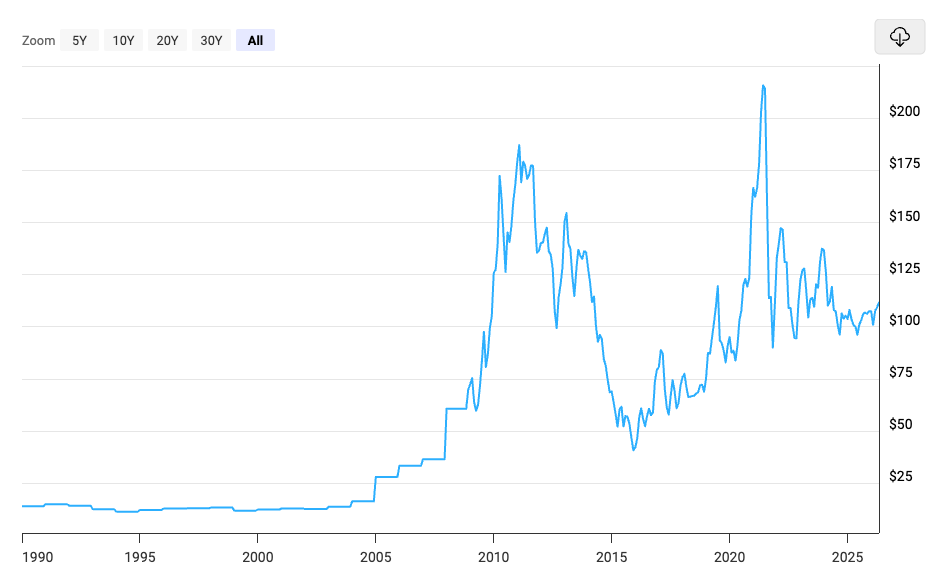
The last time a Singapore exchange and clearing house was sold was the SMX back in 2014 for ~$200 USD million inflation adjusted. This is the absolute minimum valuation. I think Abaxx can get much higher valuation for it. Current ADV for Abaxx is now 16k and nearly double the ADV of SMX when it was sold. Abaxx also holds the FBOT license to directly access the US markets along with a higher technology that is cloud based. It also has their digital title technology which they have been building over the past 7 years.
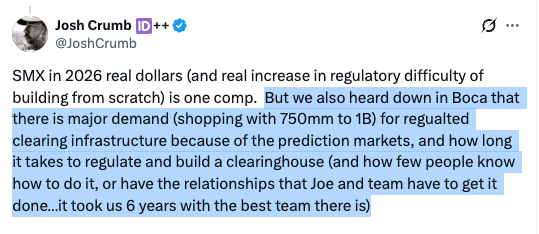
Given the combined, it's not unreasonable to be worth upwards of $500 million USD when the current market cap is ~$1 billion USD. In fact Josh has indicated there is significant interest due to prediction markets upticks putting the price at $750 million - $1 billion USD.
If one were to combine the salvage value of the exchange and clearinghouse in Singapore, along with the Labrador Deposits Abaxx owns, it's not unreasonable to see that Abaxx currently trades at liquidation value as of the writing of this article. This further enforces my initial thesis of Abaxx being a "no expiry call option with protected downside."
The Short Attack
Abaxx is currently being shorted and attacked by a short activist. The report was littered with lies, false accusations, as well as a complete lack of understanding in the way futures markets work. I address it as best as I could in my article here: A game is afoot. Sadly the attack worked to some extent, they planted enough doubt causing some long term shareholders to sell. I do not think they have won though.
Above I made the case that Abaxx is trading at liquidation value with an extremely asymmetric upside and the possibility of returning 100x+ if they succeed. I believe they will. But don't take just my word for it.
In the latest raise Abaxx welcomed two new major investors which they have not disclosed. We did accidentally get a sneak peak into one that was already invested. That being Crosby Advisors. For those unaware, that is the family office of the family who owns Fidelity Investments. One of the biggest asset managers in the world with 7.1 trillion in AUM. It has been confirmed they have been buying at these levels along with others.
The current short count sits around ~1.6 million shares with seemingly none covering since the drop. There is two implications here. Abaxx had ~1.5 million before the attack which leads me to believe there was a "changing of the guard" in terms of shorts. This means the report was successful in providing an out for previous long term shorts while driving in new ones. On the other hand, if it didn't happen, that is even more negative for shorts. This implies the vast majority of buying was done by investors with a long term view of Abaxx. It's unlikely those shares would break lose any time soon on any sign of reversal.
This creates the effect of pushing a beachball underwater which I'm sure many are aware of what happens when you let go. For current shareholders, we know the liquidation value for Abaxx is around the current price if we are wrong, and we know if we are right it presents a 100x+ potential. Any meaningful reversal of the trend here could cause a flurry of panic buying as shareholders who previously panic sold, race to buy on the market while competing with 1.6 million shares that need to be bought.
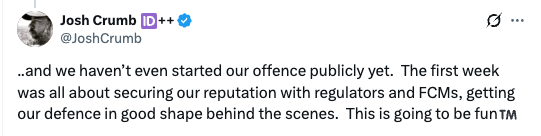
This all comes at a time when Josh has indicated they are getting ready to make public moves to counter the shorts.
Remember, for shorting, they must buy back what was sold, and there is no guarantee those shares are available at the prices they sold at. Waiting it out leaves 4% in borrow fees on a super leveraged position while Abaxx continues to make positive business developments. Plus there is now the added risk of a special dividend suddenly being spun out which shorts will be forced to eat the cost. Time is not on their side and is why short and distort is a necessity here.
Upcoming Listing, Indexes and Share Demand
Abaxx just recently uplisted to the TSX which means they are eligible for the S&P index inclusion. This should generate around ~1.5 million worth of share demand within the next 6 months. Combined with ~1.6 million shares short, there is approximately ~3.1 million pending share demand with no new shares coming on the coming markets. This latest drop only transferred shares from short term holders to long term holders (I being one of them). Any more downward pressure here only exacerbates the rebound. Abaxx at this transformational stage will be a completely different company in 6 months and in 12 months time.
Adding to this share demand, it is also entirely possible we see uplisting to both Nasdaq and the Singapore stock exchange this year. I imagine there will be a lot of Singaporeans (2nd richest country in world per capita) who would be eager to own a home grown global exchange. A grok estimation on uplisting to the Nasdaq is would generate ~2-5 million share demand due to indexes.
There are other tools as well that could create share demand. Should we see the price drop towards $20, it's entirely possible Abaxx launches an NCIB to buy back the dilution from the round at $54 just last month. They have successfully used this strategy before to fight an earlier short attack.
And lastly you have the long term holders who panic sold the past weeks. They know the vision, and they know the dream of what Abaxx is trying to accomplish. Any significant reversal or news flow could cause them to panic buying since they already know the story.
All of this to say, Abaxx could very likely have upwards of 8 million in share demand in the next year as they hit milestone after milestone while being fully funded for the next 6 quarters.
Summary
I hope I have been able to highlight how Abaxx is a highly asymmetric call option on the exchange with limited and protect downside based on the salvage value of the exchange and mineral deposits. At the same time you get the future growth of the exchange and technology as a free call option.
At the end of the day it comes down to how much you trust the Abaxx team and their history of building markets and the value they are creating. Some on the team working on this, were also the ones that helped build the Comex into what it is today.
I have owned Abaxx for 6 years already. Back then the thesis was the same as it is today. Build a fully licensed and globally recognized exchange/clearinghouse (against all odds) and use that platform to launch the second stage of their plan, a modern day digital identity network that powers Digital Title and T+0 along with all of their other products. That vision has not changed whatsoever and the second portion of that vision has only just started. Sure there have been detours due to construction along the way, but the Abaxx team as never stopped building.
Owning Abaxx for me then and still is now an asymmetric call option that has no expiry. They have continued to do everything exactly as they said they would.
And who knows, maybe I end up owning part of a new swift network built out of the Abaxx ecosystem as an added perk.
If you enjoyed the article, please don't forget follow, like and share!
AIDisclosure
Everything is written personally by me.
Stock Disclosure
The author of this report holds positions in Abaxx Technologies, which is mentioned within this analysis. These holdings represent the author’s personal investments and may reflect biases in the evaluation presented.
This report is for informational purposes only and should not be construed as investment advice. The analysis and opinions expressed herein are solely those of the author and were not influenced by any outside party. The author has not received any compensation, monetary or otherwise, for the preparation or publication of this report.
Projections and valuations are based on assumptions that are subject to market risks, uncertainties, and changes in circumstances. Past performance is not indicative of future results. Investors should conduct their own research and consult with a financial advisor before making investment decisions.

