Abaxx Technologies: The New Swift Network or Something Even Bigger?

International Finance and trade is complex. Real-time transfers, real-time settlements, real-time KYC, and real-time legal finality are even more complex. They are seen though as the pinnacle achievement in global finance. A goal so many institutions chase after. It is the root of the stablecoin race we are seeing today as institutions race to be the first to launch the best stablecoin offering. Maybe they are doing it all wrong?

At its core the Swift Network is just a standardized messaging system to help transfer funds across international borders. It connects thousands of banks together across a vast amount of countries. It isn't entirely a complex technology. It's just the one that has the biggest network. As a result, it would be standard for any new bank to connect to it if it wanted to do any international transfers.
The problem though is that it takes days for funds to be transferred and is often very expensive. Sure $50 transfer fee might not be alot if you are transferring billions, but for many, that fee could be the entire amount you want to send. Not exactly efficient. Keep in mind this varies per bank. The cost for banks to use it is much lower.
Now banks aren't exactly charged by Swift $50 to make a transfer. Often times it costs anywhere from 5 cents to 50 cents. This is all proprietary info though which isn't easily accessible. We can estimate it though! It was estimated they made 1 billion euros in 2023 and Swift indicated they did 44.8 million messages a day bringing the cost per transfer to around 6 cents (in Euros). Membership fees make up some of the revenue but that is even more proprietary so hard to estimate.
What this highlights is that the Swift network is very valuable! Maybe one might value Swift at 20x their revenue but I would argue its higher given just how valuable owning a payment network like that is. Let's say it's worth 30-40 billion in Euros or 35-46 billion USD. This also highlights that banks are not exactly keen to lose out on the ability to charge $50 for what costs them maybe 6 cents.
Swift is very valuable but also very entrenched. Owned by all the banks that make it up and overseen by central banks of the G10 countries. This entrenchment is what makes it so hard to break into it but also why they get away with slow payment processing and obscene delays to transfer your funds.
It is this entrenchment that should make it obvious that a random crypto or stablecoin isn't ever likely to somehow take over and replace the Swift Network. Central banks and all the governing parties will not just select a token or blockchain. It will come from something they have built themselves. It is a permissioned network and it will likely be a permissioned network for the foreseeable future. Adding a permissionless network to it doesn't make it better. Just makes it more complex. All of the downside of blockchain without any upsides. You can argue faster processing and clearing but I don't think that was ever the issue. That can be accomplished without blockchain.
The slowness really just comes from the way everything is handled. For starters a Swift message isn't actually the transfer of funds. It is just the messaging to indicate how a fund should be transferred and how it should be routed. The actual funds are transferred through other systems. Notice this distinction as I will mention this later. The funds and the actual Swift messages are separate.
A bank might also prefer to batch Swift requests at the end of the day. They may have someone checking all transfers and KYC of them all (more on that later) to comply with regulations. Then it goes to one bank across the world that just closed for the day. It won't be until morning those transfers are checked and passed on. Maybe they need to route it through a currency exchange only open during certain hours. Those trades then need to settle in outdated clearinghouses before sending it along.
You see technology wasn't necessarily the limiting factor. I am willing to bet once the message is sent it takes milliseconds to arrive at the next bank. It's the checking, routing through intermediaries, clearing, trading, and manual review that all takes time. Unless I am wrong and they are secretly printing the messages into letters and snail mailing them across the world but I don't think so.
KYC/AML
I mentioned KYC (Know your customer) and AML (Anti-Money Laundering) as they are both important aspects of this transfer. Every transfer must go through these checks as failing to perform them could result in significant fines for the bank or loss of licenses. Often times they are automated but other times will require a manual intervention. I am willing to guess the higher the value, the more likely it triggers a manual intervention especially if you never did it before. The internet is full of examples of people getting their funds locked for extended periods of time (months) until they can prove everything about the source and destination of funds.
Having speed improvements here would be one crucial step in creating a system that outperforms Swift as there is no room for anonymity in international money transfers.
It is also why a blockchain based system is unlikely to be a replacement for Swift. For starters, I can create an unlimited number of wallets using my private key. That would mean I can transfer the money from one account to another account. This would require another KYC/AML check to be performed every time it goes to a new wallet. It is the same reason when dealing with crypto exchanges they require you to authenticate and verify the wallet you are receiving money from and sending money to is in your control. I would imagine the headache grows as these transfers grow larger and larger.
In simple terms, the KYC/AML does not live with the asset.
So if you can't be pseudo-anonymous in the international money transfers, then any new system should have identity in its core. To make transfers easy with seamless KYC/AML checks on every transfer. Remember this for later.
Clearing Times
Now we go to the next aspect of what takes so long for international money transfers. If you are doing an international money transfer you are likely changing currencies at the same time. This means the money will be routed to a bank or exchange which will perform the conversion for you. This will come with its own fees for the pleasure of using their service. Once the money arrives it will need to be traded and then cleared before moving to the next destination.
Clearinghouses are known for taking days to settle and clear your funds. Improvements here would significantly improved transfer times of money as well as cut costs with exchange rates. Remember that $50 fee doesn't include the awful exchange rate you get by the time the money makes it to its destination after going through a currency swap.
Operating Hours
The last thing in improving times is getting around the operating hours of banks. By automating the KYC/AML and improving clearing times we can reduce the need for banks to manually intervene during their operating hours. This means transfers can occur outside of operating hours. Additionally expanding trading hours of the exchange and introducing T+0 clearing would make those international money transfers near instantaneous.
IS0 20022
Swift does recognize these issues and banks and countries are moving to ISO 20022. This new standard will support more data to be included to improve the current processes. Countries started to integrate it as early as 2018 with Swift starting in 2023 aiming to be finished in 2025. US Federal Reserve went live with it in 2025 and as of June of this year, 40% of Swift's international payment traffic was using this standard. It could take up to 2030 for full global integration of this messaging system.
The new messaging system will see significant improvements in international transfers cutting delays by 1-2 days. Which is great but not good enough, and not nearly as good as what Abaxx claims to achieve. This highlights an important aspect though. The international monetary system is slow moving. For very good reason. You have trillions flowing through it. From the start of adoption to estimated full integration is taking 12 years with ISO 20022 being first proposed in 2004. Two and half decades from start to finish.
Just to give you an idea of how complex things are, here is the workflow of how Eurobond issuance flows work that I found while diving into ISO 20022.

Or taking a look at how to transfer a portfolio.
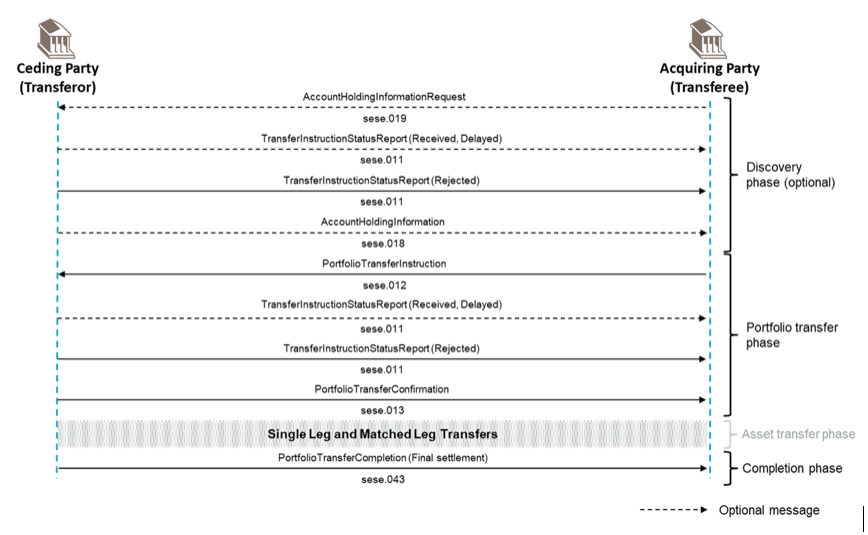
Abaxx FDT technology could make this transfer way less complex due to the legal finality living with the asset. You can see the requests are asking for information, getting instructions and then you have the actual asset transfer phase. Following that is the completion phase. This is super simplified but Abaxx FDT technology would just have the asset transfer phases because the legal ownership travels with asset itself. The ceding party would make one request and give all the assets being transferred to the transferee packaged together.
This also highlights something important though. We are unlikely to see banks and countries adopt any new standard in bank transfers that Abaxx proposes any time soon while they work on the migration to ISO 20022. Which is why Abaxx needs to build their entire own fully featured ecosystem. A fully regulated ecosystem where you use traditional banking means to onboard into but once in, you have little reason to leave as you utilize all the benefits Abaxx can provide. Abaxx understood it isn't enough to a create a new digital asset technology that's better in every form. You also need to build the applications to use it. So they have built a clearinghouse, exchanges, spot markets, custodian, messaging services, AI tooling, vault services, sign services. Everything needed to build a fully featured financial platform that all works together.
Effects of Instant Transfers
The ability to perform instant international wire transfers would improve the velocity of money while driving down costs. It would also unlock new types of trading and hedging not possible prior. Traders can open and close trades at a quicker velocity, they can move funds between accounts at a quicker velocity.
The immediate effects of this would be a more liquid futures and spot markets as you will see more high frequency arbitrage across a variety of different asset classes as those trades can be performed at a lower cost and quicker.

As you build a strong futures curve with extremely high liquidity, you drive the pricing of the commodities and goods towards its true cost. A cost that accounts for all the risks across the supply chain and isn't hidden behind close doors susceptible to hidden supply chain risks.
An open instant market is always better than a closed slow market.
Abaxx Benefits
Abaxx Strategy in One Paragraph
Banks will never sign onto a "new swift" without any new value. They enjoy the fees they can charge for gate keeping access to it. So an entirely different strategy needs to be performed. Abaxx would need to encourage connectivity to their platform not through a banks desire to lower costs for the customers but through the pushing of their customers to use the features Abaxx has otherwise they move to a competitor.
Clearinghouse and Exchange
Through the clearinghouse and exchange, Abaxx has launched much needed futures contracts that traders and firms want to use. By doing this Abaxx creates a demand to get banks to onboard into their system. The more liquid their contracts become, the more these traders and firms must use the platform. It no longer becomes an option for these banks. If they do not onboard into the Abaxx ecosystem, their traders will leave for another bank who has onboarded. It is a chicken and egg scenario. Liquidity drives onboarding but the initial onboarding is the trickiest. Fortunately Abaxx seemingly has slowly been able to overcome this with their increasing liquidity in their Gold, LNG, and Carbon futures markets with much more to follow.
It doesn't stop there. Abaxx has built a state of the start clearinghouse and exchange that will inevitably integrate their ID++ technology to support instant transfer and instant settlement. Maybe you are starting to catch on. Instant settlement was one aspect required to create a faster Swift Network.
As Abaxx exchanges grows in capability, their FDT technology will also enable them to push to 24/7 trading with instant clearing. Again reducing friction in modern day systems.
With this, it is only a matter of time until Abaxx can start to offer currency pairings for trading. This would mean using the Abaxx network would support 24/7 trading with instant settling times. Unlocking the velocity of money directly into their exchange and clearinghouse. This would drive increased volume and liquidity reducing spreads in all their contracts. Reduced spreads with 24/7 access would drive further adoption and growth pushing more and more banks to onboard.
Full Digital Title (FDT)
FDT was designed as a way to meet all the needs of a clearinghouse and exchange. As Josh (Abaxx CEO) often says, the clearinghouse and exchange will be their most demanding customer. Passing the trials there will mean they pass all requirements going down to banks and individual persons.
FDT was designed with KYC and AML at its core. It would use their ID++ technology to have real world assets digitized with ownership and identity built directly into it. When that asset is transferred, identity and legal ownership is transferred with it. This would allow legal finality of their transfers and settling, something that is missed in modern day blockchain solutions.
Why is legal finality important? Imagine you want to be bold and put ownership of your house into an NFT. You hold this NFT in your wallet. Is the NFT the final legal authority in who the house belongs to? Because if it isn't, what have you really accomplished? You can transfer the NFT to someone random and they now own your home? What if this person is using an anonymous wallet. Who owns the home? Who does the city reach out to if there are issues with taxes?
Maybe your wallet is hacked but legal ownership is tied to the NFT so now someone legally owns your house? You can't reverse the transaction though so now you have to make the NFT invalid through courts. Now you have a floating NFT in the wild that supposedly is tied to home ownership that was revoked through a court. But remember the courts cannot reverse the blockchain transaction like they could with Abaxx FDT. Honestly sounds messy. How many "ghost" ownerships will eventually exist? Will these clearinghouses and exchanges take that risk if they now need another registry to cross check every single "legal" NFT to make sure that NFT posted as collateral wasn't revoked in court? I would say it's unlikely. Reversible transactions is a must for any legal finality.
It's obvious the solution isn't to put ownership into an NFT and say whichever pseudo-anonymous address holds it owns it, but to store the ownership and identity directly with the digital asset. In a manner that is legally enforceable, reversible, private but easily verifiable.
This is why Abaxx Full digital title is so important. Banks and clearinghouses need this legal finality. WIthout it, they will not touch it.
Abaxx is currently targeting Gold, Money Market Funds, and Carbon credits for their FDT technology but it's obvious they have much larger visions such as cash, securities or even bonds.
Custodians
Because this technology is new you will need on ramps and off ramps. Similar to how the crypto markets function. You need ways to get on and off the blockchain. This would be accomplished through custodians. Abaxx has in fact launched and begun using their "Adaptive Infrastructure" custodian already. It recently took delivery of their Carbon Credits that was traded on their futures contracts.
The role of the custodian in the Abaxx network is to maintain ownership records while "supporting transfer and settlement of MMF shares across the systems". You can see the custodian is set to manage MMF funds and it already manages carbon credits.
I hope a light went of in your head just now. Using Abaxx's new FDT technology, a custodian can manage ALL asset classes. There is nothing (aside from probable regulatory barriers) that prevents Adaptive Infrastructure to act as a custodian in more asset classes than just MMF funds or carbon credits.
Custodians are crucial to this system. They aren't new thing though. They go by other names in other systems. When it comes to money, they are called banks. In the world of securities they may go by the name of brokerages.
Ultimately the role of a custodian in the Abaxx infrastructure will be to maintain ownership records and support the transfer of settlement across ALL asset classes. Think of it like a bank and a brokerage rolled up into one that you can store your MMF funds in, your carbon credits in, or even your digital gold.
You will also likely have custodial services in the exchange and clearinghouses. The way it would likely function is you transfer your funds or assets to the custodian which would begin to onboard your assets and issue Full Digital Title Assets linked to your identity. From there it can be transferred instantly within the Abaxx network to the futures exchange or the spot market for example.
Currently Abaxx has the clearinghouse and exchange for commodities but I suspect we will start to see more and more services opening up. At the very least I suspect they will start to compete with incumbents in terms of the services they offer. The goal being to keep the money flowing within the Abaxx ecosystem and give a reason for traders to keep their money within it.
Abaxx will give many reasons to. Such as 24/7 access to exchange and clearinghouse with instant settlement of their futures trades. Improved collateral on which to make margin trades or using their assets itself as collateral instead of treasuries for example.
Securities
Like I mentioned, Abaxx will likely start to offer other services to create a rich ecosystem to support keeping funds within their system. The natural evolution is to also offer securities trading with clearing and custody.
For example a trader may open their bloomberg terminal and want to unload their position in a US security before going long and taking a security position priced in EUR. To do that they will need sell the security on Monday during business hours to have the funds unlocked by Tuesday at the end of business day. Then they will have to wait for markets to open Wednesday before they can convert their US to EUR which introduces another day or two delay before they can purchase the securities and it may not be till Thursday until the trade is formally finalized and settled.
I should be clear this is the worst case scenario. If you are trading margin, brokers will often credit your account instantly and for you it will feel the trade is instant. It won't be for several days until you get an email that the trade was finally settled and you now have ownership. It is also why in tax advantage accounts (which do not allow margin) you see this slowness the worst. Especially if you try to trade between different asset classes. I often had issues selling a security and being blocked from buying options until the next day or two until those funds formally cleared.
These situations are also dependent on the relationships you have with your brokers and the interest rates and variable. To use the banks margin while waiting for these funds to clear costs interest though.
Driving down these margin costs to 0 would massively improve liquidity as it lowers costs to move between positions. For high frequency traders their funds would settle quicker, lowering need for margin and making tighter spreads more tolerable.
There is also the unlocking of collateral. Holding blue chip stocks like AAPL might allow traders to unlock 50-70% of the value to meet margin requirements. Abaxx tech allows them to drive settlement times to 0 which reduces clearing risk to near 0. This would enable them to offer higher percentages they can unlock and for traders this could be significant and unlocking tens of millions (or billions depending on their size) more collateral.
Unfortunately this comes at great cost to retail. Never before would it be easier to transfer in and out of all your losing trades.
The point of all this is to say, there is a strong need for Abaxx to launch their own securities exchange/custodian to remove those barriers and increase velocity inside their ecosystem especially if current exchanges aren't willing to offer this ability or it is too complex to integrate into their current systems.
Fortunately for Abaxx they built their own exchange and clearing from the ground up and designed to integrate FDT natively. With the standardization of their FDT, the system can be quickly configured to support instant trading and settling of securities with their ecosystem.
Currency Services
If we go back to Swift, I mentioned with international transfers you often have currency exchanging. I would say always otherwise you wouldn't be using Swift. Their is a high cost to use that and often the exchange spreads are pretty terrible. Unless of course you have your own negotiated rates.
If Abaxx is wanting to build an end to end service that could possibly compete with the likes of Swift it is a must to offer a currency exchange service. I believe we are starting to see the foundation of that through their spot gold.
I mentioned this before in my prior article but I will quickly go over it again. The instant settling of Abaxx unlocks massive advantages but there is still an issue that plagues currencies and trading. There are around 180 currencies in the world. To offer trading between all currencies you need 180 * 180 pairs or 32,400 pairs. This is never gonna happen. So you often need a bridge currency. This reduces it to just 180 trading pairs. For example JPY to EUR might go through JPY > USD > EUR. You take advantage of the liquidity pools in JPY/USD and EUR/USD. The downside is you jump between two pools. In modern systems this introduces clearing time and clearing risk.
Abaxx instant settling eliminates those problems but you still have currency risk. Why use USD when you can use EUR. What about when one currency goes through issues. Do you still want to use USD or EUR if its risk of default suddenly skyrockets?
I believe Abaxx solution is to use gold for this intermediary as it is already recognized as a HQLA under Basel III. If you can drive significant liquidity through it, on an open market spot and futures market, it will become more stable and less volatile. Stable enough to be used as the intermediary in currency transfers. All you need is 180 currency pairings with gold which would also take advantage of the natural liquidity of gold as a global commodity.
With high liquidity being driven through the currency exchange on a 24/7 basis, you drive down costs for wire transfers to be routed through Abaxx with instant settling and clearing.
Improved KYC/AML
Remember before that for Swift transfers you need to have strict KYC/AML. There is no such thing as an anonymous international money transfer. Any transfer system would need to have identity at its core.
This is why Abaxx built their Full Digital Title using ID++ which implements standardized W3C identity protocols. These credentials are private and secure with emphasis on the private but still fully compliant with KYC and AML laws. This means when you transfer a Full Digital Title asset, the ownership and identity of the owner is transferred with it. They belong together and are inseparable.
When a bank or custodian receives a Full Digital Title transfer, they can perform their KYC/AML checks immediately against the asset being transferred.
Abaxx vs Swift
At the beginning I highlighted some issues holding back faster Swift transfers. Those being operating hours, KYC/AML, clearing times, and currency exchanges. By now I have highlighted how Abaxx has tackled or begun to solve all those issues. Now I want to highlight a very big distinction between what Abaxx is working on achieving and how it differentiates between Swift.
With Abaxx, the message IS the asset. In Swift, these are separate.
This is why Abaxx legal finality is so important and what makes it so distinct. There is no message with instructions, it's just the asset because they fit the legal finality with it along with the KYC/AML through their ID++. In Swift, it's just the message to instruct banks on how to transfer the asset. In Abaxx, it is the asset being transferred.
With Abaxx you have instant transfers with instant currency exchange with extremely competitive margins as it flows through a highly liquid currency exchange pools.
With Swift you have high fees, high spreads, and long delays.
This will not be an easy feat and has not been an easy feat until now. Many believed they would never get their commodities clearinghouse license. The last one issued was more than a decade ago.
After they got their licenses many believed they would never be successful with their LNG or Gold contracts but real success is showing there. The Abaxx team is going against the grain but with enough time they have shown to be successful.
Timeline
Abaxx is finalizing their pilots to prove their legal finality with institutions by the end of the year. I believe they have already internally approved this with their regulated clearinghouse and exchange, one of their most strict customers of the technology. The pilots are done to get outside feedback and approval from their regulators to integrate this technology into their exchange. For this reason I put a high likelihood they can be launching it at the beginning of the 2026.
This means by the middle of 2026 or sooner they would have full integration of FDT into their exchange and clearinghouse along with their custodian. We may also see the launch of a securities exchange and Forex exchange in 2026. Putting the full ecosystem being built by 2027.
That being said, they will already see the benefits in the technology in their exchange and clearinghouse in the beginning of 2026 which will be driving significant onboarding interest.
They are also waiting on FBOT approval which may come any day now. This would grant them full unrestricted access to onboard traders in the US directly into their exchange. With the FBOT, it will be the last piece to be globally recognized in the largest financial hubs of the world's economy.
Network Value (Highly Speculative)
I thought I knew how much it would be worth. But the more I research it the more I find ways they can compete with existing companies. We know the revenue generated by Swift is around 1 billion Euros likely valuing it around 30-40 billion for the entire network. But Swift is slow and it only passes instructions. What value would Abaxx have if they can transfer assets internationally in real time while aligning with regulations? Surely they can charge 10 cents? Maybe even $1? But instant transfers would also unlock more money velocity. So what was $1 billion in revenue could become $10 billion in revenue. Maybe the markets value this at $100 billion. I can't say.
That is just Swift though. Abaxx could also be a custodian for trillions in assets.

Some say you can charge 5 basis points for asset custodianship. Which apparently is highly competitive. This would generate $21 billion in a year if they capture the network of $42 Trillion. Unlikely they capture everything but I have highlighted how valuable what they are building is.
Then there is the bond market which is estimated to be $130 trillion. Abaxx could also provide custodianship for bonds. What if since they already offer custodianship they begin to enter bond trading markets?
Then you get into the clearinghouse and exchange. Highly liquid futures contracts generate hundreds of millions in revenue and are worth billions. Their Gold and LNG contracts are making great progress already towards this goal. Just the clearinghouse and exchange could be worth tens of billions but what is the value of a clearinghouse and exchange with the latest technology and is a core part of their ecosystem.
What about if you get into payment processing? If you can do international money transfer in seconds then you can also do domestic money transfers just as fast or faster. Then you start competing with the likes of Wise or Paypal. Both companies valued in the tens of billions.
Then you have their additive technology such as sign and vault being used in highly regulated environments. This would be they can also start to compete with the likes of Docusign.
If you combine all of this into a package that all flows together creating an Apple like ecosystem for the world's global financial system, what is the value of that company?
I leave that question for you.
If you enjoyed the article, please don't forget to like and share it!
AIDisclosure
Everything is written personally by me.
Stock Disclosure
(Okay this part was AI generated)
The author of this report holds positions in Abaxx Technologies, which is mentioned within this analysis. These holdings represent the author’s personal investments and may reflect biases in the evaluation presented.
This report is for informational purposes only and should not be construed as investment advice. The analysis and opinions expressed herein are solely those of the author and were not influenced by any outside party. The author has not received any compensation, monetary or otherwise, for the preparation or publication of this report.
Projections and valuations are based on assumptions that are subject to market risks, uncertainties, and changes in circumstances. Past performance is not indicative of future results. Investors should conduct their own research and consult with a financial advisor before making investment decisions.

