Abaxx Technologies: Revolutionizing Commodity Markets and the Banking Industry

Abaxx Technologies is redefining financial technology with a focus on commodities and digital identities. It has launched the first custom-built clearinghouse and exchange in over a decade, integrating its proprietary ID++ technology into its core. This innovation not only modernizes an aging commodities market but also introduces groundbreaking privacy solutions, paving the way for new products not currently possible.

The clearinghouse and exchange form the foundation of Abaxx's strategy, unlocking substantial growth opportunities. Their success alone could yield remarkable returns, potentially multiplying investments many times over. Revenue from these ventures will be reinvested into technological innovation, propelling Abaxx from a promising 10x return opportunity to a transformative force with potential returns of 100x or even 200x.
This report will focus primarily on the story of Abaxx and what it is trying to solve along with the potential of it. It is meant to be an overview of the business. It won’t be focusing on things such as technical analysis but a quick overview of the financials will be presented to give an understanding of possible future dilution expected.
Understanding Futures Contracts
To fully appreciate Abaxx’s value proposition, it's helpful to understand the basics of futures contracts, their types, and their economic impact. This context will highlight the significance of Abaxx’s initial offering. If you’re already familiar with these concepts, feel free to skip this section.
What is a futures contract?
A simple futures contract works like this: Imagine you agree with a pizza shop today to buy a pizza next Friday for $10, no matter what the price of pizza is on that day. This agreement locks in the price for both of you—you’re protected if pizza prices rise, and the shop is protected if prices fall. When Friday arrives, if the price of pizza is $12, you still only pay $10, saving money. If the price drops to $8, you still pay $10, and the shop benefits. The futures contract is simply a deal to fix the price of something in the future, helping both sides manage price uncertainty.
Managing this price uncertainty is important if you are about to invest billions in a new energy project. You need to lock in a certain price to ensure you do not risk bankruptcy if the price of that energy drops too low. You limit your upside but you protect your downside. This is crucial for the global economy as it allows companies to properly account for the risk of new energy projects.
What’s the difference between financially settled and physically settled contracts?
You are hungry and want to order takeout so you order your favorite pizza online at this new financially settled pizza store at a 10% discount. When you finally get there to pick it up, they give you the cash value for the pizza you bought but no actual pizza. Dissappointed and hungry you go next door to the physically settled pizza store to buy that pizza. Now you are upset that you wasted your time with the financially settled pizza. Imagine instead you are an energy firm trying to provide electricity to millions. The stakes are higher. Failure to secure physical supply of LNG is not an option. Will you choose financially settled or physically settled LNG?
Financially settled contracts are inferior when compared to physically settled contracts. The only benefit is that they are easier to create which explains why they are the go to method for ICE and CME. They likely find it too difficult to bother with physically settled contracts leaving commodity producers unhappy with the current status quo. They still do it this day with the recent launch of CME’s Spodumene futures contract which is financially settled.

Just how valuable are these futures contracts?
Futures contracts are the holy grail in finance. Remember those tickers that flash across the screen on TV when everyone is quoting the price of oil? Those are futures contract. The WTI Light Sweet Crude Oil generates 320 million USD per year. Brent Crude Oil generates 293 million USD per year, and Henry Hub generates 113 million USD per year. Given that these contracts are high margin (60-70%), we can apply a multiple of 20x to it. This means WTI is worth around 6 billion USD, Brent is also worth around 6 billion USD and Henry Hub is worth around 2 billion USD. These are considered benchmark contracts through which the world’s energy is traded and are physically settled.

Abaxx’s Strategic Location
Singapore is the leading global financial hub in the world. It has a highly respected regulatory environment that is seen as equal throughout the world. Abaxx will soon get equivalency starting January 1st, 2025 in England and it has applied for equivalency status via FBOT with the CFTC in the USA. Equivalency status allows companies in the respective country to trade and clear directly with Abaxx in Singapore. This helps improve the speed at which new companies can connect and trade through Abaxx.
Singapore is also seen as neutral to both western nations like USA and China. This is important to bridge the gap in trading between the two nations.
Abaxx Exchange is located in Capital Tower in Singapore which is home to several prominent companies such as Bytedance, founder of Tiktok. It is also home to GIC Private Limited which is a Singapore sovereign wealth fund. Abaxx has also recently launched offices in Shanghai and Hong Kong. I suspect this move is in relation to both their Nickel Sulphate Contract, Lithium Carbonate Contract, and their Gold Contract.
Unmet Demand
Abaxx is starting by targeting contracts that are unmet by the current industry due to laziness and difficulty. Abaxx built and designed their Liquid Natural Gas (LNG) contract with the help from over 100 industry participants. This allows their LNG contract to be adopted as benchmark status as it will meet the demand and specifications desired by industry. Currently the only liquid LNG contract is JKM, however this is financially settled compared to Abaxx’s physically settled contract. Abaxx is also tackling Nickel Sulphate and Lithium Carbonate which are two other commodities in the energy transition that do not have physically settled futures contract.
JKM - Abaxx
JKM is the financially settled contract for LNG based out of Japan. It is not physically settled like Abaxx’s LNG contract.
Bold prediction: Abaxx will take over JKM volume entirely and make it obsolete within 2 years. It will be slow at first but eventually it will hit a inflection point causing all LNG trading to begin flowing through Abaxx instead of JKM. This is a bold claim but not unreasonable.
Let’s go back to the pizza example. You are hungry for pizza and need physical delivery to feed an upcoming party. There are two ways to get pizza:
Insane right? But it happens. In many instances LNG is priced as a percentage of oil. Two are energy sources but require entirely different supply chains.
Which method will you choose?
Growth of LNG
Due to its low carbon emissions, LNG is being seen as the transition fuel to alternatives such as coal and oil as it emits significantly less CO2 emissions. It compliments renewable energy like solar and wind by being able to supply quick energy when these energy sources begin to lag. The role of LNG will only grow in this nature as it becomes more adopted and accepted globally.
Let’s look at what the current spot market looks like for LNG. We are not gonna use possible export capacity (which continues to grow) but rather how much is currently being imported. NGI shows the spot market accounts for 190 Bcm per year. To account for this volume 670,979 contracts from abaxx would be required. If we assume each contract is traded 50x (a normal number for a liquid futures contract) and Abaxx gets $10 per trade, that results in roughly 335 million per year for Abaxx Exchange. Abaxx Exchange will not get 100% of the market but benchmark status should return around 50%. For Abaxx technologies which should own around 80% of the exchange, this would earn roughly 134 million per year based on this years demand. By 2030 this volume would only grow. Applying a 20x multiple to this would be 2.68 billion making it essentially a 10x from here. This does not account for the secondary markets suchs as options which would only add to the revenue growth.

Abaxx becoming benchmark status is a strong probability considering the existing methods out there such as JKM do not fully capture demands of the market who want to physically trade LNG.
If someone were to doubt these numbers, Cannacord’s Initiation Report on Abaxx also predicts $134 million in revenue assuming 20% market penetration however it also accounts for revenue in the secondary market and is slightly more conservative.
Let’s start keeping score of the potential here with a score card
Score Card: 10x potential on Abaxx with it’s LNG contract alone alone by 2030.
Nickel Contract
Abaxx recently announced the launch of its physically delivered Nickel Sulphate contract with physical delivery in Singapore. It will start trading on January 10th, 2025. They have secured the world’s largest nickel sulfate player in support of the contract along with some of the word’s largest commodity trading firms. Some of who are key strategic investors in the exchange such as Traxys.
Nickel Sulphate is a key ingredient in the production of EV batteries and is crucial for electrification. The current production in 2024 is around 500 kTs. It is expected to grow to around 1000 kTs by 2030.
Let’s do some fun math assuming Abaxx captures 30% market share and grows to 80% market share in 2030 as their contract hits benchmark status:
Assumptions: Each contract is traded 50 times and Abaxx charges $10 per trade.
800,000 Tons / 5 Tons Per Contract * 50 * $10 per trade contract * 80% ownership of exchange = $64 million USD per year.
At a 20x valuation this would be worth 1.3 billion USD or roughly a 5x for Abaxx on successful contract adoption. To be clear these are very bullish scenarios however not unprecedented given there is no benchmark contract for Nickel Sulphate and Abaxx would be the first to do so with large industry support.
I indicated 80% of market share here because the market is much smaller and easier to gain a higher percentage of the trades. Nickel doesn’t have any strong competing methods to price the nickel compared to LNG so for that reason one can reasonably suggest a higher percentage.
Cannacord estimates around 20% market share and $18.5M in revenue for a more conservative estimation.
Score Card: 15x potential by 2030 with LNG and Nickel Sulphate
Lithium Carbonate Contract
Abaxx is also set to announce the Lithium Carbonate contract and launch along with the Nickel Sulphate contract. Without the contract details, it’s hard to estimate the size and value that it could generate for Abaxx. However it is a essential commodity in the electrification of the world that will drive further value to Abaxx through onboard of firms who wish to use and trade the Lithium Carbonate Contract. If you assume they get similar values to their Nickel Sulphate contract, then it’s possible we see another 5x here bringing the score card to 20x. I will not include that however without seeing the contract specifications.
Gold Contract and Speculation
Abaxx is also set to launch a Gold Futures contract and a Gold Spot market using the 1kg size with Singapore delivery. This allows further liquidity as it is a smaller and offers the ability to have more robust trading as it allows smaller trades.
Abaxx recently launched an office in Shanghai. The CEO Josh Crumb posted on X in response:

Coincidentally, Shanghai Futures Exchange (SHFE) also has a 1kg gold futures contract. Until now Abaxx was smart by targeting commodities which does not have a physically delivered futures contracts. This ensures success as they would have no competition in these sectors. The gold contract is a break away from this plan and is unlike Abaxx. Especially when just nearby in China there is a gold futures contract of the same size. Let’s think back to the post where it referenced “to bridge commodity markets from East to West”. What if there is a partnership here in the works with the Abaxx Gold Contract and the Shanghai Gold Contract?
I referenced before that Singapore is seen as the neutral third party for western and eastern countries. The gold delivery is also set for delivery in Singapore. In addition to this China has expressed interest in expanding their metals contracts (1). One thing limiting their expansion is their tough restrictions that limit trading for China’s Gold Contract. On the other side, Abaxx is quickly expanding their ability to accept connections to USA, Europe, and England. Let’s say for example SHFE partners with Abaxx on their Gold contract using Abaxx ID++ technology that allows instant settlement. Currently when you make a trade, it takes a couple days for it to be finalized. Abaxx ID++ technology would make it instant. Using this, if a Chinese Trader using ID++ technology wanted to buy gold, they would be connected to western traders on Abaxx and be able to buy gold from a USA company also using ID++. This gold would be instantly delivered and stored in a vault in Singapore. Bridging the gap between the East and West while operating within the bounds of the tough restrictions. SHFE would collect premiums in China, Abaxx would collect premiums from Western countries.
Let’s expand what can happen. Western company using USD buys gold through Abaxx. This gold is stored in a secure vault in Singapore and tied to their ID++ id. It is instantly settled and immediately this gold can be used to buy YUAN and send it to the company they are doing business with. No direct USD/YUAN currency exchange occurred and is instead routed through the extremely liquid gold contract. What about another currency? USD is used to buy gold which is then used to buy Euros. Now instead of having to trade USD/EUR it can be done via USD/Gold and Gold/EUR.
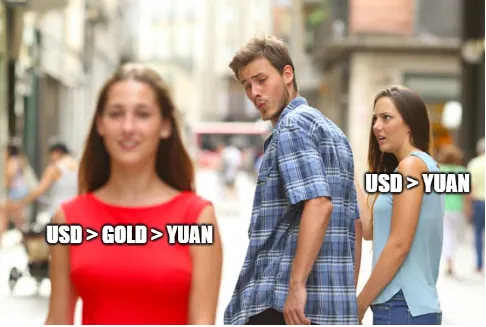
The benefits:
If this partnership were to evolve, Abaxx would be able to get a piece of the SHFE pie.
Looking at historical volume data for gold, in 2023 SHFE had 52,731,024 in volume across all their gold contracts which represented a daily average of 217,000 per day. Recently however it appears they are averaging roughly 350,000 per day which is about 85,050,000 contracts per year. They charge about $1.40 USD per contract traded making the revenue estimate to be around $120 million in yearly revenue.
Of course using Abaxx as an intermediary between trade for all of China and Western nations would only increase this volume. Currently over 1 trillion is traded between China and other countries. The flow of this capital through Abaxx and SHFE would likely generate millions per day in revenue for Abaxx. This is a very bullish scenario but lets use what SHFE currently makes for trade with Chinese companies only.
120 million x 20 multiple * 80% exchange ownership = 1.92 billion in market cap. This would be an approximately 7.3x from Abaxx current market share.
Score Card: 22.3x potential by 2030 with LNG, Nickel Sulphate, and Gold partnership with SHFE.
Let’s be clear here though. This is only speculation and should be taken with caution. Abaxx’s gold contract will still be extremely valuable if this were to not happen as explained below and can exceed without a partnership.
Full Digital Title (FDT)
Full digital title refers to the proof of ownership stored digitally. Abaxx has made lots of progress on this through their gold contract which I believe will be the first implementation of it through their ID++ technology. The gold will likely be stored in a vault in Singapore where each gold bar is stamped with a unique id. When you purchase gold on their gold spot market, ownership of this gold bar will be immediately transferred to your ID++. This also means the gold will settle instantly compared to the industry standard of 2 or 3 days. This also means you don’t have to wait to make another trade since settle time is instant. It’s also possible you will be able to use this gold as collateral to make LNG trades. This unlocks collateral that would otherwise be locked for days at a time making the markets more efficient.
This technology to settle trades instantly and be able to use gold as collateral for trades is extremely valuable. One component is de-risking of clearinghouses which settle the trades. When a trade is completed, it goes on the clearinghouse books until it’s settled. If this trade blows up, the risk is placed on the clearinghouse. By being able to settle the trades instantly, the clearinghouse takes less risk. This also means they can charge less fees and be more competitive with incumbent exchanges and clearinghouses.
Using gold as collateral lets you be more efficient in trading energy. Let’s say you want to have a position in gold anyways. By buying gold on Abaxx, you can hold and store your position there. Now you want to buy LNG for USD. In another exchange they would not let you use gold as collateral but instead require you to add additional money to your account to cover collateral requirements. Abaxx’s FDT technology would unlock billions of dollars and allow you be more efficient with your money.
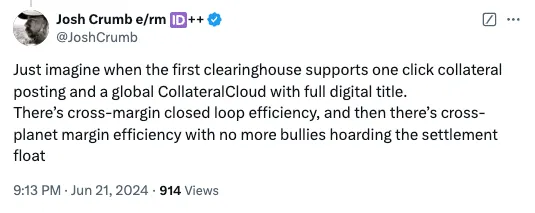
There are many applications for this technology. Real estate is one example. Even Abaxx recognizes this in their one of their many patents. Title insurance is worth tens of billions of dollars and it basically protects against issues with regards to who owns what. With FDT it becomes easily apparent as to who owns what and you can easily track if that ownership changes instantly.
You have other applications such as automotive, financial assets (such as stocks, bonds), and IP rights as well. Each one could have a market billions alone. It’s my belief that after tackling Gold, Abaxx will be tackling things such as stocks and bonds as that would be a natural next progression. It’s hard to give an exact value but success of FDT would drive exchange growth and revenue as more traders switch to Abaxx for their market efficiencies and it just being smarter. Smarter markets might be a good name for it.
Commodity Tracking
Part of the Abaxx vision is end to end commodity tracking through their ID++ platform. Tracking of the commodity through its life cycle is becoming increasingly important for upcoming regulations in regards to forced labor and CO2 emissions.
Forced Labor Regulations
Europe for example will start to ban products used forced labor in 2027 (2). Yes forced labor still exists and it’s very likely some of the products you use has some sort of forced labor in its supply chain. Due to globalization, the price of cobalt mined using forced labor in Africa (3) is the same price as cobalt mined in Canada using fair wages. With upcoming EU regulations, suspected products can be investigated and removed from the EU. In Canada, similar restrictions are being made (4). Reports are required for “its structure, activities and supply chains;“.
Battery Passports Regulations
Battery passports are also becoming a thing. What’s the point of making batteries for EVs if the process to build the batteries are more pollutive than the emissions saved from using batteries? The EU is launching a battery passport program which becomes legal requirement in 2027. In it, companies must provide key data such as environmental impact and material composition. For many companies, this data is hard to come by. You might buy Nickel from an importer but where do they get their nickel from? Well if you want to import your battery you need to get their info. Maybe even the level higher for the source of where the ore was mined and its CO2 emissions to mine that ore. It gets complex fast and you only have until 2027 to implement it.
Not All Ore is Alike
Ore comes in various different concentrations. The higher concentrated it is, the more efficient it is for extraction which results in less CO2 emissions. Kamoa-Kakula Copper Complex for example is one of the lowest carbon-emitting copper mines in the world. This mine is part owned by Robert Friedland who is an investor in Abaxx. He is active in trying to get these characteristics properly accounted for through his investment in Abaxx. Yet the copper sold from this mine costs the same as the highest carbon-emitting copper mines. This disconnect must be priced properly especially as the data becomes more important for upcoming regulations.
Commodity Grading
Now that you see there can be distinct difference in the commodities, it’s also important to be able to price this. Abaxx plans on having pricing differentials for commodities on their exchanges. Class I Copper for example might be priced higher than Class II Copper as Class I copper can prove their CO2 emissions and supply chain to ensure no forced labour were used. Class II might have no data attached. This creates a distinct edge that Abaxx will have in comparison to incumbents as this will use the ID++ technology to track and trace the commodities. It will also provide an easy method for companies to be in alignment with the new regulations. We could very well see all regulated commodities flowing through Abaxx as they will be the only exchange and clearinghouse which differentiates the unique characteristics of the commodities being traded.
Minehub Partnership
As you can imagine, this is no easy feat. Getting the world to begin using a platform to track their supply chain is a monumental task and could take years. You also need to build the platform which would also take years. For this Abaxx entered into a partnership with Minehub and will own up to 20% of the company.
Minehub already has a strong start in this field. They have a platform already built and running to track this data. They are used by giants in their respective fields. Minehub has the largest steel producers, copper smelter, Chinese metals traders, cable and wire manufacturer in North America, and copper producer in the world. Minehub also has plenty more smaller players using their product who were required to implement Minehub. This is due to Minehub requiring all upstream or downstream partners to at least use the free version if your company decides to use Minehub. They continue to add more and more companies as their network effect strengthens and grows.
The Minehub platform also unlocks an interesting new case with Abaxx. The goal is to connect companies Minehub data into Abaxx. Of course this would be done in a private environment and only share data required to partake in the rich benefits of the Abaxx platform.
New Use Case Example:
You are a small corn farmer in the USA. You produce roughly the same amount of corn each year with some slight variations based on weather. However you the amount you receive for the corn fluctuates every day. This limits your ability to project revenue which would allow you to make sizeable investments in your business. So you decided to sell your corn on the futures market. As a small time farmer you realize the steps require you take a loan from a bank as selling your corn on the futures market cannot be based on your production. You must take a loan to cover the margin to hold this short position. A short position you plan on fulfilling with your own production. Eventually you give up as the costs are prohibitive or its too complex limiting your ability to make future investments.
In comes Minehub. You implement the Minehub platform to track your corn inventory and sales orders to companies. Overtime Minehub is able to accurately predict your expected output for the year. With the Minehub platform you are able to connect to Abaxx and sell your corn into the futures market with the click of a button. Instead of taking a loan, you are able to use your yearly production and lock in corn prices in the future. This allows you to make bigger future investments to expand your farming operations. Maybe you can also purchase parametric insurance to prevent a failure to deliver should your crops have poor weather one year.
To be clear, this has not been announced, only hinted at through podcasts and posts by the CEO of Abaxx in regards to optimizing supply chains and better managing collateral.
Financing
Minehub allows you to track your production, shipping, and sales. With this information they can better facilitate loan agreements between banks and customers. With the click of a button, users can share with banks their sales, production values, inventories and other important data that would be of interest, and verified by third parties. This reduces risk to banks but also improves speed of loan applications.
Minehub Value
Minehub estimates the supply chain value is roughly worth $11 trillion USD per year. At a fee of 0.015% in SaaS Fees, this alone could generate $1.5 billion in fees.
For financing they estimate roughly $5 trillion is financed annually and the fees they would take is around 10-20 bps per loan value resulting in a 5 billion in market potential.
Combined Minehub has the opportunity to reach $6.5 billion in revenue from their platform.
The adoption rate is difficulty to predict. The nature of Minehub adoption is a snowball. When one company uses Minehub they would also require their partners to use Minehub as well (at the very least the free version). From there those partners can opt to pay to use Minehub and then have their customers also signup for Minehub. 20% adoption quickly becomes 40% adoption and that quickly becomes 80% adoption.
Let’s assume Minehub gets 15% market penetration and earns roughly 1 billion in yearly USD revenue. Applying a 20x multiple and Abaxx’s 15% position (accounting for future dilution from their current 20%), this would be worth roughly 3 billion USD by 2030 or a 11.5x. It’s also important to note that 2027 is a crucial year for regulation and Minehub will quickly grow through the Abaxx partnership given that Abaxx has plenty of industry connections. Nickel Sulphate Contract for example was designed with the help of 11 Metals Merchant Trading Companies, 4 Global Auto and Battery Manufacturers, 4 Market Makers and Financial Participants, and 2 Global Mining Companies.
This is a very bold prediction considering Minehub only has 2.2 million in yearly revenue, as mentioned in their latest investor call. It cannot be discounted though that companies will be forced to track their supply chain by 2027. As Minehub gains market adoption, the path of least resistance becomes Minehub as they snowball into being the go to option. Their low cost and efficiency gains are also perks for companies to sign up for. I also did not account for future dilution from Minehub however given their recent 37.5% annual recurring revenue growth in 1.5 months, it puts them on track for breakeven by the summer without additional dilution.
I know what you are thinking. There is no way a company can grow from 2.2 million in yearly revenue to 1 billion in 5 years. Alone, you might be right, but the Abaxx/Minehub Partnership unlocks insane amounts of opportunity. If Abaxx launches graded commodities and the only way to sell your commodities at a premium is by using Minehub, you will gladly pay 0.015% if you can sell your commodities for even just 1% more. You also can’t be running your company on excel files anyways in the face of new stricter regulations.
This assumption requires a growth rate of 35.7% per quarter sustained growth rate over 5 years.
Score Card: 33.6x potential by 2030 with LNG, Nickel Sulphate, Gold partnership with SHFE, and Commodity Tracking
Switching gears from Minehub back to Abaxx.
Market Access
From their latest Q3 Update:
Onboarded three full clearing members and two additional clearing firms, including our first global bank FCM, with one additional clearing member in progress and expected to be onboarded by year end. Two more bank futures commission merchants (FCMs) are in progress and three additional clearing firms are in discussion for potential onboarding in 2025. Onboarded six merchant trading firms with sixteen more in progress for block trades and central limit order book trading, and onboarded nine financial trading and market making firms with ten more in progress. Completed the onboarding of ten introducing brokers with five more in progress.
They have a rich pipeline of new members continuously being connected. It’s no easy task and often requires an expensive commitment from the onboarding firm to integrate into Abaxx.
The Team
The team is stacked with people from Goldman, NYMEX, BP, and CME Group. They have 100+ years of experience in exchanges and commodity markets. Abaxx executives have also previously launched exchanges and clearing platforms making the team ideal to launch another with Abaxx. As an added bonus, many of the Abaxx Singapore executive team speak fluent Mandarin which helps Abaxx work in the Chinese market.
Current Investors
Abaxx has a wide range of investors from the likes of Robert Friedland, Canoe Financial, CBOE Global Markets, Wellington, Blackrock, Rothschild, US Global, Tom Ward, and Traxys.
There is also a group of retail investors active on the CEO(dot)ca Abaxx board. They call themselves the 29ers as reference to achieving 2030 decarbonization goals in 2029 through improved technology. There was a survey they completed which showed around 80 of them owned roughly a combined 10% of the company.
Current Pricing
Abaxx is severely mispriced at this level. An extremely conservative report from Cannacord has Abaxx for a 20$ price target at this price point. By 2030 they estimate Abaxx Exchange to have 134 million in revenue with 20% market penetration. Accounting for Abaxx Technologies 80% ownership this would roughly translate to an 8x based on the current market cap by 2030 (not accounting for dilution). They currently trade on CBOE Canada which isn’t well known and lacks connection to popular brokers like Robinhood. It also limits the ability for larger funds to invest in Abaxx due to internal rules requiring them to stick to larger exchanges. Abaxx CEO indicated they are looking at uplist next year maybe after the first quarter.
Organization Layout

Worthy Mentions
There are so many pathways to follow with Abaxx that some need to be cut short.
Privacy Code
Abaxx recently purchased privacy code for a bit under $500k. It seemingly is the privacy outreach portion of all things ID++. Its product at time of acquisition appeared to be a platform which helped guide large companies in being aligned with privacy regulations and likely privacy auditing. Its being headed by Michelle Finneran Dennedy who held high level privacy roles in Silicon Valley such Chief Privacy Officer at Cisco. Her connections will likely prove valuable here as Abaxx pushes the importance of privacy in ID++.
Mining
Abaxx went public via a reverse takeover of New Millenium Iron (NML) which was a mining exploration company. I won’t go much into details here as everything there was put on hold. One thing of notable value in comparison to their much more exciting things they are building is their high iron ore concentration deposit. Due to its high concentration some would consider is green Iron which could fetch a nice price on Abaxx exchange once graded commodities are released. We might see a partnership here with a mining company where Abaxx gives the land, a mining company extracts the resources and the green iron is sold exclusively on Abaxx Exchange as a green rated commodity.
Barbados
Abaxx is applying for licenses to be a carbon credit exchange (6) and a depository for green bonds and carbon credits (7) through their subsidiaries in Barbados called Frontline Environmental Exchange and Adaptive Infrastructure. Green bonds are financial instruments used to fund projects with positive environmental benefits.
Smarter Markets
Abaxx owns a podcast platform called Smarter markets which has had 2 million downloads of their podcasts. They also own a social media platform that was recently launched called Coffeehouse. The goal of Coffeehouse is to connect industry leaders and get them talking about creating better markets away from heavily politicized platforms. So far they are only allowing guests of the Smarter markets podcast on the platform. Eventually the goal is to open it up more users but making it read only unless you are a verified contributor. This will be done through ID++.
Financials Overview
Abaxx has around 33 million shares. With 89% of ownership of the exchange and clearinghouse in Singapore. In the math prior you may have noticed I used 80% in all my math. This is due to Abaxx expecting another strategic financing in the new year. These future financings are expected to bring their ownership to around 80% before they will break even on the exchange. Their current burn rate is 9.7 million per quarter as of September 30, 2024. They have roughly 25 million in cash after accounting for debts and liabilities. In addition to these they hold 20 million in long term investments that they are unlikely to sell anytime soon.
Conclusion
Abaxx Technologies stands at the forefront of financial and technological innovation, addressing long-standing inefficiencies in commodity markets with its proprietary ID++ technology and focus on physically settled contracts. By targeting unmet demand in LNG, Nickel Sulphate, and other emerging markets, Abaxx is well-positioned to become a benchmark in global trading.
Its strategic location in Singapore, partnerships with Minehub and potential collaborators like SHFE, and commitment to regulatory compliance further bolster its competitive edge. While its ambitious vision includes applications in payment processing and digital identity management, its immediate focus on high-margin futures contracts and scalable technology offers a clear path to exponential growth.
With bold projections and a strong team, Abaxx has the potential to disrupt the status quo, redefine commodity trading, and unlock significant value for investors by 2030.
There is still more reading below which dives more into abstract ideas which I believe show even more potential for abaxx. If you stop here and enjoyed reading this, subscribe for the next free reports.
Into the Abstract
Here we talk about abstract and mysterious where not much is known. I also make some exceedingly large predictions. If you want to stay grounded, venture no further, but if you want to take a peek and see what is possible, then continue on.
ID++
Abaxx has been very closed off when it comes to ID++. It’s released to only the users of the exchange and their Coffeehouse social media platform. Abaxx’s CEO Josh Crumb has been vocal about its capabilities on X and going on to say that Jeff Currie saw the potential to be significantly larger than the exchange and clearinghouse.
ID++ can be described as this: An id protocol that complies with AML/KYC regulation and allows permissioned access to data which you yourself are in control of.
What does that mean? Suppose you are using ID++, the government might for example issue certification of your citizenship, age, and name. When you want to sign up to a bank account, often times you are required to provide all this info. If you sign up to multiple banks, you have to give private info multiple times. The idea behind ID++ is that you store this data in an encrypted vault that only you have access too. Now when you sign up to multiple banks, you share this data with them for as long as they need to verify your info. After which you can decide to lock your info down.
Let’s give another example: You want to buy something online and it requires you to make an account. They ask for an email, password, name, address, birthday, and anything else they might think of. Each time you do this, you are trusting them to store your data securely. We all know how that ends up each time. Data breaches occur regularly, your personal history gets leaked and possibly your order information. With ID++, you only give access to your data for the length of time they need to use it before they lose access. Now if they get hacked, all the hacker will get is order history associate to a random ID. They would have to hack every single ID++ account individually to get this information.
Essentially it’s made harder for data breaches and protects your data. You are put into control of your data, no one else has access.
Document Signing
This technology opens up exciting possibilities. With ID++, you can not only confirm your identity but also digitally sign documents. Imagine it as a built-in alternative to services like DocuSign—but completely free. If ID++ becomes widely used, it could disrupt a $20 billion industry.
How does this work?
To understand, let’s start with cryptographic functions. These are the building blocks for things like encryption, VPNs, and blockchains. One important concept is a hash. A hash is a unique digital code generated from any data, like a document. Think of it as a "digital fingerprint"—it’s unique to the data and always the same if the data doesn’t change.
Here’s how it works for digital signatures:
1. A document is turned into a unique fingerprint using a hashing algorithm.
2. You then use your private digital key to sign this fingerprint, creating a signature only you can make.
3. The signed fingerprint can be verified by anyone who has access to your public key. This proves the document hasn’t been tampered with and was signed by you.
Example Process:
Let’s say someone sends you a document for your signature:
1. You review the document and approve its content.
2. Using ID++, you sign the document digitally. This locks the signature to the exact content of the document—if even a comma changes, the signature becomes invalid.
3. You save a copy of the signed document in your private vault and send it back.
With ID++, there’s no need to rely on third-party platforms like DocuSign to manage your data.
Everything stays under your control. Only the people involved in the transaction have access. If verification is ever needed (like by a government), they can confirm the signature’s validity without revealing your personal details or seeing what the document is.
This approach combines privacy, security, and convenience—all the while eliminating the middleman.
Vault
Then there is the vault which works like an encrypted cloud storage. No one can see what’s inside, only you. Here you put important documents that stay encrypted. You can share and grant time limited access to personal documents but maintain control at all times who can access the data.
Example:
You want to apply for a home mortgage. In order to get a mortgage you need to provide proof of employment and income verification along with loans and assets. Inside your vault there is a banking section which stores this type of info. The bank asks for access to two of these files. You login and see the request on your verifier app. You grant access for one week so they can check the details. After they have approved your mortgage, you revoke their permissions as they no longer require it. Your information is now safe from data hacks in the bank.
Messenger
Each id++ id is unique so it can also acts like a phone number. Using Messenger and id++ you can connect with a friend to talk, talk business with business partners, or you can create and authorize secure futures trades from within the app. All chats are stored encrypted in your own data storage vault. No one can see or get access unless you grant them permission.
Messenger is currently being implemented into Minehub. It’s not clear if there is a licensing fee here or if its done for free due to their shared strategic partnership. The goal is to reduce email fraud by only being able to communicate with KYC’s ids. It makes it hard for a fraudster to spin up a fake email that’s slightly different to a real one and try to impersonate someone.
Verifier
Verifier acts as the gateway to grant and remove permissions for your data. Using the app you sign into Abaxx exchange and Coffeehouse. It’s essentially a single sign on application where you sign a QR code and grant access via the app. You don’t need to remember a different password everywhere and it improves security by not having the same password on every single site you use.
Revenue Avenue for Document Signing, Verifier, Messenger, Vault
As of now Abaxx is still building out the technology, but posts from the CEO Josh Crumb seem to be pointing to a rollout in 2025. ID++ is currently only open to exchange participants. There is reference to hyper-scaler who was so impressed with ID++ they immediately wanted to sign an NDA. Latest posts from Josh regarding the hyper-scaler seem to suggest progress is being made but they are being cautious as to what they share and when they share with this hyper-scaler.
Josh and others seem to suggest ID++ is much bigger than the exchange. It many ways it can unlock new technologies, however with Document Signing, Verifier, Messenger, and Vault I don’t see their to be much revenue options compared to their larger plans. Verifier is just a permission tool (as far as we know) so you can’t really charge people or companies for this. Document Signing, Messenger, and Vault do have some potential for revenue generation though. I suspect however most value would be derived by simply giving this for free to exchange users as being a successful competitor to CME and ICE would result in larger returns than trying to compete against DocuSign and a race to the bottom in pricing.
They could also license this technology to a hyper-scaler who would implement this in their backends but it’s too difficult to put any revenue generation on it at this time.
Payment Processing
By now you are starting to understand the role Abaxx clearinghouse and exchange has in the commodity markets. The more the clients want to use Abaxx, the more banks connect so that their clients can trade Abaxx contracts. Each time a connection is made, the possible amount of trades between participants increases exponentially.
What does Abaxx have now? They have banks connected to a fully licensed clearinghouse and exchange on which billions of dollars worth of trades are made and settled instantly. They also have a state of the art cloud structure which can process 1 million trades per second with 20 microsecond latency (5) (VISA can only process 65,000 transactions per second). On top of this all they have ID++ which has privacy and KYC/AML built into the protocol on which you can securely share important information such as home address and billing details. As a result of these three things combined, Abaxx has laid the foundation on which they begin to process retail transactions. After all, the purchase of a cup of coffee runs through the same banking system as a trade for LNG. Only much simpler and higher margins.
Let’s look at the margins and what’s in it for Abaxx.
To clear a physically delivered LNG trade Abaxx charges $10 on roughly $136,700 in value. That corresponds to 0.008% in fees. The typical payment processor like VISA and AMEX charges anywhere from 0.5% to 3%. From this alone you can see that Abaxx with its technology can easily compete on price with incumbents.
If Abaxx were to enter the market (which I believe is their plan based on patent references) they could start create an international payment system that has low fees, and clears directly in their clearinghouse. They could go one step further by routing all international money transfers through their Gold contracts promoting even more liquidity and trading volumes.
If anyone has ever used international money transfer systems, you will know it can be very expensive and can easily have your account locked if you accidentally set off some international money laundering flags. Using ID++, each payment could be tracked, and exchanged instantly with KYC built into the product. You wouldn’t need call up your bank or create an account with a third party. Simply ask for their ID++ id and initiate a transfer. Its instantly processed, exchanged, and deposited with proper KYC checks. It’s essentially what people dreamed blockchain would be but done in a regulated financial environment.
To give you an example of the value of this AMEX has 4.68% market share in payment processors. They are valued at $212 billion. Should Abaxx achieve this vision within a 10 year time frame and get a similar 4.68% market share, their value would be exponentially higher. Something to consider however is that they would be much more competitive at the fee level and therefore have less revenue. It would not be unreasonable however that they could be worth $50 billion and upwards as they gain market share for their competitive pricing. This would be a 192x multiple alone from the current valuations.
These are lofty goals but one has to understand the overlap of a clearinghouse/exchange with that of a payment provider. Abaxx built their exchange from the ground up with the help of Exberry in a couple years time. They are building banking connections as we speak and ID++ is authorized for use in a regulated financial environment. Traders are using ID++ to process trades on Abaxx exchange. They do not require much more to begin procession retail transactions.
And if one looks through their patent applications, reference to payment processors is on their radar.

Bitcoin Abaxx’s Digital Gold
Why do people buy Bitcoin?
One of the most common reasons is that Bitcoin is the digital gold. Bitcoin has a store of value but if you were to look at the chart of Bitcoin, it’s one of the most volatile store of values there is to exist. I am not denying it hasn’t been a lucrative investment and may continue to be in the future, but I am arguing the things it claims to be do not exactly line up. Let’s look at some of them.
If Abaxx were to launch a digital gold as hinted at in the latest Holiday Special Part 1 on Smarter Markets Podcast, how might that look?
Things to consider with this is storage fees. It wouldn’t make much sense for people to adopt this if it costs 0.5% in storage fees yearly for example. However if they can charge a small transaction fee like 0.05% on each transaction up to a certain limit, then they can use it to fund storage costs to allow people to use it as a store of value without holding fees. VISA for example might charge anywhere from 0.5% to 3% on a transaction for example.
If Abaxx is successful in actually launching a true digital gold, then the total addressable market might be infinite. Maybe it is the infinite TAM Josh Crumb has been referencing in his posts? It won’t be as sexy as Bitcoin, but it will be usable as collateral for commodity trading, banking reserves, and a true store of value. If one were to think about the total value of a network like this would add to Abaxx, it wouldn’t be hard to imagine it adding tens of billions to the market cap.
Closing Thoughts
I made bold predictions here, I am a dreamer after all. If someone wanted to ignore all of those bold predictions and instead choose something more reasonable, then one could read the Cannacord Initiation report on Abaxx. It’s revenue projections are much more grounded and suggest a simple 8x by 2030 instead of my hopeful 33.6x or daring 225x value estimation with payment processing. For me this makes more sense than buying an S&P ETF amd hoping to get a 40-60% gain over the next 5 years at these sky high valuations.
Abaxx is making history with its transformation of the commodity markets and data markets and I for one am happy to be along for the ride.
References
3. Child and Forced Labor in Artisanal Cobalt Mining in the Congo: New Cobalt Fund supports GoodStone™ Initiative | GoodWeave
5. How Exberry built a cloud-native matching engine on AWS that can process 1 million trades per sec, with 20 microseconds latency | AWS for Industries
Disclosure
The author of this report holds positions in Abaxx Technologies and Minehub, which are mentioned within this analysis. These holdings represent the author’s personal investments and may reflect biases in the evaluation presented.
This report is for informational purposes only and should not be construed as investment advice. The analysis and opinions expressed herein are solely those of the author and were not influenced by any outside party. The author has not received any compensation, monetary or otherwise, for the preparation or publication of this report.
Projections and valuations are based on assumptions that are subject to market risks, uncertainties, and changes in circumstances. Past performance is not indicative of future results. Investors should conduct their own research and consult with a financial advisor before making investment decisions.

