How One File Called CLAUDE.md Turns Claude from a Search Engine into a Second Employee

Here is what happens to 99% of Claude users.
They sign up. They open the chat. They type a question. They get an answer. They do it again tomorrow. And the day after.
No memory. No context. No system. Starting from scratch every single session.
They are paying $20 a month for a search engine with better grammar.
Meanwhile, Boris Cherny, the creator of Claude Code, runs thousands of agents overnight from his phone. Anthropic's engineering leads told Dario Amodei they don't write code anymore. Claude Cowork was built in a week and a half by Claude itself.
The difference is not intelligence. Not access. You have the same model they do.
The difference is one file. It is called claude-md.
What CLAUDE-md Actually Is
A plaintext file in the root of any project folder. Every time Claude Code opens that folder, it reads this file first. Before your code. Before your prompt. Before anything.
Think of it as a rulebook.
You write the rules once. Claude follows them every session, every task, every agent you spawn. It does not forget. It does not drift.
Without claude-md, Claude is a smart stranger you re-explain everything to every morning.
With claude-md, Claude is an employee who read the handbook on day one and never needs to be told twice.

Why This Changes Everything
Most people think the skill gap in AI is prompting. It is not. Prompting is a conversation. Conversations end. Context disappears.
claude-md is infrastructure. It persists. It compounds.
Say you are a content creator. Without claude-md, every session starts the same way: "Write me a post about AI. Make it punchy. No fluff." You type this every time. Sometimes Claude gives you corporate slop because you forgot to say "no buzzwords."
With claude-md, you write this once:
You are my content strategist.
My style: direct, specific, zero fluff.
Short paragraphs. Bold claims backed by numbers.
Never use: leverage, utilize, game-changer, deep dive.
Default length: under 250 words unless I say otherwise.
When I say "draft", produce a complete piece, not an outline.
When I say "edit", cut ruthlessly.
Every session inherits these rules automatically. You never repeat yourself. Claude never forgets.
That is the difference between a tool and a system.
How to Build Your CLAUDE-md in 15 Minutes
You do not need Claude Code. Start with Claude Projects on claude.ai, same concept under a different name - Project System Prompt.
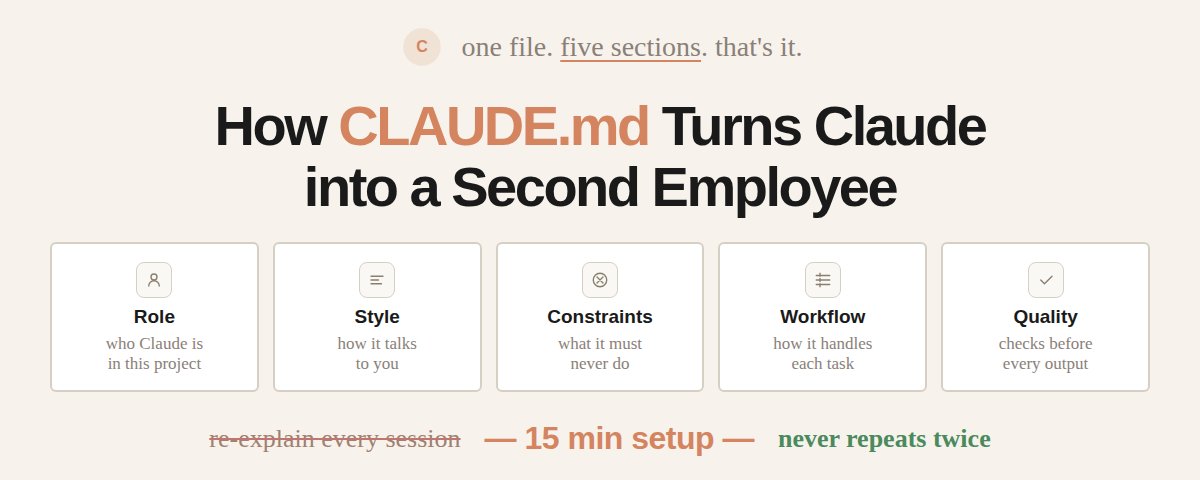
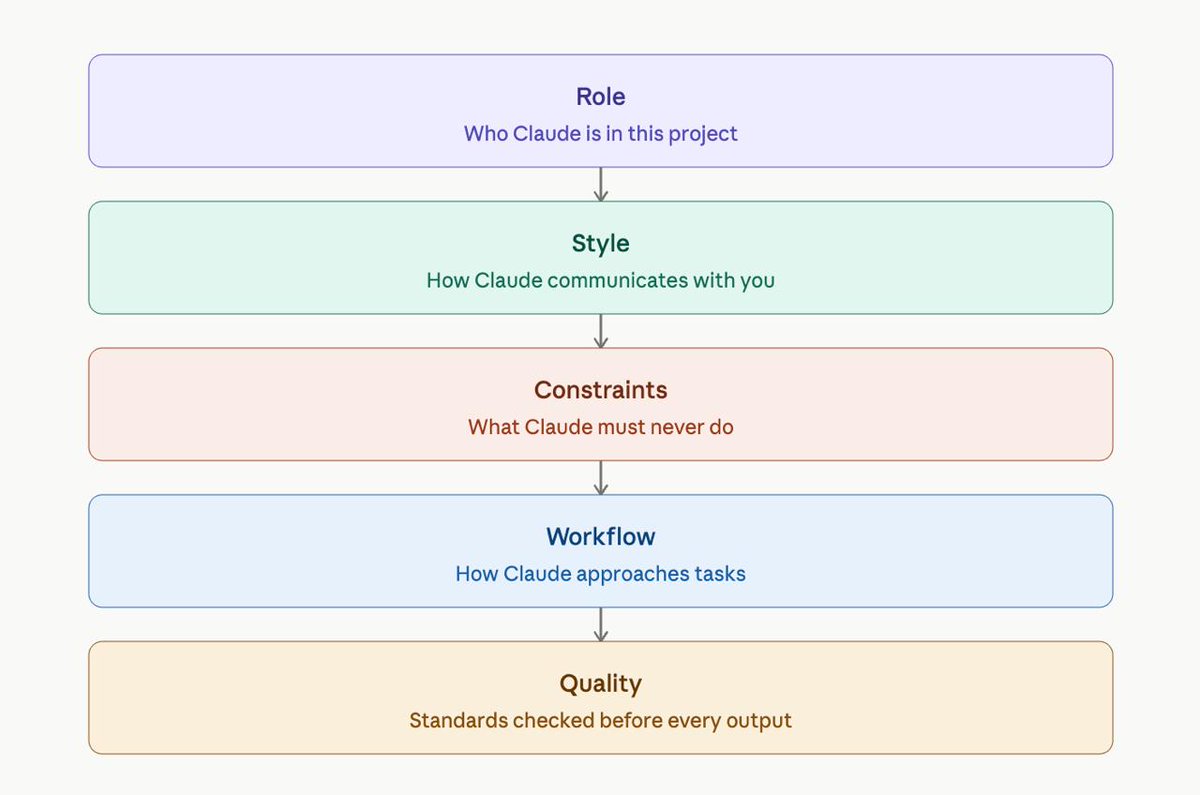
For full power, create a claude-md file in your project folder with five sections:
Section 1 - Role
Tell Claude what it is. Not "helpful assistant." Be specific.
You are my investment research analyst.
You are not a chatbot. You are a workflow operator.
Section 2 - Style
Be concise. No preamble. Bullet points over paragraphs.
Specific numbers over vague statements.
Section 3 - Constraints
Never invent data.
Never reformat files without asking.
Never commit code without running tests.
Section 4 - Workflow
When I drop a file in raw/, process it:
Section 5 - Quality
Before delivering any output:
Five sections. Fifteen minutes. Save the file.
The Compound Effect
Week 1: Claude stops giving generic output. Every response matches your style and constraints.
Week 2: You add rules as you notice patterns. Your claude-md grows from 10 lines to 40.
Week 3: Different claude-md files for different projects. Content. Research. Code. Each one makes Claude a specialist.
Week 4: You stop thinking of Claude as a chatbot. You give it tasks and walk away. Output matches your standards because the standards are in the rulebook.
This is what Boris Cherny figured out months ago. His agents are not smarter than your Claude. They just have better instructions.
The Hierarchy Most People Get Wrong
People think: better prompts - better output
The actual path: better system setup - better prompts - dramatically better output
claude-md is the system setup. Without it, you are optimizing prompts on top of nothing. With it, even a lazy prompt produces good output because the rules are already in place.
The setup is 15 minutes. The compound effect is permanent.
Follow me and subscribe to my Telegram channel: