@tenshi_anna ↔ @jackburden_34 conversation

Anna K. Winters@tenshi_anna
30 views
Aug 15, 2026
~4 min read
Advertisement
Anna K. Winters@tenshi_anna
Here Jacques Lacan speaks of exactly the same paradox of the anxiogenic character of presupposed erotic reciprocity as Jean-Luc Marion does below, pointing crucially to the fundamental ontological constitution of his “objet petit a” concept of desire’s “object-cause” on the path of Eros, which for a Marionian Christian is nothing other than the limit of idolatry, which in Lacanian terms is the imaginary-objectifying form of desire to which sublimation-love condescends (here I believe we have the elements of an important critique of the “Anglo” school of gift-reciprocity erotology advocated by @johnmilbank3, @pickstockc and David Bentley Hart):
“To put myself forward as the one who desires, ἐρῶν, is to put myself forward as the want of [objet petit] a, and it is by this path that I open the door to the jouissance of my Being.
The aporic character of this position cannot fail to emerge for you, but there are still a few more steps to be taken. I think you have already grasped, because I’ve been telling you for a long while now, that if I am standing at the level of the ἐρῶν, opening the door to the jouissance of my Being, it is clear that the nearest slope that offers itself to this enterprise is for me to be appreciated as ἐρώμενος, lovable. This is what does not fail to come about, and without any conceit, but where already the fact that something has gone amiss in the affair can be read.
This is not an aphorism, but already a commentary. I believed it necessary for two reasons, firstly because I made a kind of double negative slip, which ought to warn me of something, and secondly because I believed I could see the miracle of incomprehension shining across a few faces.
I continue. Any requirement of [objet petit] a on the path of this enterprise to encounter woman — since I’ve taken the androcentric perspective — can only trigger the Other’s anxiety, precisely because I don’t make any more of the Other than [objet petit] a, because my desire ays [a poetic neologism] the Other, as it were. This is precisely why sublimation-love allows jouissance to condescend to desire. Here, my little circuit of aphorisms chases its tail.
What noble words are these. You see, I don’t fear ridicule. All this might sound a bit preachy and each time one advances on this ground one always runs this risk. But still, you seem to be taking your time before laughing at it. I can only thank you and be off again.”
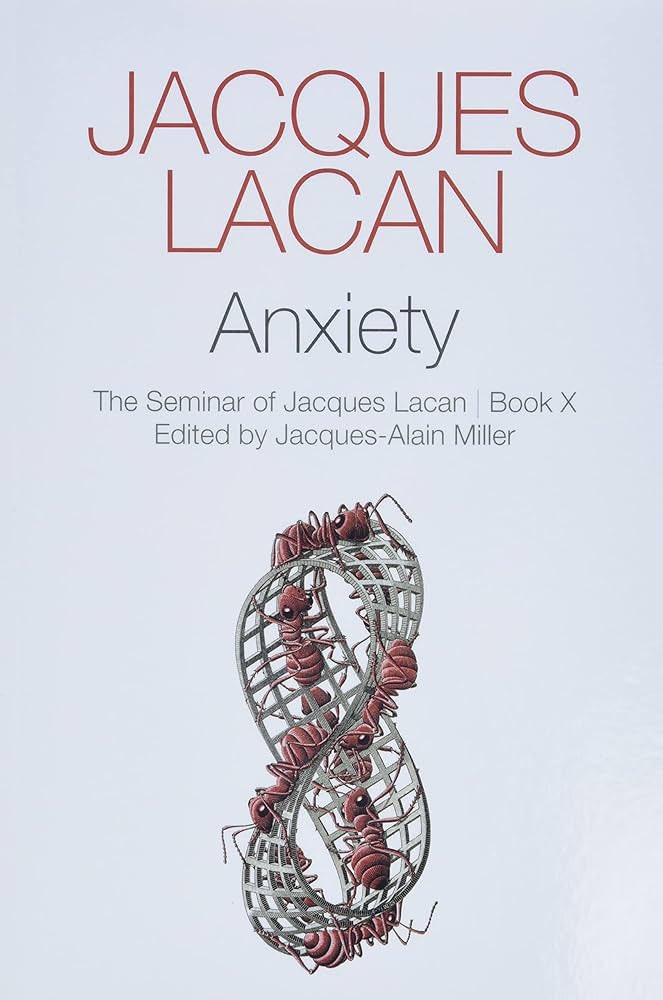



“To put myself forward as the one who desires, ἐρῶν, is to put myself forward as the want of [objet petit] a, and it is by this path that I open the door to the jouissance of my Being.
The aporic character of this position cannot fail to emerge for you, but there are still a few more steps to be taken. I think you have already grasped, because I’ve been telling you for a long while now, that if I am standing at the level of the ἐρῶν, opening the door to the jouissance of my Being, it is clear that the nearest slope that offers itself to this enterprise is for me to be appreciated as ἐρώμενος, lovable. This is what does not fail to come about, and without any conceit, but where already the fact that something has gone amiss in the affair can be read.
This is not an aphorism, but already a commentary. I believed it necessary for two reasons, firstly because I made a kind of double negative slip, which ought to warn me of something, and secondly because I believed I could see the miracle of incomprehension shining across a few faces.
I continue. Any requirement of [objet petit] a on the path of this enterprise to encounter woman — since I’ve taken the androcentric perspective — can only trigger the Other’s anxiety, precisely because I don’t make any more of the Other than [objet petit] a, because my desire ays [a poetic neologism] the Other, as it were. This is precisely why sublimation-love allows jouissance to condescend to desire. Here, my little circuit of aphorisms chases its tail.
What noble words are these. You see, I don’t fear ridicule. All this might sound a bit preachy and each time one advances on this ground one always runs this risk. But still, you seem to be taking your time before laughing at it. I can only thank you and be off again.”
Anna K. Winters@tenshi_anna
“The lover believes everything, endures everything and lasts without limit or help, with the sovereign power of he who loves before knowing himself loved, or worrying about it. The lover makes the difference—he alone differs. He differs from all those who want to love on condition of reciprocity, those metaphysical or natural-attitude egos that are obsessed by their equality to themselves, to the point of wanting to enlarge it into a new equality—between what they imagine of themselves, and what they require receipt of from elsewhere. The lover also differs from all the visible objects, and thus from subsistent and ready-to-hand beings, because he loves by advancing himself into a distance, where they must not appear, so that their commerce will not muddle the erotic reduction. Nothing supports the lover, thus it is necessary that he bear everything, in particular that his presupposition—that the other will end up by entering into the erotic reduction—not come, or not come yet; and the very addition of “not yet” amounts to believing everything. The lover believes everything, endures everything and, more precisely, puts up with remaining alone in the situation of the erotic reduction. He alone has as his own the erotic reduction—he remains the idiot of the erotic reduction. But nevertheless the lover assumes this idiotic solitude as a sovereign privilege, acting on a motive that we have already sketched. In the banal, nearly universal case wherein one of the two is no longer in love, or indeed was never in love, who should be designated the least unhappy of the two? It is necessary to make a distinction; in the natural attitude, the least unhappy seems to be the one who loved the least, or who stopped loving earlier—because he has lost less, and suffered less when love disappeared; by contrast, in the erotic reduction, the least unhappy appears as the one who loved the most, because he does not stop loving, even when the other has disappeared, so that he alone maintains love afloat. He has not lost everything, because he still loves. Indeed, he has lost nothing, because he still remains a lover. In the erotic reduction, if one truly wants to win, it is necessary to love and to persist in this advance, without condition—thus the last to love wins the stake. What stake? To love, of course. The winner is—the last lover, the one who loves to the end. For the lover loves to love. That does not turn him away from loving a beloved, but instead allows him to love the beloved, even if the beloved does not love him, or simply loves no one, or indeed even takes exception to her status as other to be loved. The lover loves to love for the love of love. Henceforth, just as he bears everything, the lover can believe everything and hope for everything. To believe and to hope here signify to love without knowing or possessing. Unknowing (which believes) and poverty (which hopes) nevertheless do not indicate any scarcity or shortage, but rather the properly infinite excess of the lover, as he loves without the condition of reciprocity.” - Jean-Luc Marion

Prodigal@jackburden_34
I just don't see where JM, CP, or DBH advocate a gift-reciprocity that is contractual, demanding, appropriative, or inevitable. As far as I can tell the gift-reciprocity is always graceful, participatory, mutual indwelling, surprising, superabundant, and ecstatic.
Anna K. Winters@tenshi_anna
Nominally it’s all these things, but a denial of contract is not a refutation of contract. In fact, I’d say more specifically that a contractual structure indwells necessarily in the political order of legal enforcement as such, which is something both St. Thomas Aquinas and @johnmilbank3, in his reading of Aquinas in Beyond Secular Order, evade. The idea that a state order can be eschatological does seem to me to be an “ontotheological” thesis that fails to recognize that state power requires negative coercive enforcement predicated over knowledge and initiation gaps, which are eliminated in the eschaton in favor of the transparency of really predestined hierarchical order in the total gratuity of divine love.
My position here is strictly Augustinian, which I do think Milbank is right to note in Theology & Social Theory conflicts ineluctably with the Thomistic theopolitical view. I do see St. Thomas as too much of a compromiser with Islamic proto-liberalism and proto-Bonapartism, and St. Augustine as more faithful to a consistent Christian opposition to political idolatry.
Kōjin Karatani shows well I think in The Structure of World History that gift reciprocity remains a kind of idolatrous economic structure (he calls it “mode of exchange A”) while the contract economy of the state does as well (“mode of exchange B”). His “mode of exchange C” is the capitalist commodity economy. “Mode of exchange D” is for him the eschatological overcoming of all these modes. No wonder he turns to St. Augustine in his recent (unfortunately still untranslated) book on power and exchange.


My position here is strictly Augustinian, which I do think Milbank is right to note in Theology & Social Theory conflicts ineluctably with the Thomistic theopolitical view. I do see St. Thomas as too much of a compromiser with Islamic proto-liberalism and proto-Bonapartism, and St. Augustine as more faithful to a consistent Christian opposition to political idolatry.
Kōjin Karatani shows well I think in The Structure of World History that gift reciprocity remains a kind of idolatrous economic structure (he calls it “mode of exchange A”) while the contract economy of the state does as well (“mode of exchange B”). His “mode of exchange C” is the capitalist commodity economy. “Mode of exchange D” is for him the eschatological overcoming of all these modes. No wonder he turns to St. Augustine in his recent (unfortunately still untranslated) book on power and exchange.
Prodigal@jackburden_34
I do think it's fair to say that JM, CP, and DBH are trying to realize reciprocity as non-commensurable and non-coercive. 1/x

