Why Bitcoin Explodes at Settlement and Not Adoption (Paper vs Spot)...

David@david_eng_mba
62 views
Jan 28, 2026
~4 min read
Advertisement
1
Why Bitcoin Explodes at Settlement and Not Adoption (Paper vs Spot)
Given this structure, a 5 to 10X Bitcoin settlement squeeze is not just possible, it’s the likely outcome.
Most people think Bitcoin rallies on adoption.
That’s wrong.
Bitcoin reprices when claims are forced to settle.
Paper vs Spot: The Core Mistake
There are two Bitcoins trading under the same ticker:
Spot Bitcoin bearer asset, on chain, final settlement, capped at 21M.
Paper Bitcoin exchange balances, ETFs, derivatives, lending claims.
Same ticker. Different physics.
Price is not set by total supply.
Price is set by marginal tradable supply.
Paper Bitcoin expands that supply without creating coins.
The Setup (Hard Numbers)
Reduce the system to one representative venue:
Real reserves: 100 BTC
Customer claims: 130 BTC
Paper multiple: 1.3×
Spot price: $100,000
The exchange is economically short 30 BTC.
Not fraud.
A balance-sheet bet that users won’t all withdraw at once.
The Game Theory (Coordination Game)
Every depositor faces the same choice:
Trust (leave funds) or
Verify (withdraw).
1. Everyone Trusts (Status Quo)
Depositor Result: App shows “1 BTC”
Market Result: Suppressed. (Supply appears inflated: 130 claims vs 100 coins)
2. You Withdraw, Others Don’t
Depositor Result: You get real BTC.
Market Result: No Impact.
3. Everyone Withdraws (The Snap)
Depositor Result: Claims > Coins.
Market: Forced spot buying the missing coins must be bought immediately
The equilibrium is “everyone trusts.”
It works until it doesn’t.
You’re not betting on adoption.
You’re betting on Option 3.
How the Unwind Actually Plays Out
Step 1: Early Withdrawals
Withdrawals: 20 BTC
Reserves: 80 BTC
Remaining claims: 110 BTC
System holds. Confidence remains.
Step 2: Coordination Shift
Fear replaces yield.
Additional withdrawal demand: 81 BTC
Available reserves: 80 BTC
Shortfall: 1 BTC
That’s the break.
Step 3: Forced Settlement (This is where price jumps)
The exchange cannot delay settlement.
They must buy spot BTC immediately.
But the sell side is thin.
Illustrative order book:
0.1 BTC @ $100k
0.1 BTC @ $105k
0.3 BTC @ $120k
0.5 BTC @ $150k
To source 1 BTC, the buyer must clear the book up to $150,000. A 50% price move caused by a 1% reserve gap.
Why This Move is Non-Linear
The exchange is a price-insensitive buyer.
They are not optimizing execution.
They are avoiding insolvency.
That’s why:
Small shortages
Create large gaps
Not smooth rallies
This is not a demand story. It’s a settlement constraint.
The Rubber Band Effect
Paper supply behaves like a stretched rubber band.
Expansion phase: Paper multiple rises to Liquidity looks abundant to Price looks capped.
Resolution phase: Claims converge to coins to Effective supply contracts instantly.
Price doesn’t adjust gradually.
It snaps.
The Math (Foundation)
You are not betting on adoption curves.
You are betting on this identity:
130 claims cannot clear against 100 coins without repricing.
No narrative required.
No timing required.
Bottom Line
Bitcoin doesn’t explode when demand appears.
It explodes when settlement is demanded.
The music is still playing.
The system is already short chairs.
That’s the game.
The Trillion Dollar Question, When Does it Break?
Bitcoin doesn’t break on a schedule.
It breaks when claims cross a settlement threshold.
What moves the system from stability to failure isn’t price.
It’s claims rising while float shrinks.
State 2 can last months.
State 3 rarely lasts long.
State 4 happens in days.
Nothing happens.
Then everything happens.
Given my background in energy development, derivatives, and commodity trading and hedging, the clearest analogue is a freeze:
Prices don’t rise gradually, they jump 5–10× when delivery breaks.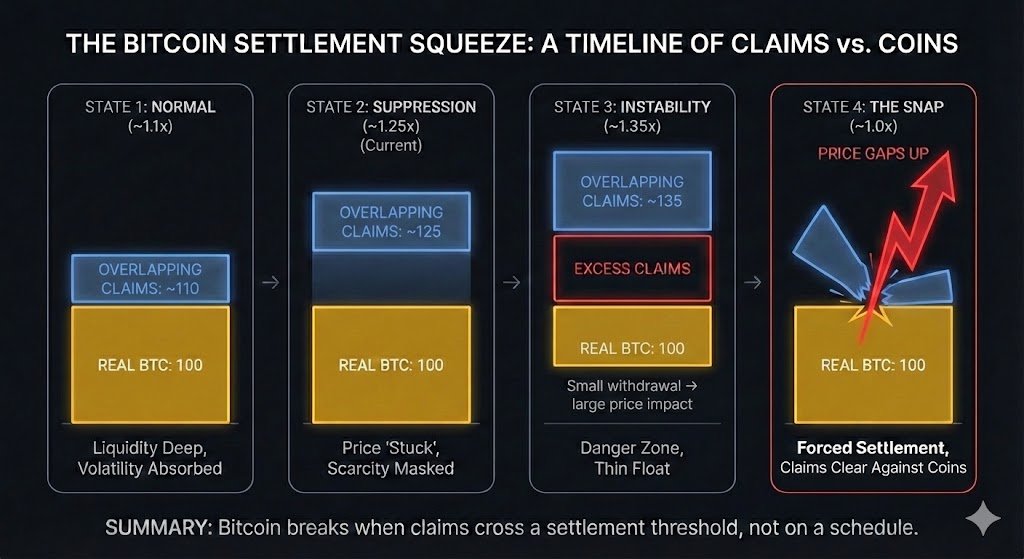
Given this structure, a 5 to 10X Bitcoin settlement squeeze is not just possible, it’s the likely outcome.
Most people think Bitcoin rallies on adoption.
That’s wrong.
Bitcoin reprices when claims are forced to settle.
Paper vs Spot: The Core Mistake
There are two Bitcoins trading under the same ticker:
Spot Bitcoin bearer asset, on chain, final settlement, capped at 21M.
Paper Bitcoin exchange balances, ETFs, derivatives, lending claims.
Same ticker. Different physics.
Price is not set by total supply.
Price is set by marginal tradable supply.
Paper Bitcoin expands that supply without creating coins.
The Setup (Hard Numbers)
Reduce the system to one representative venue:
Real reserves: 100 BTC
Customer claims: 130 BTC
Paper multiple: 1.3×
Spot price: $100,000
The exchange is economically short 30 BTC.
Not fraud.
A balance-sheet bet that users won’t all withdraw at once.
The Game Theory (Coordination Game)
Every depositor faces the same choice:
Trust (leave funds) or
Verify (withdraw).
1. Everyone Trusts (Status Quo)
Depositor Result: App shows “1 BTC”
Market Result: Suppressed. (Supply appears inflated: 130 claims vs 100 coins)
2. You Withdraw, Others Don’t
Depositor Result: You get real BTC.
Market Result: No Impact.
3. Everyone Withdraws (The Snap)
Depositor Result: Claims > Coins.
Market: Forced spot buying the missing coins must be bought immediately
The equilibrium is “everyone trusts.”
It works until it doesn’t.
You’re not betting on adoption.
You’re betting on Option 3.
How the Unwind Actually Plays Out
Step 1: Early Withdrawals
Withdrawals: 20 BTC
Reserves: 80 BTC
Remaining claims: 110 BTC
System holds. Confidence remains.
Step 2: Coordination Shift
Fear replaces yield.
Additional withdrawal demand: 81 BTC
Available reserves: 80 BTC
Shortfall: 1 BTC
That’s the break.
Step 3: Forced Settlement (This is where price jumps)
The exchange cannot delay settlement.
They must buy spot BTC immediately.
But the sell side is thin.
Illustrative order book:
0.1 BTC @ $100k
0.1 BTC @ $105k
0.3 BTC @ $120k
0.5 BTC @ $150k
To source 1 BTC, the buyer must clear the book up to $150,000. A 50% price move caused by a 1% reserve gap.
Why This Move is Non-Linear
The exchange is a price-insensitive buyer.
They are not optimizing execution.
They are avoiding insolvency.
That’s why:
Small shortages
Create large gaps
Not smooth rallies
This is not a demand story. It’s a settlement constraint.
The Rubber Band Effect
Paper supply behaves like a stretched rubber band.
Expansion phase: Paper multiple rises to Liquidity looks abundant to Price looks capped.
Resolution phase: Claims converge to coins to Effective supply contracts instantly.
Price doesn’t adjust gradually.
It snaps.
The Math (Foundation)
You are not betting on adoption curves.
You are betting on this identity:
130 claims cannot clear against 100 coins without repricing.
No narrative required.
No timing required.
Bottom Line
Bitcoin doesn’t explode when demand appears.
It explodes when settlement is demanded.
The music is still playing.
The system is already short chairs.
That’s the game.
The Trillion Dollar Question, When Does it Break?
Bitcoin doesn’t break on a schedule.
It breaks when claims cross a settlement threshold.
What moves the system from stability to failure isn’t price.
It’s claims rising while float shrinks.
State 2 can last months.
State 3 rarely lasts long.
State 4 happens in days.
Nothing happens.
Then everything happens.
Given my background in energy development, derivatives, and commodity trading and hedging, the clearest analogue is a freeze:
Prices don’t rise gradually, they jump 5–10× when delivery breaks.
2
Thanks
When you run the numbers, it becomes clear that the current paper-vs-spot structure is not sustainable longer term.
When you run the numbers, it becomes clear that the current paper-vs-spot structure is not sustainable longer term.
3
Early in my career, I worked on the valuation, development, and royalty negotiation of a gold mine. My first task was assessing reserves. Unlike Bitcoin, gold reserves like oil reserves are price dependent. What counts as a “reserve” expands and contracts with price. Bitcoin’s supply does not. That difference matters enormously.
This is why the paper-spot system has worked for gold:
Gold’s physical supply is elastic at the margin. Higher prices convert resources into reserves, encourage new production, and justify higher costs. Settlement can be deferred, audits are slow and expensive, and delivery is often optional. Paper claims can roll indefinitely because the system can adapt.
Bitcoin is the opposite.
Its supply is perfectly inelastic and precisely known. No higher price creates new reserves. No delay creates new coins. When settlement is demanded, claims must clear against a fixed, deliverable quantity.
That’s why paper markets can persist in gold but why the same structure is structurally unstable in Bitcoin.
Gold absorbs stress through geology, time, and cost.
Bitcoin absorbs stress through price.
That is why the paper-spot dynamic endures in gold, and why by the mechanics already laid out, it is likely to break in Bitcoin.
4
Lots of questions re ETFs:
If you own Bitcoin through BlackRock or Fidelity ETFs, you’re not the risk.
These ETFs are fully funded, unlevered, and held in segregated custody.
There’s no rehypothecation and no run risk.
ETFs don’t fail. They quietly remove supply.
Bitcoin reprices after the paper clears.
At Risk:
When stress hits, leverage breaks first derivatives, basis trades, then weak exchanges.
Shorting bitcoin and covered calls.
#DYOR


