Galla/Oromo Slavery in Somalia 🇪🇹🪓🇸🇴 (🧵 A THREAD)

HA📚@hornaristocrat
9 views
Nov 10, 2026
~32 min read
Advertisement
1
Galla/Oromo Slavery in Somalia 🇪🇹🪓🇸🇴
(🧵 A THREAD)
(🧵 A THREAD)
2
Oromo Ethiopians have recently been trying to falsify history in an attempt of putting their shameful history onto us Somalis. So I have dedicated a week of my time to expose their lies. This thread contains a lot of content, I put some work into it and it is certainly more educational than it looks like so I recommend reading it till the end especially if you are Somali.
I hope that you will enjoy the thread and support my work by liking, sharing and reposting it ♥️🔃
Don't forget my Paypal is in my bio if you wanna support my work and finance my projects.
I hope that you will enjoy the thread and support my work by liking, sharing and reposting it ♥️🔃
Don't forget my Paypal is in my bio if you wanna support my work and finance my projects.
3
From the 18th to 20th century the favorite chasing ground of Somali slave traders was in Oromo territory.


4
Map of the slave trade in Africa, as you can see the roots of the slave trade in the Horn of Africa are in the Galla country in Central Ethiopia. Where the red lines start is where the slaves are captured and where they end is where they are sold off on the coast and shipped to Europe or Asia.
Although European knowledge of the slave trade in the HOA wasn't that good at that time, this map still illustrates it well.
Although European knowledge of the slave trade in the HOA wasn't that good at that time, this map still illustrates it well.
5
In two centuries, it is estimated that up to 5M Central Ethiopian slaves majority of which being Oromo were shipped from Zeila, Berbera & Massawa. And this is only the north, there was a whole different slave trade going on in the south which I will talk about in this thread, the number could be inflated a bit further if the Banaadir etc is counted in.
To give you an idea of how big that number is, that's 5-6 times the amount of Europeans who fell victim to the Barbary slave trade. Oromos also come only second to the Trans-Atlantic slave trade making up half of the number of slaves shipped from the West African coast to the Americas.
If we take into account this number and the fact that Oromo slaves costed more than West African slaves, it means the Galla slave trade generated around half a Billion dollars which is roughly the equivalent of the Trans-Atlantic slave-trade according to most sources.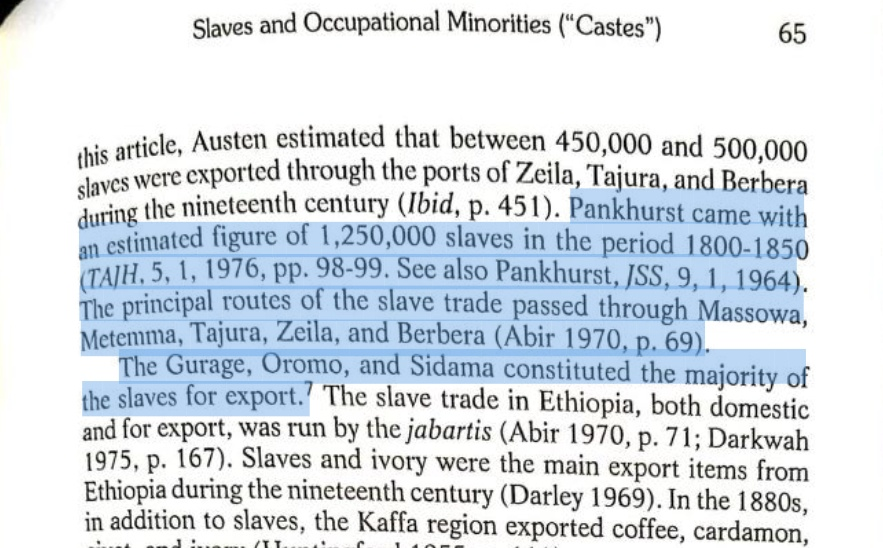
To give you an idea of how big that number is, that's 5-6 times the amount of Europeans who fell victim to the Barbary slave trade. Oromos also come only second to the Trans-Atlantic slave trade making up half of the number of slaves shipped from the West African coast to the Americas.
If we take into account this number and the fact that Oromo slaves costed more than West African slaves, it means the Galla slave trade generated around half a Billion dollars which is roughly the equivalent of the Trans-Atlantic slave-trade according to most sources.
6
In 1873 alone the US Department of State estimated that around 90 000 slaves were taken a year from the Walla-Galla area in Central Ethiopia, again, these numbers truly rival the Trans-Atlantic.


7
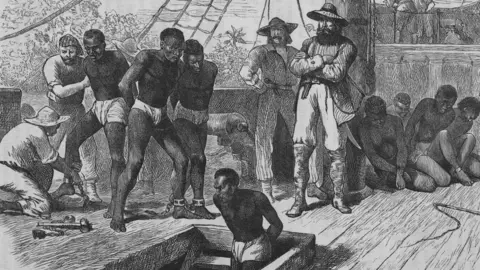
Did you know Oromos were also part of the Trans-Atlantic slave trade ? Check my mini-thread below 👇
HA📚@hornaristocrat
🌳 Did you know the Oromo people of East-Africa were also part of the Trans Atlantic slave-trade ? (1/3)
8
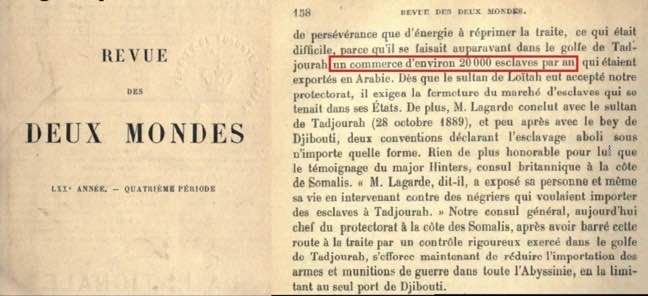
Even the small Afar port of Tadjurah alone exported 20 thousand Galla slaves per year, the numbers for Zeila, Berbera & Massawa are probably a few tens of thousands above that number.
9
Some sources are more precise and tell us the Galla slaves who go trough Massawa in Eritrea come from the Western Galla tribes, while the ones captured from the Eastern Galla tribes are sold at Zeila & other Somali ports, in this thread I will try to focus more on the Eastern & Southern Galla slave trade which were both run by Somalis.
(Source: Abstract of the letters from India)

(Source: Abstract of the letters from India)
10
The Gallas were sadly most of the time captured like animals by the Somalis but a good chunk also sold their own children and family members into slavery.


11
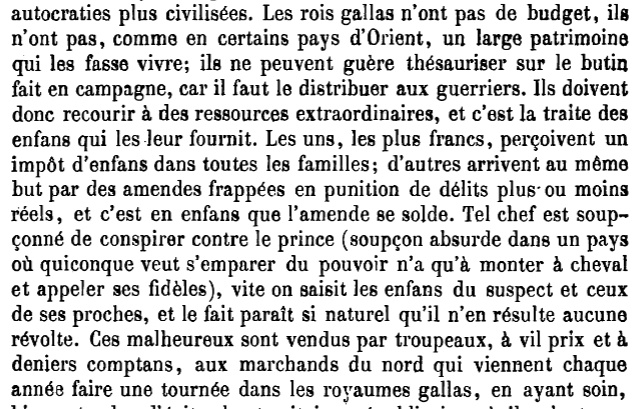
It was actually also part of their traditions to sell their own children into slavery check the mini-thread I made 👇
HA📚@hornaristocrat
🌳 Among the sick traditions of the Gallas are selling their own children into slavery ;
"The Galla kings have no budget, they do not have, as in some Eastern countries, a large heritage which keeps them alive; they can hardly hoard on the booty made in the field, because it must be distributed to the warriors. They must so resort to extraordinary resources, and this is the trafficking of children who provide them. Some, the most frank, receive a child tax in all families; others arrive at the same but by fines imposed as punishment for more or less serious offences real, and it is in children that the fine is paid. Such a chief is accused of conspiring against the prince (an absurd suspicion in a country where anyone who wants to seize power only has to mount a horse and call his followers), the children of the one suspected and those of his relatives, and the fact seems so natural that no revolt. These unfortunate people are sold in herds, at a low price and at cash, to the merchants from the north who come every year to tour the Galla kingdoms."
Huge thread coming on this topic stay tuned.
12
The majority of Galla slaves were not voluntarily sold at a young age by their family, but captured by force, as precised here by a German missionary in Ethiopia (1839-1842)


13
After the Oromo invasions separated the Somali Muslims and the Habesha Christians, Somalis started raiding their new Oromo neighbors to keep their very lucrative business alive, shipping them as far as Europe & West Africa. In the space of a few centuries the Slave trade in Somalia switched from Northern Ethiopian Habeshas to Oromos.
But Oromos still captured and sold Habesha slaves to Somalis for around a century so the switch was not sudden and approximately occurred in the late 1600s.



But Oromos still captured and sold Habesha slaves to Somalis for around a century so the switch was not sudden and approximately occurred in the late 1600s.
HA📚@hornaristocrat
Due to the Oromo invasions which separated the crescent and cross making a sort of buffer zone between the Christian Abyssinians and Somali Adalites, Somalis lost their most lucrative business, a slave trade which has made them rich for centuries; Raiding and selling Habeshas.
Pedro Paez reports that when the oromos separated the two lands they quickly learned that they too could take part in that business and kept it alive for a few more centuries by raiding & enslaving the Habesha and trading them to the Somalis in exchange of different items.
Pedro Paez reports that when the oromos separated the two lands they quickly learned that they too could take part in that business and kept it alive for a few more centuries by raiding & enslaving the Habesha and trading them to the Somalis in exchange of different items.
14
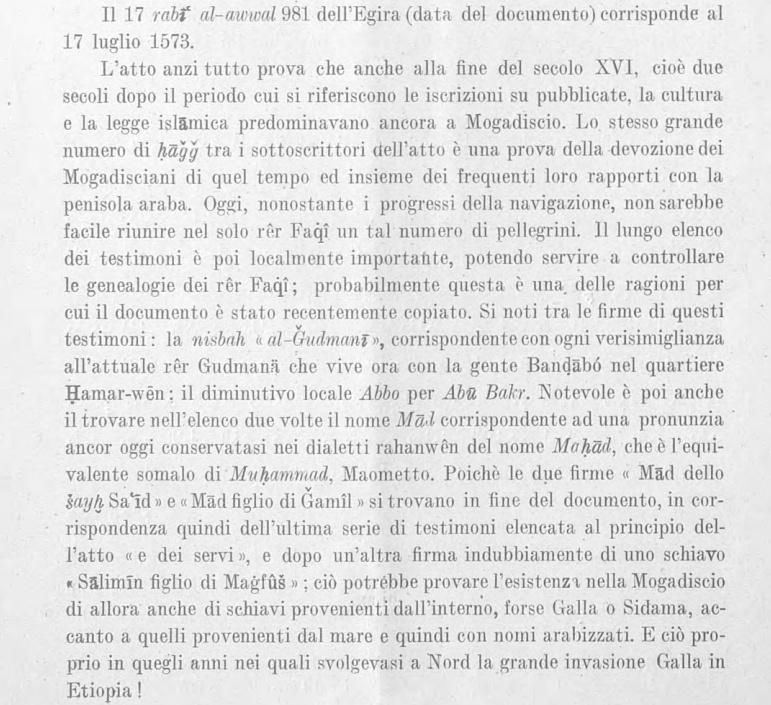
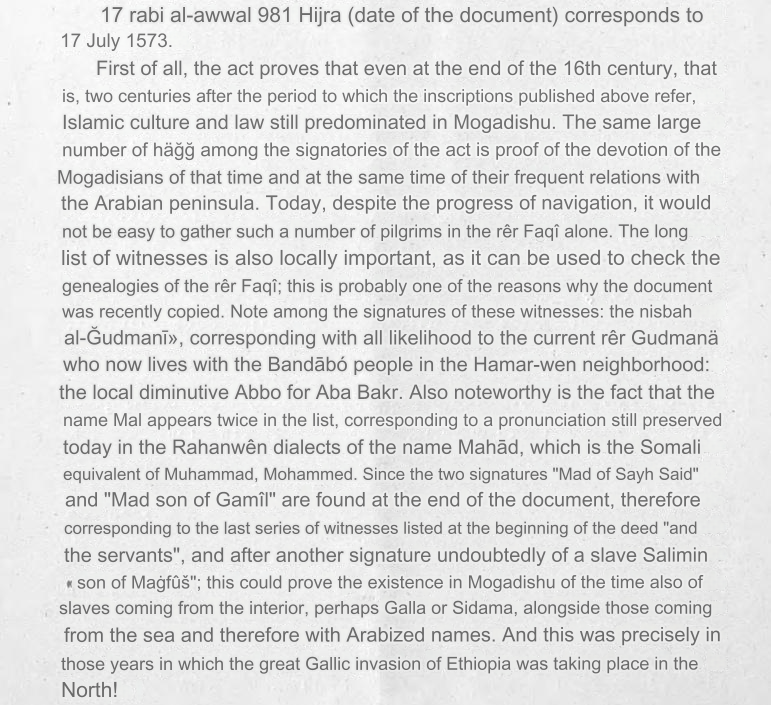
Although this slave trade can be dated to the late 17th century for Northern and Western Somalia, we could find Oromo slaves in the Banaadir as early as the 16th century, which coincides with the period in which the Oromo invasion started in the North. The Oromos weren't as successful on the Southern front and after being defeated at the Juba we can see Oromo slaves appearing in the records of the Mogadishan state during the reign of Sultan Muzaffar, here is a manuscript of a Somali women freeing her Oromo slave in 1573.
15
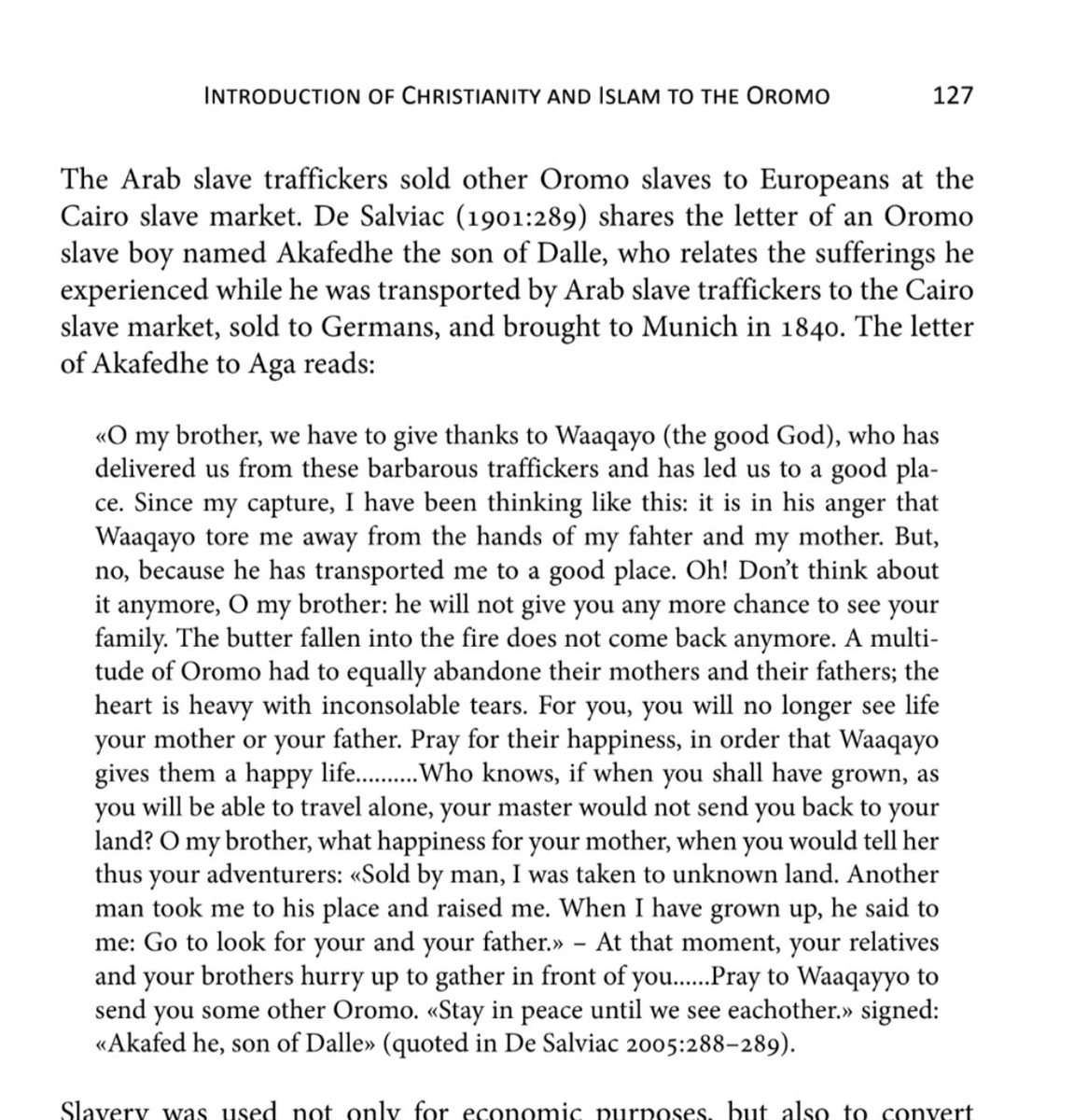
German noblemen craved for these newly shipped Oromo concubines, and Prince Hermann for example, was no exception. He owned an Oromo concubine which he had bought from Cairo in Egypt. And this isn't anything uncommon, there was a huge demand for Oromo slaves in Cairo and after arriving in Zeila they were shipped straight to Egypt where they were bought by European noblemen.

16
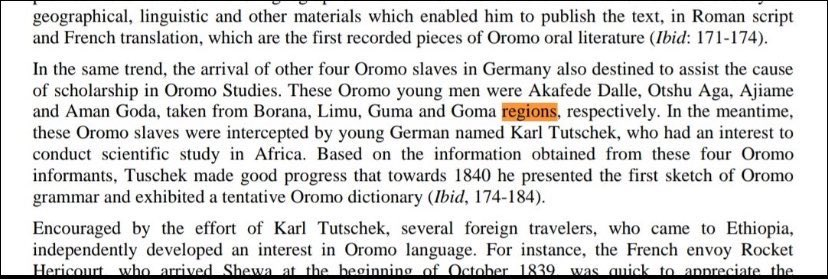
The Germans, it seems, had a peculiar interest in the Oromo race as German scientists even bought Oromo slaves and shipped them to Germany to study them & their language.
17
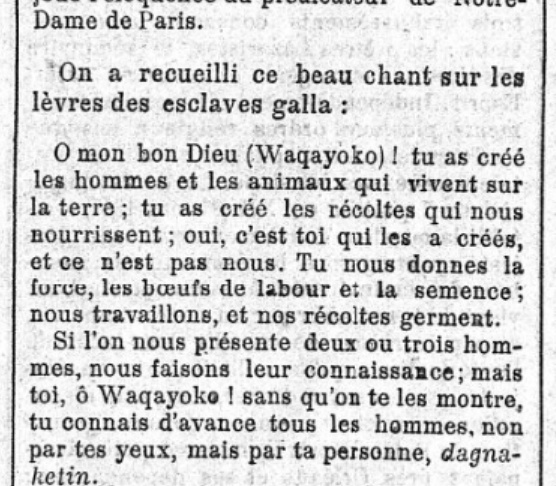
The french also occasionally bought Galla slaves to study their religion & customs, this was found in a French newspaper (L'UNIVERS)

18
Galla slave-girls from Zeila quickly became a new trend in Egyptian Harems, the Harems of Egypt switched from Sudanese to Galla slave girls which were seen as much more beautiful than their Nubian predecessors in the market.

19
The city of Brava on the Somali coast was renowned for its Galla slaves which were exported on boats to the markets of Zanzibar and Egypt, it is said that they sell so well that the some Arab slavers specialized in their sale only.
Source: Slave-catching in the Indian ocean by Philip Howard Colomb

Source: Slave-catching in the Indian ocean by Philip Howard Colomb
20
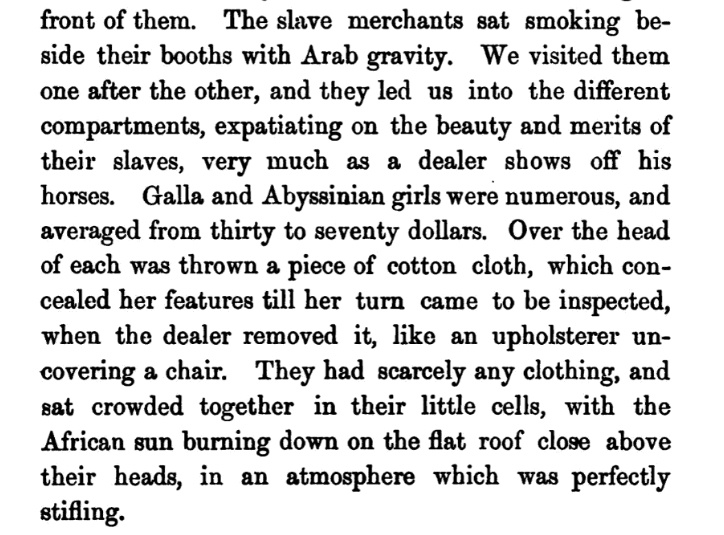
British explorer Emilius Albert De Cosson visited in 1877 a slave market in Egypt and he documented that it was full of Galla slave girls which were openly sold in the glazing sun, they had barely any clothes and they were kept in a crowded cage next to their seller. The prices ranged between 30 to 70 dollars which in today's currency would be from 900$ to 2000$.

21
Another British explorer in Egypt visits a Theban market, there he saw a Galla slave girl who greatly captivated his eye, he found her so beautiful that he decided to buy her on spot in exchange of a single rifle he had with him.
To the right is an illustration of a Galla concubine in Egypt as is written in the caption.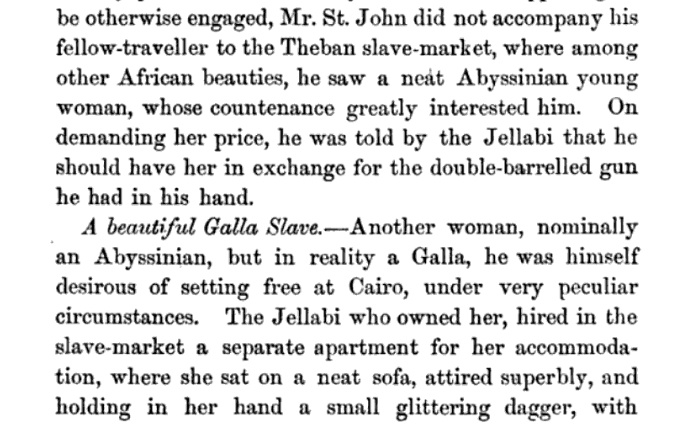

To the right is an illustration of a Galla concubine in Egypt as is written in the caption.
22
This is not the first time an European bought a Galla woman in exchange of a single rifle, it seems this trick was actually known by Europeans and wasn't rare at all 👇
Here a French explorer trades an Arussi Galla concubine to accompany him during his stay in Ethiopia in exchange of a single rifle, the slave girl was named Chalma and was previously owned by an Amhara Shewan noble.
Here a French explorer trades an Arussi Galla concubine to accompany him during his stay in Ethiopia in exchange of a single rifle, the slave girl was named Chalma and was previously owned by an Amhara Shewan noble.
23
The Harems of 18th & 19th century Egypt were composed of two races :
- White Europeans (Balkans/Slavs)
- Red Abyssinians (Galla)
(Quoting from Edward William Lane in his book An Account of the manners and customs of the modern Egyptians)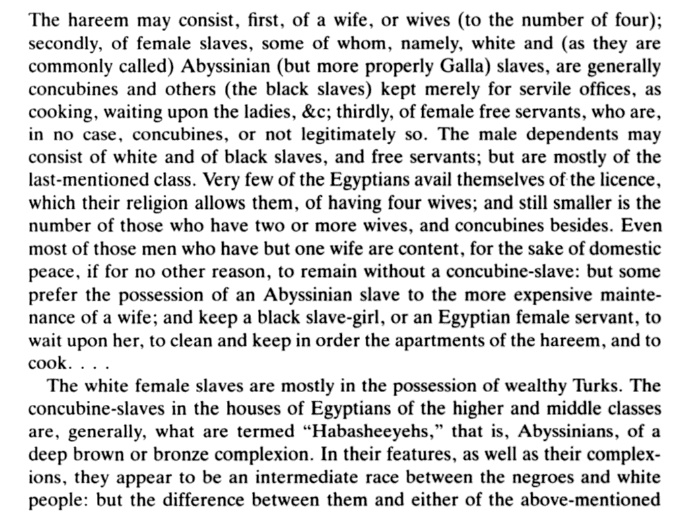

- White Europeans (Balkans/Slavs)
- Red Abyssinians (Galla)
(Quoting from Edward William Lane in his book An Account of the manners and customs of the modern Egyptians)
24
French explorer Edmond Combes recognized Galla slaves among the servants in an Egyptian household (happening during Muhmmad Ali Pasha's time)

25
French consul in Khedive owned Khartoum has a Galla wife who is said to have been an ex-slave. It's also precised that nearly all the women of Khartoum at that time were Galla concubines.


26
The German missionary Johann Ludwig Krapf says that the Galla women are the most beautiful & prized African slaves in Egypt, all the while clearly making a distinction between them and Sidama/Gurage.

27
Here are two authentic historical illustrations below of Galla slave-girls attending to their Egyptian mistresses👇
This is not based on the imagination of the author or fantastical stories but real people & events, unlike you we do not have to make up rage-bait scenarios using shady sources like science-fiction novels. Your history is not only written but also drawn. 🖼️
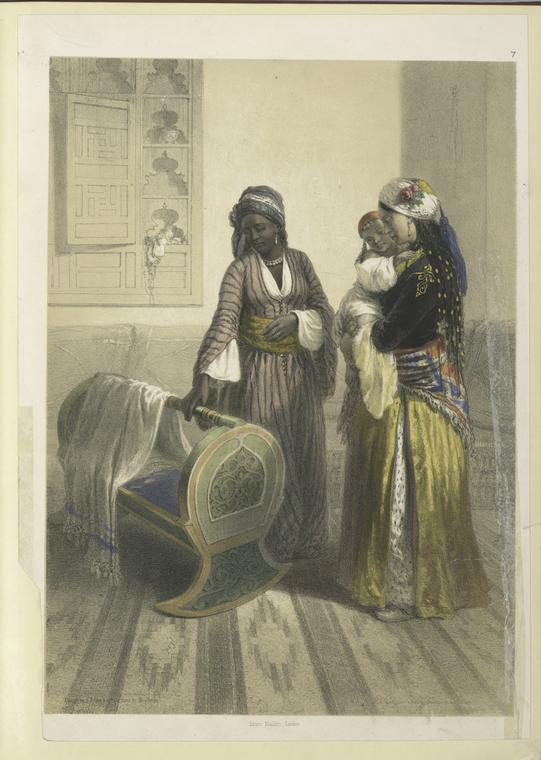
This is not based on the imagination of the author or fantastical stories but real people & events, unlike you we do not have to make up rage-bait scenarios using shady sources like science-fiction novels. Your history is not only written but also drawn. 🖼️
28
And Egypt was not the only place where Galla women became a trend, let's now look into Arabia.
In 1863 Abu bakr bin Ibrahim the governor of Zeila sends boats full of Galla slaves to Arabia, the British fear that the slave trade is only increasing despite their efforts to suppress it.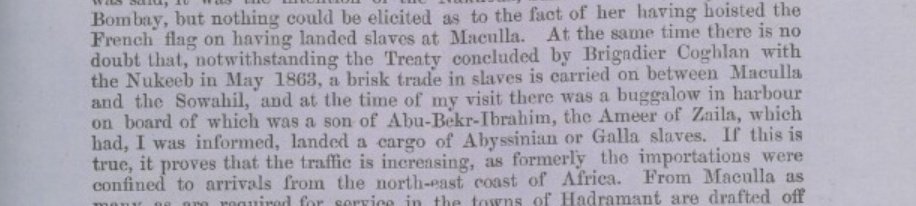

In 1863 Abu bakr bin Ibrahim the governor of Zeila sends boats full of Galla slaves to Arabia, the British fear that the slave trade is only increasing despite their efforts to suppress it.
29
The British in their efforts to suppress the slave-trade freed many Galla slaves in the late 19th century. Below is a picture of the HMS "Dryad" docked at Zanzibar whose crew freed about 200 Galla slaves, and to the right is an authentic illustration of Galla slaves on board of the HMS "Daphne" freed by the crew of that ship.


30
The most famous of these stories is the one where the Brits in 1888 freed a group of 204 Gallas from slavery and brought them to South Africa. I think there is a whole book about it the story is pretty well known.
theconversation.com/the-story-of-o…
theconversation.com/the-story-of-o…
31
British ambassador documents how 300 Galla slave-girls that were intended to end up in the Sultan of Oman's new harem in Muscat were rescued & freed by the British.

32
In the early years of this new slave-trade, the agricultural sector of Somalia wasn't as developed so approximately half of these enslaved Oromos would end up in the Middle-east and beyond. There were so many Oromo slaves in Arabia that their language could be heard in every household.

33
Galla slave girls in Arabia were very much in demand, the most beautiful costing between 100 & 150$ each in 1860 which amounts to 3800 to 5700$ today, that is aproximately 2 times more than the prices in Somali markets which I will show later in the thread. The Arabs would cover their Galla slave girls with butter, one of the earliest recorded practices of 'oiling up' a body for God knows what freaky purpose.

34
The slaves which arrive in Hodeida, small Yemeni island near the coast, are all Gallas from Zeila and Tadjurah, the women cost more than the men (75$).
Source: Abstract of the letters from India
Source: Abstract of the letters from India
35
This wasn't only happening in the coastal towns of Arabia, Galla slaves are also documented deep in interior towns like Buraidah.


36
And we find trace of them on the other side of Arabia as well.
Here is a story of 3 Galla slaves in Dubai who are documented in a successful attempt to escape back to their homeland, a Somali merchant agrees to help them for 190 rupees and puts them on one of his boats back to Djibouti.
Here is a story of 3 Galla slaves in Dubai who are documented in a successful attempt to escape back to their homeland, a Somali merchant agrees to help them for 190 rupees and puts them on one of his boats back to Djibouti.
37
The Sharif of Mecca was reported to have 'many Galla wives' certainly hinting at a harem.

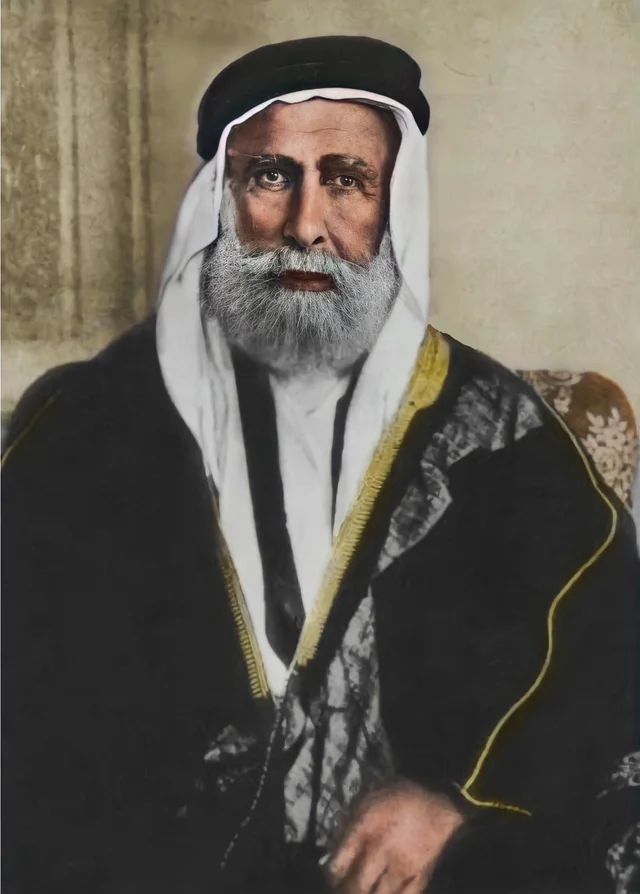
38
And it wasn't specific to him, all ottoman officials from Hejaz to Yemen often bought Galla slave girls for their harems 👇


39
The people of Arabia in the 19th century preferred having sexual intercourse with their Galla concubines rather than with their wives, and as such, their concubines eventually ended up bearing them a child. This is the reason for their skin color being tanner than other Arabs.
"Yet they are to be regarded as not less genuine Arabs than many of the townspeople of Arabia itself; among whom has long and very generally prevailed a custom of keeping Galla and Abyssinian female slaves, either instead of marrying their own countrywomen, or (as is commonly the case with the opulent) in addition to their Arab wives: so that they now bear almost as much resemblance to the Gallas and Abyssinians as to the Bedouins, or Arabs of the Desert."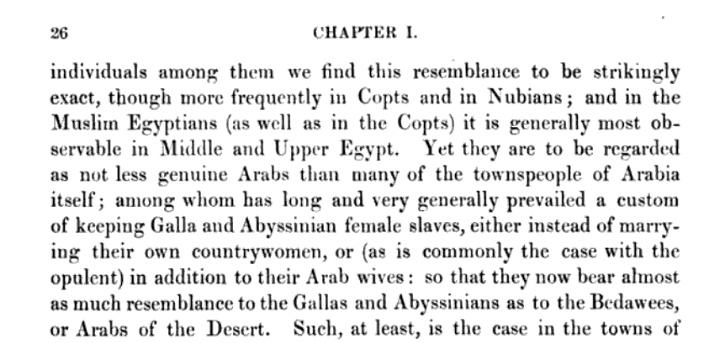


"Yet they are to be regarded as not less genuine Arabs than many of the townspeople of Arabia itself; among whom has long and very generally prevailed a custom of keeping Galla and Abyssinian female slaves, either instead of marrying their own countrywomen, or (as is commonly the case with the opulent) in addition to their Arab wives: so that they now bear almost as much resemblance to the Gallas and Abyssinians as to the Bedouins, or Arabs of the Desert."
40
In the 19th century the inhabitants of Mecca mixed with Abyssinian concubines so much that their skin color darkened and they had a distinct look from other Arabs.
I have shown above from this same book how the 'Abyssinians' referred to here are of the Galla race.

I have shown above from this same book how the 'Abyssinians' referred to here are of the Galla race.
41
French explorer Edmond Combes in Arabia says there is a 'great number' of Galla slaves in Yemen (1830-40s)

42
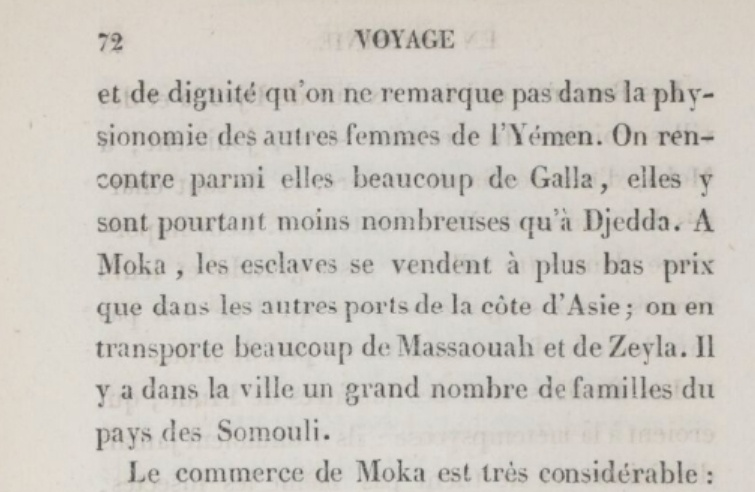
He also says that the city of Mukha is inhabited by numerous Galla slaves but less than in the city of Jeddah in Saudi Arabia, he goes on to say that in Yemen the Galla slaves are sold at a cheaper price & that they are exported from Zeyla & Massawa.
43
Indeed, another French explorer in Arabia (1834) confirms this by saying that the city of Jeddah was inhabited by a "large quantity of Galla slaves of both sexes"

44
British officer describes the Yemeni port of Mukalla in the 19th century :
"We saw many slaves in Al-Mukalla, Blacks and (recently) the arrival of slaves to this town has increased especially from the Galla.."
From the "تاريخ إبطال الرقة في زنجبار وما يليها من البلدان في عهد صاحب السعادة السيد برغش بن سعيد بن سلطان"
"We saw many slaves in Al-Mukalla, Blacks and (recently) the arrival of slaves to this town has increased especially from the Galla.."
From the "تاريخ إبطال الرقة في زنجبار وما يليها من البلدان في عهد صاحب السعادة السيد برغش بن سعيد بن سلطان"
45
Italian records of the slave trade (1883)
Slaves captured from the Sudan or the Galla still frequently get shipped to Arabia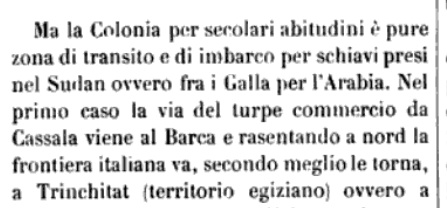
Slaves captured from the Sudan or the Galla still frequently get shipped to Arabia
46
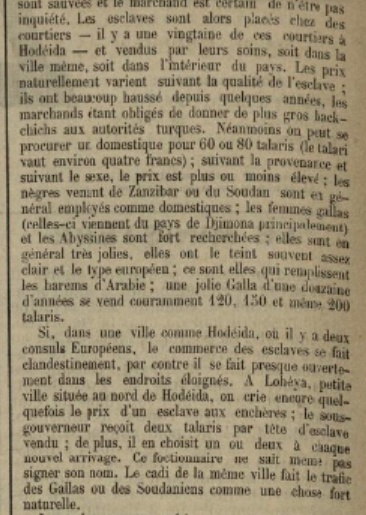
At that time, Galla slave girls were known in the the Western world as 'the favorites of the Arabian harems'.
Here is a French Newspaper talking about it (La Depeche 23 Feb. 1889)
"..Galla women are highly sought after; they are generally very pretty, they often have a fairly light complexion and a European type; they are the ones who fill the harems of Arabia; a pretty Galla of a dozen years old is commonly sold for 120, 150 and even 200 talaris (4000$ today's currency).. At Luhayya, a small town north of Hodeida, the price of a slave is still sometimes called out at auction; the sub governor receives two talaris per head of slave sold; moreover, he chooses one or two for each new arrival.. The qadi of the same town traffics in Gallas or Sudanese as if it is a very natural thing."
(Luhayya being a port in Yemen founded by a Somali sheikh)
Here is a French Newspaper talking about it (La Depeche 23 Feb. 1889)
"..Galla women are highly sought after; they are generally very pretty, they often have a fairly light complexion and a European type; they are the ones who fill the harems of Arabia; a pretty Galla of a dozen years old is commonly sold for 120, 150 and even 200 talaris (4000$ today's currency).. At Luhayya, a small town north of Hodeida, the price of a slave is still sometimes called out at auction; the sub governor receives two talaris per head of slave sold; moreover, he chooses one or two for each new arrival.. The qadi of the same town traffics in Gallas or Sudanese as if it is a very natural thing."
(Luhayya being a port in Yemen founded by a Somali sheikh)
47
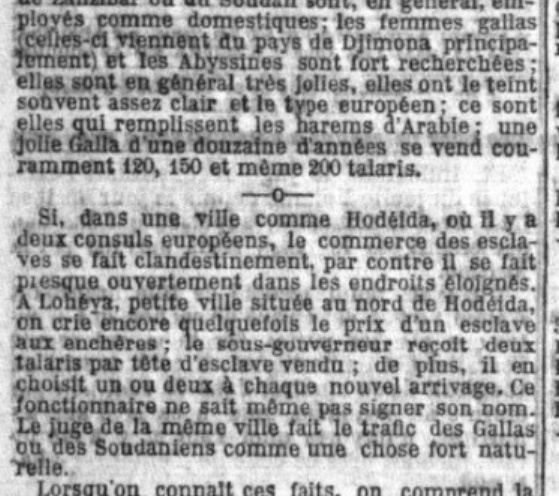
Same thing can be found in basically all French newspaper, Galla slave girls were a trending topic in France that month.
I think you get my point but there are like 40 other newspapers like this and hundreds throughout Europe in that same year, we had some difficulties in the research so we couldn't access the German ones which contained more details about the "Galla women of East"
1. "Le petit Parisien" 24 Feb. 1889
2. "La Justice" 21 Feb. 1889
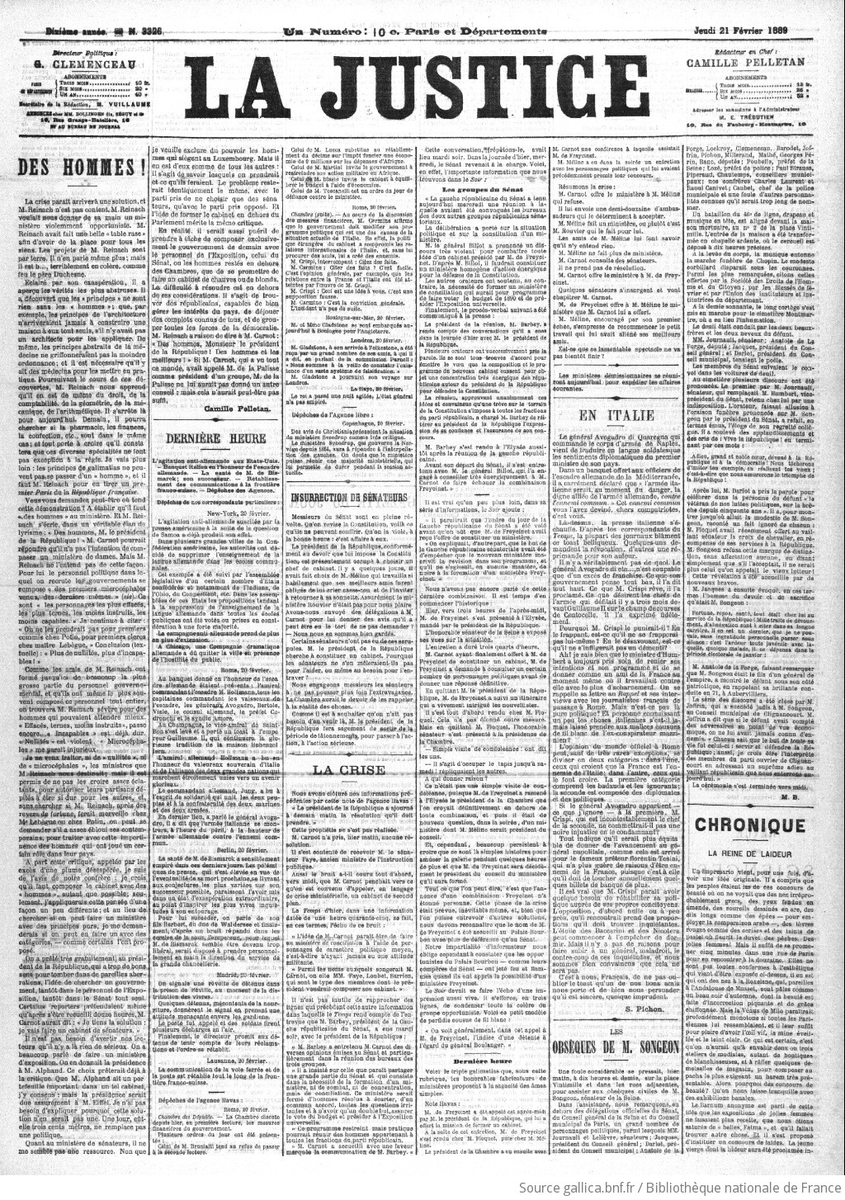

I think you get my point but there are like 40 other newspapers like this and hundreds throughout Europe in that same year, we had some difficulties in the research so we couldn't access the German ones which contained more details about the "Galla women of East"
1. "Le petit Parisien" 24 Feb. 1889
2. "La Justice" 21 Feb. 1889
48
Galla slave girls were also the most prized concubines in 19th century Persia.

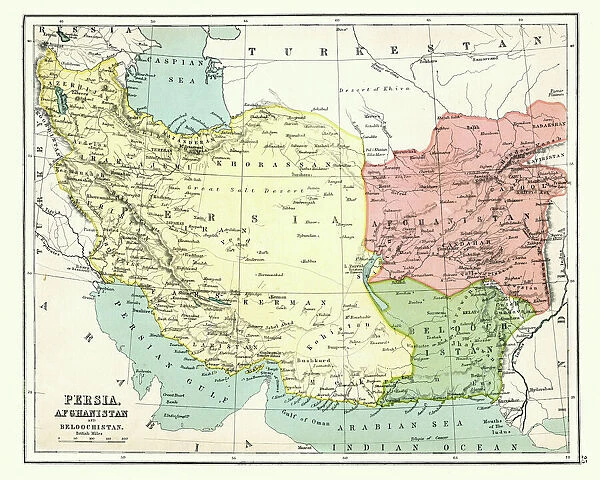
49
The Galla slave girls of Persia are at the origin of many Persian traditions such as the Zar, Liwa and Gowat which can be found as far as Balochistan in Afghanistan & Pakistan.


50
An official 1898 Iranian report estimated the population of Galla slave girls in Iran to be around 25000, these were only freed in 1929 when slavery was abolished.

51
And lastly on the topic of exports, one thing which should be pointed out is Somali slavers did not only export their Galla merchandise by sea, but also through Caravans connecting both sides of the African continent. Here for example it is is said that Somali Caravans starting from the Shabelle river & the Ogaden desert are known to export a considerable amount of Galla slaves to the West African Sahel.
This is not a one time thing as centuries prior Ethiopian Habesha slaves are also documented in the records of the Mali Empire centuries prior, so the West-Africans were very accustomed with these Somali products.

This is not a one time thing as centuries prior Ethiopian Habesha slaves are also documented in the records of the Mali Empire centuries prior, so the West-Africans were very accustomed with these Somali products.
52
Now that we've established the fact that throughout the 19th century the most common & prized slaves in the Middle-East were Oromo, let me add to this that out of all the Galla women exported to the ME, a minority ended up being exploited by their owners as prostitutes as it was a well known fact that women who sell their body in the Arab world were 99% of the time slave-girls :
"For most of history the prostitutes origins were known to be outside the Arab countries, such as slaves brought from the countries of Rome or Abyssinia.. the slave owners exploited their slaves, especially female slaves, by forcing them to practice prostitution in markets, and the Al-Kalbi tribe is perhaps the most famously known for this.. accordingly; female slaves, were found in abundance in taverns.. free Arab women were not known to practice prostitution, because it is shameful among the Arabs, and it was limited to female slaves only.. and most prostitutes were mostly female slaves."
So basically, for the Galla women enslaved and shipped to the Middle-East; you were lucky if you ended up as a fourth wife, maid, concubine or in a private harem and not in markets or taverns for the drunkards.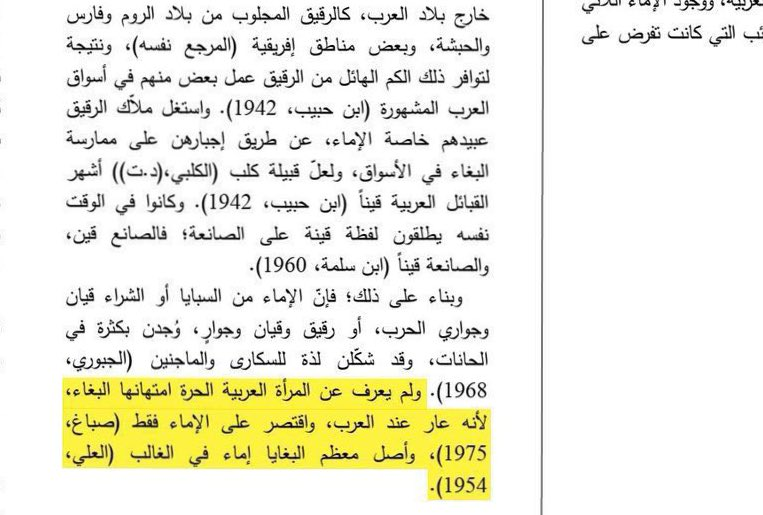
"For most of history the prostitutes origins were known to be outside the Arab countries, such as slaves brought from the countries of Rome or Abyssinia.. the slave owners exploited their slaves, especially female slaves, by forcing them to practice prostitution in markets, and the Al-Kalbi tribe is perhaps the most famously known for this.. accordingly; female slaves, were found in abundance in taverns.. free Arab women were not known to practice prostitution, because it is shameful among the Arabs, and it was limited to female slaves only.. and most prostitutes were mostly female slaves."
So basically, for the Galla women enslaved and shipped to the Middle-East; you were lucky if you ended up as a fourth wife, maid, concubine or in a private harem and not in markets or taverns for the drunkards.
53
And I know Oromos will cope in an attempt to falsify history again by saying these Galla slaves were Gurage or Kaffa, in EVERY source I showed their ethnicity and language is described very well, they are Oromo. Adding to that this thread contains undeniable proof of constant Somali raids on these specific Oromo tribes.

54
These “Galla” slaves in sources were in fact, actual GALLAS. They were, on the basis of phenotypes and temperament, not only specifically distinguished from Gurage but also from darker Nilotic Ethiopians as well.
I also find it funny how Oromos often source Mohammed Hassen to cope with their shameful history, everyone knows he is a lying Oromo supremacist & Ethiopianist. Quoting him will only make your case worse.



I also find it funny how Oromos often source Mohammed Hassen to cope with their shameful history, everyone knows he is a lying Oromo supremacist & Ethiopianist. Quoting him will only make your case worse.
55
The slaves found in the Somali port of Berbera according to Transactions of the Bombay Geographical Society. Again here a clear distinction is made between the Gurage, Shanqalla & Galla tribes.
Unfortunately for our Oromo friends, the sources are very clear.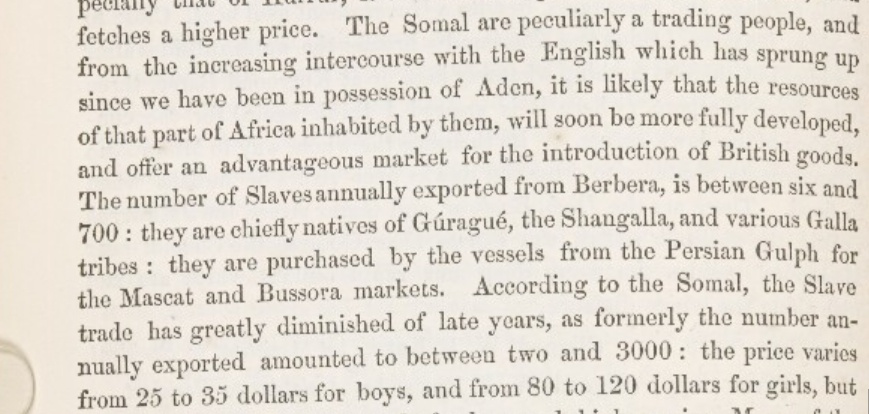
Unfortunately for our Oromo friends, the sources are very clear.
56
Now that we've talked about the exports, let's head to the main topic which is Who, How & Why they were captured.
Here is a young Oromo slave in Somalia who was freed by an Italian explorer, he was captured in a Somali raid and sold to an old Somali woman who lives in the countryside, his mistress constantly starved him and he confesses that she often forced him to work more than his strength allows.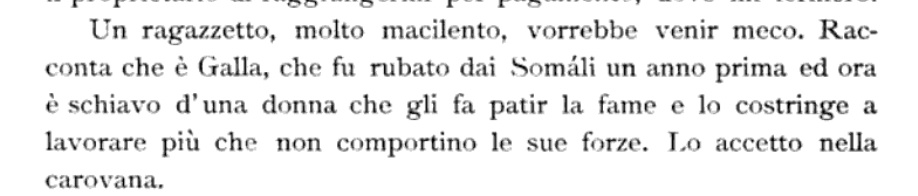
Here is a young Oromo slave in Somalia who was freed by an Italian explorer, he was captured in a Somali raid and sold to an old Somali woman who lives in the countryside, his mistress constantly starved him and he confesses that she often forced him to work more than his strength allows.
57
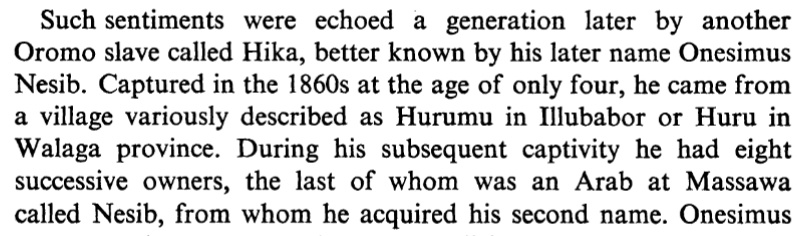
Similar case; Oromo named Hika captured at the age of four, sold 8 different times and had 8 different owners, he finished his life of humiliation at the hands of an Arab in Eritrea.
58
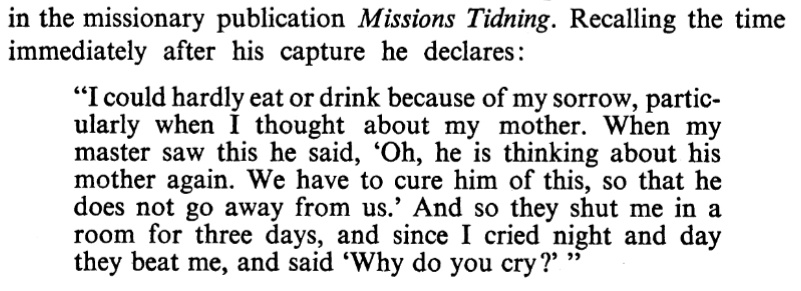
Hika cried every night about his Oromo family, recalling the day he was captured.
59
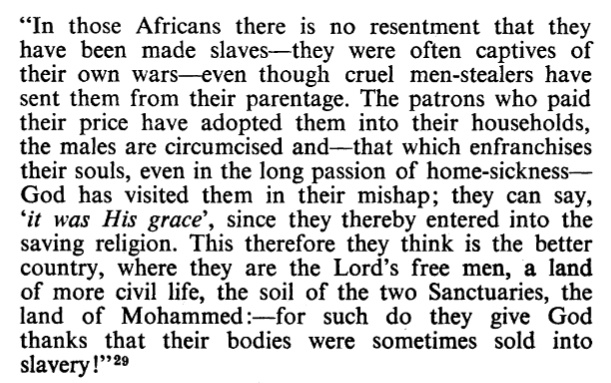
The treatment of slaves varies according to the behavior of their master and how the slave takes it, so in reality it really depends from case to case, but most of the time they were treated very well, most of them well clothed and provided for, in fact they were treated so well that they preferred their slave life in Somalia rather than their primitive life in the plains of Central Ethiopia.
"Every well-off Somali [..] generally has a slave [...] In the villages of Banaadir, there are still today, not less than two or three thousand slaves [ ...] they live with their masters who treat them just like any other household member, and they dress and eat like all Somalis, so much so that I am convinced that offering them liberty many of them would refuse immediately."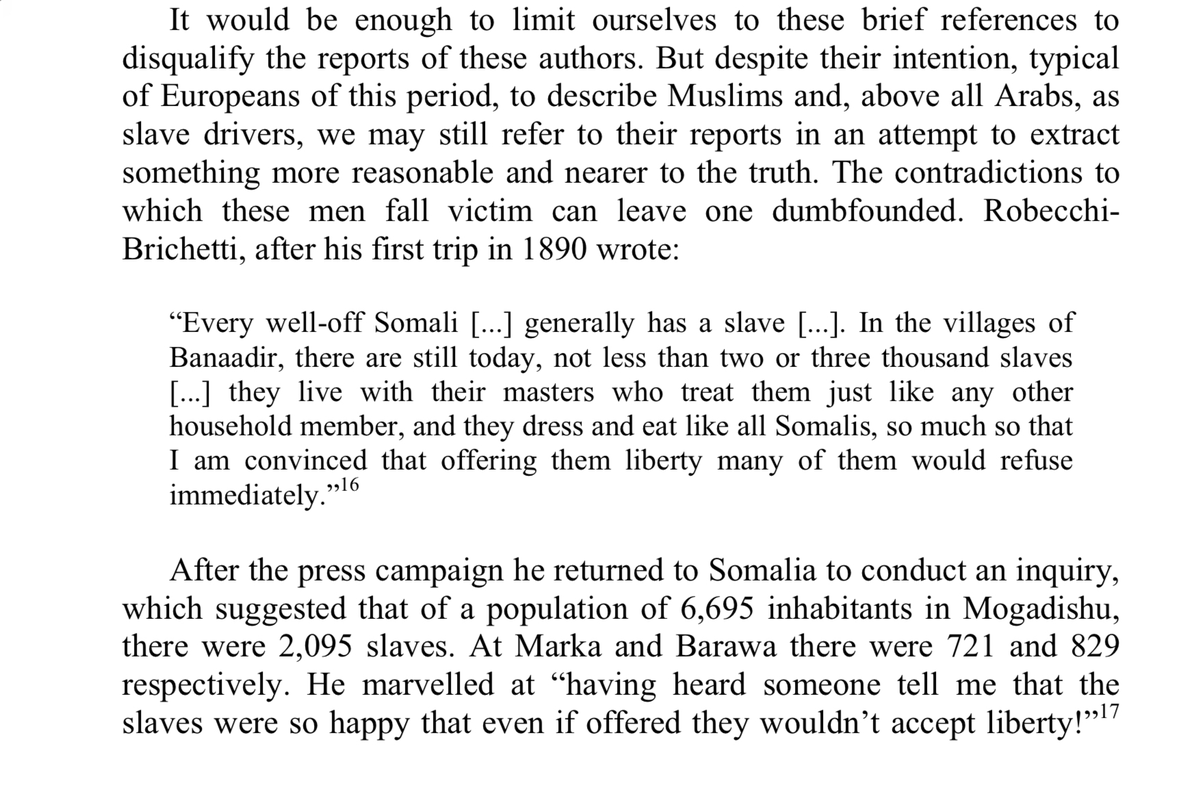
"Every well-off Somali [..] generally has a slave [...] In the villages of Banaadir, there are still today, not less than two or three thousand slaves [ ...] they live with their masters who treat them just like any other household member, and they dress and eat like all Somalis, so much so that I am convinced that offering them liberty many of them would refuse immediately."
60
Confirmation of the acceptance of slavery by Oromo slaves in the Muslim world is offered by the early twentieth century British traveler C. M. Doughty, who, writing of the Oromo slaves in Somalia observes :
61
Although some Oromos after gaining their freedom would spend the little energy they have left to go back to Oromiya, some Oromo slaves like Aman became so used to their life of servitude that they have embraced it.


62
In fact the Galla slave-girls had a great reputation for their politeness & loyalty to their masters, as weird as it may sound this docile behavior made them even more prized in the Arab world.

63
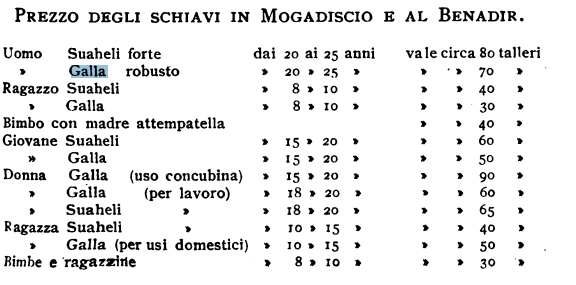
The Italians record that in some markets of the Banaadir there were still more Gallas slaves than Bantu Swahilis 👇
64
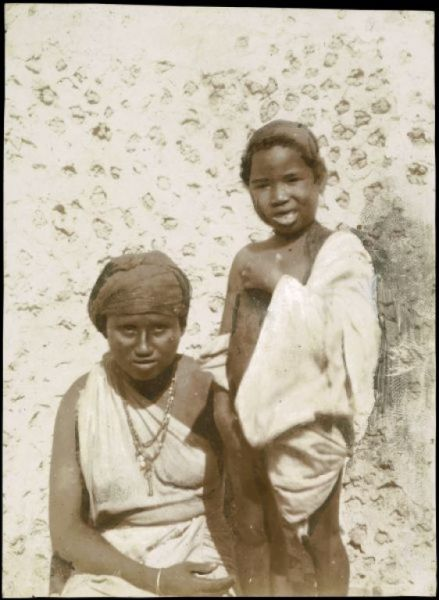
Here are two pictures of Oromo slaves in Somalia taken by Ugo Ferrandi (1891-1897)

65
At one point in history Somalis captured so many Oromo slaves that it was more common to see an Oromo slave than a Bantu one in Somalia. Below is a picture of an Oromo slave girl as well.
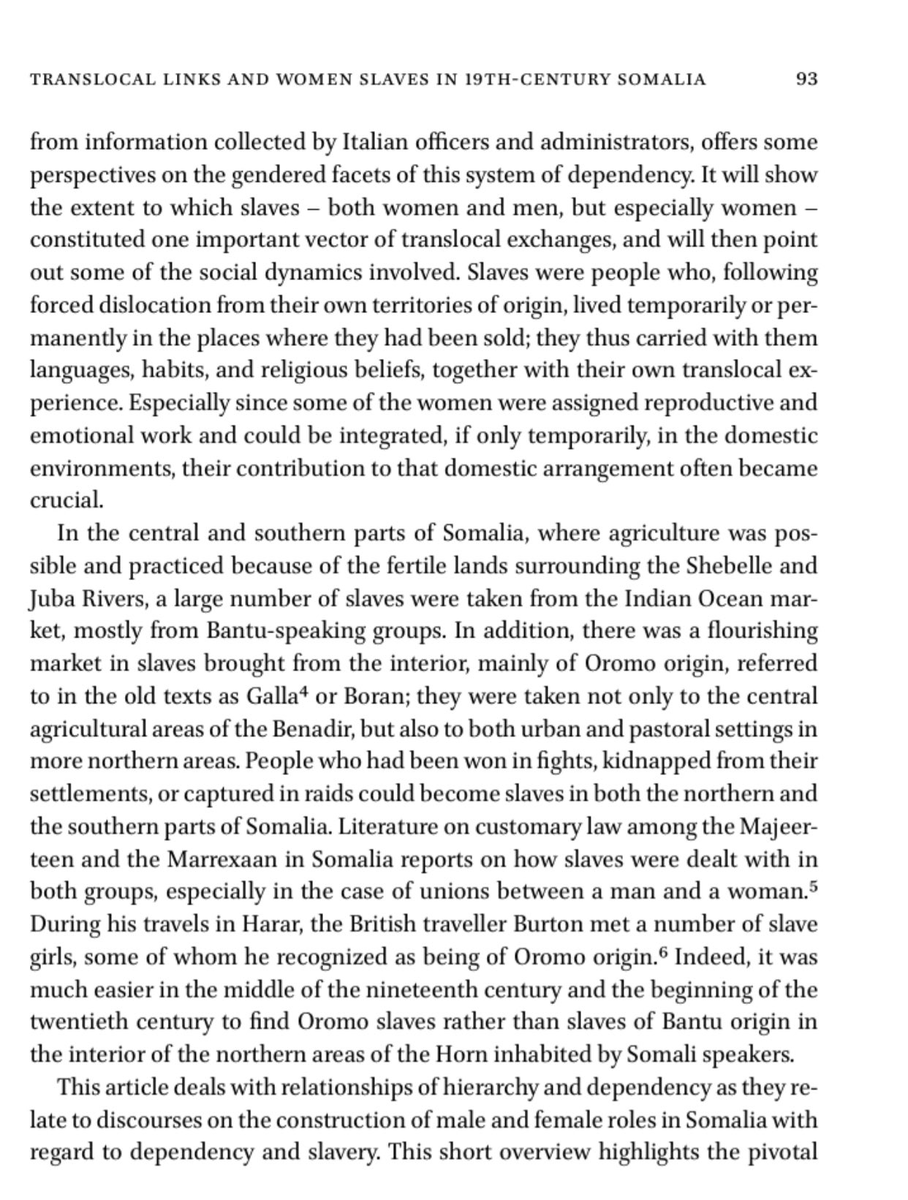
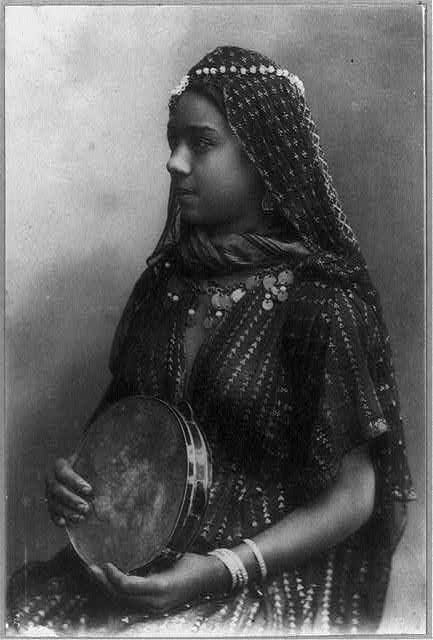
66
Italian explorer in Somalia says the slaves in this country are of two sorts : Galla (Oromo) & Swahili (Bantu)
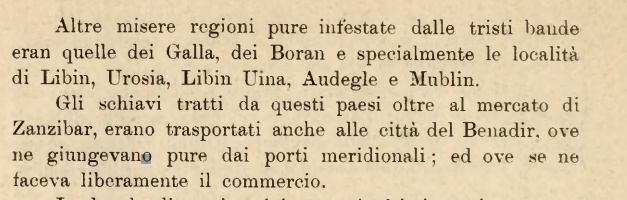
67
And we know the Bantu slaves only massively arrived in Somalia in the 19th century through the Zanzibari Omanis. So for more than a century the majority of slaves in Somalia and especially the Banaadir were Oromo Gallas.

68
Translocal Links and Women Slaves in Nineteenth-Century Somalia by Francesca Declich :
"Indeed, it was much easier in the middle of the nineteenth century and the beginning of the twentieth century to find Oromo slaves rather than slaves of Bantu origin in the interior of the northern areas of the Horn inhabited by Somali speakers."
A famous example being the Galla slave-girls of the Harar Emirate, to the right is a picture of a Galla concubine.
69
And these Oromos slave-girls did not appear in the city by accident, all Amiirs of Harar until the mid 1800s frequently led expeditions against the Oromos, especially in the late 18th century and dawn of the 19th where 3 Somali Amiirs of Harar that marked the peak of the Emirate of whom two are especially remembered for their subjugation and raids on the Galla tribes.

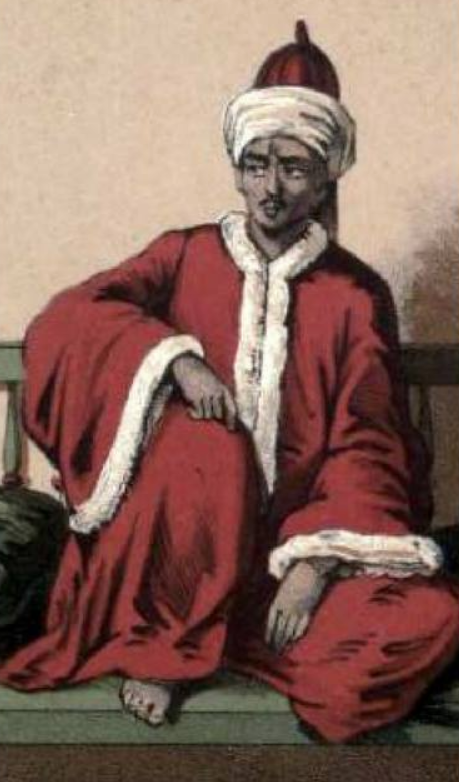
70
Amiir Ahmed bin Abu Bakr (1756-1783)
For nearly 30 years, he led a Jihad against the Oromos and successfully subjugated numerous Galla tribes, his conquests are commemorated in inscriptions partially destroyed by the Shewans, his successor Abd al Shakur built mosques in the conquered Galla territories like in Bale where Oromos still visit to this day.

For nearly 30 years, he led a Jihad against the Oromos and successfully subjugated numerous Galla tribes, his conquests are commemorated in inscriptions partially destroyed by the Shewans, his successor Abd al Shakur built mosques in the conquered Galla territories like in Bale where Oromos still visit to this day.
71
Amiir Ahmed bin Muhammad (1794-1820)
His predecessor, Abd al Shakur is remembered for a period of peace and prosperity where he was able to carry out many administrative reforms thanks to Ahmed bin Abu bakr's conquests, however Ahmed bin Muhammad followed on Ahmed bin Abu bakr's footsteps and resumed the punitive expeditions on the Galla tribes for a little more than two decades.

His predecessor, Abd al Shakur is remembered for a period of peace and prosperity where he was able to carry out many administrative reforms thanks to Ahmed bin Abu bakr's conquests, however Ahmed bin Muhammad followed on Ahmed bin Abu bakr's footsteps and resumed the punitive expeditions on the Galla tribes for a little more than two decades.
72
Due to the poor leadership of the 19th century in the Emirate's these raids stopped in the mid 1800s and although a majority of the Somali city was against it and a civil war broke out, figures like Emir Ahmed bin Abu bakr II (1852-1856) & his successors were the ones who made relations with the Oromos more favorable.

73
The three Amiirs of Harar shown above are not the first nor the last ones to be known for subjugating the Gallas tribes.
Amiir Nur bin Mujahid in the 16th century was the first to be reported leading succesful expeditions against the Galla tribes. In the contrary the last to lead significant raids against the Gallas was Muhammad Abdullah Hassan in the 1910s. A lot of Imams of Awsa are also especially remembered for their expeditions into Galla territory.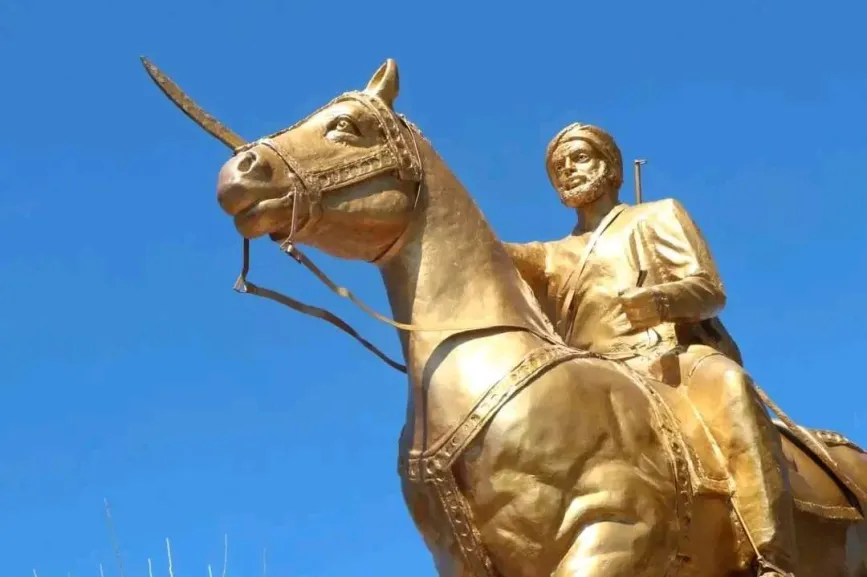
Amiir Nur bin Mujahid in the 16th century was the first to be reported leading succesful expeditions against the Galla tribes. In the contrary the last to lead significant raids against the Gallas was Muhammad Abdullah Hassan in the 1910s. A lot of Imams of Awsa are also especially remembered for their expeditions into Galla territory.
74
Now what I talked about above were the Northern and Western Somali-Oromo borders, if you think Oromos were safe in the south you're making a big mistake.
Things were not looking any better for Oromos in Kenya; Sherif Hussein had raided & traumatized the Oromos so badly that when he came to talk about a diplomatic matters with the Sultan of Witu the Oromos although being under the protection of the Sultan recognized the Sharif and his troops from his previous war expeditions and fled in terror from the city.
"In turn, there was no milk to be had in Witu on the day of the Somalis' arrival because the Oromo, "notwithstanding that they were under the protection of the Sultan, had fled in panic terror into the woods, with their herds, before the Somalis." These Somalis were part of a group which had carried on war expeditions even across the Tana. Peters wisely made a treaty of peace with Sharif Hussein."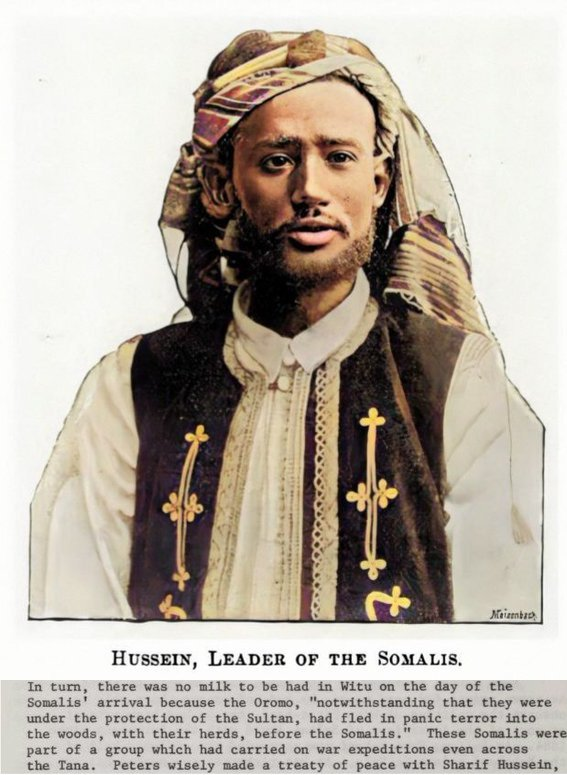
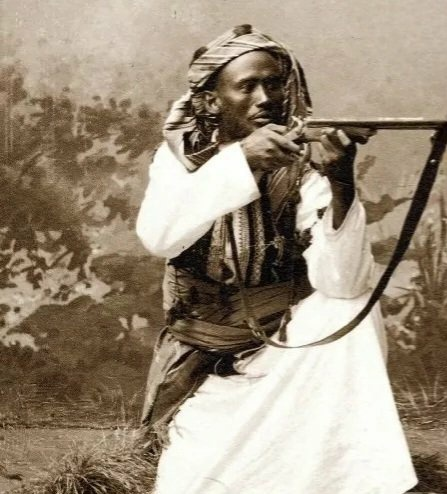
Things were not looking any better for Oromos in Kenya; Sherif Hussein had raided & traumatized the Oromos so badly that when he came to talk about a diplomatic matters with the Sultan of Witu the Oromos although being under the protection of the Sultan recognized the Sharif and his troops from his previous war expeditions and fled in terror from the city.
"In turn, there was no milk to be had in Witu on the day of the Somalis' arrival because the Oromo, "notwithstanding that they were under the protection of the Sultan, had fled in panic terror into the woods, with their herds, before the Somalis." These Somalis were part of a group which had carried on war expeditions even across the Tana. Peters wisely made a treaty of peace with Sharif Hussein."
75
According to Besteman, the 19th century in the Horn of Africa was marked by the absolute domination of the Somalis over the Oromo race, he acknowledges not only their subjugation but also their mass enslavement at the hands of the Somalis.

76
"The Somali must be imagined to be always on the offensive, especially in the southern area where the people are spread, and the Galla on the defensive. The Somali are victorious on all fronts, the Oromo are defeated everywhere.. in the south the Somali are waging a war of extermination against the Galla." - Philipp Paulitschke

77
To give some context as to how the situation got so bad for the Oromos in the south; the Oromos had invaded and occupied the Somali territories to the south of the Juba river in the 16th & 17th centuries at the dawn of the Oromo invasions, they destroyed all trace of Somali civilization like the city of Juba which was a big walled medieval city since the 10th century.
In 1819-23 Sheikh Ibrahim Hassan and his companions founded the fortified town of Bardheere. In the early 19th century the Shuyukh of the town launched a Jihad against the Oromos to reclaim the lands they took in the 16th century on the other side of the Juba. This would be the start of a century long reconquest where the Somalis chased the Oromos out of southern Somalia all the way to the Tana river in Kenya.
In 1819-23 Sheikh Ibrahim Hassan and his companions founded the fortified town of Bardheere. In the early 19th century the Shuyukh of the town launched a Jihad against the Oromos to reclaim the lands they took in the 16th century on the other side of the Juba. This would be the start of a century long reconquest where the Somalis chased the Oromos out of southern Somalia all the way to the Tana river in Kenya.
78
After two battles and two raiding expeditions which turned out catastrophic for the Oromos, the reconquest of the southern Juba started and it would end only when the Somalis reached British administered Kenya & the Tana river going as far as bordering the Bantu tribes.

79
Map Illustrating the first campaign 👇

80
It is clear from sources that the Galla tribes were getting constantly harassed and raided by the Somalis, the British consul in Zanzibar reports :
"In character the Galla and the Somali now show little resemblance to one another. The Somali are warlike and aggressive, proud and independent, with a marked taste for trade and travel. The Borana, on the other hand, are said to be a pleasant people to deal with, friendly and docile, but very lazy, dirty, and not very intelligent. They are quite incapable of holding their ground against the constant pressure of the Somali."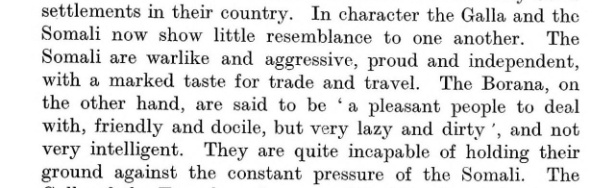
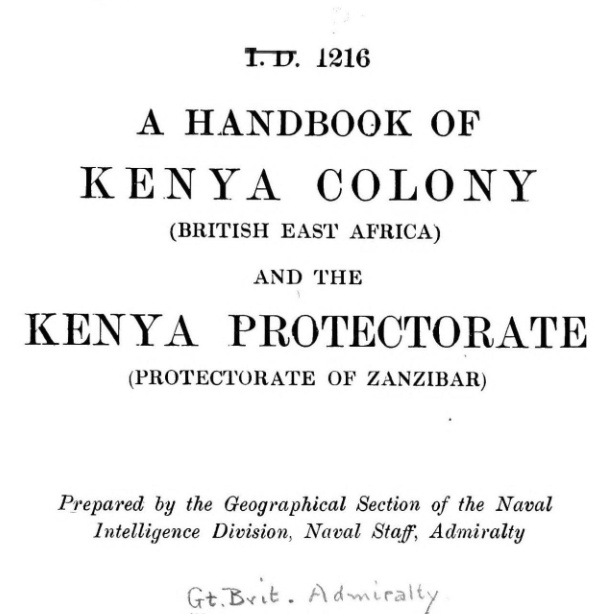
"In character the Galla and the Somali now show little resemblance to one another. The Somali are warlike and aggressive, proud and independent, with a marked taste for trade and travel. The Borana, on the other hand, are said to be a pleasant people to deal with, friendly and docile, but very lazy, dirty, and not very intelligent. They are quite incapable of holding their ground against the constant pressure of the Somali."
81
The reason why this was so catastrophic for the Gallas is that when the Gallas go to confront the Somali incursions they bring along all their family and leave no one at camp. So everytime they lost (which was the case most of the time) the men of a whole tribe would be slaughtered and the women and children would be captured and sent to Somalia, this is how many Galla tribes were completely decimated.
This became a key factor in the reconquest of the opposite bank of the Juba as the tribes who lost would immediately disappear off the map and the land they occupied would be vacant.
This became a key factor in the reconquest of the opposite bank of the Juba as the tribes who lost would immediately disappear off the map and the land they occupied would be vacant.
82
By the 1890s the reconquest was over, the Somali borders reached the Tana river and it is said the Somalis now not only successfully reconquered the southern bank of the Juba river but chased the Galla tribes all the way to the Tana river, and they did not stop there either as they would occasionally cross the river to make further incursions & raids on the Galla. Somali clans like Ajuuraan which lived on the other side of the Juba before the Oromo invasions also regained their lands.
"The Gállas at Golbanti said they feared the Somális even more than the Masai, as the former being good swimmers, the Tana River was no obstacle to them." - Swayne H. G. C.
"The Gállas at Golbanti said they feared the Somális even more than the Masai, as the former being good swimmers, the Tana River was no obstacle to them." - Swayne H. G. C.
83
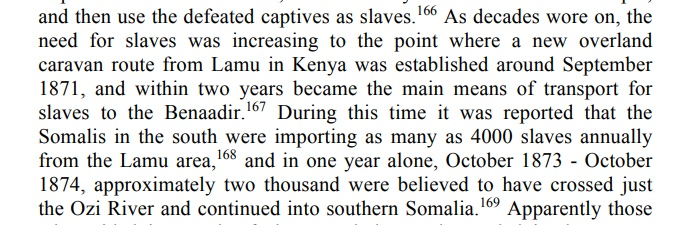
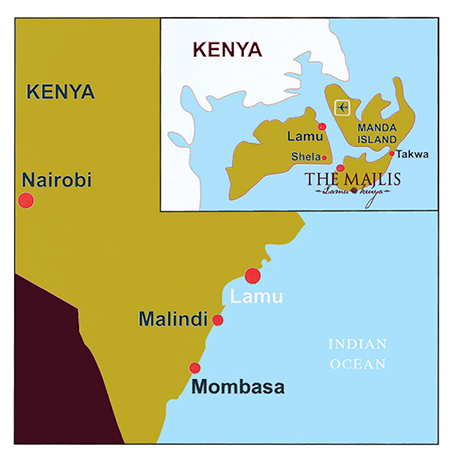
The Oromo slaves captured in raids across the Tana river were so numerous that in 1871 a new trade route was opened specifically for them in an effort to ship the captives faster from Kenya to the Somali cities in the Banaadir. The Somali tribes in Kenya would cross the Tana river and capture Oromos in their raiding expeditions, they would then ship them from Kenya to the Island of Lamu, then from there they would be put on other boats which shipped them to Somali cities like Mogadishu Merka & Brava. The Oromo slaves captured in raids across the Tana river amounted to approximately 6000 annually.
84
British ambassador to Zanzibar ; In his short stay at the city of Lamu he saw 4 boats full of Galla slaves arrive at the island from the Somali mainland

85
Mr. J. M. Hildebrandt in his travels in East Africa mentioned one of those Somali raids on Oromos across the Tana, he says that when the Somalis launch these incursions into Galla territory all trade routes in the area are shut down & no caravans go trough the country because they kill or capture anyone they see.

86
As late as 1928 Captain Clifford reports that Oromo tribes are getting "eternally raided" by Somali tribes in his 'Notes on Jubaland'

87
Journal of the African Society
The British author talking about the Galla of Kenya is clear about the reputation of their women at the hands of the Somalis 👇
The British author talking about the Galla of Kenya is clear about the reputation of their women at the hands of the Somalis 👇
88
(Patterns of Trade and Politics in the Somali Benadir, 1840-1885)
By the late 19th century it was reported that a great quantity of young Galla women were being sent from the fortress of Bardheere to the cities on the coast which shows how successful the century long Jihad that the Shuyukh of Bardheere started was.
To the right is an European drawing of the fortress.

By the late 19th century it was reported that a great quantity of young Galla women were being sent from the fortress of Bardheere to the cities on the coast which shows how successful the century long Jihad that the Shuyukh of Bardheere started was.
To the right is an European drawing of the fortress.
89
The inhabitants of the fortress of Bardheere also all had Galla concubines, here is the son of the Sheikh of Bardheere illustrated with his Galla Borana wife gifted to him by his father, he was a 'camel driver' and spent his days leading caravans on his camel with her.
Illustration below 👇
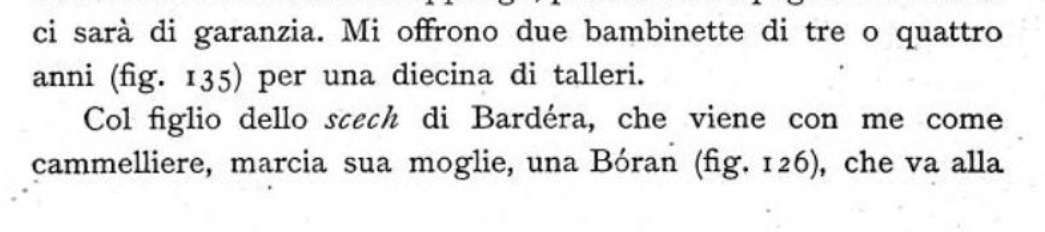
Illustration below 👇
90
The history of Bardheere and their military expeditions against Oromos are still very blurry and lack proper research.
Below is a picture of one of the Shuyuukh of Bardheere, it was provided by his grandson which has in his possession a considerable a mount of manuscripts on the history of the city.
Future research on the history of southern Somalia will certainly tell us more on the history of the slave trade in that period.
91
The Oromos had lost a territory as big as Poland in less than a century.
When the Somalis conquered the area and re-settled in the Juba-Tana area the remaining Galla tribes which survived where all enslaved and took up the name of Wardey/Orma, they adopted Somali culture overtime but did not mix with Somali tribes. The enslavement process also persisted under British colonial rule in Kenya and the colonial authorities preferred avoiding the situation until Kenya's independence in the mid 20th century.

When the Somalis conquered the area and re-settled in the Juba-Tana area the remaining Galla tribes which survived where all enslaved and took up the name of Wardey/Orma, they adopted Somali culture overtime but did not mix with Somali tribes. The enslavement process also persisted under British colonial rule in Kenya and the colonial authorities preferred avoiding the situation until Kenya's independence in the mid 20th century.
92
Throughout the 20th century British colonial administrators recognized that the position of the Oromo living among the Somalis amounted to slavery, yet consistently intervened to maintain the over-lordship rights of Somali masters in instances of Oromo attempts to gain their freedom.

93
Now that we've talked about Somali historical figures into north-western Galla territory and what happened in the south let me also talk about the constant raids the Somalis were doing in the western interior border. Somalis from all over Somalia lead raiding expedition to capture and sell Galla slaves, whole families are known to have become exceedingly rich from this business in the 1700s & 1800s.
Here is a documented example :
In a single expedition Shaykh Murgan Yusuf captured 8000 Oromo women, to give an idea of how big that number is; even if he keeps 1000 to distribute it among his family this means he could have made 7000x1800$ meaning in one expedition this Shaykh could have made around 12,6M$.
This truly shows how profitable this business was.
94
Same Italian explorer in Somalia that I quoted above says that the Oromo slaves in Somalia are captured from 6 Oromo tribes/confederations one of which being the Arussi which is the most widespread in the Ethiopia, and the Arussi do not directly border Somalis which shows how deep these incursions could reach.
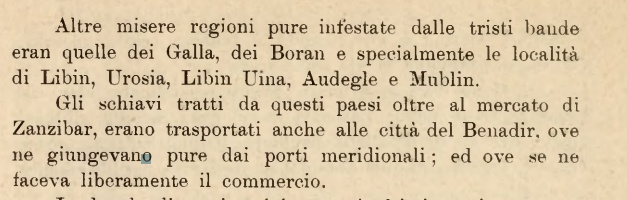
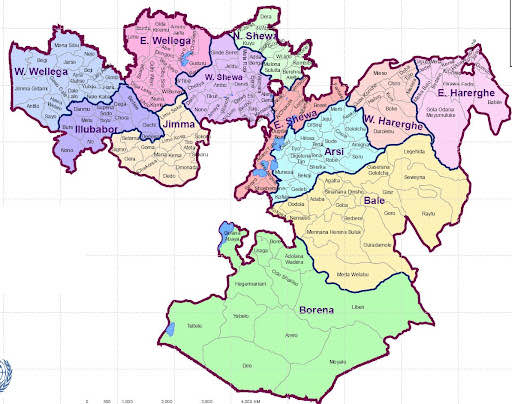
95
To give an idea of how far Somali raiders could go, here the Somali Issa raids are said to have reached as far Hereto in Oromiya 👇
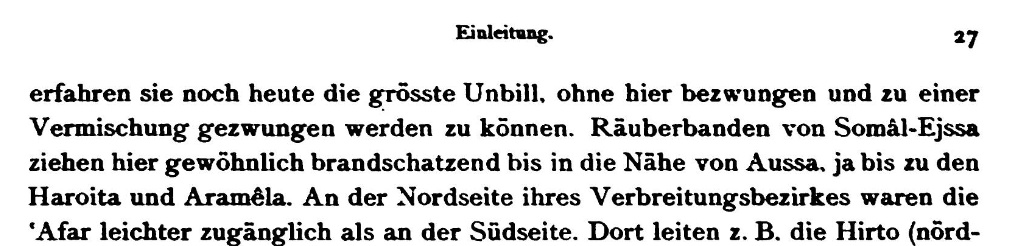

96
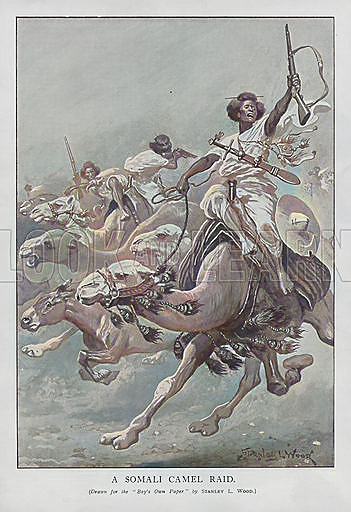
Illustrations of Somalis raiders 🐪⚔️

97
In these frequent raids, the Somalis would kill the Oromo men of a whole tribe and take their women and children for themselves, the only male slaves that could be seen in Somalia were captured when they were younger.


98
As for the women, they were either sold or kept as concubines.


99
Here is a story of a French explorer in the Galla country found in a 19th century newspaper. While he was in a Galla village, Somali raiders launched a surprise attack on the place, it is said that as soon as the Galla women heard the Somali raiders galloping towards their village they started fleeing and yelling out of fear as they knew the Somalis came especially for them.

100
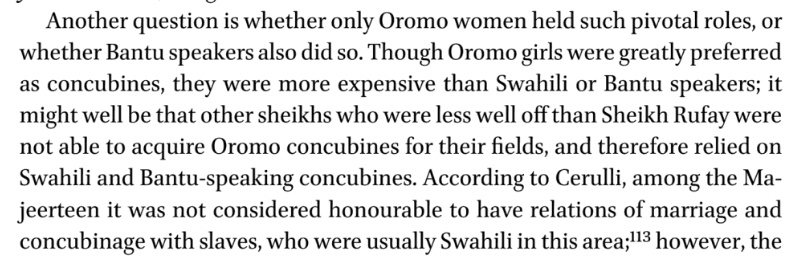
On the contrary of the Bantu slave girls, the Oromo slave girls in Somalia were not only used in the fields but were also most preferred as concubines as having sexual intercourse with Bantus was seen as repulsive or loathsome by Somalis.

101
Here we can see how Galla slave girls could cost nearly twice the amount of a Bantu Swahili slave girl in Somalia, as said here this can be explained by the fact that Somalis considered Galla slave-girls more sexually attractive than Bantus as I've pointed out before.

102
These charts represent the average prices of slaves in the markets of throughout Somalia and their purpose, as you can see Swahilis are cost the least and Galla women which are bought as concubines but also maids.
In today's currency :
- Oromo (Female) = 1800$
- Oromo (Male) = 1200$

In today's currency :
- Oromo (Female) = 1800$
- Oromo (Male) = 1200$
103
An example of this can be seen when a French explorer who was a guest at a Somali Sheikh's house in the city of Brava narrates how every morning when they woke up they would sit down to have breakfast and the fourth wife of the Sheikh who was a Galla slave girl would cook and bring them a delicious meal. This illustrates perfectly the role of Oromo concubines in Somalia, they acted as maids & servants but also often as a second or fourth wife.
"Having spent the night in a plantation of Rufay, and his fourth wife, a very pretty Galla slave, with large black eyes, who lived there, having served me an excellent breakfast consisting of coffee beans not separated from their shell, roasted in butter and sprinkled with sugar; then corn also roasted, with fresh milk"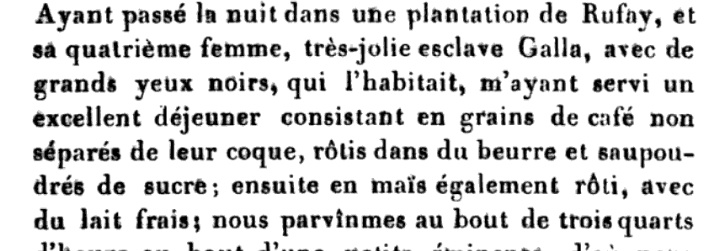

"Having spent the night in a plantation of Rufay, and his fourth wife, a very pretty Galla slave, with large black eyes, who lived there, having served me an excellent breakfast consisting of coffee beans not separated from their shell, roasted in butter and sprinkled with sugar; then corn also roasted, with fresh milk"
104
Now on the topic of freed Oromo slaves :
The freed Oromo slaves in Somalia would often mix with the freed Bantu Swahili ones, the example given here is Borana Oromo x Bantu. The fusion of these two backgrounds of freed slave created a new people in Somalia who are called the 'Gubahin' : a race made up of freed Bantu and Galla slaves who intermixed with each others. they are oppressed and looked down upon by the Somalis till this day, seen as an inferior outcast.
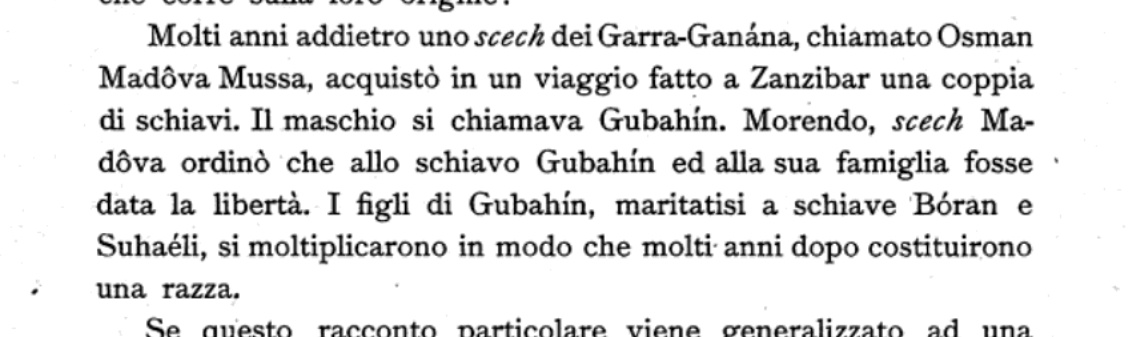
The freed Oromo slaves in Somalia would often mix with the freed Bantu Swahili ones, the example given here is Borana Oromo x Bantu. The fusion of these two backgrounds of freed slave created a new people in Somalia who are called the 'Gubahin' : a race made up of freed Bantu and Galla slaves who intermixed with each others. they are oppressed and looked down upon by the Somalis till this day, seen as an inferior outcast.
105
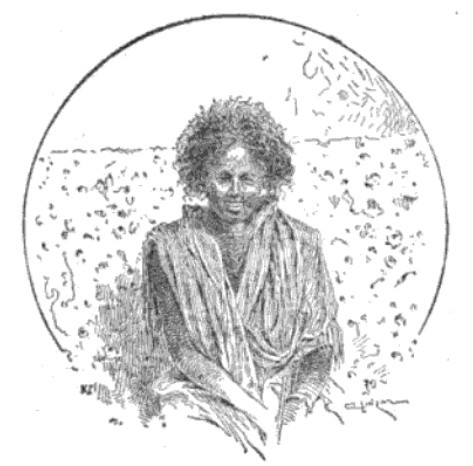
Even after the Bantu arrival some sources say that the Galla slaves were most preferred to work in the plantations of Somalia.

106
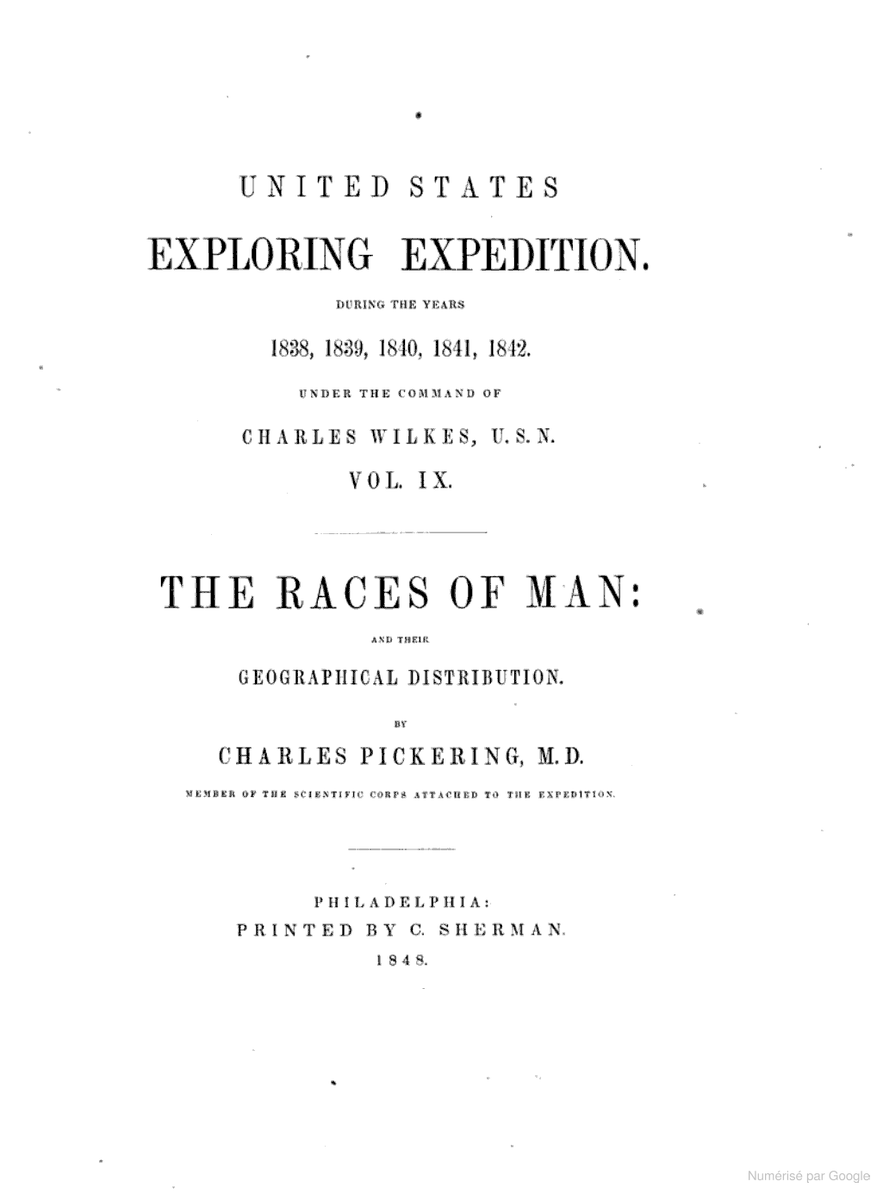
But we all know the Bantus in Somalia were preferred for crop cultivation so how could Oromos do that job ?
This question is very well answered by some sources which go in a bit more in detail, like in this book where it is said that the city of Brava in the Banaadir, the Galla slaves were known to cultivate specific plants like the Finger millet (Eleusine coracana).
This question is very well answered by some sources which go in a bit more in detail, like in this book where it is said that the city of Brava in the Banaadir, the Galla slaves were known to cultivate specific plants like the Finger millet (Eleusine coracana).
107
Now Oromos have been trying to cope by saying that they are Somalis since they are wearing clothes similar to Somalis. This logic is really dumb and here is an example of an Oromo slave wearing the same thing, do you guys really think they were gonna be naked or something ? I have also talked about this earlier in the thread.

108
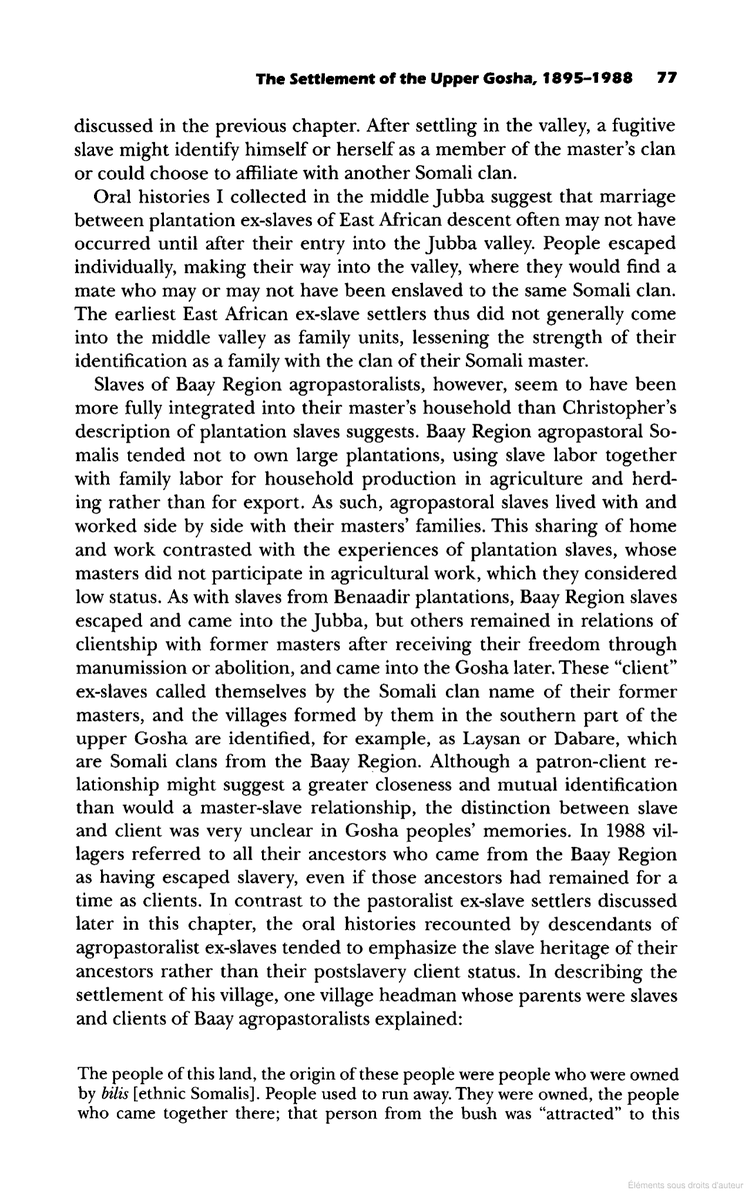
Oromo slaves also identified with their Somali master's tribe, this applies before and after being freed so in some descriptions you will see them being identified as a Somali tribe like Abgaal but in reality we call them "Abgaal Af Af" (the ex-slaves of Abgaal) 👇

109
The abolition of slavery in Somalia only came in effect in 1912 and even then it did not change much as the Oromos would still work as client farmers for their Somali ex-masters. The Italian colonial regime sided with the slaves former masters in an effort to keep farm labor under the discipline of traditional authority for much longer.


110
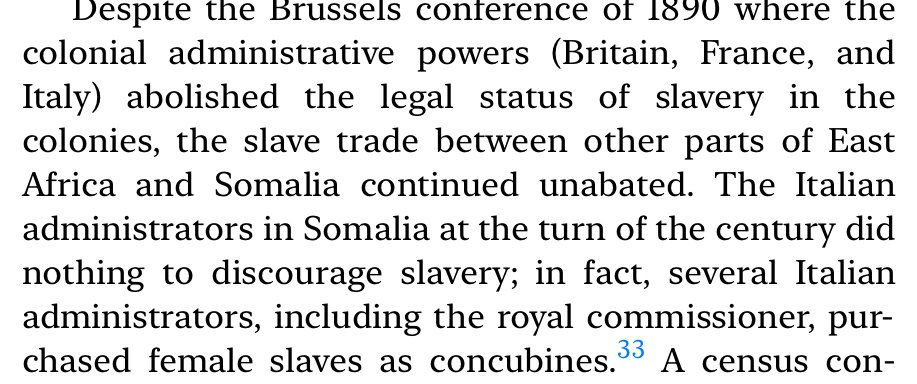
Not only did the Italians side with Somali slave owners but some of them even purchased Galla concubines, contributing to the slave trade that they were supposed to suppress.
111
In many cases the Italians handed over fugitive slaves back to their Somali masters, hearing of the abolition of slavery by the Italians, these slaves from the interior escaped from their masters and came to the coast to gain their freedom and get a safe passage back to their homeland in Central Ethiopia.

112
In fact in 1903 when a group of Oromo slave-girls in Somalia asked the Italians for help to go back to their homeland in Oromiya the Italian officials refused to take them on a caravan headed to the interior saying that they would either become prostitutes or get enslaved by Somali raiders again. This is why as I pointed out above most freed Oromo slaves in Somalia assimilated into communities of freed Bantu slaves as they both couldn't make it back to their homeland (even after being freed).


113
Although being free on paper, these ex-slaves were still dependent on their masters and even after the virtual abolition of slavery in Somalia the Oromos were still treated as slaves.
"..every Galla living with the Somalis is virtually a slave. Children born of Galla girls among Somalis are virtually slaves and therefore exploitable."
"..every Galla living with the Somalis is virtually a slave. Children born of Galla girls among Somalis are virtually slaves and therefore exploitable."
114
And finally I'm going to end this beautiful thread by presenting to you the first ever freed slave in Somalia; Galla Abdallah 🇪🇹🌳
I hope Oromos will take this thread as a lesson to stop trying to manipulate history, as shameful as it may be. If any of them starts acting up just quote this thread to remind them who was in charge.
Wa Salaamu Caleykum 🫡
I hope Oromos will take this thread as a lesson to stop trying to manipulate history, as shameful as it may be. If any of them starts acting up just quote this thread to remind them who was in charge.
Wa Salaamu Caleykum 🫡


