In my previous post, I demonstrated how Waze user data can be...

harry@Harrris0n
53 views
Jan 23, 2026
~2 min read
Advertisement
1
In my previous post, I demonstrated how Waze user data can be scraped from the public web map to track individuals.
But I glossed over something important: what does Waze's own privacy policy say about your data?
I went through the full policy. Here's what stood out.
But I glossed over something important: what does Waze's own privacy policy say about your data?
I went through the full policy. Here's what stood out.
2
1. They Track You Even When You're Not Using the App
From the policy:
"GPS signals (combined with a time-stamp), IP address and other information from sensors"
And crucially:
Collection occurs "also while you are not using the app"
This means Waze can collect location data in the background. You don't need to have the app open.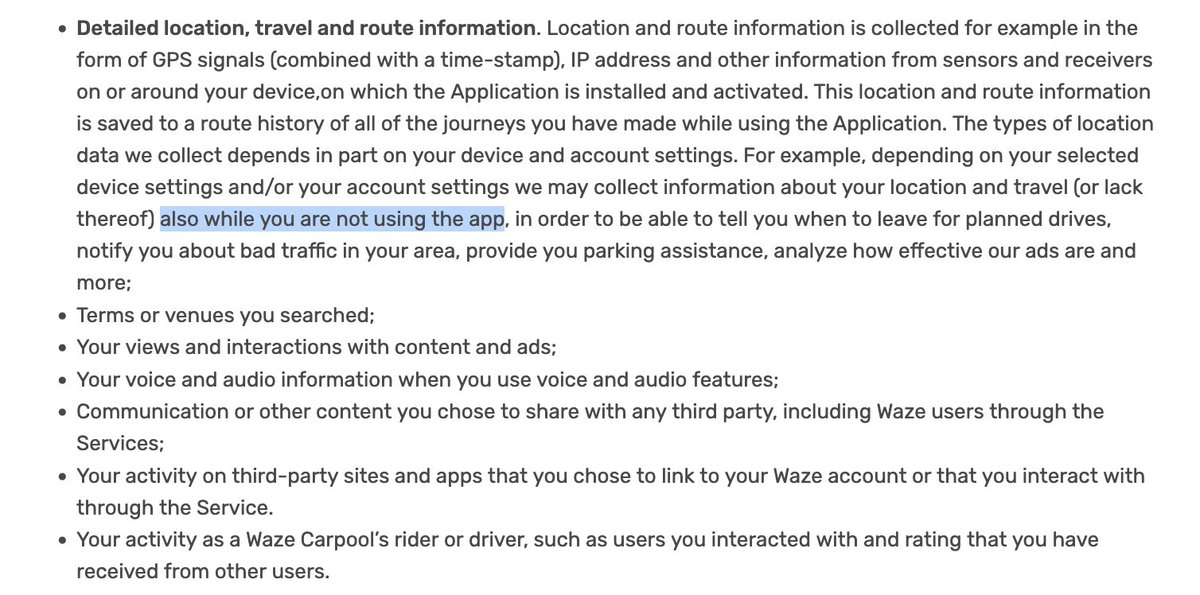
From the policy:
"GPS signals (combined with a time-stamp), IP address and other information from sensors"
And crucially:
Collection occurs "also while you are not using the app"
This means Waze can collect location data in the background. You don't need to have the app open.
3
2. They Store Your Entire Route History
"Route history captures all of the journeys you have made while using the Application"
Not summaries. Not aggregates. Every journey.
This creates a complete historical record of your movements.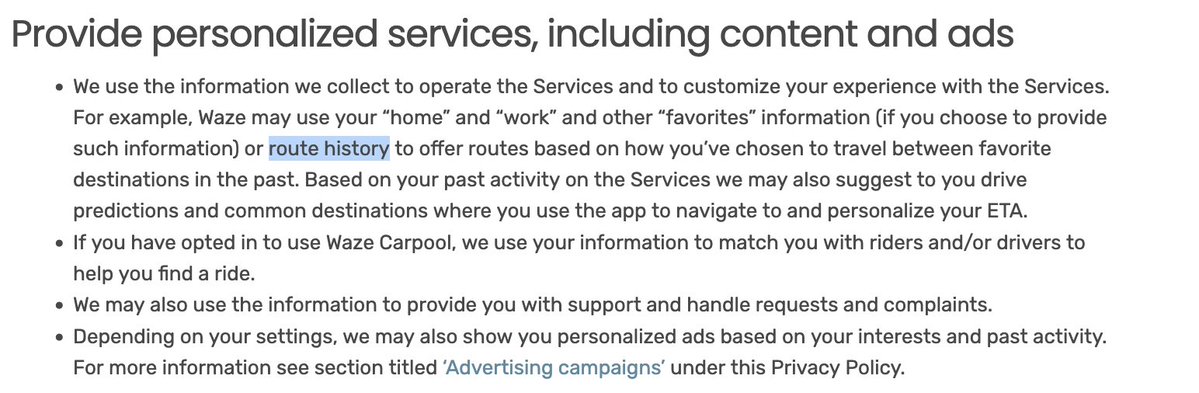
"Route history captures all of the journeys you have made while using the Application"
Not summaries. Not aggregates. Every journey.
This creates a complete historical record of your movements.
4
3. Law Enforcement Access is Broad
The policy states Waze will share your data:
"To comply with any applicable law and assist law enforcement agencies...when Waze has a good faith belief that Waze's cooperation with the law enforcement agencies is legally mandated or meets the applicable legal standards"
The phrase "good faith belief" gives Waze significant discretion. They don't need a warrant – just a belief that cooperation "meets applicable legal standards."
5
4. Data Retention is Indefinite
Account information is retained "until you choose to remove it"
Some data is kept "for the life of your Waze Account"
And if you do request deletion:
Deletion "generally takes around 2 months"
Two months is a long time for location data to remain accessible after you've asked for it to be removed.
Account information is retained "until you choose to remove it"
Some data is kept "for the life of your Waze Account"
And if you do request deletion:
Deletion "generally takes around 2 months"
Two months is a long time for location data to remain accessible after you've asked for it to be removed.
6
5. Sharing with Google and Affiliates
Waze is owned by Google. The policy permits sharing with:
"Companies or organizations connected or affiliated with Waze, such as subsidiaries...parent companies"
This means your Waze data can flow into Google's broader data ecosystem.
Waze is owned by Google. The policy permits sharing with:
"Companies or organizations connected or affiliated with Waze, such as subsidiaries...parent companies"
This means your Waze data can flow into Google's broader data ecosystem.
7
6. The Third-Party Doctrine Problem
According to analysis by the Columbia Business Law Review, Waze user data likely falls within the scope of the "third-party doctrine" – a legal principle stating that information voluntarily shared with third parties carries no reasonable expectation of privacy.
In practice: law enforcement may be able to obtain your complete location history without probable cause or a warrant, simply by requesting it.
8
7. What This Means
Your Waze data can reveal:
Home address (where you park overnight)
Workplace (where you spend 9-5)
Religious affiliation (regular visits to places of worship)
Medical conditions (visits to specialists)
Political activities (attendance at rallies)
Personal relationships (repeated visits to specific addresses)