Russia as Colonial Power 84 years ago Russian deportations started...

Martin Sauerbrey@MartinSauerbrey
1 views
Nov 12, 2026
~5 min read
Advertisement
1
Russia as Colonial Power
84 years ago Russian deportations started mass deportations in the Baltics
Why the Baltics are a good example why it should be a goal to restore Ukraine in it´s 1991 borders as fast as possible.
A long 🧵
1/x
84 years ago Russian deportations started mass deportations in the Baltics
Why the Baltics are a good example why it should be a goal to restore Ukraine in it´s 1991 borders as fast as possible.
A long 🧵
1/x
2
The Baltics seem to have regained their independece after they were "occupied for half a century."
So now let´s take a dive into Baltic history and look into the history of Russian and Soviet occupation of the Baltics.
2/x
So now let´s take a dive into Baltic history and look into the history of Russian and Soviet occupation of the Baltics.
2/x
3
Let´s start with the obvious: The Russian occupation of the Baltics lasted much longer.
- Estonia and parts of Livland (Latvia) came under Russian rule in 1710
- Lithuania and the rest of Latvia became part of the Russian Empire in 1795 after the 3rd Partition of Poland
3/x
- Estonia and parts of Livland (Latvia) came under Russian rule in 1710
- Lithuania and the rest of Latvia became part of the Russian Empire in 1795 after the 3rd Partition of Poland
3/x
4
From 1889 onwards, Estonia was subjected to Russification, which mainly affected the German elites but also the fledgling Estonian middle classes. After the revolution in 1905, demands for independence became louder.
4/x
4/x
5
The Lithuanians and Poles revolted against Russia twice: in 1830-31 and 1863-64. Both uprisings failed and Russian repression and Russification measures steadily increased. During World War I, parts of Lithuania belonged to the German "Ober Ost" occupation zone and
5/x
5/x
6
the Baltic Germans in particular cooperated with the occupying power. The German plans to annex Lithuania were rendered meaningless by the defeat in WW I. However, a kind of provisional government was able to form under German occupation.
6/x
6/x
7
With the Octoberrevolution in 1917 in Russia and the defeat of the Central Powers new possibilities opened for the Region. The Balts, Poland and Belarus tried to gain independence and a bloody struggle began in which German Freikorps, the Red Army, Poles, Latvians.
7/x
7/x
8
Estonians, Lithuanians fought against each other with the Red Army as the main adversaries. After a series of bloody struggles all three Baltic states gained their independence.
8/x
8/x
9
- Estonia in the Treaty of Tartu on 2 February 1920. In this treaty, the Bolsheviks renounced all territorial claims against Estonia forever.
- Latvia in the Latvian-Soviet Peace Treaty on 11 August 1920
9/x
- Latvia in the Latvian-Soviet Peace Treaty on 11 August 1920
9/x
10
- Lithuania: On July 12, 1920, the Bolsheviks and Lithuanians signed the Soviet-Lithuanian Peace Treaty, in which the Soviets renounced all territorial claims. On October 7, 1920, the Suwłaki Treaty was concluded with Poland, which annexed the Vilnius region.
10/x
10/x
11
Freedom only lasted a short time because on August 23, 1939, the Soviet Union and the Third Reich signed the Molotov-Ribbentrop Pact, in whose "secret additional protocol" they divided Eastern Europe between themselves.
11/x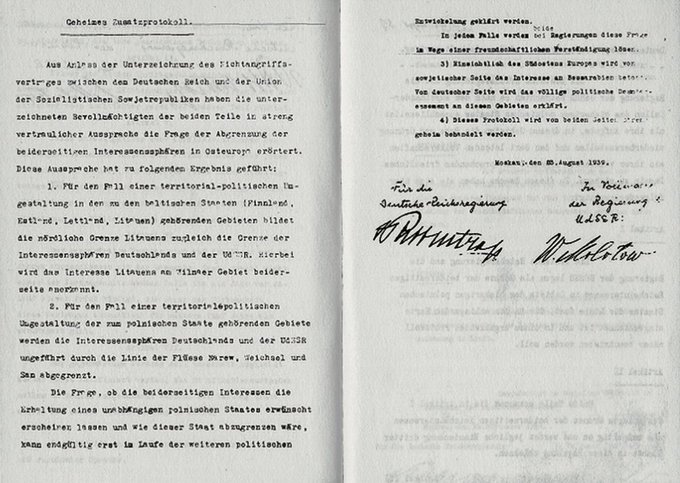
11/x
12
As early as the autumn of 1939, the USSR forced the Baltic states to agree to the stationing of Soviet troops on their territory. In 1940, the NKVD began to provoke unrest. In Latvia, politicians were murdered and replaced by Soviet cadres, "elections" were held in
12/x
12/x
13
which only pro-Soviet candidates were allowed. This government applied for admission to the USSR. On August 5, 1940, Latvia became part of the USSR. Before Operation Barbarossa, at least 35,000 Latvians were deported to Siberia, about 40% died.
13/x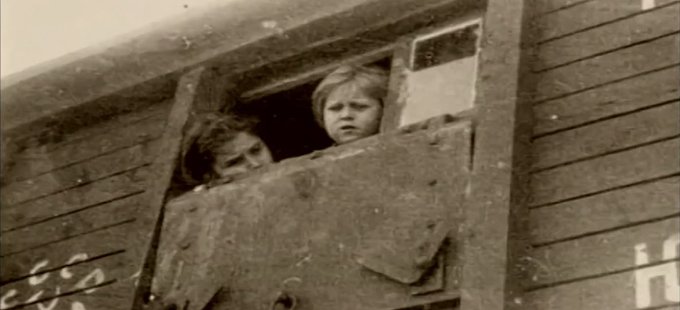
13/x
14
Lithuania was given an ultimatum on June 14, 1940. 150,000 Soviet soldiers invaded Lithuania. Around 12,000 "enemies of the people" were arrested. Around 12,000 were deported. Many were murdered.
14/x
14/x
15
Estonia was occupied on June 16, 1940. About 8,000 politicians, officers and officials were immediately arrested, 2,200 were executed in Estonia, many were sent to the GULAG. Another 10,000 Estonians were also deported to Siberia. About 30,000 men were sent to Russia,
15/x
15/x
16
many of whom died in "worker battalions".
When the Wehrmacht and SS invaded the Baltic States, they were celebrated by many as liberators - also because of their history. Many collaborated, helped in the Holocaust, fought in the Wehrmacht and SS.
16/x
When the Wehrmacht and SS invaded the Baltic States, they were celebrated by many as liberators - also because of their history. Many collaborated, helped in the Holocaust, fought in the Wehrmacht and SS.
16/x
17
The hopes were quickly dashed and resistance against the new occupiers quickly developed. However, the USSR remained the main enemy. Public resistance against the Germans was strongest in Lithuania where they had to chancel a planed SS-Division because of public dissent.
17/x
17/x
18
After the Soviets reconquered the Baltics, the terror began again. Between 1945 and 1953, around 290,000 Balts were deported. Many of them during "Operation Priboi" in March 1949.
18/x
18/x
19
In all three states, armed resistance continued until the 1950s. At the same time, many ethnic Russians came to the Baltic States with the new rulers, many of them as colonists. After Stalin's death, the situation improved but Russification went on.
19/x
19/x
20
With Gorbachev's Perestroika and Glasnost, the desire for independence grew louder and in 1991 all three became independent. In Latvia and Lithuania the Soviets tried to suppress it. This failed. The USSR collapsed.
20/x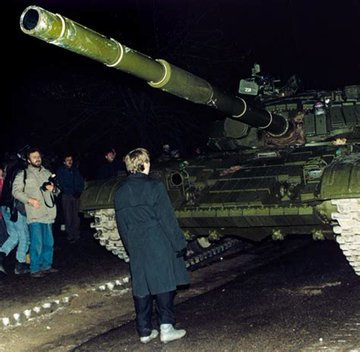
20/x
21
This should make it clear that the Russian (Soviet) occupation
a) lasted much longer
b) was often accompanied by terror, murder, rape, deportation, Russification
The Balts (and Eastern Europeans) have learned their lessons and try to warn the rest of Europe and the USA.
21/x
a) lasted much longer
b) was often accompanied by terror, murder, rape, deportation, Russification
The Balts (and Eastern Europeans) have learned their lessons and try to warn the rest of Europe and the USA.
21/x
22
This would be a mere historical lesson if we would not see the same happening in Ukraine right now: 1) Deportations: Tens of thousands of children have been deported to Russia. They are adopted by Russians, sent to "summer camps" to be "Russified" and are often mistreated.
22/x
22/x
23
Adults also have been forcefully deported to Russia or have been expelled.
2) Torture, murder, rape are a daily business in the occupied territories.
3) Eviction, passportisation are daily business
23/x
2) Torture, murder, rape are a daily business in the occupied territories.
3) Eviction, passportisation are daily business
23/x
24
4) Ukrainian culture is being suppressed and destroyed. Books are being destroyed, Ukrainian is being banned, teachers are being fired. Nothing less than the complete annihilation of Ukrainian culture is being attempted here.
24/x
24/x
25
The longer the occupation lasts, the closer Russia comes to its goal. It´s completly dilusional to think that Russia will give back the already annexed territories. The history of the Balts should make that clear. Eastern European people
25/x
25/x
26
share this experience nad that´s one - if not THE - main reason they were so eager to join NATO. Because they fear Russia. Because they know that Russia will most likley not stop in Ukraine.
26/x
26/x
27
It´s paramount to bring Ukraine in a position of strenght in order to make it possible to negotiate on Ukraines terms. Without massive support there will be no negotiations. There will only be war until Russia wins or collapses out of some reason. End