I posted something similar yesterday, but here is a different...

William A. Wallace, Ph.D.@WilliamWallace
74 views
Jan 09, 2026
~2 min read
Advertisement
1
I posted something similar yesterday, but here is a different graphical representation of nutrient absorption in the GI tract, explained simply:
1️⃣ Stomach – preparation and partial absorption
The stomach begins protein digestion through acid and enzymes while absorbing a few small molecules such as water, ethanol, and some minerals.
🟢 Example: Copper, iodide, and fluoride can pass directly through the stomach lining, but most nutrients remain bound until released in the small intestine.
2️⃣ Duodenum – the entry point for minerals and fat-soluble vitamins
As chyme from the stomach mixes with bile and pancreatic enzymes, the duodenum becomes the main site for mineral and fat-soluble vitamin absorption.
🟢 Example: Calcium, iron, magnesium, and vitamins A, D, E, and K are absorbed here, often requiring bile acids for solubility.
3️⃣ Jejunum – primary absorption zone for macronutrients
The jejunum’s extensive villi and microvilli surface area make it the key site for nutrient uptake.
🟢 Example: Lipids, monosaccharides, amino acids, and small peptides are efficiently absorbed, along with B vitamins such as thiamin, riboflavin, and niacin.
4️⃣ Ileum – absorption of specialized compounds and vitamins
The ileum completes digestion and reclaims nutrients not absorbed upstream.
🟢 Example: Vitamin B12 binds to intrinsic factor for absorption here, while bile salts and fat-soluble vitamins are recycled back to the liver.
5️⃣ Large intestine – water recovery and microbial synthesis
Although most nutrients are absorbed earlier, the colon plays a key role in fluid and electrolyte balance and produces additional vitamins through bacterial fermentation.
🟢 Example: Gut microbes synthesize vitamin K and biotin, while fermentation of fiber yields short-chain fatty acids that fuel colon cells.
Your gut is not a single absorption site but a coordinated system of specialized regions—each tuned to extract specific nutrients with precision, ensuring that every molecule from food is used efficiently to sustain life.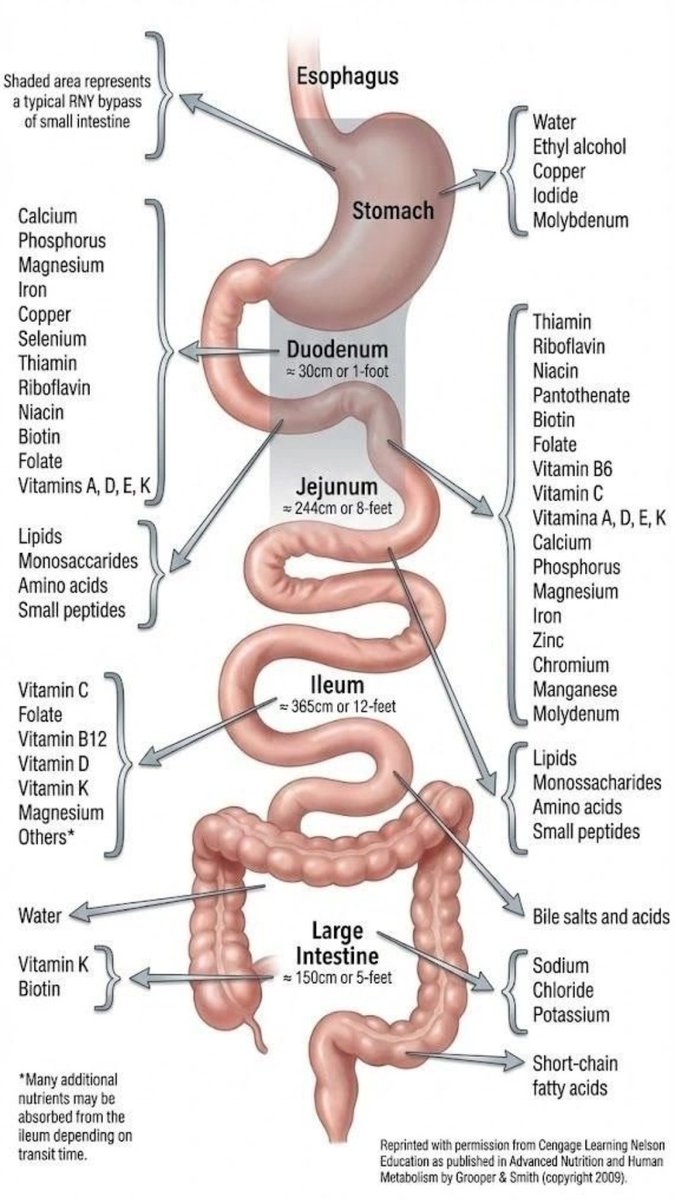
1️⃣ Stomach – preparation and partial absorption
The stomach begins protein digestion through acid and enzymes while absorbing a few small molecules such as water, ethanol, and some minerals.
🟢 Example: Copper, iodide, and fluoride can pass directly through the stomach lining, but most nutrients remain bound until released in the small intestine.
2️⃣ Duodenum – the entry point for minerals and fat-soluble vitamins
As chyme from the stomach mixes with bile and pancreatic enzymes, the duodenum becomes the main site for mineral and fat-soluble vitamin absorption.
🟢 Example: Calcium, iron, magnesium, and vitamins A, D, E, and K are absorbed here, often requiring bile acids for solubility.
3️⃣ Jejunum – primary absorption zone for macronutrients
The jejunum’s extensive villi and microvilli surface area make it the key site for nutrient uptake.
🟢 Example: Lipids, monosaccharides, amino acids, and small peptides are efficiently absorbed, along with B vitamins such as thiamin, riboflavin, and niacin.
4️⃣ Ileum – absorption of specialized compounds and vitamins
The ileum completes digestion and reclaims nutrients not absorbed upstream.
🟢 Example: Vitamin B12 binds to intrinsic factor for absorption here, while bile salts and fat-soluble vitamins are recycled back to the liver.
5️⃣ Large intestine – water recovery and microbial synthesis
Although most nutrients are absorbed earlier, the colon plays a key role in fluid and electrolyte balance and produces additional vitamins through bacterial fermentation.
🟢 Example: Gut microbes synthesize vitamin K and biotin, while fermentation of fiber yields short-chain fatty acids that fuel colon cells.
Your gut is not a single absorption site but a coordinated system of specialized regions—each tuned to extract specific nutrients with precision, ensuring that every molecule from food is used efficiently to sustain life.