Your muscles aren’t just moving weight, they’re protecting your...

William A. Wallace, Ph.D.@WilliamWallace
71 views
Jan 01, 2026
~1 min read
Advertisement
1
Your muscles aren’t just moving weight, they’re protecting your brain.
Every rep you lift sends signals far beyond the muscle.
The brain feels it.
Blood vessels feel it.
Your long-term cognitive health feels it.
A single, well-designed strength-training routine influences:
🔹 Endothelial function & cerebral blood flow: keeping the brain’s vascular system responsive and healthy.
🔹 Neurotrophic factors: the growth signals your brain uses to repair, adapt, and form memories.
🔹 Blood–brain barrier integrity: the shield that protects your brain from toxins and inflammation.
🔹 White-matter preservation: the wiring that keeps your cognition sharp.
🔹 Amyloid and tau accumulation: proteins strongly linked to Alzheimer’s pathology.
🔹 Inflammation and antioxidant defenses: the balance that determines how fast the brain ages.
🔹 Cognition & memory: the functional outcome that actually matters.
Greater muscle strength is consistently associated with lower Alzheimer’s and dementia risk.
Not because muscles and memory are directly connected…
but because resistance training remodels the systems that support brain health.
And none of this works without a program people can actually stick to. Effective resistance training requires:
• Adoption: getting people started
• Adherence: keeping them going
• Feasibility: making it accessible for everyone
Citation
Allison E.Y., Bedi A.M., Rourke A.J., Mizzi V., Walsh J.J., Heisz J.J., Al-Khazraji B.K. (2025).
Resisting decline: The neuroprotective role of resistance exercise in supporting cerebrovascular function and brain health in aging.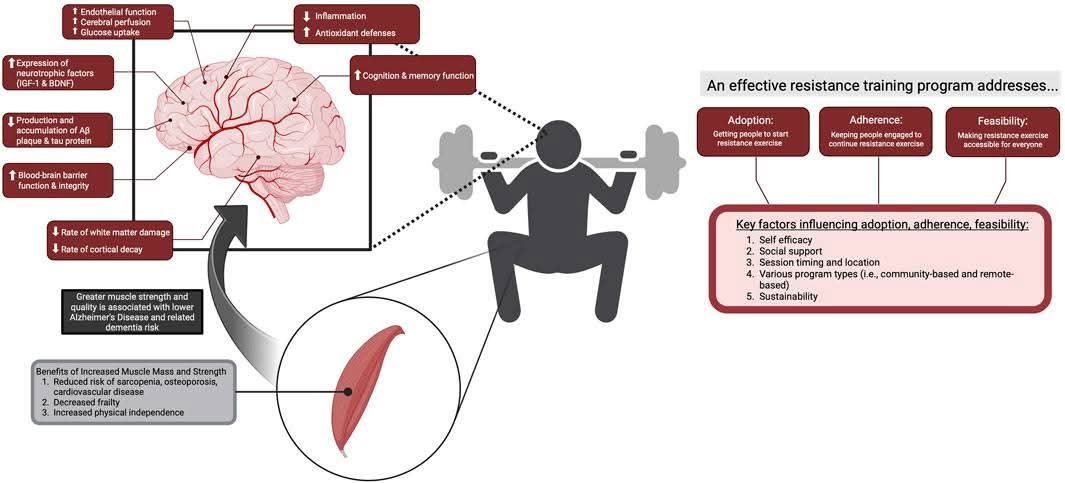
Every rep you lift sends signals far beyond the muscle.
The brain feels it.
Blood vessels feel it.
Your long-term cognitive health feels it.
A single, well-designed strength-training routine influences:
🔹 Endothelial function & cerebral blood flow: keeping the brain’s vascular system responsive and healthy.
🔹 Neurotrophic factors: the growth signals your brain uses to repair, adapt, and form memories.
🔹 Blood–brain barrier integrity: the shield that protects your brain from toxins and inflammation.
🔹 White-matter preservation: the wiring that keeps your cognition sharp.
🔹 Amyloid and tau accumulation: proteins strongly linked to Alzheimer’s pathology.
🔹 Inflammation and antioxidant defenses: the balance that determines how fast the brain ages.
🔹 Cognition & memory: the functional outcome that actually matters.
Greater muscle strength is consistently associated with lower Alzheimer’s and dementia risk.
Not because muscles and memory are directly connected…
but because resistance training remodels the systems that support brain health.
And none of this works without a program people can actually stick to. Effective resistance training requires:
• Adoption: getting people started
• Adherence: keeping them going
• Feasibility: making it accessible for everyone
Citation
Allison E.Y., Bedi A.M., Rourke A.J., Mizzi V., Walsh J.J., Heisz J.J., Al-Khazraji B.K. (2025).
Resisting decline: The neuroprotective role of resistance exercise in supporting cerebrovascular function and brain health in aging.

