My favorite kind of tech story is when unexpected capabilities...

LaurieWired@lauriewired
75 views
Nov 24, 2025
~1 min read
Advertisement
1
My favorite kind of tech story is when unexpected capabilities arise from something a human would never try.
In the late 90s, Dr. Thompson was experimenting with genetic algorithms on FPGAs.
The goal was simple; distinguish between two audio tones, 1kHz and 10kHz.
He wanted novel solutions, so he severely restricted scope. The chip was crippled to a maximum of ten cells wide, and 10 cells tall, with *no system clock*.
- An typical EE student might use a few hundred gates
- An expert might get it down to ~100
- Thompson’s genetic algorithm found a solution with *32 Gates*.

In the late 90s, Dr. Thompson was experimenting with genetic algorithms on FPGAs.
The goal was simple; distinguish between two audio tones, 1kHz and 10kHz.
He wanted novel solutions, so he severely restricted scope. The chip was crippled to a maximum of ten cells wide, and 10 cells tall, with *no system clock*.
- An typical EE student might use a few hundred gates
- An expert might get it down to ~100
- Thompson’s genetic algorithm found a solution with *32 Gates*.
2
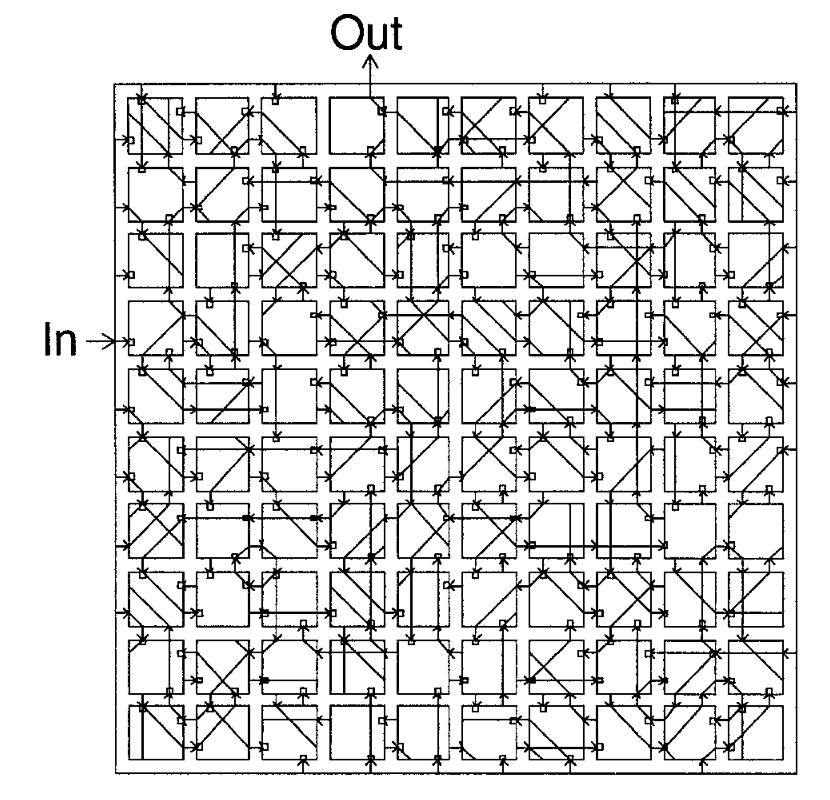
The design looked ridiculous. There were “islands” of logic not connected to any input or output.
But it worked.
After much investigation, Dr. Thompson discovered that the 32 gate solution relied on feedback loops, EMI effects between unconnected logic units, and even the temperature of the lab!
The evolved circuit only functioned correctly within a ~10C range because of its reliance on analog physical effects.
But it worked.
After much investigation, Dr. Thompson discovered that the 32 gate solution relied on feedback loops, EMI effects between unconnected logic units, and even the temperature of the lab!
The evolved circuit only functioned correctly within a ~10C range because of its reliance on analog physical effects.
3
The FPGA that made this evolutionary algorithm possible no longer exists btw.
The Xilinx XC6200 series was quite special in that it was essentially the only FPGA with documented bitstreams.
You can’t really do these sort of low-level analogue experiments without a bitstream.
(the only modern attempts are community projects that attempt to reverse engineer the internal architecture, like Project IceStorm which is pretty cool)
The Xilinx XC6200 series was quite special in that it was essentially the only FPGA with documented bitstreams.
You can’t really do these sort of low-level analogue experiments without a bitstream.
(the only modern attempts are community projects that attempt to reverse engineer the internal architecture, like Project IceStorm which is pretty cool)
