The E-7 Wedgetail Programme: A Case Study in Strategic Procurement...

MtarfaLee@MtarfaL
26 views
Nov 14, 2025
~7 min read
Advertisement
1
The E-7 Wedgetail Programme: A Case Study in Strategic Procurement Failure
Views my own, comments and corrections welcome. References in post 25.
1/25 The Royal Air Force’s (RAF) acquisition of the Boeing E-7 Wedgetail was intended to restore sovereign airborne early warning and control (AEW&C) capability post-E-3D retirement. Instead, it has become emblematic of systemic deficiencies in Ministry of Defence (MoD) major project delivery. This thread attempts to examine the requirement, procurement strategy, risk management, and international ramifications using official reporting and parliamentary evidence.
Views my own, comments and corrections welcome. References in post 25.
1/25 The Royal Air Force’s (RAF) acquisition of the Boeing E-7 Wedgetail was intended to restore sovereign airborne early warning and control (AEW&C) capability post-E-3D retirement. Instead, it has become emblematic of systemic deficiencies in Ministry of Defence (MoD) major project delivery. This thread attempts to examine the requirement, procurement strategy, risk management, and international ramifications using official reporting and parliamentary evidence.
2
Original Requirement and Operational Concept
2/25 The 2015 Strategic Defence and Security Review (SDSR) mandated a successor to the E-3D Sentry capable of persistent, multi-domain surveillance and command and control (C2). The E-7’s Multi-role Electronically Scanned Array (MESA) provides 360° coverage, simultaneous air/maritime tracking of 2,000 contacts, and range exceeding 370 km. The Initial Gate business case specified five airframes to sustain a continuous two-aircraft orbit with appropriate maintenance float.
2/25 The 2015 Strategic Defence and Security Review (SDSR) mandated a successor to the E-3D Sentry capable of persistent, multi-domain surveillance and command and control (C2). The E-7’s Multi-role Electronically Scanned Array (MESA) provides 360° coverage, simultaneous air/maritime tracking of 2,000 contacts, and range exceeding 370 km. The Initial Gate business case specified five airframes to sustain a continuous two-aircraft orbit with appropriate maintenance float.
3
Role Within RAF Force Structure
3/25 The Wedgetail is designed to function as a high-endurance C2 node, integrating sensor feeds from F-35, Typhoon, P-8, satellites, and ground-based radars via Link 16 and sovereign datalinks. It enables standoff direction of offensive counter-air, strike coordination, and maritime domain awareness. Endurance: 9 hours unrefuelled, >20 hours with AAR. The platform was to be fully interoperable with NATO and Five Eyes partners while preserving UK cryptographic sovereignty (from aircraft 3).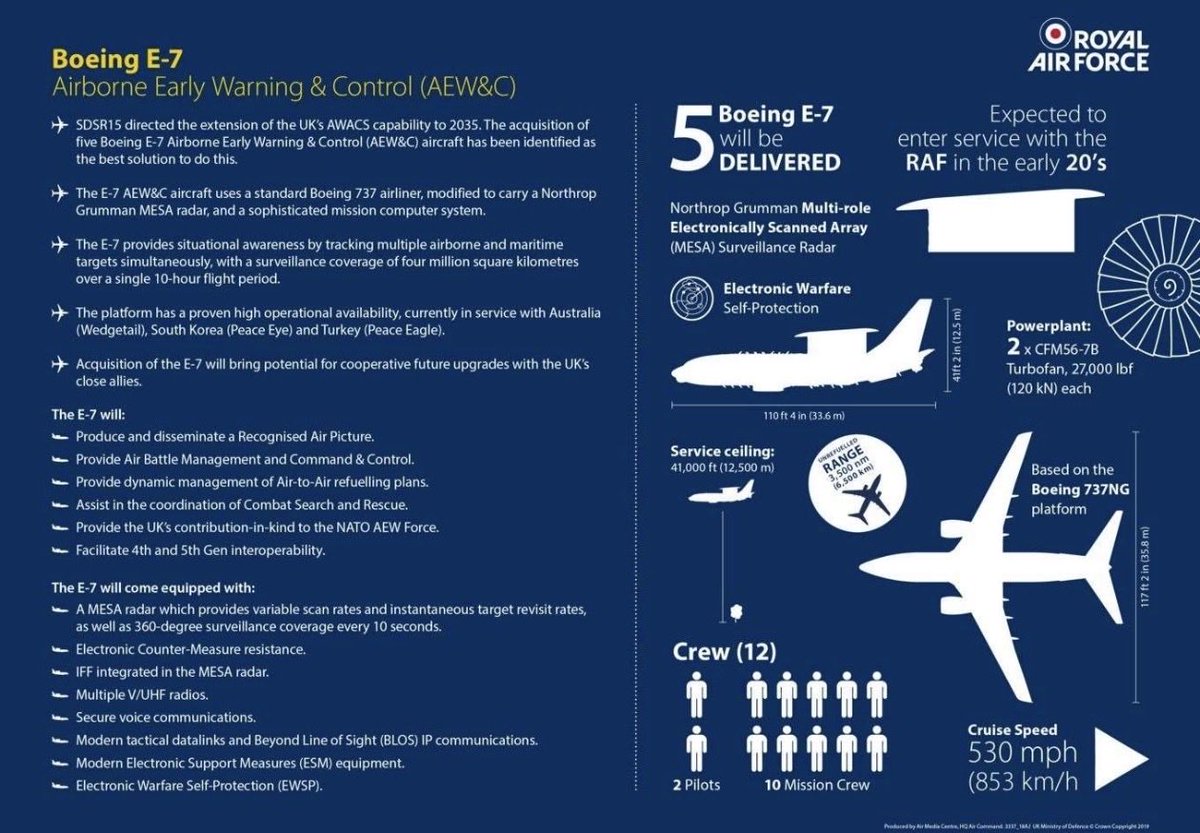
3/25 The Wedgetail is designed to function as a high-endurance C2 node, integrating sensor feeds from F-35, Typhoon, P-8, satellites, and ground-based radars via Link 16 and sovereign datalinks. It enables standoff direction of offensive counter-air, strike coordination, and maritime domain awareness. Endurance: 9 hours unrefuelled, >20 hours with AAR. The platform was to be fully interoperable with NATO and Five Eyes partners while preserving UK cryptographic sovereignty (from aircraft 3).
4
Procurement Strategy: Single-Source and Its Consequences
4/25 October 2018: the MoD elected single-source negotiation with Boeing, citing schedule urgency and the Royal Australian Air Force (RAAF) operational precedent. March 2019: £1.5 billion contract awarded for five modified 737-700 airframes, mission systems, initial support, and training. The decision bypassed full competition and omitted a signed Full Business Case until 2023—four years post-contract.
4/25 October 2018: the MoD elected single-source negotiation with Boeing, citing schedule urgency and the Royal Australian Air Force (RAAF) operational precedent. March 2019: £1.5 billion contract awarded for five modified 737-700 airframes, mission systems, initial support, and training. The decision bypassed full competition and omitted a signed Full Business Case until 2023—four years post-contract.
5
The MESA Radar Acquisition Anomaly
5/25 Prior to fleet reduction, the MoD separately procured five MESA radar sets from Northrop Grumman at £300 million (£60 million per unit). The 2021 Integrated Review reduced the fleet to three aircraft, rendering two radar sets surplus. No contractual mechanism existed for recovery or reallocation, creating an £120 million stranded asset and eliminating volume pricing leverage.
5/25 Prior to fleet reduction, the MoD separately procured five MESA radar sets from Northrop Grumman at £300 million (£60 million per unit). The 2021 Integrated Review reduced the fleet to three aircraft, rendering two radar sets surplus. No contractual mechanism existed for recovery or reallocation, creating an £120 million stranded asset and eliminating volume pricing leverage.
6
Senior Responsible Owner (SRO) Accountability Framework
6/25 Under Government Major Projects Portfolio (GMPP) rules, the SRO holds personal accountability for risk, cost, and schedule. The inaugural Wedgetail SRO—believed to be an Air Cdre—failed to escalate affordability concerns prior to the 2021 fleet reduction. Rotation occurred before consequences materialised. GMPP appointment letters mandate 3–5 year tenure; continuity was not enforced.
6/25 Under Government Major Projects Portfolio (GMPP) rules, the SRO holds personal accountability for risk, cost, and schedule. The inaugural Wedgetail SRO—believed to be an Air Cdre—failed to escalate affordability concerns prior to the 2021 fleet reduction. Rotation occurred before consequences materialised. GMPP appointment letters mandate 3–5 year tenure; continuity was not enforced.
7
Cost Escalation and Affordability Collapse
7/25 Whole-life cost for five aircraft: £2.5 billion. Post-reduction estimate for three: £1.89 billion—90% of original expenditure for 60% capability. Unit flyaway cost rose ~47%. The Equipment Plan 2023–2033 identifies a £16.9 billion affordability gap driven by unmodelled inflation, FX volatility, and support contract misalignment.
7/25 Whole-life cost for five aircraft: £2.5 billion. Post-reduction estimate for three: £1.89 billion—90% of original expenditure for 60% capability. Unit flyaway cost rose ~47%. The Equipment Plan 2023–2033 identifies a £16.9 billion affordability gap driven by unmodelled inflation, FX volatility, and support contract misalignment.
8
Risk Management: From Amber to Red
8/25 The Integrated Project Team (IPT) persistently rated supply-chain, integration, and certification risks as “amber” despite known Boeing 737 production constraints. The Infrastructure and Projects Authority (IPA) downgraded Wedgetail to Red in 2023–24, denoting delivery as planned is unachievable without fundamental restructure. Certification risk crystallised upon airframe arrival.
ukdefencejournal.org.uk/confidence-in-…
8/25 The Integrated Project Team (IPT) persistently rated supply-chain, integration, and certification risks as “amber” despite known Boeing 737 production constraints. The Infrastructure and Projects Authority (IPA) downgraded Wedgetail to Red in 2023–24, denoting delivery as planned is unachievable without fundamental restructure. Certification risk crystallised upon airframe arrival.
ukdefencejournal.org.uk/confidence-in-…
9
Optimism Bias in Planning Assumptions
9/25 MoD financial approvals use P50 confidence levels despite historic evidence that 70% of major projects overrun by ≥20%. Wedgetail IOC forecasts migrated from 2023 → 2024 → late 2025 → 2026 without corrective budgetary action. The Public Accounts Committee describes this as “systemic over-optimism” incompatible with prudent stewardship.
9/25 MoD financial approvals use P50 confidence levels despite historic evidence that 70% of major projects overrun by ≥20%. Wedgetail IOC forecasts migrated from 2023 → 2024 → late 2025 → 2026 without corrective budgetary action. The Public Accounts Committee describes this as “systemic over-optimism” incompatible with prudent stewardship.
10
Programme Timeline and Milestone Erosion
10/25 Key dates:
• 2019: Contract award
• 2021: Fleet reduced to three
• 2023: E-3D retired; capability gap opens
• Sep 2024: First airframe ferried (ZZ990)
• May 2025: Boeing concedes “technical delivery issues”
• Dec 2025: Revised first aircraft handover
• IOC: now 2026 at earliest
Each slippage triggered downstream support and infrastructure cost growth.
10/25 Key dates:
• 2019: Contract award
• 2021: Fleet reduced to three
• 2023: E-3D retired; capability gap opens
• Sep 2024: First airframe ferried (ZZ990)
• May 2025: Boeing concedes “technical delivery issues”
• Dec 2025: Revised first aircraft handover
• IOC: now 2026 at earliest
Each slippage triggered downstream support and infrastructure cost growth.
11
USAF Programme Termination – June 2025
11/25 The United States Air Force cancelled its 26-aircraft E-7 fleet, citing >$12 billion projected overrun and survivability deficits against peer hypersonic and long-range SAM threats. The pivot is toward distributed sensing architectures (space, high-altitude UAVs, loyal wingmen). UK unit costs increased 15% post-cancellation due to loss of economies of scale.
aerospaceglobalnews.com/news/usaf-requ…
11/25 The United States Air Force cancelled its 26-aircraft E-7 fleet, citing >$12 billion projected overrun and survivability deficits against peer hypersonic and long-range SAM threats. The pivot is toward distributed sensing architectures (space, high-altitude UAVs, loyal wingmen). UK unit costs increased 15% post-cancellation due to loss of economies of scale.
aerospaceglobalnews.com/news/usaf-requ…
12
NATO Multinational Fleet Abandoned – July 2025
12/25 NATO’s planned 6–8 aircraft shared programme was terminated following USAF withdrawal. Alternative platforms—Saab GlobalEye (Erieye ER on Bombardier Global 6500) and Airbus A321-based concepts—offer 30–40% lower acquisition and sustainment costs with comparable endurance and sensor performance.
aviacionline.com/english/defenc…
12/25 NATO’s planned 6–8 aircraft shared programme was terminated following USAF withdrawal. Alternative platforms—Saab GlobalEye (Erieye ER on Bombardier Global 6500) and Airbus A321-based concepts—offer 30–40% lower acquisition and sustainment costs with comparable endurance and sensor performance.
aviacionline.com/english/defenc…
13
MoD Narrative vs Independent Assessment
13/25 Ministerial statements (Hansard, 15 July 2025) assert Wedgetail remains “future-proof” with IOC in 2026. Contrasting IPA Red rating and NAO warnings of a £500 million interim NATO leasing bill since 2023 underscore a widening credibility gap between official optimism and audited reality.
13/25 Ministerial statements (Hansard, 15 July 2025) assert Wedgetail remains “future-proof” with IOC in 2026. Contrasting IPA Red rating and NAO warnings of a £500 million interim NATO leasing bill since 2023 underscore a widening credibility gap between official optimism and audited reality.
14
Radar Integration Status
14/25 As of (this month) November 2025, no UK E-7 has flown with MESA powered. ZZ990 completed ferry and handling trials in 2024; radar remains in ground test due to power generation and cooling mismatches. RAAF achieved >1,000 radar-active flight hours within two years of contract; RAF lags by >5 years on equivalent milestones.
14/25 As of (this month) November 2025, no UK E-7 has flown with MESA powered. ZZ990 completed ferry and handling trials in 2024; radar remains in ground test due to power generation and cooling mismatches. RAAF achieved >1,000 radar-active flight hours within two years of contract; RAF lags by >5 years on equivalent milestones.
15
Airworthiness Certification Failure
15/25 ZZ990 arrived without FAA Supplemental Type Certificate. UK CAA/MAA mandated full military airworthiness reassessment—new structural analyses, software verification, and flight test programme—adding nine months minimum. The discrepancy between civil-derived build standard and UK military airworthiness directives was flagged in 2019 risk registers but not mitigated.
15/25 ZZ990 arrived without FAA Supplemental Type Certificate. UK CAA/MAA mandated full military airworthiness reassessment—new structural analyses, software verification, and flight test programme—adding nine months minimum. The discrepancy between civil-derived build standard and UK military airworthiness directives was flagged in 2019 risk registers but not mitigated.
16
Industrial Base: Marshalls Withdrawal
16/25 July 2019: Marshalls Aerospace awarded £20 million risk-reduction contract for UK mission system integration. May 2020: withdrawal citing “unprecedented technical complexity” and fixed-price exposure. Scope escalated to 500,000 engineering hours; no commercial margin existed under Boeing’s terms.
16/25 July 2019: Marshalls Aerospace awarded £20 million risk-reduction contract for UK mission system integration. May 2020: withdrawal citing “unprecedented technical complexity” and fixed-price exposure. Scope escalated to 500,000 engineering hours; no commercial margin existed under Boeing’s terms.
17
STS Aviation Succession and Cost
17/25 Modification work transferred to STS Aviation Services, Birmingham. Re-tooling, supply-chain revalidation, and workforce ramp-up incurred £50 million non-recurring cost and 18-month schedule extension. Current workforce retention: 80%; skills pipeline disrupted.
17/25 Modification work transferred to STS Aviation Services, Birmingham. Re-tooling, supply-chain revalidation, and workforce ramp-up incurred £50 million non-recurring cost and 18-month schedule extension. Current workforce retention: 80%; skills pipeline disrupted.
18
Infrastructure Overbuild at RAF Lossiemouth
18/25 £83 million invested in hangars, simulators, and secure facilities sized for five aircraft. Now configured for three, with two £60 million radar sets in bonded storage. Annual through-life cost per airframe projected at ~£100 million (fuel, 40-person crew, radar support, software sustainment).
18/25 £83 million invested in hangars, simulators, and secure facilities sized for five aircraft. Now configured for three, with two £60 million radar sets in bonded storage. Annual through-life cost per airframe projected at ~£100 million (fuel, 40-person crew, radar support, software sustainment).
19
Technological Obsolescence Risk
19/25 USAF FY27 planning (pre-cancellation) included “Advanced E-7” with gallium-nitride T/R modules, AI threat correlation, and UCAV datalinks. RAF aircraft are frozen at 2019 baseline specification and will enter service already one generation behind a cancelled programme.
19/25 USAF FY27 planning (pre-cancellation) included “Advanced E-7” with gallium-nitride T/R modules, AI threat correlation, and UCAV datalinks. RAF aircraft are frozen at 2019 baseline specification and will enter service already one generation behind a cancelled programme.
20
Accountability Mechanisms and Outcomes
20/25 GMPP mandates SRO performance review and potential sanction. No disciplinary action recorded against Wedgetail SRO, procurement lead, or commercial officers. Precedent across Type 45 PIP, Warrior CSP, and Ajax confirms systemic absence of consequence.
20/25 GMPP mandates SRO performance review and potential sanction. No disciplinary action recorded against Wedgetail SRO, procurement lead, or commercial officers. Precedent across Type 45 PIP, Warrior CSP, and Ajax confirms systemic absence of consequence.
21
Interim Capability Gap Cost
21/25 E-3D retirement in 2023 initiated reliance on NATO E-3A Component aircraft for North Atlantic and Eastern Flank tasks. Cumulative leasing, crewing, and support cost exceeds £500 million (NAO estimate, 2025). Sovereign AEW&C absence persists into seventh year.
21/25 E-3D retirement in 2023 initiated reliance on NATO E-3A Component aircraft for North Atlantic and Eastern Flank tasks. Cumulative leasing, crewing, and support cost exceeds £500 million (NAO estimate, 2025). Sovereign AEW&C absence persists into seventh year.
22
Force Structure Vulnerability
22/25 A three-aircraft fleet lacks resilience. Loss of one platform to attrition or deep maintenance collapses continuous coverage. In contested environments, survivability constraints force operation behind friendly lines, reducing sensor horizon and battlespace utility.
22/25 A three-aircraft fleet lacks resilience. Loss of one platform to attrition or deep maintenance collapses continuous coverage. In contested environments, survivability constraints force operation behind friendly lines, reducing sensor horizon and battlespace utility.
23
Strategic Implications for UK Air Power
23/25 Wedgetail delay defers full operationalisation of Carrier Enabled Power Projection (QE-class) and Lightning Force (F-35B). NATO interoperability is maintained via allied assets, but at the cost of UK influence in coalition planning and intelligence dissemination.
23/25 Wedgetail delay defers full operationalisation of Carrier Enabled Power Projection (QE-class) and Lightning Force (F-35B). NATO interoperability is maintained via allied assets, but at the cost of UK influence in coalition planning and intelligence dissemination.
24
Conclusion: Systemic Reform Required
24/25 The E-7 programme exhibits:
• Requirement setting without affordability gates
• Single-source contracting without exit clauses
• Risk registers divorced from reality
• Leadership rotation precluding accountability
• Optimism bias embedded in financial approval
When delivered, the fleet will be late, over-cost, under-sized, high-maintenance, and technologically trailing.
Absent structural reform—P75 budgeting, extended SRO tenure, mandatory spiral development—this pattern will recur.
24/25 The E-7 programme exhibits:
• Requirement setting without affordability gates
• Single-source contracting without exit clauses
• Risk registers divorced from reality
• Leadership rotation precluding accountability
• Optimism bias embedded in financial approval
When delivered, the fleet will be late, over-cost, under-sized, high-maintenance, and technologically trailing.
Absent structural reform—P75 budgeting, extended SRO tenure, mandatory spiral development—this pattern will recur.
25
References and Supporting Essay
25/25 I have added this in due to the nature of the topic and the emotion that sometimes surround threads that attempt to hold departments or individuals to account.
Data from: House of Commons Defence Committee HC 1099 (2023); NAO Equipment Plan 2023–33; IPA Annual Report 2023–24; Hansard 15 July 2025; MoD FOI releases; Boeing E-7 technical manuals. The complete essay (drafted yesterday) with full bibliography is available on request via email or DM. I’ve given up on the Substack 🤷🏻♂️
25/25 I have added this in due to the nature of the topic and the emotion that sometimes surround threads that attempt to hold departments or individuals to account.
Data from: House of Commons Defence Committee HC 1099 (2023); NAO Equipment Plan 2023–33; IPA Annual Report 2023–24; Hansard 15 July 2025; MoD FOI releases; Boeing E-7 technical manuals. The complete essay (drafted yesterday) with full bibliography is available on request via email or DM. I’ve given up on the Substack 🤷🏻♂️