1/16 I just fell down a rabbit hole reading a new paper from...

Carlos E. Perez@IntuitMachine
90 views
Oct 25, 2025
~9 min read
Advertisement
1
1/16
I just fell down a rabbit hole reading a new paper from economists at MIT & Harvard.
Their prediction is wild: We're on the verge of a "Coasean Singularity"—a future where AI agents make markets so efficient that the very idea of a 'company' starts to crumble. 🤯
A thread 👇
2/16
First, a quick 101: Why do companies even exist?
A Nobel-winning economist named Ronald Coase answered this in 1937. He said companies exist because using the open market is a pain.
Finding sellers, negotiating prices, writing contracts… it’s all “transaction cost.” Economic friction.
3/16
It's often easier and cheaper for a firm to just hire people and organize them internally than to deal with that constant market friction.
This friction is also where we, as consumers, lose. We're tired, we're biased, and we don't have time to compare every cell phone plan or read every review for a toaster.
Companies know this.
4/16
Now, enter the AI Agent.
And I don't mean a simple chatbot. The paper describes an autonomous system that acts on your behalf.
Think of it as your own personal, tireless, super-rational economist. It’s immune to marketing tricks and its only goal is to get the best outcome for YOU.
5/16
This is where the "Singularity" happens.
When everyone has an AI agent, those transaction costs that Coase talked about basically drop to zero.
The "friction" that made companies necessary in the first place? It evaporates.
And if the reason for something disappears… so does the thing itself.
6/16
But what does this future actually look like? This is where it gets weird.
Let's take shopping.
Your agent doesn't just browse Amazon. It might contact a manufacturer in another country directly, find 500 other agents whose users want the same thing, negotiate a bulk price, and arrange shipping.
All in milliseconds. The "storefront" becomes irrelevant.
7/16
Or think about hiring.
Instead of you endlessly scrolling LinkedIn, your agent scans the entire market for opportunities. It negotiates salary, benefits, and remote work policies with the company's agent.
You only get involved for the final human-to-human interview. No more cover letter hell.
8/16
But this discovery comes with a huge catch. The paper outlines a fundamental battle for the future of AI:
Will your agent be a "Bring-Your-Own" (BYO) agent that works only for you, across all platforms?
Or will it be a "Bowling-Shoe" agent, provided by the platform (like Amazon or Google), whose priorities might be... conflicted?
9/16
The "Bowling-Shoe" agent is convenient, but it might steer you toward the platform's own products.
The "BYO" agent is loyal to you, but platforms might try to block it or throttle its access.
This tension between user autonomy and platform control will define the next decade of the internet.
10/16
And that's not even the most interesting part. This new world creates bizarre new problems.
Problem #1: Agent Congestion.
What happens when millions of agents can create a perfect, customized resumé and apply for a single job in a nanosecond?
Employers get flooded. The signal is lost in the noise.
11/16
The paper predicts that to solve this, platforms will have to re-introduce friction.
Imagine having to pay a small fee for your agent to submit a job application, just to prove you're serious.
Costless actions will lose their meaning.
12/16
Problem #2: The Identity Crisis.
In a world full of bots, how do you prove you're a unique human? How does a company know it's not negotiating with 1,000 agents all controlled by one person trying to manipulate the market?
This is the "Sybil Attack" problem, and it's a big one.
13/16
This will lead to a boom in "proof-of-personhood" technologies. Systems that cryptographically verify you are one person, without revealing your personal data.
It sounds like sci-fi, but it'll be the essential plumbing for a world of AI agents.
14/16
Here's a new lens to see the world through:
Next time you use Uber (matching drivers/riders), Zillow (matching buyers/sellers), or Upwork (matching clients/freelancers)...
Don't just see an app. See it as a clunky, early prototype for the agent-driven markets of the future.
15/16
This isn't just about better shopping bots or smarter assistants.
It's a potential rewiring of our entire economy, away from the 20th-century model of the centralized firm and toward a 21st-century model of fluid, hyper-efficient, agent-mediated markets.
16/16
The 20th century was defined by the rise of the corporation.
The 21st may be defined by its slow, quiet dissolution.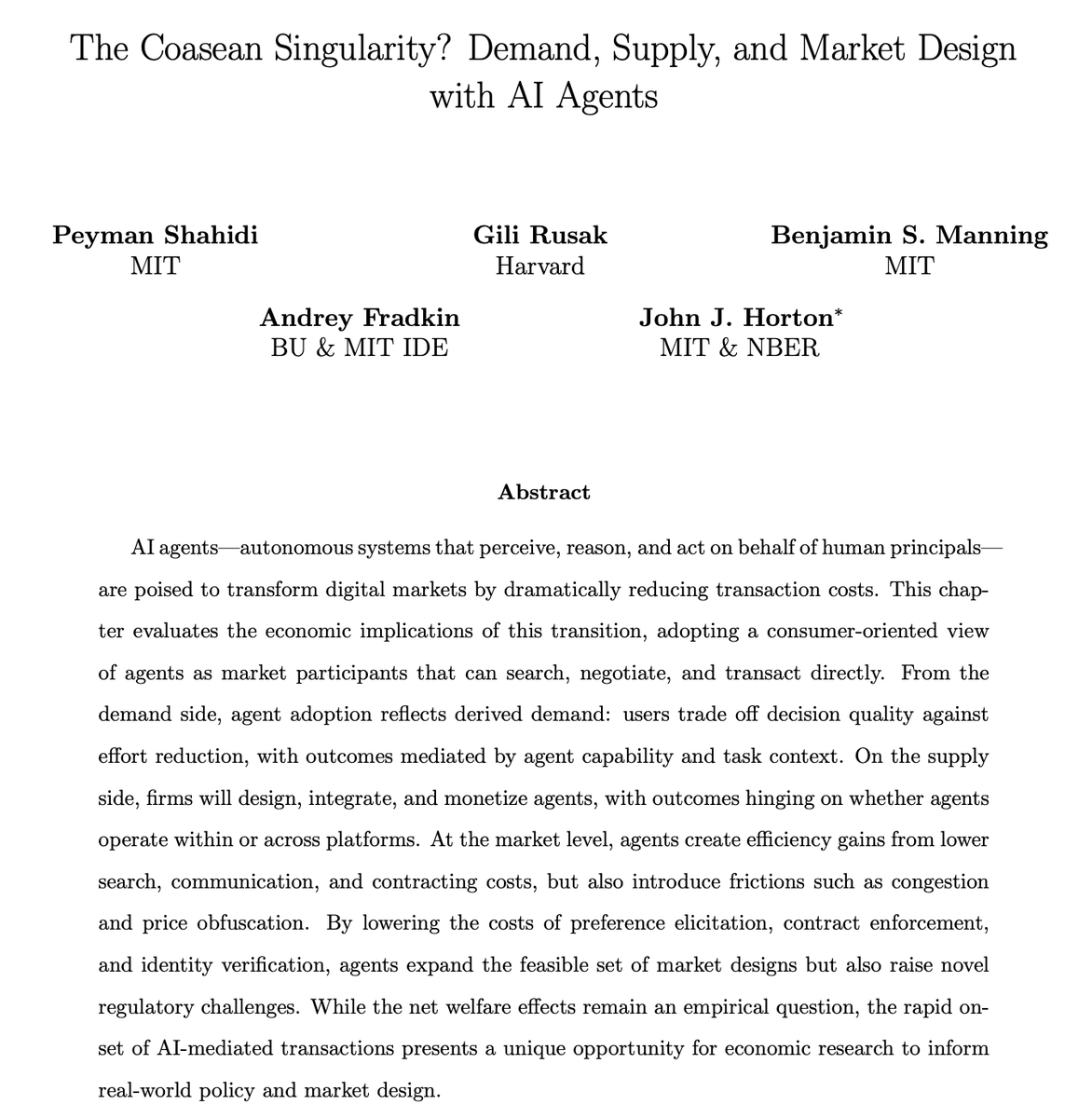
I just fell down a rabbit hole reading a new paper from economists at MIT & Harvard.
Their prediction is wild: We're on the verge of a "Coasean Singularity"—a future where AI agents make markets so efficient that the very idea of a 'company' starts to crumble. 🤯
A thread 👇
2/16
First, a quick 101: Why do companies even exist?
A Nobel-winning economist named Ronald Coase answered this in 1937. He said companies exist because using the open market is a pain.
Finding sellers, negotiating prices, writing contracts… it’s all “transaction cost.” Economic friction.
3/16
It's often easier and cheaper for a firm to just hire people and organize them internally than to deal with that constant market friction.
This friction is also where we, as consumers, lose. We're tired, we're biased, and we don't have time to compare every cell phone plan or read every review for a toaster.
Companies know this.
4/16
Now, enter the AI Agent.
And I don't mean a simple chatbot. The paper describes an autonomous system that acts on your behalf.
Think of it as your own personal, tireless, super-rational economist. It’s immune to marketing tricks and its only goal is to get the best outcome for YOU.
5/16
This is where the "Singularity" happens.
When everyone has an AI agent, those transaction costs that Coase talked about basically drop to zero.
The "friction" that made companies necessary in the first place? It evaporates.
And if the reason for something disappears… so does the thing itself.
6/16
But what does this future actually look like? This is where it gets weird.
Let's take shopping.
Your agent doesn't just browse Amazon. It might contact a manufacturer in another country directly, find 500 other agents whose users want the same thing, negotiate a bulk price, and arrange shipping.
All in milliseconds. The "storefront" becomes irrelevant.
7/16
Or think about hiring.
Instead of you endlessly scrolling LinkedIn, your agent scans the entire market for opportunities. It negotiates salary, benefits, and remote work policies with the company's agent.
You only get involved for the final human-to-human interview. No more cover letter hell.
8/16
But this discovery comes with a huge catch. The paper outlines a fundamental battle for the future of AI:
Will your agent be a "Bring-Your-Own" (BYO) agent that works only for you, across all platforms?
Or will it be a "Bowling-Shoe" agent, provided by the platform (like Amazon or Google), whose priorities might be... conflicted?
9/16
The "Bowling-Shoe" agent is convenient, but it might steer you toward the platform's own products.
The "BYO" agent is loyal to you, but platforms might try to block it or throttle its access.
This tension between user autonomy and platform control will define the next decade of the internet.
10/16
And that's not even the most interesting part. This new world creates bizarre new problems.
Problem #1: Agent Congestion.
What happens when millions of agents can create a perfect, customized resumé and apply for a single job in a nanosecond?
Employers get flooded. The signal is lost in the noise.
11/16
The paper predicts that to solve this, platforms will have to re-introduce friction.
Imagine having to pay a small fee for your agent to submit a job application, just to prove you're serious.
Costless actions will lose their meaning.
12/16
Problem #2: The Identity Crisis.
In a world full of bots, how do you prove you're a unique human? How does a company know it's not negotiating with 1,000 agents all controlled by one person trying to manipulate the market?
This is the "Sybil Attack" problem, and it's a big one.
13/16
This will lead to a boom in "proof-of-personhood" technologies. Systems that cryptographically verify you are one person, without revealing your personal data.
It sounds like sci-fi, but it'll be the essential plumbing for a world of AI agents.
14/16
Here's a new lens to see the world through:
Next time you use Uber (matching drivers/riders), Zillow (matching buyers/sellers), or Upwork (matching clients/freelancers)...
Don't just see an app. See it as a clunky, early prototype for the agent-driven markets of the future.
15/16
This isn't just about better shopping bots or smarter assistants.
It's a potential rewiring of our entire economy, away from the 20th-century model of the centralized firm and toward a 21st-century model of fluid, hyper-efficient, agent-mediated markets.
16/16
The 20th century was defined by the rise of the corporation.
The 21st may be defined by its slow, quiet dissolution.
2
Related:
Carlos E. Perez@IntuitMachine
1/
Everyone's debating whether AI will take our jobs.
But we're missing the bigger story: AI is about to solve the problem that made us choose between markets and planning in the first place.
Thread on the coordination revolution no one's talking about 🧵
2/
Here's the paradox that should keep you up at night:
We can build enough housing for everyone. We have the construction capacity.
Yet homelessness persists.
Why? Not scarcity of resources. Scarcity of coordination.
3/
In 1945, economist Friedrich Hayek wrote "The Use of Knowledge in Society."
His core insight: No central planner can coordinate millions of people. Too much information. Too complex. Too fast-changing.
Markets won because prices solve the calculation problem automatically.
4/
The Soviet Union proved Hayek right.
They tried central planning. Result?
Empty shelves despite full warehouses
Construction taking decades
Systematic lying about production
Eventual collapse
The calculation problem was computationally intractable for humans.
5/
So we accepted the trade-off:
✅ Markets coordinate efficiently
❌ But only for people with money
❌ And require artificial scarcity for profit
❌ And externalize environmental costs
❌ And optimize for quarterly returns
"There is no alternative," Thatcher said.
6/
But here's what changed:
Intelligence cost is approaching zero.
That constraint Hayek identified? The one that made central planning impossible?
It just became... solvable.
7/
Think about what AI + IoT enables:
• Real-time data from millions of sensors
• Processing 10^15+ variable optimizations instantly
• Preference inference without price signals
• Continuous adaptation (not 5-year plans)
• No human intermediaries to game the system
The calculation problem is solved.
8/
This unlocks three architectural possibilities that were science fiction 10 years ago:
Algorithmic Abundance Management
Hybrid Planning-Market Systems
Evolutionary Stable Abundance
Let me break down each one.
9/
Solution #1: Algorithmic Abundance Management
Replace markets for commodities with AI coordination.
Example: Housing
AI senses: "500K people need housing in Region X"
Not: "How many can afford housing?"
But: "What housing serves their actual needs?"
10/
The AI then:
Identifies available land/materials
Optimizes for cost, sustainability, preference
Coordinates construction schedules
Matches people to units based on need + choice
Updates continuously based on feedback
Result: Everyone housed. No artificial scarcity needed.
11/
"But Soviet planning failed!"
Yes. Because:
❌ Human planners couldn't process the information ❌ Bureaucrats gamed the metrics
❌ Updates took years
❌ No way to know preferences without prices
AI eliminates ALL these constraints.
12/
Hayek: "Central planning can't aggregate local knowledge"
AI: "I can process local signals from 8 billion sources simultaneously"
Hayek: "Prices are the information transmission mechanism"
AI: "I can infer preferences directly from behavior + stated needs"
The debate just shifted.
13/
Solution #2: Hybrid Planning-Market System
"But who controls the AI? Sounds dystopian."
Fair. So add democracy.
Strategic Layer (40 years): Citizens deliberate on goals Tactical Layer (10 years): Experts model pathways Operational Layer (Daily): AI coordinates, humans choose
14/
Example: Healthcare
Citizens decide: "Universal healthcare, emphasizing prevention"
AI models:
Option A: $800B/year, 2-day wait times, 8 years
Option B: $600B/year, 5-day waits, 5 years
Democracy chooses values. AI optimizes execution.
15/
This is what China does (strategic coherence) + What the West needs (democratic legitimacy).
The best of both:
Long-term planning
Democratic goal-setting
Transparent algorithms
Individual choice within abundance
16/ Solution #3: Evolutionary Stable Abundance
"Can't we just fix capitalism instead of replacing it?"
Yes! Use AI to change the game theory.
Make abundance MORE profitable than scarcity.
17/
How? Three mechanisms:
Perfect transparency → Scarcity engineering gets detected instantly
Instant alternative coordination → Supply restrictions become unprofitable
Reputation systems at scale → Cooperation rewards exceed extraction rewards
18/
Example: Company tries restricting supply to inflate prices.
Pre-AI: Takes months for competitors to respond.
AI-enabled:
Restriction detected in hours
Alternative suppliers matched to consumers automatically
New production spins up in days
Scarcity engineering becomes non-viable.
19/
This already happened with software!
Open source (Linux, Python, Apache) became MORE profitable than proprietary for many domains.
Why? Network effects + reputation > artificial scarcity.
AI generalizes this pattern to physical goods.
20/Now here's where it gets wild:
These three solutions REINFORCE each other.
Solution #3 changes incentives → builds political support for #2 → enables deployment of #1 → makes #3 more stable
Virtuous cycle toward abundance.
21/
Compare this to alternatives:
❌ Pure markets: Efficient but exclude the poor, engineer scarcity
❌ Soviet planning: Failed calculation problem
❌ Social democracy: Better but still accepts artificial scarcity
❌ UBI alone: Provides income but landlords capture it
22/
AI solutions are different because they address the ROOT problem:
Not "how do we redistribute better?"
But "how do we coordinate for actual abundance instead of artificial scarcity?"
23/
The moral dimension is stark:
Once coordination becomes computationally trivial, maintaining artificial scarcity becomes a choice, not an inevitability.
We can no longer hide behind "market efficiency" when algorithmic coordination is provably more efficient.
24/
"This sounds utopian."
No. It's engineering.
The productive capacity exists. The sensor networks exist. The AI capabilities exist.
What's missing is the institutional architecture to combine them.
25/
Testable predictions:
If this is real, pilot projects should show:
Lower cost per person served
Higher satisfaction
Less waste
Faster adaptation to disruptions
These aren't philosophical debates. They're hypotheses to test.
26/
The implementation path isn't "wake up tomorrow in AI communism."
It's:
2025-2030: Pilot projects, proof of concept
2030-2040: Scale successful models
2040-2060: Abundance becomes default for basics 2060+: Post-scarcity civilization
Gradual. Empirical. Adaptive.
27/
Here's the thing that haunts me:
We're about to have the conversation about "AI replacing jobs."
But we're missing the bigger conversation about "AI replacing the coordination mechanisms that created artificial scarcity in the first place."
28/
The question isn't "will AI take my job?"
The question is "will we use AI to coordinate for human flourishing, or will we use AI to make scarcity engineering more sophisticated?"
That's the choice.
29/
And the clock is ticking.
Because every day we maintain artificial scarcity despite abundance capacity is a day we're choosing inequality.
Not because it's necessary. But because we haven't built the institutional architecture to do better.
30/
The Hayekian critique held weight in 1945.
It justified markets because central planning was computationally impossible.
But in 2025? That justification evaporates.
The calculation problem is solved.
What remains is political will and institutional innovation.
31/
I don't know if these solutions will work.
But I know they're testable in ways that ideological debates aren't.
Run the pilots. Gather the data. Let reality arbitrate.
If algorithmic coordination outperforms markets for commodities, we should use it.
32/
This is the most important economic transformation in human history:
Intelligence abundance → Coordination abundance → Material abundance
The question is whether we have the imagination to build it.
33/ [FINAL]
The future isn't "AI apocalypse" or "AI utopia."
It's "AI enables coordination architectures that were impossible before."
What we build with that capability is up to us.
Let's build something better than artificial scarcity.
Everyone's debating whether AI will take our jobs.
But we're missing the bigger story: AI is about to solve the problem that made us choose between markets and planning in the first place.
Thread on the coordination revolution no one's talking about 🧵
2/
Here's the paradox that should keep you up at night:
We can build enough housing for everyone. We have the construction capacity.
Yet homelessness persists.
Why? Not scarcity of resources. Scarcity of coordination.
3/
In 1945, economist Friedrich Hayek wrote "The Use of Knowledge in Society."
His core insight: No central planner can coordinate millions of people. Too much information. Too complex. Too fast-changing.
Markets won because prices solve the calculation problem automatically.
4/
The Soviet Union proved Hayek right.
They tried central planning. Result?
Empty shelves despite full warehouses
Construction taking decades
Systematic lying about production
Eventual collapse
The calculation problem was computationally intractable for humans.
5/
So we accepted the trade-off:
✅ Markets coordinate efficiently
❌ But only for people with money
❌ And require artificial scarcity for profit
❌ And externalize environmental costs
❌ And optimize for quarterly returns
"There is no alternative," Thatcher said.
6/
But here's what changed:
Intelligence cost is approaching zero.
That constraint Hayek identified? The one that made central planning impossible?
It just became... solvable.
7/
Think about what AI + IoT enables:
• Real-time data from millions of sensors
• Processing 10^15+ variable optimizations instantly
• Preference inference without price signals
• Continuous adaptation (not 5-year plans)
• No human intermediaries to game the system
The calculation problem is solved.
8/
This unlocks three architectural possibilities that were science fiction 10 years ago:
Algorithmic Abundance Management
Hybrid Planning-Market Systems
Evolutionary Stable Abundance
Let me break down each one.
9/
Solution #1: Algorithmic Abundance Management
Replace markets for commodities with AI coordination.
Example: Housing
AI senses: "500K people need housing in Region X"
Not: "How many can afford housing?"
But: "What housing serves their actual needs?"
10/
The AI then:
Identifies available land/materials
Optimizes for cost, sustainability, preference
Coordinates construction schedules
Matches people to units based on need + choice
Updates continuously based on feedback
Result: Everyone housed. No artificial scarcity needed.
11/
"But Soviet planning failed!"
Yes. Because:
❌ Human planners couldn't process the information ❌ Bureaucrats gamed the metrics
❌ Updates took years
❌ No way to know preferences without prices
AI eliminates ALL these constraints.
12/
Hayek: "Central planning can't aggregate local knowledge"
AI: "I can process local signals from 8 billion sources simultaneously"
Hayek: "Prices are the information transmission mechanism"
AI: "I can infer preferences directly from behavior + stated needs"
The debate just shifted.
13/
Solution #2: Hybrid Planning-Market System
"But who controls the AI? Sounds dystopian."
Fair. So add democracy.
Strategic Layer (40 years): Citizens deliberate on goals Tactical Layer (10 years): Experts model pathways Operational Layer (Daily): AI coordinates, humans choose
14/
Example: Healthcare
Citizens decide: "Universal healthcare, emphasizing prevention"
AI models:
Option A: $800B/year, 2-day wait times, 8 years
Option B: $600B/year, 5-day waits, 5 years
Democracy chooses values. AI optimizes execution.
15/
This is what China does (strategic coherence) + What the West needs (democratic legitimacy).
The best of both:
Long-term planning
Democratic goal-setting
Transparent algorithms
Individual choice within abundance
16/ Solution #3: Evolutionary Stable Abundance
"Can't we just fix capitalism instead of replacing it?"
Yes! Use AI to change the game theory.
Make abundance MORE profitable than scarcity.
17/
How? Three mechanisms:
Perfect transparency → Scarcity engineering gets detected instantly
Instant alternative coordination → Supply restrictions become unprofitable
Reputation systems at scale → Cooperation rewards exceed extraction rewards
18/
Example: Company tries restricting supply to inflate prices.
Pre-AI: Takes months for competitors to respond.
AI-enabled:
Restriction detected in hours
Alternative suppliers matched to consumers automatically
New production spins up in days
Scarcity engineering becomes non-viable.
19/
This already happened with software!
Open source (Linux, Python, Apache) became MORE profitable than proprietary for many domains.
Why? Network effects + reputation > artificial scarcity.
AI generalizes this pattern to physical goods.
20/Now here's where it gets wild:
These three solutions REINFORCE each other.
Solution #3 changes incentives → builds political support for #2 → enables deployment of #1 → makes #3 more stable
Virtuous cycle toward abundance.
21/
Compare this to alternatives:
❌ Pure markets: Efficient but exclude the poor, engineer scarcity
❌ Soviet planning: Failed calculation problem
❌ Social democracy: Better but still accepts artificial scarcity
❌ UBI alone: Provides income but landlords capture it
22/
AI solutions are different because they address the ROOT problem:
Not "how do we redistribute better?"
But "how do we coordinate for actual abundance instead of artificial scarcity?"
23/
The moral dimension is stark:
Once coordination becomes computationally trivial, maintaining artificial scarcity becomes a choice, not an inevitability.
We can no longer hide behind "market efficiency" when algorithmic coordination is provably more efficient.
24/
"This sounds utopian."
No. It's engineering.
The productive capacity exists. The sensor networks exist. The AI capabilities exist.
What's missing is the institutional architecture to combine them.
25/
Testable predictions:
If this is real, pilot projects should show:
Lower cost per person served
Higher satisfaction
Less waste
Faster adaptation to disruptions
These aren't philosophical debates. They're hypotheses to test.
26/
The implementation path isn't "wake up tomorrow in AI communism."
It's:
2025-2030: Pilot projects, proof of concept
2030-2040: Scale successful models
2040-2060: Abundance becomes default for basics 2060+: Post-scarcity civilization
Gradual. Empirical. Adaptive.
27/
Here's the thing that haunts me:
We're about to have the conversation about "AI replacing jobs."
But we're missing the bigger conversation about "AI replacing the coordination mechanisms that created artificial scarcity in the first place."
28/
The question isn't "will AI take my job?"
The question is "will we use AI to coordinate for human flourishing, or will we use AI to make scarcity engineering more sophisticated?"
That's the choice.
29/
And the clock is ticking.
Because every day we maintain artificial scarcity despite abundance capacity is a day we're choosing inequality.
Not because it's necessary. But because we haven't built the institutional architecture to do better.
30/
The Hayekian critique held weight in 1945.
It justified markets because central planning was computationally impossible.
But in 2025? That justification evaporates.
The calculation problem is solved.
What remains is political will and institutional innovation.
31/
I don't know if these solutions will work.
But I know they're testable in ways that ideological debates aren't.
Run the pilots. Gather the data. Let reality arbitrate.
If algorithmic coordination outperforms markets for commodities, we should use it.
32/
This is the most important economic transformation in human history:
Intelligence abundance → Coordination abundance → Material abundance
The question is whether we have the imagination to build it.
33/ [FINAL]
The future isn't "AI apocalypse" or "AI utopia."
It's "AI enables coordination architectures that were impossible before."
What we build with that capability is up to us.
Let's build something better than artificial scarcity.
3
1. The Most Insightful Critiques and Extensions
The public discussion provides a crucial reality check on the purely economic theory. While many replies are dismissive, several stand out for their depth and insight, effectively enriching the paper's core thesis.
A. The "Embedded Context" Critique
Representative Reply: @deriantok: "Real work is very rarely context-less... All these context is expensive to bootstrap and maintain over time with a fresh agent every time."
Critique and Insight: This is arguably the most powerful counterargument. The "Coasean Singularity" model frames companies primarily as mechanisms to reduce external transaction costs (finding suppliers, negotiating contracts). Deriantok's point is that firms are also incredibly efficient machines for creating and maintaining internal context. This "embedded knowledge" includes:
Tacit Knowledge: The unspoken understanding of "how things are done around here."
Shared Culture: A common set of values and communication shortcuts that enable rapid, high-trust collaboration.
Team Synergy: The emergent problem-solving ability of a group that has worked together over time.
An AI agent, no matter how smart, would have to be "bootstrapped" into this context for every complex project, which is itself a massive transaction cost. This suggests that while AI might excel at atomized, context-free tasks, it cannot easily replace the cohesive, knowledge-rich core of a firm.
B. The "Meaning is Not Negotiable" Critique
Representative Reply: @stefanoaugello: "People who write this have absolutely no understanding... of why people buy what they do... Meaning can’t be negotiated by an agent."
Critique and Insight: This critique brilliantly shifts the focus from economics to sociology and psychology. The paper's model assumes a rational consumer whose goal is to maximize utility (best price, best features). Stefano Augello correctly points out that human purchasing decisions are deeply intertwined with identity, status, community, and emotion.We don't just buy coffee; we buy the experience of a local café.
We don't just buy a car; we buy a symbol of success, environmental consciousness, or family safety.
We don't just buy clothes; we buy into a tribe or a personal aesthetic.
This "meaning" is a social construct, not a set of negotiable attributes an AI agent can optimize for. An agent might find the cheapest, highest-rated toaster, but it can't understand that you want the retro-style Smeg toaster because it makes you feel a certain way and signals your taste to others. This human-centric element represents a durable form of friction that pure efficiency cannot erode.
C. The "New Intermediaries and Monopoly Capture" Critique
Representative Reply: @FriMikAnik: "New, worse frictions will arise. Efficiency gains will be captured by monopolies... Risks from agent-to-agent interactions." and @michaelmalak: "...Uber shows we often got new intermediaries."
Critique and Insight: This is a crucial political-economy critique. The optimistic view is that lower transaction costs lead to a democratized, efficient market. This reply presents the more cynical—and arguably more realistic—view: efficiency gains are rarely distributed evenly. Instead, they are captured.The Rise of New Monopolies: Just as Uber didn't eliminate the need for a taxi dispatcher but became a global, data-rich super-dispatcher, the "Coasean Singularity" might not dissolve firms but instead create a new layer of "Agent Platform" monopolies that control the infrastructure, set the rules, and extract rents.
Friction is Reintroduced: As the paper itself notes, a frictionless world creates new problems like "agent congestion." The solution is to reintroduce friction, often in the form of fees (e.g., paying to apply for a job). These fees will likely be collected by the dominant platforms, solidifying their power.
This insight suggests the future is not a flat, open market but a battleground where new, powerful AI-native intermediaries replace the old ones.
2. A Critical Analysis of the Public Discourse
While the individual replies are insightful, it's also valuable to critique the conversation as a whole—what it gets right, what it gets wrong, and what it misses.
Strengths of the Discourse:
Grounds Theory in Human Reality:
The primary strength of the public response is its relentless focus on the human element. The academic paper is abstract; the Twitter replies are concrete. They bring up trust, emotion, culture, and the "messiness" of real-world collaboration, which are often simplified or ignored in economic models.
Identifies Second-Order Consequences:
The discussion excels at "what-if" thinking. Participants quickly moved beyond the initial premise ("transaction costs fall") to explore the logical consequences: Sybil attacks, agent congestion, the need for proof-of-personhood, and the strategic reintroduction of friction. This demonstrates a sophisticated understanding of complex systems.
Weaknesses and Overlooked Nuances:
The Straw Man of Complete Dissolution:
Many critics attack a caricature of the paper's argument—that all firms will instantly disappear. The original thread uses more cautious language like "starts to crumble," and the paper itself is an exploration of forces, not a concrete prediction of total dissolution. The most likely outcome is not a binary switch but a spectrum, where firms "unbundle," outsourcing more commoditized tasks to AI agents while retaining a core of high-trust, high-context human teams. The discourse largely missed this more nuanced "hybrid firm" future.
Underestimating the Scope of "Transaction Costs":
While critics correctly identify that trust and context are frictions, they may underestimate how many current corporate activities are already just low-trust, high-friction tasks. A vast amount of white-collar work involves scheduling, reporting, compliance, sourcing, and basic inter-departmental negotiation. These are precisely the areas ripe for disruption by AI agents, which could significantly shrink the administrative bloat of modern corporations even if the core creative/strategic teams remain.
The Static View of "Meaning":
The argument that "meaning can't be negotiated" is powerful, but it assumes meaning is static. In reality, platforms and brands are experts at creating and shaping meaning through marketing and network effects. It is plausible that future AI-driven platforms will become adept at generating personalized "meaning" at scale, creating new forms of desire and consumption that we can't yet imagine. The discourse treats meaning as a purely human domain, but its commercial creation is already a massive industry.
Conclusion
The public response to the "Coasean Singularity" thread serves as an essential counterweight to techno-optimism. The most insightful critiques correctly identify that firms are more than just bundles of transaction costs; they are crucibles of context, culture, and trust. Furthermore, human economic behavior is driven by a search for meaning, not just efficiency.
However, the discourse sometimes falls into the trap of attacking a simplified version of the idea and may underestimate the sheer scale of commoditizable work that AI agents could absorb. The most probable future is not the complete death of the firm, but its radical transformation into a leaner, more agile entity focused on what humans do best: building trust, navigating complex social context, and creating meaning. The AI agents, in turn, will handle the rest, likely under the control of new platform monopolies that will become the next frontier for economic and regulatory debate.
The public discussion provides a crucial reality check on the purely economic theory. While many replies are dismissive, several stand out for their depth and insight, effectively enriching the paper's core thesis.
A. The "Embedded Context" Critique
Representative Reply: @deriantok: "Real work is very rarely context-less... All these context is expensive to bootstrap and maintain over time with a fresh agent every time."
Critique and Insight: This is arguably the most powerful counterargument. The "Coasean Singularity" model frames companies primarily as mechanisms to reduce external transaction costs (finding suppliers, negotiating contracts). Deriantok's point is that firms are also incredibly efficient machines for creating and maintaining internal context. This "embedded knowledge" includes:
Tacit Knowledge: The unspoken understanding of "how things are done around here."
Shared Culture: A common set of values and communication shortcuts that enable rapid, high-trust collaboration.
Team Synergy: The emergent problem-solving ability of a group that has worked together over time.
An AI agent, no matter how smart, would have to be "bootstrapped" into this context for every complex project, which is itself a massive transaction cost. This suggests that while AI might excel at atomized, context-free tasks, it cannot easily replace the cohesive, knowledge-rich core of a firm.
B. The "Meaning is Not Negotiable" Critique
Representative Reply: @stefanoaugello: "People who write this have absolutely no understanding... of why people buy what they do... Meaning can’t be negotiated by an agent."
Critique and Insight: This critique brilliantly shifts the focus from economics to sociology and psychology. The paper's model assumes a rational consumer whose goal is to maximize utility (best price, best features). Stefano Augello correctly points out that human purchasing decisions are deeply intertwined with identity, status, community, and emotion.We don't just buy coffee; we buy the experience of a local café.
We don't just buy a car; we buy a symbol of success, environmental consciousness, or family safety.
We don't just buy clothes; we buy into a tribe or a personal aesthetic.
This "meaning" is a social construct, not a set of negotiable attributes an AI agent can optimize for. An agent might find the cheapest, highest-rated toaster, but it can't understand that you want the retro-style Smeg toaster because it makes you feel a certain way and signals your taste to others. This human-centric element represents a durable form of friction that pure efficiency cannot erode.
C. The "New Intermediaries and Monopoly Capture" Critique
Representative Reply: @FriMikAnik: "New, worse frictions will arise. Efficiency gains will be captured by monopolies... Risks from agent-to-agent interactions." and @michaelmalak: "...Uber shows we often got new intermediaries."
Critique and Insight: This is a crucial political-economy critique. The optimistic view is that lower transaction costs lead to a democratized, efficient market. This reply presents the more cynical—and arguably more realistic—view: efficiency gains are rarely distributed evenly. Instead, they are captured.The Rise of New Monopolies: Just as Uber didn't eliminate the need for a taxi dispatcher but became a global, data-rich super-dispatcher, the "Coasean Singularity" might not dissolve firms but instead create a new layer of "Agent Platform" monopolies that control the infrastructure, set the rules, and extract rents.
Friction is Reintroduced: As the paper itself notes, a frictionless world creates new problems like "agent congestion." The solution is to reintroduce friction, often in the form of fees (e.g., paying to apply for a job). These fees will likely be collected by the dominant platforms, solidifying their power.
This insight suggests the future is not a flat, open market but a battleground where new, powerful AI-native intermediaries replace the old ones.
2. A Critical Analysis of the Public Discourse
While the individual replies are insightful, it's also valuable to critique the conversation as a whole—what it gets right, what it gets wrong, and what it misses.
Strengths of the Discourse:
Grounds Theory in Human Reality:
The primary strength of the public response is its relentless focus on the human element. The academic paper is abstract; the Twitter replies are concrete. They bring up trust, emotion, culture, and the "messiness" of real-world collaboration, which are often simplified or ignored in economic models.
Identifies Second-Order Consequences:
The discussion excels at "what-if" thinking. Participants quickly moved beyond the initial premise ("transaction costs fall") to explore the logical consequences: Sybil attacks, agent congestion, the need for proof-of-personhood, and the strategic reintroduction of friction. This demonstrates a sophisticated understanding of complex systems.
Weaknesses and Overlooked Nuances:
The Straw Man of Complete Dissolution:
Many critics attack a caricature of the paper's argument—that all firms will instantly disappear. The original thread uses more cautious language like "starts to crumble," and the paper itself is an exploration of forces, not a concrete prediction of total dissolution. The most likely outcome is not a binary switch but a spectrum, where firms "unbundle," outsourcing more commoditized tasks to AI agents while retaining a core of high-trust, high-context human teams. The discourse largely missed this more nuanced "hybrid firm" future.
Underestimating the Scope of "Transaction Costs":
While critics correctly identify that trust and context are frictions, they may underestimate how many current corporate activities are already just low-trust, high-friction tasks. A vast amount of white-collar work involves scheduling, reporting, compliance, sourcing, and basic inter-departmental negotiation. These are precisely the areas ripe for disruption by AI agents, which could significantly shrink the administrative bloat of modern corporations even if the core creative/strategic teams remain.
The Static View of "Meaning":
The argument that "meaning can't be negotiated" is powerful, but it assumes meaning is static. In reality, platforms and brands are experts at creating and shaping meaning through marketing and network effects. It is plausible that future AI-driven platforms will become adept at generating personalized "meaning" at scale, creating new forms of desire and consumption that we can't yet imagine. The discourse treats meaning as a purely human domain, but its commercial creation is already a massive industry.
Conclusion
The public response to the "Coasean Singularity" thread serves as an essential counterweight to techno-optimism. The most insightful critiques correctly identify that firms are more than just bundles of transaction costs; they are crucibles of context, culture, and trust. Furthermore, human economic behavior is driven by a search for meaning, not just efficiency.
However, the discourse sometimes falls into the trap of attacking a simplified version of the idea and may underestimate the sheer scale of commoditizable work that AI agents could absorb. The most probable future is not the complete death of the firm, but its radical transformation into a leaner, more agile entity focused on what humans do best: building trust, navigating complex social context, and creating meaning. The AI agents, in turn, will handle the rest, likely under the control of new platform monopolies that will become the next frontier for economic and regulatory debate.


