My Deep Dive into $BZAI — The Company Bringing AI to the Edge This...

Misunderstood Multibaggers@meeijer
15 views
Nov 16, 2025
~18 min read
Advertisement
1
My Deep Dive into $BZAI — The Company Bringing AI to the Edge
This is the second part of my series, Misunderstood Baggers, enjoy!
This is the second part of my series, Misunderstood Baggers, enjoy!
2
1) History
Blaize Holdings is an American technology company founded in 2010 in El Dorado Hills, California, by Dinakar Munagala, Satyaki Koneru, and Ke Yin. All of them shared the same vision as they were colleagues at Intel before they started Blaize: to build a company that would help power the next generation of intelligent computing, technology capable of running AI applications more efficiently and closer to where data is created.
In its early years, Blaize operated quietly, focusing on research, product development, and building its intellectual foundation. Over time, it developed a combination of hardware and software designed to make artificial intelligence more accessible and efficient across industries such as automotive, industrial systems, and connected devices. While still a relatively small player compared to large semiconductor and AI firms, Blaize earned a reputation for innovation in edge computing, the idea of enabling smart processing outside of traditional data centers.
As its technology matured, Blaize attracted significant attention from investors and strategic partners. Backers have included major global corporations such as Mercedes-Benz, DENSO, Samsung, and Magna, along with institutional investors like Franklin Templeton and GGV Capital. These relationships helped the company grow beyond the US, establishing a presence in the United Kingdom, India, and the United Arab Emirates, and building partnerships with leading universities and research institutes.
After more than a decade as a private company, Blaize announced in 2024 that it would go public through a merger with BurTech Acquisition Corp, a SPAC. The deal, completed in January 2025, valued Blaize at around $894 million and resulted in its listing on the Nasdaq under the ticker $BZAI.
Blaize Holdings is an American technology company founded in 2010 in El Dorado Hills, California, by Dinakar Munagala, Satyaki Koneru, and Ke Yin. All of them shared the same vision as they were colleagues at Intel before they started Blaize: to build a company that would help power the next generation of intelligent computing, technology capable of running AI applications more efficiently and closer to where data is created.
In its early years, Blaize operated quietly, focusing on research, product development, and building its intellectual foundation. Over time, it developed a combination of hardware and software designed to make artificial intelligence more accessible and efficient across industries such as automotive, industrial systems, and connected devices. While still a relatively small player compared to large semiconductor and AI firms, Blaize earned a reputation for innovation in edge computing, the idea of enabling smart processing outside of traditional data centers.
As its technology matured, Blaize attracted significant attention from investors and strategic partners. Backers have included major global corporations such as Mercedes-Benz, DENSO, Samsung, and Magna, along with institutional investors like Franklin Templeton and GGV Capital. These relationships helped the company grow beyond the US, establishing a presence in the United Kingdom, India, and the United Arab Emirates, and building partnerships with leading universities and research institutes.
After more than a decade as a private company, Blaize announced in 2024 that it would go public through a merger with BurTech Acquisition Corp, a SPAC. The deal, completed in January 2025, valued Blaize at around $894 million and resulted in its listing on the Nasdaq under the ticker $BZAI.
3
2) So, what does Blaize do exactly?
To concisely understand what Blaize offers, we have to know what their main products are build around, Graph Streaming Processors (GSPs). Blaize’s GSPs are special computer chips designed to run AI models very efficiently. Instead of working like regular CPUs or GPUs that process data in batches, the GSP is built to handle data as a flow, passing it smoothly from one operation to the next without constantly stopping to read and write from memory.
Inside a GSP, there are multiple small processing cores that work together. Each one handles parts of an AI model and communicates with the others through a fast internal network. These cores include built-in math units that do the heavy lifting for neural network calculations like multiplying and adding numbers.
There’s also a hardware scheduler, which is a controller that decides which tasks each core should handle and when. This makes it possible for the chip to run several AI models at once or switch quickly between them.
The GSP keeps most data on the chip, using small local memories or caches instead of constantly going out to slower, power-hungry external memory. That design saves a lot of energy and time, which is why GSPs are used in low-power, real-time systems like cameras, vehicles, and robots.
In short, Blaize’s GSPs are built to stream data, process AI models efficiently, and use very little power, making them ideal for devices at the edge, where quick, local intelligence is needed without relying on the cloud.
To concisely understand what Blaize offers, we have to know what their main products are build around, Graph Streaming Processors (GSPs). Blaize’s GSPs are special computer chips designed to run AI models very efficiently. Instead of working like regular CPUs or GPUs that process data in batches, the GSP is built to handle data as a flow, passing it smoothly from one operation to the next without constantly stopping to read and write from memory.
Inside a GSP, there are multiple small processing cores that work together. Each one handles parts of an AI model and communicates with the others through a fast internal network. These cores include built-in math units that do the heavy lifting for neural network calculations like multiplying and adding numbers.
There’s also a hardware scheduler, which is a controller that decides which tasks each core should handle and when. This makes it possible for the chip to run several AI models at once or switch quickly between them.
The GSP keeps most data on the chip, using small local memories or caches instead of constantly going out to slower, power-hungry external memory. That design saves a lot of energy and time, which is why GSPs are used in low-power, real-time systems like cameras, vehicles, and robots.
In short, Blaize’s GSPs are built to stream data, process AI models efficiently, and use very little power, making them ideal for devices at the edge, where quick, local intelligence is needed without relying on the cloud.
4
2.2) Accelerators and modules
Despite Blaize designing their GSPs, they do not sell plain Graph Streaming Processors. Instead, they incorporate them and sell them in modules and accelerators.
First, let’s start with Blaize’s accelerators.
Blaize’s accelerators are add-in boards that house one or more GSPs and are designed to bring high-performance AI inference to existing systems. These accelerators are typically PCIe or M.2 form factor cards that can be plugged into servers, industrial PCs, or edge computers. Their flagship accelerator line is called Xplorer, with models such as the Xplorer X1600P and X1600E.
These cards allow companies to add AI computing power to their existing infrastructure without replacing the entire system. For example, a manufacturer or a data center could install Blaize accelerators to handle real-time video analytics, predictive maintenance, or sensor fusion workloads. They deliver excellent performance per watt, around 16 TOPS (trillion operations per second) at only ~7 watts of power, which gives them a competitive edge in energy efficiency compared to many GPU-based accelerators. In comparison, a typical GPU-based accelerator with similar AI performance often consumes 50–250 watts, meaning Blaize’s chips can achieve comparable inference throughput using up to 20–30× less power.
Because of their low latency and efficient architecture, Blaize’s accelerators are well suited for industrial automation, smart city applications, and edge data centers, where quick decisions and minimal energy usage are critical.
Next, the modules: Blaize’s Pathfinder modules are compact, self-contained systems built around the same GSP technology. These are known as Systems on Module (SoM), meaning they combine the processing unit, memory, and input/output interfaces into a single small board. The Pathfinder P1600 SoM is their flagship module.
Unlike the accelerators, which require a host system to operate, the Pathfinder module can run standalone. It includes not just the GSP but also ARM Cortex-A53 cores (small, power-efficient processor units often used in smartphones and embedded devices to handle general tasks and run the operating system), onboard memory, camera interfaces, and support for video processing. This makes it perfect for embedding directly into products like drones, security cameras, autonomous robots, and smart sensors, all of which demand on-device intelligence with minimal power use.
Despite Blaize designing their GSPs, they do not sell plain Graph Streaming Processors. Instead, they incorporate them and sell them in modules and accelerators.
First, let’s start with Blaize’s accelerators.
Blaize’s accelerators are add-in boards that house one or more GSPs and are designed to bring high-performance AI inference to existing systems. These accelerators are typically PCIe or M.2 form factor cards that can be plugged into servers, industrial PCs, or edge computers. Their flagship accelerator line is called Xplorer, with models such as the Xplorer X1600P and X1600E.
These cards allow companies to add AI computing power to their existing infrastructure without replacing the entire system. For example, a manufacturer or a data center could install Blaize accelerators to handle real-time video analytics, predictive maintenance, or sensor fusion workloads. They deliver excellent performance per watt, around 16 TOPS (trillion operations per second) at only ~7 watts of power, which gives them a competitive edge in energy efficiency compared to many GPU-based accelerators. In comparison, a typical GPU-based accelerator with similar AI performance often consumes 50–250 watts, meaning Blaize’s chips can achieve comparable inference throughput using up to 20–30× less power.
Because of their low latency and efficient architecture, Blaize’s accelerators are well suited for industrial automation, smart city applications, and edge data centers, where quick decisions and minimal energy usage are critical.
Next, the modules: Blaize’s Pathfinder modules are compact, self-contained systems built around the same GSP technology. These are known as Systems on Module (SoM), meaning they combine the processing unit, memory, and input/output interfaces into a single small board. The Pathfinder P1600 SoM is their flagship module.
Unlike the accelerators, which require a host system to operate, the Pathfinder module can run standalone. It includes not just the GSP but also ARM Cortex-A53 cores (small, power-efficient processor units often used in smartphones and embedded devices to handle general tasks and run the operating system), onboard memory, camera interfaces, and support for video processing. This makes it perfect for embedding directly into products like drones, security cameras, autonomous robots, and smart sensors, all of which demand on-device intelligence with minimal power use.
5
2.3) Software
In addition to the accelerators and modules, $BZAI also offers its own software. I’ll divide this into 3 pieces:
To begin with, Blaize has their own “Blaize® Software Development Kit (SDK)”, which makes it easy for developers to run AI models on Blaize’s hardware. The SDK works with popular frameworks like TensorFlow, PyTorch, and ONNX, automatically converting models into a format optimized for Blaize’s GSP chips.
It handles complex tasks like scheduling, memory management, and data flow behind the scenes, so developers don’t have to worry about hardware details. The SDK also includes simple tools to test and fine-tune model performance.
Secondly, Blaize also provides its own “Blaize® AI Studio”, a visual development platform that lets users design, test, and deploy AI applications without deep coding experience. It offers a drag-and-drop interface where developers can connect components of an AI workflow (such as image inputs, neural network layers, and output functions) directly on screen.
AI Studio integrates with the Blaize SDK, so once a model is built, it can be optimized and deployed straight to Blaize’s hardware. This makes it especially useful for teams that want to move quickly from concept to working prototype, whether for robotics, surveillance, or industrial automation.
Lastly, the company also has their own “Blaize® Picasso”, a software platform built for AI-based video analytics and application management. Picasso allows users to process and analyze video streams directly on Blaize hardware, enabling real-time tasks like object detection, tracking, and activity recognition.
In addition to analytics, Picasso also handles model deployment, updates, and device management, making it easy to maintain and scale AI applications across many edge devices. In short, Blaize Picasso combines video intelligence with flexible deployment tools, completing Blaize’s end-to-end AI ecosystem.
In addition to the accelerators and modules, $BZAI also offers its own software. I’ll divide this into 3 pieces:
To begin with, Blaize has their own “Blaize® Software Development Kit (SDK)”, which makes it easy for developers to run AI models on Blaize’s hardware. The SDK works with popular frameworks like TensorFlow, PyTorch, and ONNX, automatically converting models into a format optimized for Blaize’s GSP chips.
It handles complex tasks like scheduling, memory management, and data flow behind the scenes, so developers don’t have to worry about hardware details. The SDK also includes simple tools to test and fine-tune model performance.
Secondly, Blaize also provides its own “Blaize® AI Studio”, a visual development platform that lets users design, test, and deploy AI applications without deep coding experience. It offers a drag-and-drop interface where developers can connect components of an AI workflow (such as image inputs, neural network layers, and output functions) directly on screen.
AI Studio integrates with the Blaize SDK, so once a model is built, it can be optimized and deployed straight to Blaize’s hardware. This makes it especially useful for teams that want to move quickly from concept to working prototype, whether for robotics, surveillance, or industrial automation.
Lastly, the company also has their own “Blaize® Picasso”, a software platform built for AI-based video analytics and application management. Picasso allows users to process and analyze video streams directly on Blaize hardware, enabling real-time tasks like object detection, tracking, and activity recognition.
In addition to analytics, Picasso also handles model deployment, updates, and device management, making it easy to maintain and scale AI applications across many edge devices. In short, Blaize Picasso combines video intelligence with flexible deployment tools, completing Blaize’s end-to-end AI ecosystem.
6
3) Strategy: hybrid model
Blaize follows a hybrid strategy that complements, rather than competes directly with, traditional GPU-based AI systems. While companies like NVIDIA dominate cloud and data center AI training, Blaize focuses on the edge and inference layer, where power efficiency, latency, and real-time decision-making matter most.
Instead of trying to replace GPUs, Blaize’s GSP architecture is designed to work alongside them. GPUs handle the heavy training workloads in the cloud, while Blaize’s GSP-powered accelerators and modules run the trained models locally (on devices like vehicles, cameras, and drones) where quick, low-power inference is critical.
This hybrid approach allows enterprises to build end-to-end AI pipelines, using GPUs for centralized model development and Blaize hardware for distributed edge execution. It’s a complementary relationship: GPUs provide the “brains” for large-scale learning, while Blaize provides the “reflexes” for fast, efficient, on-the-ground intelligence.
Here’s an example that the CEO gave regarding their Hybrid model during the last earnings call to give you a better idea:
“the South Asia contract that we announced is also with a sovereign AI provider. And they are doing traffic management use cases where they they have a box right behind the camera and and also a server in an on prem cloud that can do analytics for traffic. So what what we’re seeing bigger picture is customer care customers primarily care about ROI for a project. And this is where they’re looking at hybrid as the right strategy, where where they do GPU based systems for part of the problem.
And then they need part of the AI stack. Blaze runs more efficiently for a TCO advantage, for a cost advantage, power advantage. And this is where they complement GPUs with place.”
By positioning itself as the bridge between cloud AI and edge AI, Blaize captures a growing segment of the market that needs scalable, real-time processing outside of data centers. This strategy reduces direct competition with GPU giants and instead places Blaize in a supportive, enabling role within the broader AI ecosystem.
Blaize follows a hybrid strategy that complements, rather than competes directly with, traditional GPU-based AI systems. While companies like NVIDIA dominate cloud and data center AI training, Blaize focuses on the edge and inference layer, where power efficiency, latency, and real-time decision-making matter most.
Instead of trying to replace GPUs, Blaize’s GSP architecture is designed to work alongside them. GPUs handle the heavy training workloads in the cloud, while Blaize’s GSP-powered accelerators and modules run the trained models locally (on devices like vehicles, cameras, and drones) where quick, low-power inference is critical.
This hybrid approach allows enterprises to build end-to-end AI pipelines, using GPUs for centralized model development and Blaize hardware for distributed edge execution. It’s a complementary relationship: GPUs provide the “brains” for large-scale learning, while Blaize provides the “reflexes” for fast, efficient, on-the-ground intelligence.
Here’s an example that the CEO gave regarding their Hybrid model during the last earnings call to give you a better idea:
“the South Asia contract that we announced is also with a sovereign AI provider. And they are doing traffic management use cases where they they have a box right behind the camera and and also a server in an on prem cloud that can do analytics for traffic. So what what we’re seeing bigger picture is customer care customers primarily care about ROI for a project. And this is where they’re looking at hybrid as the right strategy, where where they do GPU based systems for part of the problem.
And then they need part of the AI stack. Blaze runs more efficiently for a TCO advantage, for a cost advantage, power advantage. And this is where they complement GPUs with place.”
By positioning itself as the bridge between cloud AI and edge AI, Blaize captures a growing segment of the market that needs scalable, real-time processing outside of data centers. This strategy reduces direct competition with GPU giants and instead places Blaize in a supportive, enabling role within the broader AI ecosystem.
7
3.2) MOAT
Blaize’s moat lies in its Hybrid AI architecture and integrated software ecosystem, which together deliver performance and flexibility that most GPU-only systems can’t match.
Traditional AI systems built solely on GPUs are powerful but monolithic, they consume high power, require expensive integrations, and are better suited for cloud data centers than for real-time edge inference. Blaize’s Hybrid (GPU + Blaize) model solves this by combining the strength of GPUs for training with Blaize’s low-power GSP-based hardware for inference at the edge. This setup delivers 2–3× better performance at significantly lower cost and energy consumption, creating a highly efficient edge-to-cloud AI workflow.
This hybrid design gives Blaize a unique advantage: it doesn’t compete with GPUs, it complements them. Enterprises can keep using their existing GPU infrastructure for training, while Blaize handles real-time, power-optimized AI at the edge. This “bridge” position between cloud and edge makes Blaize’s technology easy to adopt and scalable across industries.
Beyond hardware, Blaize extends its moat through software, making it simple to build, deploy, and manage AI pipelines without deep technical expertise. Picasso and PyAct enable modular, AI-driven video analytics like people counting, behavior detection, and security monitoring: high-demand applications for smart cities, retail, and defense (I will write more about this later)
By combining efficient hardware, developer-friendly software, and real-world analytics solutions, Blaize creates an ecosystem that is hard to replicate. Competitors may match its performance in one layer (hardware or software), but few can match its end-to-end integration, cost efficiency, and edge-readiness.
Blaize’s moat lies in its Hybrid AI architecture and integrated software ecosystem, which together deliver performance and flexibility that most GPU-only systems can’t match.
Traditional AI systems built solely on GPUs are powerful but monolithic, they consume high power, require expensive integrations, and are better suited for cloud data centers than for real-time edge inference. Blaize’s Hybrid (GPU + Blaize) model solves this by combining the strength of GPUs for training with Blaize’s low-power GSP-based hardware for inference at the edge. This setup delivers 2–3× better performance at significantly lower cost and energy consumption, creating a highly efficient edge-to-cloud AI workflow.
This hybrid design gives Blaize a unique advantage: it doesn’t compete with GPUs, it complements them. Enterprises can keep using their existing GPU infrastructure for training, while Blaize handles real-time, power-optimized AI at the edge. This “bridge” position between cloud and edge makes Blaize’s technology easy to adopt and scalable across industries.
Beyond hardware, Blaize extends its moat through software, making it simple to build, deploy, and manage AI pipelines without deep technical expertise. Picasso and PyAct enable modular, AI-driven video analytics like people counting, behavior detection, and security monitoring: high-demand applications for smart cities, retail, and defense (I will write more about this later)
By combining efficient hardware, developer-friendly software, and real-world analytics solutions, Blaize creates an ecosystem that is hard to replicate. Competitors may match its performance in one layer (hardware or software), but few can match its end-to-end integration, cost efficiency, and edge-readiness.
8
4) Industry + examples
Blaize’s core mission is to bring AI capabilities closer to where data is generated. Instead of sending video or sensor data to the cloud for processing, the device itself can run complex neural networks locally, making split-second decisions in the field.
Blaize’s module can be used in many instances, and all of those are growing rapidly. Here are most cases in which Blaize’s products can be used:
Blaize’s core mission is to bring AI capabilities closer to where data is generated. Instead of sending video or sensor data to the cloud for processing, the device itself can run complex neural networks locally, making split-second decisions in the field.
Blaize’s module can be used in many instances, and all of those are growing rapidly. Here are most cases in which Blaize’s products can be used:
9
4.1) Traffic lights
Let’s imagine a crossroads equipped with multiple smart cameras powered by these modules. If a person suddenly starts crossing the road, the system could instantly turn all lights red, potentially saving that individual’s life.
And if you think incidents like this are rare, I have to disappoint you. Accidents that could easily be prevented happen far too often.
Traffic incidents cost U.S. society nearly $340 billion in 2019, more than $1,000 per person and 1.6% of GDP. According to the National Highway Traffic Safety Administration, when quality-of-life impacts are included, societal harm reaches $1.37 trillion.
Let’s imagine a crossroads equipped with multiple smart cameras powered by these modules. If a person suddenly starts crossing the road, the system could instantly turn all lights red, potentially saving that individual’s life.
And if you think incidents like this are rare, I have to disappoint you. Accidents that could easily be prevented happen far too often.
Traffic incidents cost U.S. society nearly $340 billion in 2019, more than $1,000 per person and 1.6% of GDP. According to the National Highway Traffic Safety Administration, when quality-of-life impacts are included, societal harm reaches $1.37 trillion.
10
4.2) Drones
Another sector that presents significant opportunity for Blaize is the drone industry. Currently, only a small percentage of Intelligence, Surveillance, and Reconnaissance (ISR) drones and field units leverage embedded AI, as most rely on off-site or delayed data processing. Traditional AI solutions typically require excessive power and generate too much heat for tactical operations.
Blaize technology delivers ultra-low-SWaP (Size, Weight, and Power) AI inference capabilities, enabling real-time, on-device intelligence across defense platforms. This allows for local AI learning, multi-sensor data fusion, and enhanced ISR operational flexibility.
The drone sector is also growing at a fast pace; its TAM is anticipated to increase at a CAGR of around 20% until 2030.
Another sector that presents significant opportunity for Blaize is the drone industry. Currently, only a small percentage of Intelligence, Surveillance, and Reconnaissance (ISR) drones and field units leverage embedded AI, as most rely on off-site or delayed data processing. Traditional AI solutions typically require excessive power and generate too much heat for tactical operations.
Blaize technology delivers ultra-low-SWaP (Size, Weight, and Power) AI inference capabilities, enabling real-time, on-device intelligence across defense platforms. This allows for local AI learning, multi-sensor data fusion, and enhanced ISR operational flexibility.
The drone sector is also growing at a fast pace; its TAM is anticipated to increase at a CAGR of around 20% until 2030.
11
4.3) AVs (Autonomous Vehicles)
Currently, AVs could incorporate Blaize technology for the following reasons:
• Most automotive manufacturers lack comprehensive onboard AI analytics for predictive maintenance and driver safety.
• Many vehicles still depend on basic, non-AI sensor systems with limited real-time analytical capabilities.
• The absence of predictive AI solutions results in higher maintenance costs and reduced fleet efficiency.
• Existing systems rarely use real-time AI for driver behavior monitoring, anomaly detection, or autonomous driving support.
• Vehicles face strict power and processing constraints, making traditional AI deployment inefficient, an area where Blaize’s solutions excel.
Currently, AVs could incorporate Blaize technology for the following reasons:
• Most automotive manufacturers lack comprehensive onboard AI analytics for predictive maintenance and driver safety.
• Many vehicles still depend on basic, non-AI sensor systems with limited real-time analytical capabilities.
• The absence of predictive AI solutions results in higher maintenance costs and reduced fleet efficiency.
• Existing systems rarely use real-time AI for driver behavior monitoring, anomaly detection, or autonomous driving support.
• Vehicles face strict power and processing constraints, making traditional AI deployment inefficient, an area where Blaize’s solutions excel.
12
4.4)
Here are a few more situations in which Blaize could be applied:
· Smart school
· Smart healthcare
· Smart retail
· Smart manufacturing
Here are a few more situations in which Blaize could be applied:
· Smart school
· Smart healthcare
· Smart retail
· Smart manufacturing
13
4.5) Cloud
During the last earnings call, the CEO mentioned that Blaize’s products can and will be used in data centers. GPUs are a much better alternative for the training of AI models compared to Blaize’s GSPs, but when it comes down to smaller, inference-based tasks, $BZAI’s chips are far more power-efficient, cost-effective, and optimized for real-time performance.
Their GSPs can deliver the same results as GPUs for many edge-level AI workloads (such as image recognition, sensor fusion, or video analytics) but at a fraction of the power and cost. This makes them ideal for running trained models in edge servers and hybrid data centers, where low latency and energy efficiency are just as important as raw performance.
Additionally, the company has said that it will provide their own servers to one of their customers.
During the last earnings call, the CEO mentioned that Blaize’s products can and will be used in data centers. GPUs are a much better alternative for the training of AI models compared to Blaize’s GSPs, but when it comes down to smaller, inference-based tasks, $BZAI’s chips are far more power-efficient, cost-effective, and optimized for real-time performance.
Their GSPs can deliver the same results as GPUs for many edge-level AI workloads (such as image recognition, sensor fusion, or video analytics) but at a fraction of the power and cost. This makes them ideal for running trained models in edge servers and hybrid data centers, where low latency and energy efficiency are just as important as raw performance.
Additionally, the company has said that it will provide their own servers to one of their customers.
14
5) Management
What I found fascinating, is that all three of the founders are still in the company’s management team.
1. Dinakar Munagala is the current CEO, with 22 years of experience in leading global teams in developing graphics chips for high-profile projects. Before founding $BZAI, Munagala spent 12 years at Intel holding key positions in graphics processor microarchitecture, design, and feature ownership within the mobile and graphics engineering group, as well as the Intel Centrino platforms. His contributions included developing Intel’s next-generation multi-core, multi-threaded graphics chips and architecting the company’s first integrated CPU/GPU product family.
2. Satyaki Koneru is the current CTO bringing more than 20 years of experience in next-generation system-on-a-chip design. Before co-founding Blaize, Satyaki held Architect/Micro-Architect and Design Engineer positions at Intel and Nvidia.
3. Ke Yin is the current Chief Scientist and VP of engineering, bringing more than 22 years of experience in graphics and video processor architecture and micro-architecture. A noted expert in multi-thread, multi-core, and SIMD/MIMD processor architecture, Ke defined the Blaize core architecture and developed multiple algorithm innovations in the area of graphics, video processing and network graphics, with multiple patents pending.
He also created the Blaize core simulator, a transaction-accurate model with bit-accurate precision that validates the correctness of the Blaize architecture and provides performance and power projections.
Prior to co-founding Blaize, Ke was at Intel for 12 years in a variety of Architect/Micro-Architect and Design Engineer roles across multiple key Intel products and initiatives. He also did architecture work on the Intel Gen graphics core where he led a power reduction effort resulting in a more than 30% power saving.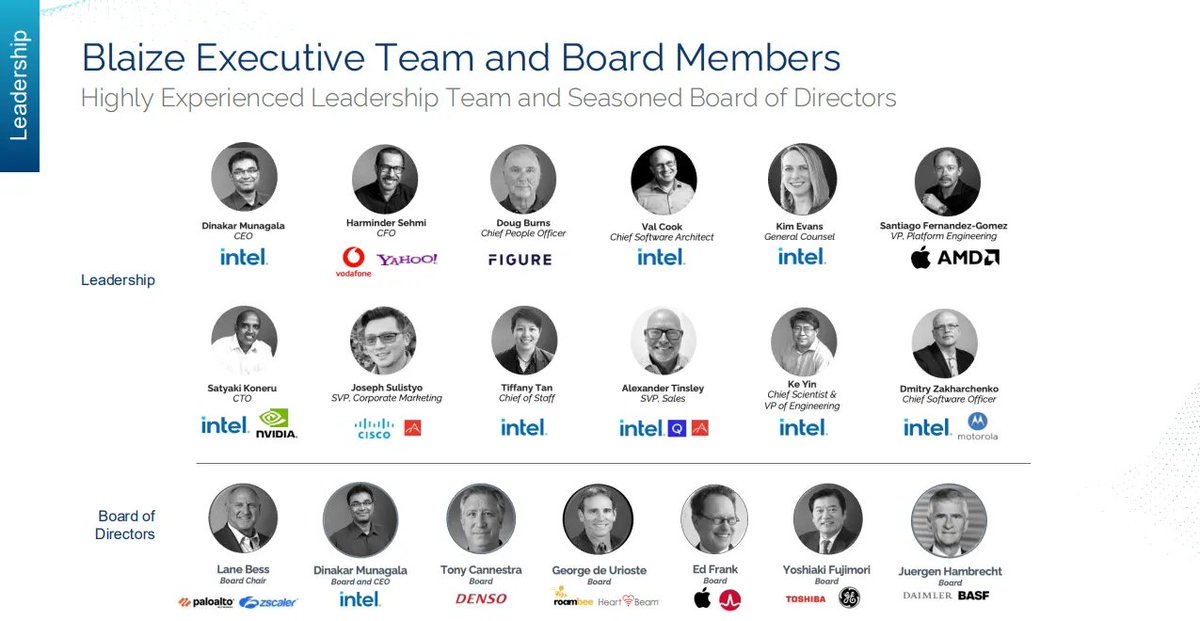
What I found fascinating, is that all three of the founders are still in the company’s management team.
1. Dinakar Munagala is the current CEO, with 22 years of experience in leading global teams in developing graphics chips for high-profile projects. Before founding $BZAI, Munagala spent 12 years at Intel holding key positions in graphics processor microarchitecture, design, and feature ownership within the mobile and graphics engineering group, as well as the Intel Centrino platforms. His contributions included developing Intel’s next-generation multi-core, multi-threaded graphics chips and architecting the company’s first integrated CPU/GPU product family.
2. Satyaki Koneru is the current CTO bringing more than 20 years of experience in next-generation system-on-a-chip design. Before co-founding Blaize, Satyaki held Architect/Micro-Architect and Design Engineer positions at Intel and Nvidia.
3. Ke Yin is the current Chief Scientist and VP of engineering, bringing more than 22 years of experience in graphics and video processor architecture and micro-architecture. A noted expert in multi-thread, multi-core, and SIMD/MIMD processor architecture, Ke defined the Blaize core architecture and developed multiple algorithm innovations in the area of graphics, video processing and network graphics, with multiple patents pending.
He also created the Blaize core simulator, a transaction-accurate model with bit-accurate precision that validates the correctness of the Blaize architecture and provides performance and power projections.
Prior to co-founding Blaize, Ke was at Intel for 12 years in a variety of Architect/Micro-Architect and Design Engineer roles across multiple key Intel products and initiatives. He also did architecture work on the Intel Gen graphics core where he led a power reduction effort resulting in a more than 30% power saving.
15
6) Balance sheet
To be fair, $BZAI's balance sheet is very strong. They currently have around $30 million in cash and virtually no debt, which gives them a solid financial cushion for a small-cap tech company.
That said, while the company isn’t profitable yet, its low leverage and healthy liquidity mean it can continue funding operations and product development through the next few growth phases. For a company in its early commercialization stage, this is a key advantage.
To be fair, $BZAI's balance sheet is very strong. They currently have around $30 million in cash and virtually no debt, which gives them a solid financial cushion for a small-cap tech company.
That said, while the company isn’t profitable yet, its low leverage and healthy liquidity mean it can continue funding operations and product development through the next few growth phases. For a company in its early commercialization stage, this is a key advantage.
16
7.1) Financials (deals)
Currently, $BZAI has nearly no revenue, but during the last quarter, Blaize signed two large deals. The first one, was signed with Yotta: India’s leading sovereign AI, sovereign cloud infrastructure, and platform services provider.
Blaize AI platform will power Yotta’s hybrid infrastructure, transforming more than 250,000 cameras with the aim to deliver real-time insights at scale across India.
“With its unique programmability, multimodal performance, and seamless integration, the Blaize AI Platform gives us the flexibility to scale our Hybrid AI infrastructure and unlock new opportunities for enterprises and public sector organizations across the region.”
— Said Darshan Hirandani, Chairman and Co-founder at Yotta.
The deployment of Blaize’s GSPs will enable:
AI-powered video surveillance as a service (VSaaS) for enterprises and government agencies
Real-time edge AI analytics for traffic management, license plate recognition, and public safety
Seamless integration between edge inference and centralized cloud analytics
Scalable architecture designed to support national-level smart infrastructure
Yotta will offer VsaaS only in India for now, but plans to expand into the Middle East soon. The deal is worth $56 million right now.
The second deal was signed with Starshine Computing Power Technology Limited: a provider of AI infrastructure solutions in Asia.
The deal was closed with the goal to efficiently drive real-world hybrid AI deployment across Asia through scalable infrastructure, powering smart cities, industrial automation, and intelligent public services.
The deal will be worth at least $120 million over the initial 18-month term and will initially focus on opportunities to deploy Blaize’s hybrid AI solutions for smart city applications. Blaize and Starshine will also accelerate software development to expand into additional industries. These are the countries in which Blaize’s systems will be used by Starshine:
· India
· Indonesia
· Japan
· South Korea
· China
All of these countries are extremely underpenetrated by AI and especially physical AI. I believe there’s massive upside, growth, and potential for physical AI in these countries.
“Hybrid AI is no longer an experiment; it’s infrastructure,”
— Said Teng Ma, Chairman of Starshine.
“Blaize delivers exactly what our customers demand: flexibility, power efficiency, multimodal support, and scalability. This partnership gives us the technology and capability to meet surging demand across Asia for real-time, localized intelligence.”
— In other words: bullish :)
The second deal with Starshine did raise some concerns for me, as I could find almost no information about the company. I don’t think it’s a major issue, but it’s definitely something to keep an eye on.
These deals are worth $176 million in total and should generate over $140 million in 2026.
I was perplexed that Blaize now has a pipeline of $725 million, which grew over 80% from the previous quarter, with $300 million in advanced discussions right now.
Currently, $BZAI has nearly no revenue, but during the last quarter, Blaize signed two large deals. The first one, was signed with Yotta: India’s leading sovereign AI, sovereign cloud infrastructure, and platform services provider.
Blaize AI platform will power Yotta’s hybrid infrastructure, transforming more than 250,000 cameras with the aim to deliver real-time insights at scale across India.
“With its unique programmability, multimodal performance, and seamless integration, the Blaize AI Platform gives us the flexibility to scale our Hybrid AI infrastructure and unlock new opportunities for enterprises and public sector organizations across the region.”
— Said Darshan Hirandani, Chairman and Co-founder at Yotta.
The deployment of Blaize’s GSPs will enable:
AI-powered video surveillance as a service (VSaaS) for enterprises and government agencies
Real-time edge AI analytics for traffic management, license plate recognition, and public safety
Seamless integration between edge inference and centralized cloud analytics
Scalable architecture designed to support national-level smart infrastructure
Yotta will offer VsaaS only in India for now, but plans to expand into the Middle East soon. The deal is worth $56 million right now.
The second deal was signed with Starshine Computing Power Technology Limited: a provider of AI infrastructure solutions in Asia.
The deal was closed with the goal to efficiently drive real-world hybrid AI deployment across Asia through scalable infrastructure, powering smart cities, industrial automation, and intelligent public services.
The deal will be worth at least $120 million over the initial 18-month term and will initially focus on opportunities to deploy Blaize’s hybrid AI solutions for smart city applications. Blaize and Starshine will also accelerate software development to expand into additional industries. These are the countries in which Blaize’s systems will be used by Starshine:
· India
· Indonesia
· Japan
· South Korea
· China
All of these countries are extremely underpenetrated by AI and especially physical AI. I believe there’s massive upside, growth, and potential for physical AI in these countries.
“Hybrid AI is no longer an experiment; it’s infrastructure,”
— Said Teng Ma, Chairman of Starshine.
“Blaize delivers exactly what our customers demand: flexibility, power efficiency, multimodal support, and scalability. This partnership gives us the technology and capability to meet surging demand across Asia for real-time, localized intelligence.”
— In other words: bullish :)
The second deal with Starshine did raise some concerns for me, as I could find almost no information about the company. I don’t think it’s a major issue, but it’s definitely something to keep an eye on.
These deals are worth $176 million in total and should generate over $140 million in 2026.
I was perplexed that Blaize now has a pipeline of $725 million, which grew over 80% from the previous quarter, with $300 million in advanced discussions right now.
17
7.2) Future expectations
$BZAI isn’t profitable yet, nor are they burning through loads of money, which is why I chose not to write a whole section about it. I do expect $BZAI to become profitable somewhere in 2027.
Now let’s move on to the expectations for Blaize’s revenue:
Analysts expect $BZAI to generate just south of $40 million in revenue for FY2025, nearly $140 million in FY2026, and more than $210 million in FY2027. In my opinion, these estimates are quite conservative, given their current pipeline and the significant room it still has to grow.
(The TTM revenue on the picture here below is incorrect)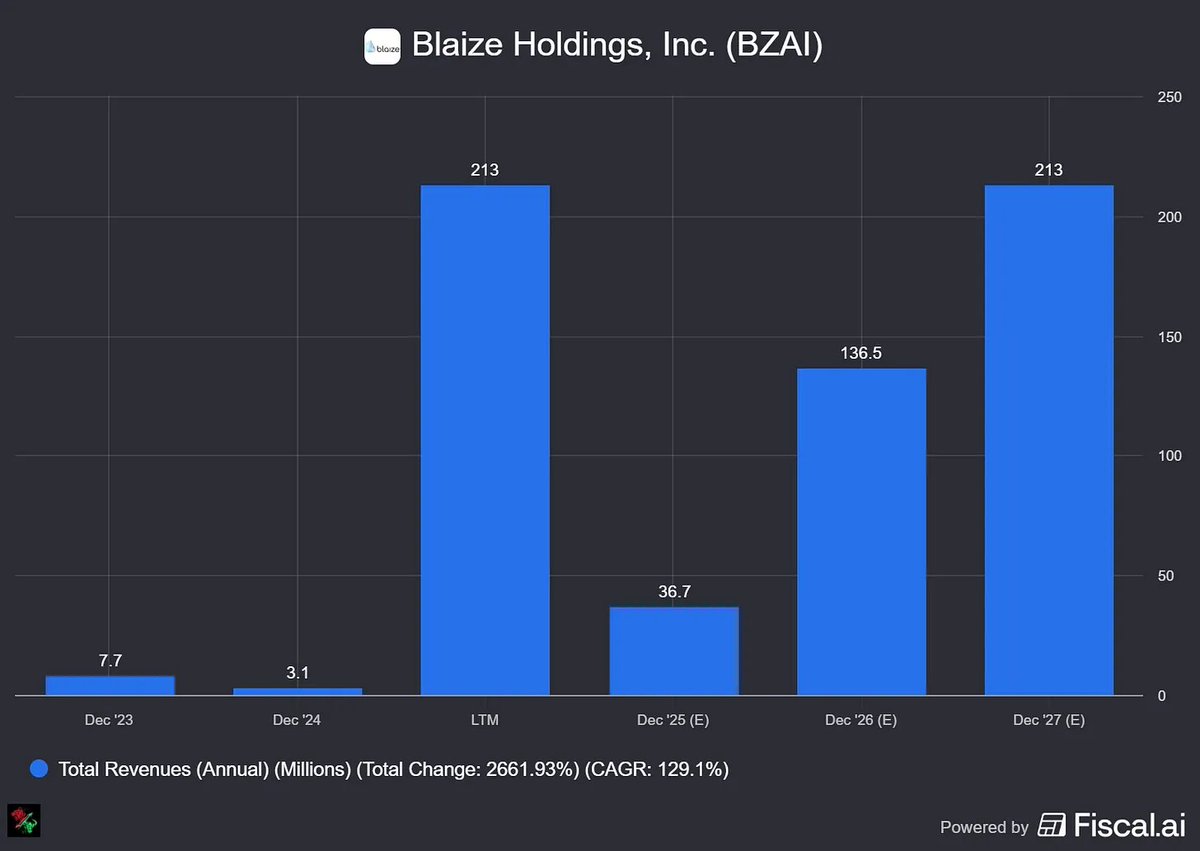
$BZAI isn’t profitable yet, nor are they burning through loads of money, which is why I chose not to write a whole section about it. I do expect $BZAI to become profitable somewhere in 2027.
Now let’s move on to the expectations for Blaize’s revenue:
Analysts expect $BZAI to generate just south of $40 million in revenue for FY2025, nearly $140 million in FY2026, and more than $210 million in FY2027. In my opinion, these estimates are quite conservative, given their current pipeline and the significant room it still has to grow.
(The TTM revenue on the picture here below is incorrect)
18
8) Price targets
Let’s assume $BZAI generates $300 million in revenue by FY2028 (a conservative estimate) with a net profit margin of 25%. That would translate to approximately $75 million in net income for FY2028.
Applying a P/E multiple of 25 gives a market cap of about $1.9 billion, roughly a 5x increase from today’s valuation.
Of course, this is purely an estimate and could turn out to be off, but if Blaize manages to secure a few more large contracts, this outlook would be far from overly optimistic.
Let’s assume $BZAI generates $300 million in revenue by FY2028 (a conservative estimate) with a net profit margin of 25%. That would translate to approximately $75 million in net income for FY2028.
Applying a P/E multiple of 25 gives a market cap of about $1.9 billion, roughly a 5x increase from today’s valuation.
Of course, this is purely an estimate and could turn out to be off, but if Blaize manages to secure a few more large contracts, this outlook would be far from overly optimistic.
19
9) Risks
While $BZAI shows strong technological potential, investors should remain aware of several key risks.
· Profitability and cash burn: Blaize is not yet profitable and continues to invest heavily in research, development, and commercialization. Even with roughly $30 million in cash, sustained operating losses could force the company to raise capital, potentially leading to shareholder dilution.
· Execution risk: Transitioning from an engineering-driven startup to a scaled, publicly traded company introduces operational challenges. Delays in product launches, software updates, or supply-chain issues could impact adoption rates and revenue growth.
· Market adoption risk: Although the edge-AI market is growing rapidly, customer adoption cycles can be slow. Many enterprises still rely heavily on cloud-based GPU inference. Convincing them to adopt a new architecture (GSP) requires time, education, and proven results.
· Macroeconomic and funding environment: A tighter capital-markets environment or a slowdown in technology spending could make it harder for Blaize to raise funds or close new enterprise deals, especially given its small-cap status.
While $BZAI shows strong technological potential, investors should remain aware of several key risks.
· Profitability and cash burn: Blaize is not yet profitable and continues to invest heavily in research, development, and commercialization. Even with roughly $30 million in cash, sustained operating losses could force the company to raise capital, potentially leading to shareholder dilution.
· Execution risk: Transitioning from an engineering-driven startup to a scaled, publicly traded company introduces operational challenges. Delays in product launches, software updates, or supply-chain issues could impact adoption rates and revenue growth.
· Market adoption risk: Although the edge-AI market is growing rapidly, customer adoption cycles can be slow. Many enterprises still rely heavily on cloud-based GPU inference. Convincing them to adopt a new architecture (GSP) requires time, education, and proven results.
· Macroeconomic and funding environment: A tighter capital-markets environment or a slowdown in technology spending could make it harder for Blaize to raise funds or close new enterprise deals, especially given its small-cap status.
20
If you enjoyed this thread, be sure to check out my SS; I’ll be posting plenty of additional deep dives, portfolio updates, and insights on what I’m planning to do with $BZAI and other stocks: substack.com/@meeijer
I hope this thread gave you a better understanding of, and perhaps helped you become a better investor in misunderstood companies.
— IIMC
I hope this thread gave you a better understanding of, and perhaps helped you become a better investor in misunderstood companies.
— IIMC