Taking Profit Euphoria is coming, but nobody tells you how not to...

CryptoAmsterdam@damskotrades
56 views
Aug 26, 2025
~10 min read
Advertisement
1
Taking Profit
Euphoria is coming, but nobody tells you how not to round-trip profit
1. Introduction
2. Tips
3. My strategy
Read along 👇 (1/5)

Euphoria is coming, but nobody tells you how not to round-trip profit
1. Introduction
2. Tips
3. My strategy
Read along 👇 (1/5)
2
1. Introduction
Now you are still calm, but if the market keeps following last cycle's pattern, we’ll soon hit a short but explosive mania.
Many here still pray the cycle isn’t over, scared to enter or hold, but soon they’ll be euphoria-struck.
In the first 90% of the cycle, everyone fears dips and the end. But in the last 5–10%, euphoria flips it: people suddenly believe it’ll never end, that a new paradigm started.
Huge gains will be made fast, but without a plan, most will get lost in euphoria and roundtrip profits back to entry or worse.
I’ll continue with some tips and things I’ve learned from past cycles, and finish with how I form my plan.
Hopefully, it inspires you to make your own plan and secure it this time.
3
2. Tips
1/ human nature
It starts with understanding why so few will sell. Same reason most fail to buy the bottom.
Human emotions make it feel terrible to buy when price went down a lot, and terrible to sell when it’s only going up.
The way to go is simple: buy the red (lows/early cycle) and sell the green (highs/late cycle).
The real reason you fail to buy early and sell at the end is a natural human trait.
Making the right moves in the market almost always feels bad and uncomfortable.
If you just do what feels good, you’ll end up doing the opposite of what you should to make money and keep it.
Step 1 is being aware of this.
2/ make selling a habit
Pressing the red button feels weird after holding for a long time, and even harder when things have only gone up and holding worked. You fall into the habit of just holding and watching uPNL rise.
Start selling small batches here and there. Doesn’t matter if it’s tiny. It’s about getting used to selling and building the habit. The more you do it, the lower the mental barrier will be when it’s time to really sell.
3/ life-changing money made?
First of all, don’t wait — change your life.
Also, don’t keep it in stables on your exchange or trading wallet. There’s third-party risk on a CEX, and the bigger risk: giving in to euphoria and putting it back into the market.
The market hype is still in you, still around you on Twitter, friends will say it’s going higher, Eric says it’ll never stop.
You still feel overconfident from your wins, and prices keep rising even after you secured your gains.
With stables in your wallet you’re only 2 clicks away from giving in and chasing more while time is running out.
→ Move it into fiat in your bank account
→ Or into more stable assets that maybe also are fun to buy and hold value (like a watch, real estate.)
Whatever you think is good, idk just something that does not generally drop 99% after the bull market (altcoins).
Just be aware of the risks of keeping stables in your wallet.
4
4/ stop rotating.
You make great money, put it in the next play, make more, and then lose it when the music stops.
Imagine starting with 10k, dreaming of 100k this cycle. Once you hit 100k, you start thinking about doing it again to reach a million. Do this once, twice, and the third time the music stops, and you’ll be down 99% and lose it all.
At some point, stop rotating, or at least take a lot out and rotate with smaller capital.
Trust me, it will be very tempting to do it again with a winner’s confidence in your head in a roaring bull market, and you will automatically start dreaming about extremely high targets with suddenly bigger capital to play with.
5/ Don’t compare yourself to others
10k is a lot. 100k is a lot. 1M is a lot.
Ignore million-dollar single trade PNLs. Don’t let them mess with your head and make you lose touch with your own level. It’s easy to start thinking you should be there too, which makes you vulnerable for oversizing, not taking profit, and risking more deeply in the bull once you’ve made some money.
Maybe 1% of those big PNLs happened in one cycle. The vast majority of big capital was built by compounding across multiple cycles. Imagine starting the next bear with 10x what you had this time.
Focus on having more for the next bear and making it that cycle, or the one after. You don’t need to make it all this cycle.
6/ Focus on printing higher lows
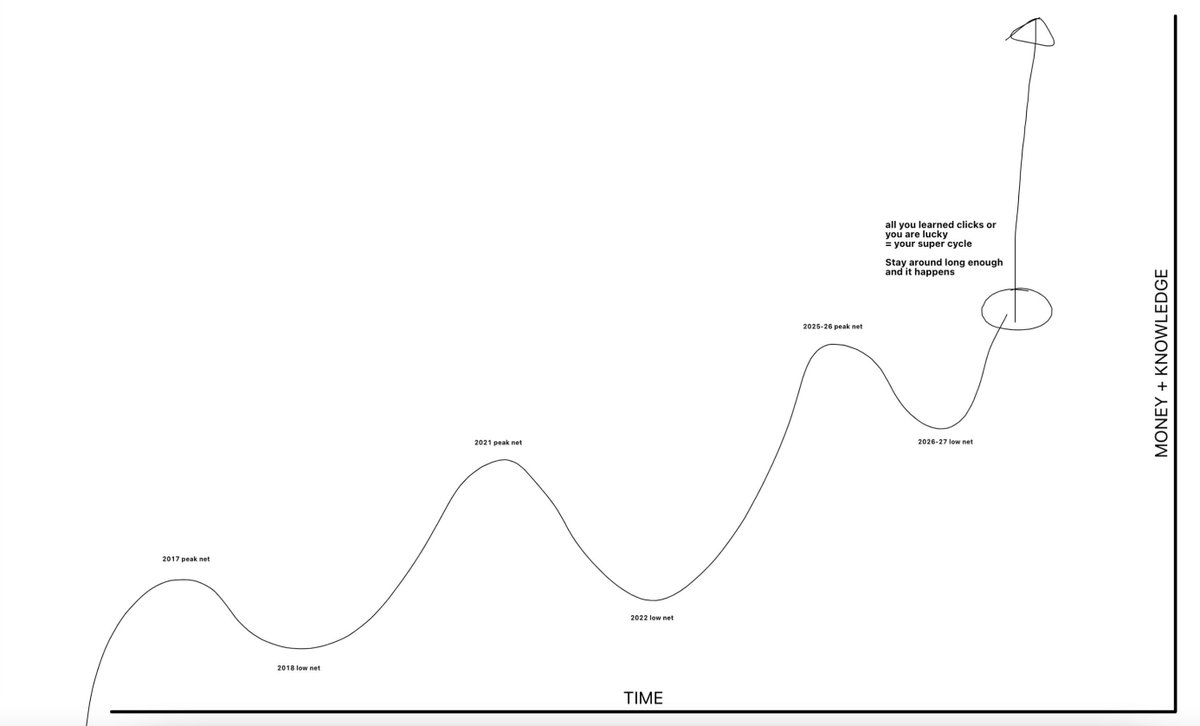
Shift your focus away from your peak net worth this cycle. It’s a magical number that almost no one actually realizes in cash, yet it’s the number most people fixate on.
The number that drags people back to zero because they’ll always feel unsatisfied, not hitting it again.
This leads to holding too long, not selling, and taking on more risk late in the cycle.
Instead of focusing on your high, focus on creating higher lows in your net worth.
Your most recent high might not be broken again this cycle, but setting a higher low compared to the last cycle is much more realistic.
Focusing on printing higher lows each cycle will help you feel satisfied, proud, and more at peace, realizing profits even if you’re down a bit from the top.
You make great money, put it in the next play, make more, and then lose it when the music stops.
Imagine starting with 10k, dreaming of 100k this cycle. Once you hit 100k, you start thinking about doing it again to reach a million. Do this once, twice, and the third time the music stops, and you’ll be down 99% and lose it all.
At some point, stop rotating, or at least take a lot out and rotate with smaller capital.
Trust me, it will be very tempting to do it again with a winner’s confidence in your head in a roaring bull market, and you will automatically start dreaming about extremely high targets with suddenly bigger capital to play with.
5/ Don’t compare yourself to others
10k is a lot. 100k is a lot. 1M is a lot.
Ignore million-dollar single trade PNLs. Don’t let them mess with your head and make you lose touch with your own level. It’s easy to start thinking you should be there too, which makes you vulnerable for oversizing, not taking profit, and risking more deeply in the bull once you’ve made some money.
Maybe 1% of those big PNLs happened in one cycle. The vast majority of big capital was built by compounding across multiple cycles. Imagine starting the next bear with 10x what you had this time.
Focus on having more for the next bear and making it that cycle, or the one after. You don’t need to make it all this cycle.
6/ Focus on printing higher lows
Shift your focus away from your peak net worth this cycle. It’s a magical number that almost no one actually realizes in cash, yet it’s the number most people fixate on.
The number that drags people back to zero because they’ll always feel unsatisfied, not hitting it again.
This leads to holding too long, not selling, and taking on more risk late in the cycle.
Instead of focusing on your high, focus on creating higher lows in your net worth.
Your most recent high might not be broken again this cycle, but setting a higher low compared to the last cycle is much more realistic.
Focusing on printing higher lows each cycle will help you feel satisfied, proud, and more at peace, realizing profits even if you’re down a bit from the top.
5
7/ Doing things slowly & the mindset (mission)
Before making a plan, let's think about mindset and see if we can understand the toxic way of thinking that leads to giving back all your money and controlling it.
Acceptance and the mission.
95% of people:
A) think they need to be either fully allocated or entirely out, and
B) try to sell the absolute top of the bull market.
99% of those who try this either sell way too early and end up completely sidelined, FOMO back in higher, or miss the top and hold back to zero while dreaming about their peak net worth.
Accept that trying to sell it all at the top is a recipe for disaster.
You don’t need every move to be all-in or all-out. You can scale in and out over time.
There’s no reason to stay fully allocated as we head into the late part of the cycle, even if you think the best is still to come (I do).
The goal is simple:
> Scale in early, scale out late.
> Catch most of the move.
> Walk away with more than you put in.
If you walk away from this cycle with more than you put in, if you have more cash in the next bear than the last one, you outperformed 90% of people.
6
3. My plan.
I base my profit-taking strategy on my core concepts, which also helped me scale in crypto early this cycle in 2023.
> Ranges and Cycles
Most of the crypto market (if the project is not dead) goes through very similar cycles.
Even Bitcoin and total market cap charts.
1. Bull (parabolic up)
2. Bear (steeply down)
3. Accumulation (sideways)
4. Disbelief (initial higher high and range low reclaim)
5. Bull (slowly up to the range high, parabolic price action later above the range)
Same price action concepts over and over again, everywhere.
Where to take profit?
First of all, I’ll do it slowly over time with multiple points to start, increase, or take extra out.
> First point: upper part of the range and range high (small TPs)
> Second point: once prices go vertical into price discovery (stage 5), take slowly over time — for example every week x% (adjust to your liking)
> Extra points: extend the range by using the old range high as a new mid-range (0.25 point), pushing the range higher into price discovery. This gives you a new upper part and range high to take more profit.
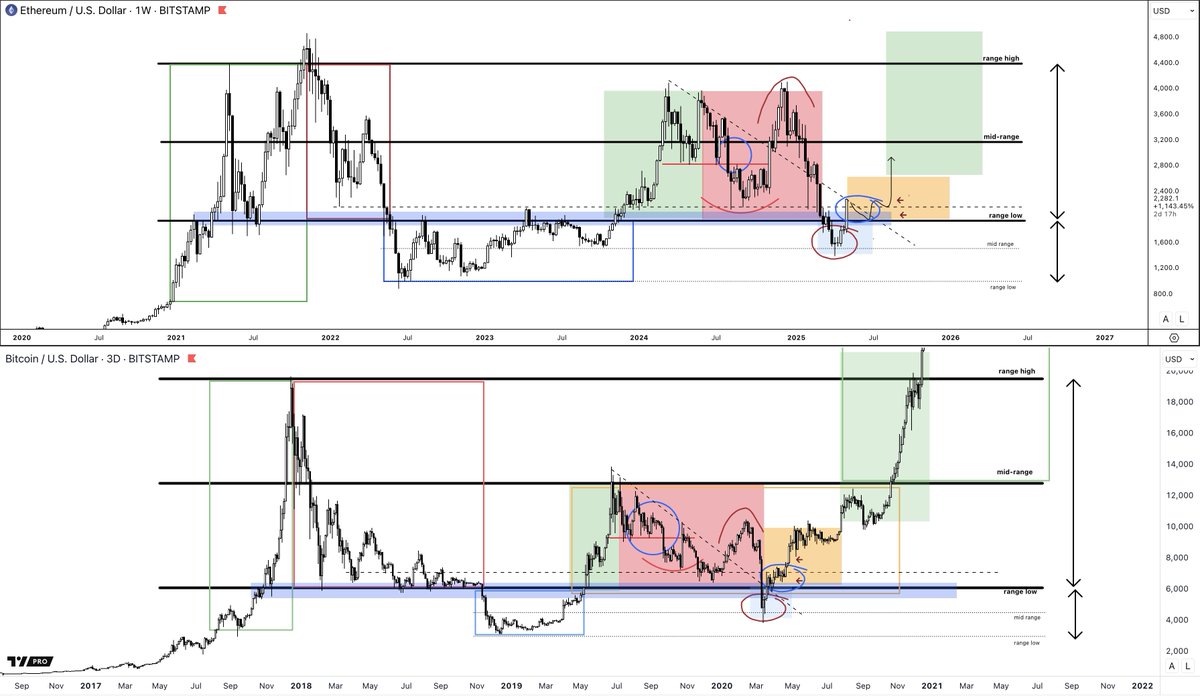
This is the inverse of how we scaled in earlier on Bitcoin and Solana, at the range low zone in stages 3 and 4.
Cycle:
> Scale in: stage 3 and 4
> Scale out: stage 5
Range:
> Scale in: Range low reclaim or the deviation lows
> Scale out: Upper part range and range high
7
What charts am I using to scale out? (+ examples)
Using the same cycle + range high scale out strategy and points I'm using:
1. Individual charts
2. Total, Total 3, and Others charts (total market caps)
3. Also, Bitcoin Dominance, but without the range and cycle structure.
1. Individual charts
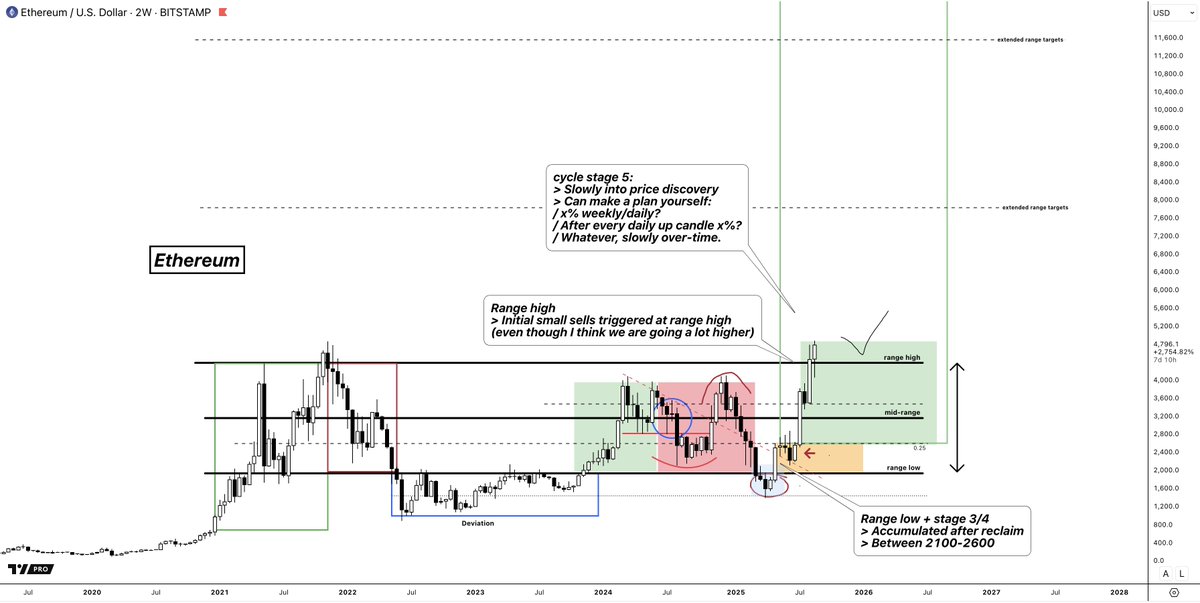
ETH as an example:
- Upper range and range high small tp
- Rest slowly over time into price discovery, aka stage 5
- Think of how you will make your 'overtime' clearer and easier to follow.
- Can use extended range levels.
(Initial eth trade: )
Here you can see how you could have extended the range on Ethereum in 2021 — the new range high would have marked the perfect top.
1. Asset breaks above the range high
2. Pull up your range
3. Move the range high into price discovery
4. Until the 0.25 sits at the old range
5. Now you have a new range high
Again, I don’t like single targets and prefer scaling out, but this can be a zone to take a little extra profit.


Using the same cycle + range high scale out strategy and points I'm using:
1. Individual charts
2. Total, Total 3, and Others charts (total market caps)
3. Also, Bitcoin Dominance, but without the range and cycle structure.
1. Individual charts
ETH as an example:
- Upper range and range high small tp
- Rest slowly over time into price discovery, aka stage 5
- Think of how you will make your 'overtime' clearer and easier to follow.
- Can use extended range levels.
(Initial eth trade: )
Here you can see how you could have extended the range on Ethereum in 2021 — the new range high would have marked the perfect top.
1. Asset breaks above the range high
2. Pull up your range
3. Move the range high into price discovery
4. Until the 0.25 sits at the old range
5. Now you have a new range high
Again, I don’t like single targets and prefer scaling out, but this can be a zone to take a little extra profit.
8
2. Total, Total 3, and Others charts (total market caps)
You can also use the total market cap charts to scale out slowly from certain altcoins.
And use the money flow:
1. BTC
2. Majors
3. Other altcoins
Same pattern, all lagging behind Bitcoin. I used this to scale in first — mainly into Bitcoin and Solana as majors, since they likely move first.
I also used it to scale out slowly from BTC and majors once they hit the range high and Bitcoin broke into price discovery. Again, very slowly over time.
As you can see, the Others chart is still in the lower part of the range, so I haven’t really taken profit there yet — I expect them to end the cycle.
Here’s an example of how I used the Total 3 to load up on altcoins (Solana back then), with the range high as my initial take profit point for majors.
9
/ Bitcoin Dominance
Usually the cycle ends with Bitcoin at the cycle resistance line and dominance dropping to the lows in the last leg up.
There’s no strict point, but if both line up, Bitcoin at parabolic resistance and dominance making a big move down, watching this might be handy tool as well.
I’m planning to build a new Bitcoin stack, not tied to the usual cycle, but aimed at holding into the break of that diminishing returns line. I’ll scale out a bit more into longer-term Bitcoin as usual.
The breakout might happen this cycle or the next. I don’t really care. Doing it partially, of course, with most still slowly going into fiat.
Will be using the BTC.D chart for this.
10
> Make your own plan
> This is just an example of the technique I use: ranges, price action, and cycle structure, to inspire people to make their plan.
> This is just an example of the metrics and charts I use > Fill it in yourself or find another way: just have a plan, or you won’t take much home
> Scale out vs static price points: sell slowly over time with the goal to sell late in the cycle, not at the exact top all at once
> Over time looks different for everyone, same for initial TP points like the range high
> For one, it could mean selling 30% at the range high, for another maybe 5% (I also check other metrics at that moment)
> For one, selling 1% a week, and for another 10% a week once in price discovery.
> Make your own plan!

