Altcoins are about to fly. Here’s how to catch the winners: 1 - How...

CryptoAmsterdam@damskotrades
25 views
Nov 23, 2024
~9 min read
Advertisement
1
Altcoins are about to fly. Here’s how to catch the winners:
1 - How to spot the winners.
2 - Strong Altcoin setups right now.
This helped me buy Bitcoin under 30k and DOGE before its 300% pump.
Read along below! 👇
1 - How to spot the winners.
2 - Strong Altcoin setups right now.
This helped me buy Bitcoin under 30k and DOGE before its 300% pump.
Read along below! 👇
2
I'll make this high-quality and aim for more bookmarks than likes. 🫡
How, sir?
1. Picking the right sector
2. Ranges
3. Cycle structure
4. Mixing Ranges and Cycle structure
5. Mini-cycle within a cycle
6. How to use the mix
7. Couple of strong Altcoin setups right now
How, sir?
1. Picking the right sector
2. Ranges
3. Cycle structure
4. Mixing Ranges and Cycle structure
5. Mini-cycle within a cycle
6. How to use the mix
7. Couple of strong Altcoin setups right now
3
1. Picking the right sector
Sadly, this isn’t 2017. Back then, 50 altcoins on 1 CEX got all the money.
Now, we have millions of tokens, sectors, chains, and ecosystems spread across 1239 DEXs and CEXs.
You must work to spot the sectors getting the most attention and inflows.
Sitting in the wrong ones means missing out.
How?
There are a couple of ways to do this:
1. The market often shows its hand early in the cycle. Which tokens led the first bull waves, and does one sector stand out?
2. What tokens held up the best in the market pullback over the last 8-9 months?
3. Which tokens drop least in a short-term pullback and bounce hardest in a recovery?
4. Use common sense. Is something in the real world grabbing attention? Crypto could be an easy way for people to gain exposure.
(Metaverse in 2021 with the Meta rebrand, maybe AI this cycle?)
5. Use cycle charts: Check sectors or an index if available. If not, build one or track leading tokens to find sectors in the most interesting cycle stage.
(Later in this thread, we’ll cover cycle stages and their meaning.)
6. Use Tools: Tools like @velo_xyz and @_kaitoai give you insight into sector performance or mindshare.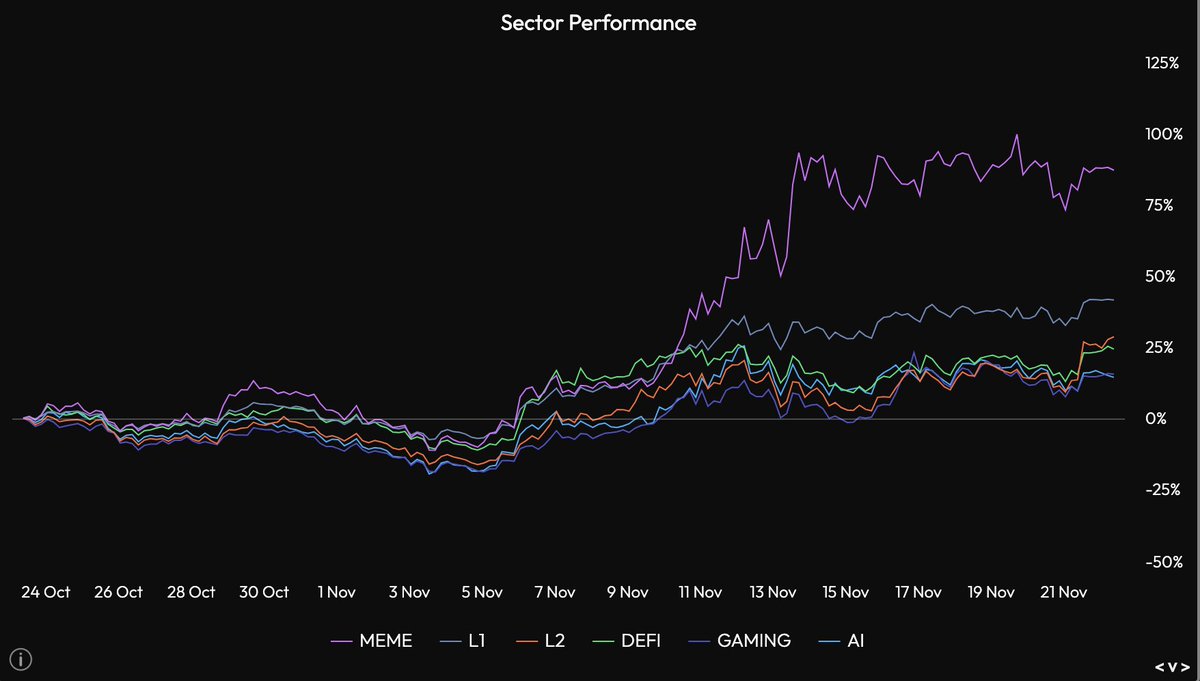
Sadly, this isn’t 2017. Back then, 50 altcoins on 1 CEX got all the money.
Now, we have millions of tokens, sectors, chains, and ecosystems spread across 1239 DEXs and CEXs.
You must work to spot the sectors getting the most attention and inflows.
Sitting in the wrong ones means missing out.
How?
There are a couple of ways to do this:
1. The market often shows its hand early in the cycle. Which tokens led the first bull waves, and does one sector stand out?
2. What tokens held up the best in the market pullback over the last 8-9 months?
3. Which tokens drop least in a short-term pullback and bounce hardest in a recovery?
4. Use common sense. Is something in the real world grabbing attention? Crypto could be an easy way for people to gain exposure.
(Metaverse in 2021 with the Meta rebrand, maybe AI this cycle?)
5. Use cycle charts: Check sectors or an index if available. If not, build one or track leading tokens to find sectors in the most interesting cycle stage.
(Later in this thread, we’ll cover cycle stages and their meaning.)
6. Use Tools: Tools like @velo_xyz and @_kaitoai give you insight into sector performance or mindshare.
4
2. Ranges
What is a range?
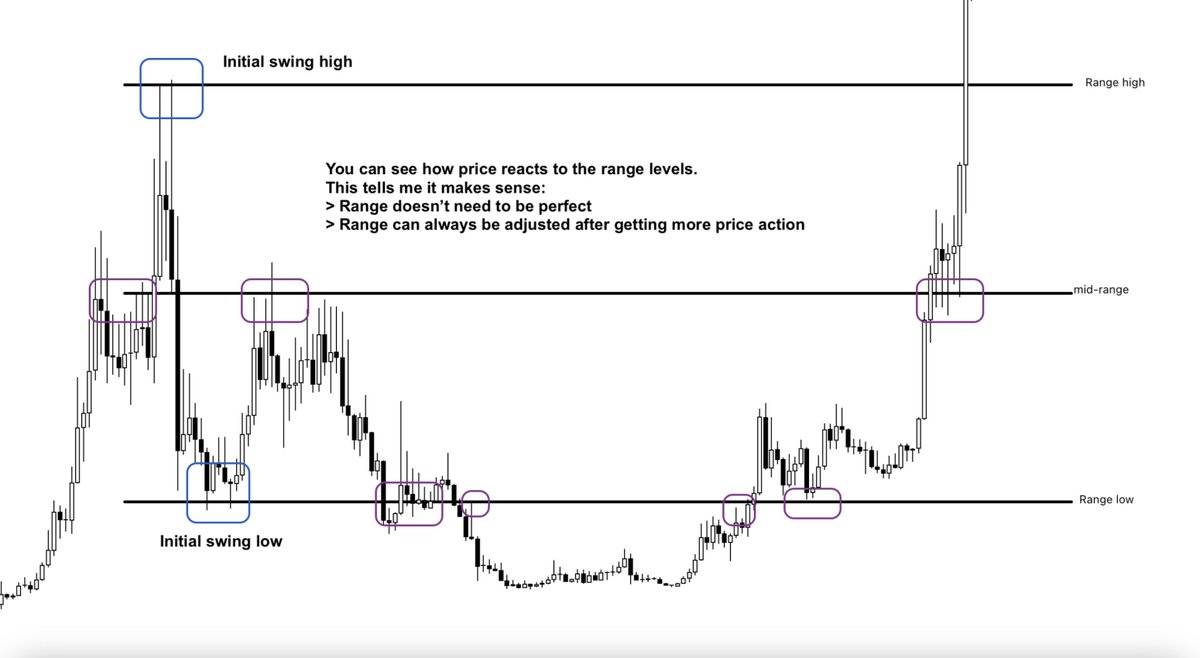
A non-trending market where price moves between two zones. At the zones, you can draw a range high and low.
Price bounces between these two levels until we get a breakout, and the market becomes trending again.
What is a range?
A non-trending market where price moves between two zones. At the zones, you can draw a range high and low.
Price bounces between these two levels until we get a breakout, and the market becomes trending again.
5
How to draw it?
It's important to understand that everyone draws ranges differently, and there's no single correct way.
As long as your method works, it's okay.
Context, like levels outside the range and market structure, also matters, so exact ranges often aren't that important. After a while, you'll learn how they work best for you.
1. Place your range high and low.
I often start by marking the range's initial swing high and low.
6
2. Refine your Range
After you find your initial swing high and low, you'll likely have at least some more price action to work with. To double-check your range, you can add the mid-range and quarters.
If the price reacts at these levels, it's a sign that you're doing things right.
Also, refine the range placement if you get a different idea after having more price action.
More examples:

After you find your initial swing high and low, you'll likely have at least some more price action to work with. To double-check your range, you can add the mid-range and quarters.
If the price reacts at these levels, it's a sign that you're doing things right.
Also, refine the range placement if you get a different idea after having more price action.
More examples:
7
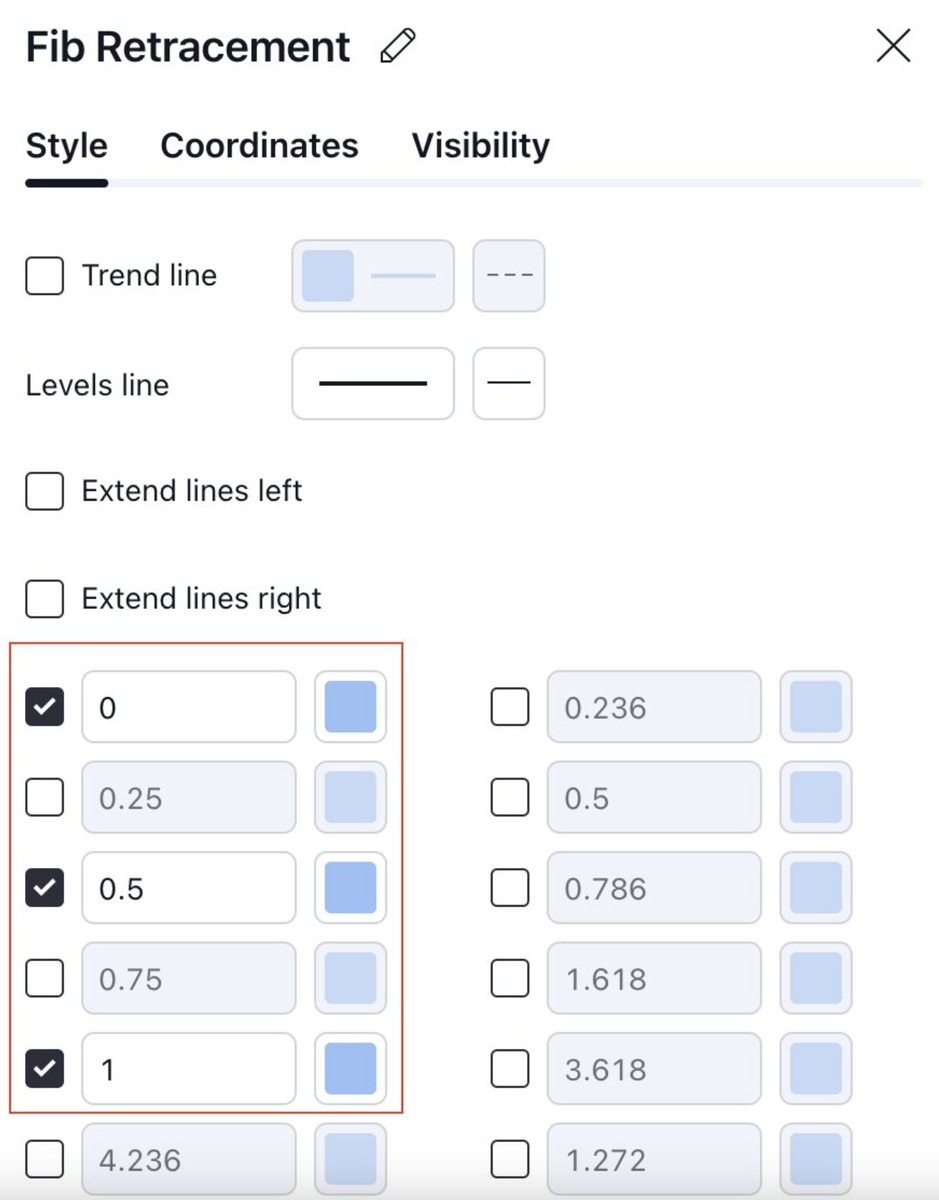
Tip: I'm using the 'Fib Retracement' tool on TradingView to draw ranges. You must change a few fib level settings to 0 - 0.25 - 0.5 - 0.75 - 1. You can save different templates now. I got a template with only the primary levels, the range high and low, plus the mid-range (1 - 0 - 0.5) and one for the quarterly levels (0.25 - 0.75)
8
How can a range help you with the price direction?
3. Range deviations
Eventually, a range breaks up or down.
In this example, we focus on a breakdown.
What happens after a breakdown is that people:
- Open a short
- They sell their position as they're assuming lower prices.
- Their stoplosses getting tagged on leverage longs or spot.
But what if this breakdown fails, and prices reclaim the range?
- People with shorts close these (they buy themselves out)
- People with shorts get their stop loss hit (automatically buys them out)
- People that sold spot buy themselves back in.
- People see a range reclaim/support flip setup and buy-in.
Bias and Trade idea:
Now, after a confirmed deviation and reclaim, either at the top or bottom of the range, prices often quickly reverse and visit the opposite side.
So you could wait for the deviation and reclaim and take a trade with a target at the opposite side of the range.
9
3. Cycle structure
People bag holding coins, while it's not profitable in most of the stages they go through.
You want to catch them when the probability of the downside is the lowest and the parabolic upside is the highest.
Every asset, including Bitcoin and Altcoins, goes through similar market cycles with similar market stages.
1. Bull = parabolic upside
2. Bear = lower lows and highs = vertical downtrend
3. Accumulation = after the bear, lower lows and highs transit into equal highs/lows
4. Disblief = Initial macro higher high = trend is shifting bullish
5. Bull = parabolic upside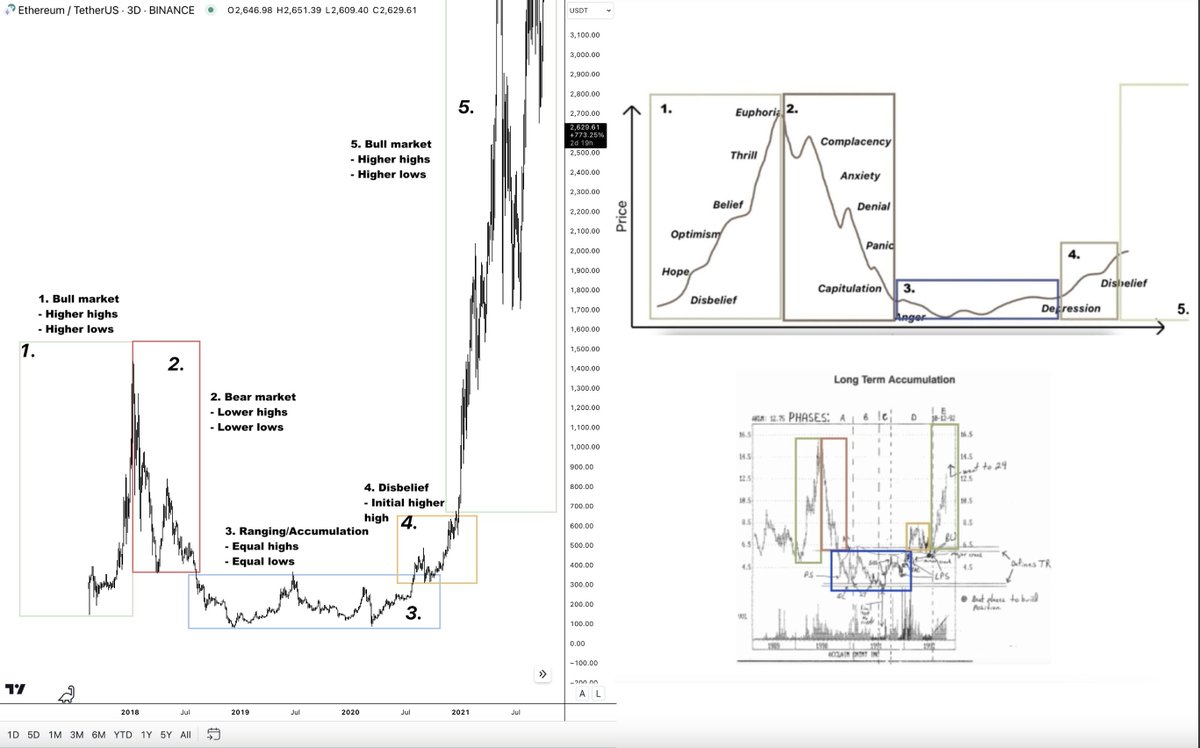
People bag holding coins, while it's not profitable in most of the stages they go through.
You want to catch them when the probability of the downside is the lowest and the parabolic upside is the highest.
Every asset, including Bitcoin and Altcoins, goes through similar market cycles with similar market stages.
1. Bull = parabolic upside
2. Bear = lower lows and highs = vertical downtrend
3. Accumulation = after the bear, lower lows and highs transit into equal highs/lows
4. Disblief = Initial macro higher high = trend is shifting bullish
5. Bull = parabolic upside
10
3. Mixing Cycle structure and Ranges
Now, we can mix the ranges with the cycle structure.
Range high and low:
You can see that the previous cycle top acts as range high, and the initial swing low of stage 2 acts as range low.
Stage 3:
The accumulation stage 3, is the deviation below the range low.
Stage 4:
In disbelief stage 4, the market structure shifts bullish, with the initial higher high confluenced with the range low reclaim.
Stage 5:
The parabolic bull stage is when the price surges to and above the range high. The move from range low to high was expected, even without cycle structure, as it’s the range low reclaim setup.
11
I'll give a few examples of how you can get in after spotting the strong cycle stages: 3,4 and 5.
> Stage 3:
If you're bullish on an asset, you can choose to enter in stage 3—the accumulation range. It might take time but offers ideal risk-reward.
You can spot this when stage 2’s steep downtrend flattens, and lower lows shift to equal highs and lows.
Stage 3 can be seen as a range.
You want to buy the range low or range high break out. You don't want to buy the upper 50% of the range.
12
> Stage 4:
The disbelief stage is when the price prints its first macro higher high since stage 2's bear market of lower lows and highs and stage 3's accumulation of equal highs and lows.
It is in confluence with our range low setup, when prices reclaim the range low after the deviation.
Here you can see the higher high + range low reclaim = stage 4.
Entry options:
1. Initial reclaim of the range low and break out above stage 3.
2. Retest range low; initial macro higher low.
3. Stage 4 consolidation break out.
Often, when prices reclaim the 0.25 level of the range, and with that, I mean the first quarter of the range, it also makes the price move from stage 4 to our parabolic cycle stage 4.
Often the consolidation of stage 4 forms precisely below the 0.25 of the range, and you can use this level to jump in when prices move from stage 4 to stage 5.
13
> Stage 5: the parabolic bull stage
Cons:
- Higher in the range, price moves quick = difficult to get in and find an invalidation
Pros:
- Short holding time as prices should move fast here.
Options to get in here: (look for key levels)
0.25 key level:
1 - Break from stage 4, above the 0.25 into stage 5.
1 - reclaim mid-range
2 - Wait for some consolidation above the mid-range and buy a breakout
3 - Wait for a deviation below the mid-range and buy the reclaim.
14
Here's a cheat sheet for the mid-range deviation:
The same applies to the range high.
The same applies to the range high.
15
Lastly, mini-cycles exist within macrocycles.
A stage 4 breakout can help you enter at key levels in the bigger cycle's stage 4 or 5.
The last 8-9 months' corrections are mini-cycles within the larger cycle.
I posted $DOGE weeks ago, using mini and macro cycles to time my entry before the pump—I'll explain this as a great educational example.
Another example is $SUI, posted a while ago: 👇
- We have an uncompleted macrocycle; we only hit the range highs and not into price discovery.
- We retraced into our key level, the range low
- We can see that there's now a mini-cycle.
I aimed to enter after a sweep of the macro range low, aligning with the mini-cycle stage 3 sweep of lows or a breakout into stage 4 of the mini-cycle, which also matched the 0.25 level of the macro range.
You can see that the mini-cycle playing out transits into the higher cycle playing out.
16
Here's my $DOGE trade example of a couple of weeks ago:
HTF:
- Stage 4
- Range low key level
LTF:
- Stage 3
- Looking for a break into mini cycle stage 4 to enter

HTF:
- Stage 4
- Range low key level
LTF:
- Stage 3
- Looking for a break into mini cycle stage 4 to enter
17
Mini-cycle is playing out and rolling over into a macrocycle playing out.

18
But these mini-cycles within bigger cycles can also happen at the mid-range or range high.
$NAVI / @AtlasNavi is an AI project with a working product that I've been working with for a while.
Very clear macrocycle, and retraced in a mini-cycle format into the range high and mid-range key levels.
I'm looking for a trigger in the form of a clear break into stage 4 of the mini-cycle by reclaiming the range high and breaking the local top.
19
Few other strong Altcoin setups:
1) $AAVE
I like AAVE, as I think ETH will bottom soon. DeFi should make a comeback, making AAVE a solid beta play.
Using Velo tool I already noticed some DeFi strength lately.
I also like how AAVE printed a higher high in stage 4, while others pulled back deeply.
Entry options:
- Retest or sweep of the range low zone
- Build a base, then break above the 0.25
20
2. $FTM
I’m putting this here because I’ve held a position since the range low, their rebrand is coming, and it’s showing a super clear mini-cycle within a bigger cycle at the range lows.
Entry ideas:
- Close above these local highs, into mini cycle stage 5
- Retest or sweep at the range lows.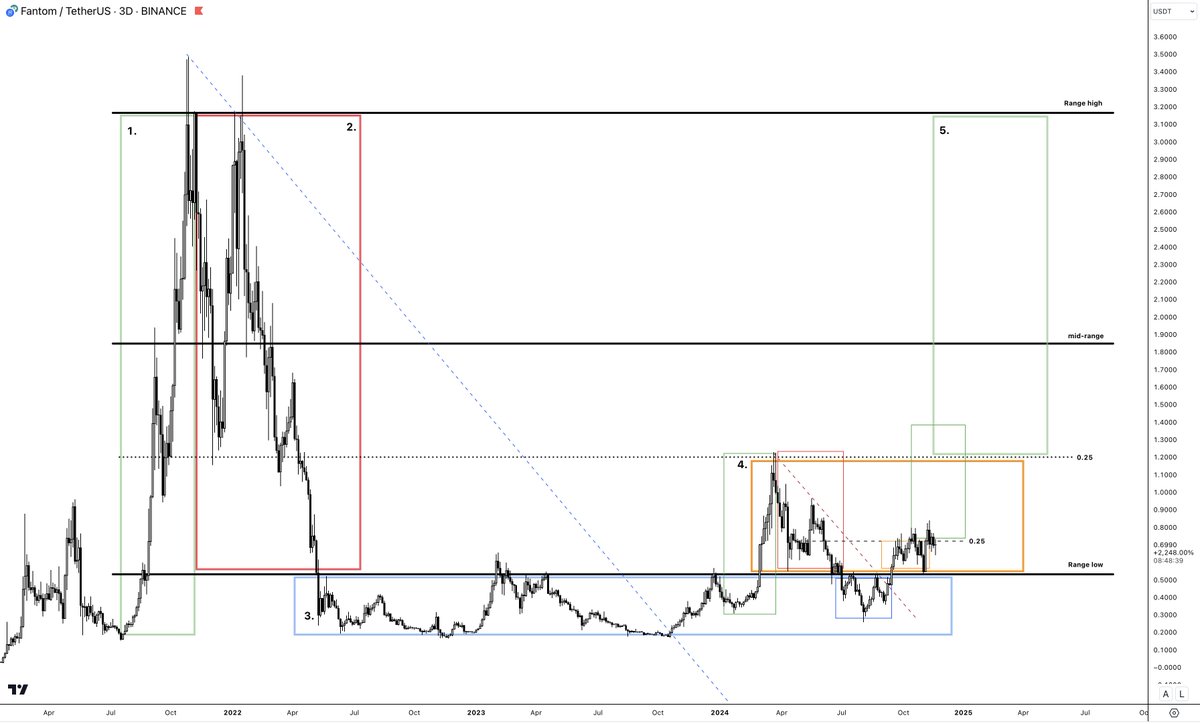
I’m putting this here because I’ve held a position since the range low, their rebrand is coming, and it’s showing a super clear mini-cycle within a bigger cycle at the range lows.
Entry ideas:
- Close above these local highs, into mini cycle stage 5
- Retest or sweep at the range lows.
21
3. $SEI
Beautiful range low reclaim, into stage 4.
Entry option:
- Range low and/or sweep of it
- Break above the 0.25
Beautiful range low reclaim, into stage 4.
Entry option:
- Range low and/or sweep of it
- Break above the 0.25
22
4. $NEAR
I like NEAR as AI major play.
I could make a case to buy here in the mini cycle, but I'd instead give it some time to form a base that we can use to buy a sweep-off or a breakout. The current breakout isn't too convincing, imo.
But overall, it has a beautiful macro range key level, nice HTF cycle, and mini cycle formed.
23
TLDR:
1. Spot the strong niches and outperformers
2. Use the cycle to find the ones in the stages you are looking for
3. Use the ranges as confluence, for your entry/target/invalidation/triggers and to understand where we are.
4. Use mini-cycles as entry technique
1. Spot the strong niches and outperformers
2. Use the cycle to find the ones in the stages you are looking for
3. Use the ranges as confluence, for your entry/target/invalidation/triggers and to understand where we are.
4. Use mini-cycles as entry technique
24
I will drop some more range/cycle threads with setup examples I now see in the markets.
I'd love to hear if you enjoyed this or hated it but learned something. Feel free to share the first post!
Next: A chart request thread.✍️
I'd love to hear if you enjoyed this or hated it but learned something. Feel free to share the first post!
Next: A chart request thread.✍️

