Hi everyone, Inspired by @ScottPh77711570's interview on flirting...

beaver quant@idro___
14 views
Mar 13, 2025
~3 min read
Advertisement
1
Hi everyone,
Inspired by @ScottPh77711570's interview on flirting with models, I’m diving into funding arbitrages on DEXs.
I’ll be sharing my early findings below , hoping to get feedback and spark discussions.
Maybe even share how the live trading is going.
Inspired by @ScottPh77711570's interview on flirting with models, I’m diving into funding arbitrages on DEXs.
I’ll be sharing my early findings below , hoping to get feedback and spark discussions.
Maybe even share how the live trading is going.
2
I’m planning on smashing funding arbitrages between HyperLiquid and dYdX.
First step: pulling funding and volume data from both DEXs. Next, I’ll analyze the annualized funding difference for pairs listed on both exchanges.
First step: pulling funding and volume data from both DEXs. Next, I’ll analyze the annualized funding difference for pairs listed on both exchanges.
3
diff = (dydx_fundings - hyperliquid_fundings) * 24 * 365
Here is what dataset looks like:
Here is what dataset looks like:
4
First thing that comes to mind: capacity. I want to identify the most lucrative opportunities in terms of volume.
If these opportunities are heavily capacity-constrained, scaling will be difficult (which I expect—if an arb is too easy, it shouldn't exist).
If these opportunities are heavily capacity-constrained, scaling will be difficult (which I expect—if an arb is too easy, it shouldn't exist).
5
I might be a bit sloppy on this one, but I’m keeping it simple.
I’m only interested in the top 5% of arbs—no point analyzing lower funding differential pairs since I won’t be trading them.
I’m only interested in the top 5% of arbs—no point analyzing lower funding differential pairs since I won’t be trading them.
6
Next step: taking the top 5% arbitrage opportunities and analyzing the traded volume in the same hour.
I’ll group these arbs by volume quantile and compute the mean funding differential for each group.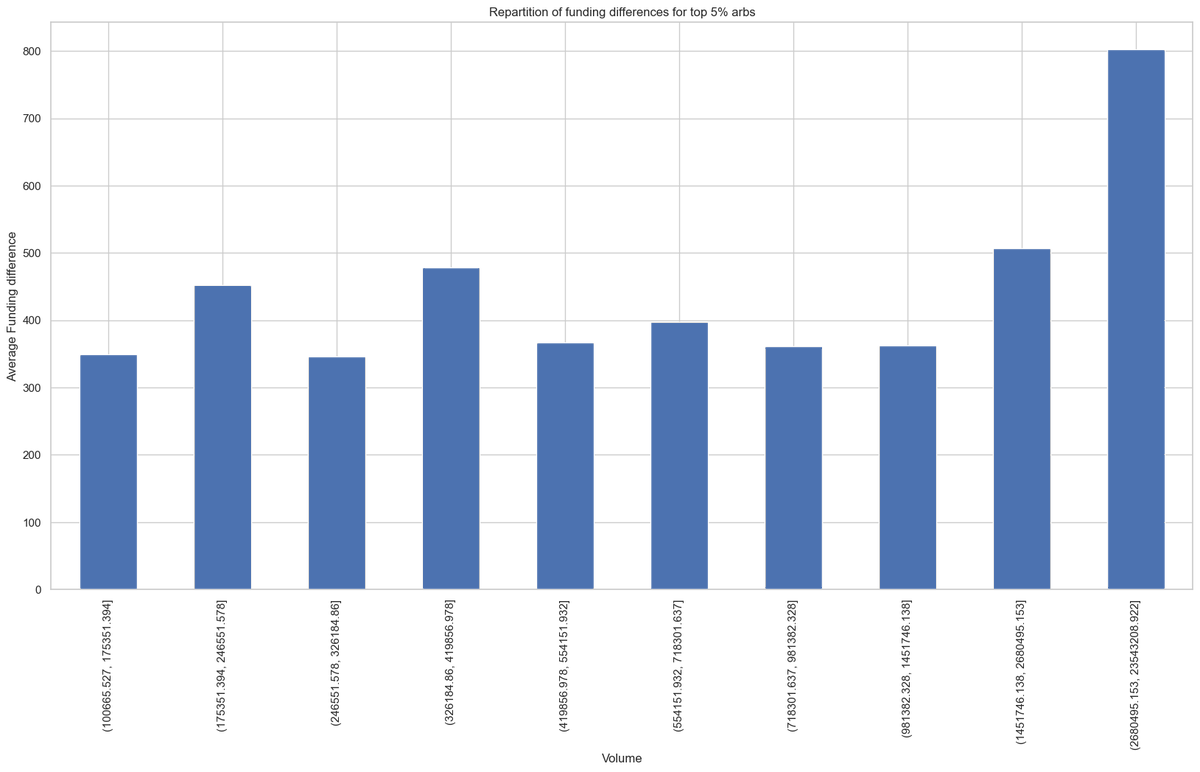
I’ll group these arbs by volume quantile and compute the mean funding differential for each group.
7
Surprisingly, the most liquid brackets have the highest average arbitrage.
I don’t have a solid theory to explain this yet—could be outliers in the data. But either way, there are great opportunities across all volume brackets, so I’m fine with it.
I don’t have a solid theory to explain this yet—could be outliers in the data. But either way, there are great opportunities across all volume brackets, so I’m fine with it.
8
Since there don’t seem to be major capacity constraints, my next focus is the persistence of the funding arbitrage.
I want these opportunities to last long enough to cover trading costs and make them worth exploiting.
I want these opportunities to last long enough to cover trading costs and make them worth exploiting.
9
To assess this, I’m analyzing the correlation between the funding rate at time t and its lagged values—essentially evaluating the autocorrelation of each funding series.
I’ll also plot the mean to get a clearer picture.
I’ll also plot the mean to get a clearer picture.
10
Looks pretty autocorrelated to me. This means I have some time to put on trades and collect favorable funding arbitrages for several days.
It doesn’t seem to exhibit an effect where the series flips to negative correlation—which is great, as it won’t be too time-sensitive.
It doesn’t seem to exhibit an effect where the series flips to negative correlation—which is great, as it won’t be too time-sensitive.
11
To get a more precise look at the funding series I’m focused on, I’ll retain only the 20 best arbitrages per day and analyze their autocorrelation.
The goal is to assess: If I put on a trade with today’s top arbs, how likely are they to stay high and positive in the future?
The goal is to assess: If I put on a trade with today’s top arbs, how likely are they to stay high and positive in the future?
12
The autocorrelation for these top arbs is lower than other series, which makes sense—more profitable arbs tend to resolve quicker than average ones.
However, 10 hours of autocorrelation is still pretty decent to me, offering a good window for trades.
However, 10 hours of autocorrelation is still pretty decent to me, offering a good window for trades.
13
Next up: portfolio construction. Some key considerations:
- Minimize cash on DEXs—I want to keep liquidity efficient and reduce hack risk.
- Reduce liquidation risk—I need to avoid situations where one leg of the trade gets liquidated and I’m left exposed on the other side.
- Minimize cash on DEXs—I want to keep liquidity efficient and reduce hack risk.
- Reduce liquidation risk—I need to avoid situations where one leg of the trade gets liquidated and I’m left exposed on the other side.
14
- I need to think about offsetting my exposure on each exchange individually to reduce liquidation risk during big moves. This means having both long and short positions on each exchange.
I’ll start trading with small size to get a better sense of what areas I need to dig into.
I’ll start trading with small size to get a better sense of what areas I need to dig into.
15
Thanks for reading! Feel free to drop any feedback if you have some.
Also, feel free to DM me for any discussions.
P.S. I’m currently looking for a quant job and have experience in both Crypto and TradFi.
Also, feel free to DM me for any discussions.
P.S. I’m currently looking for a quant job and have experience in both Crypto and TradFi.