Today in 399 BC, Socrates was sentenced to death for "corrupting...

The Culturist@the_culturist_
35 views
Feb 16, 2025
~3 min read
Advertisement
1
Today in 399 BC, Socrates was sentenced to death for "corrupting the youth" of Athens.
What did he say that was so dangerous?
He taught them to think for themselves — via 3 simple steps... (thread) 🧵
What did he say that was so dangerous?
He taught them to think for themselves — via 3 simple steps... (thread) 🧵
2
These were the charges against him:
1. Impiety (not worshiping the traditional gods)
2. Corrupting the youth of Athens
Why, exactly? Let's focus on the second...
1. Impiety (not worshiping the traditional gods)
2. Corrupting the youth of Athens
Why, exactly? Let's focus on the second...
3
Socrates, age 70 at trial, was known for pushing the people of Athens to question their beliefs through dialogue.
It made him unpopular at times, especially when he made people (and political elites) look foolish.
It made him unpopular at times, especially when he made people (and political elites) look foolish.
4
Socrates was against reading and writing (what's written about him comes from his student Plato).
Why? Because growth and learning come most effectively from dialogue...
Why? Because growth and learning come most effectively from dialogue...
5
The Socratic method of dialogue is this:
1. Start with an open-ended question about someone's beliefs
2. Listen and propose deeper questions to test for contradictions
3. Repeat until wisdom or ignorance emerges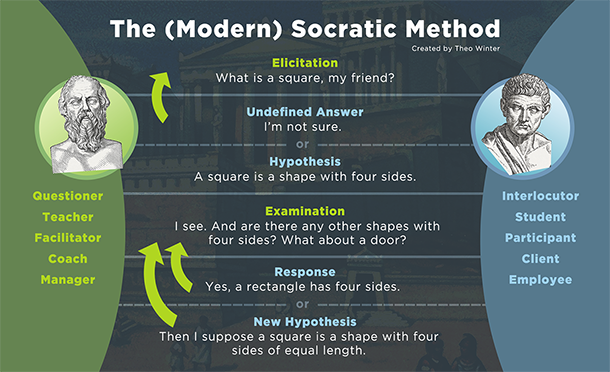
1. Start with an open-ended question about someone's beliefs
2. Listen and propose deeper questions to test for contradictions
3. Repeat until wisdom or ignorance emerges
6
In doing so, Socrates never taught his students *what* to think — only *how* to think.
And that made him dangerous to the established order...
And that made him dangerous to the established order...
7
Athenian democracy was on the brink after losing war to Sparta and enduring brief rule by the Thirty Tyrants.
It seemed the gods were angered, and people were out to find scapegoats — people like Socrates were a threat to stability.
It seemed the gods were angered, and people were out to find scapegoats — people like Socrates were a threat to stability.
8
Socrates was famously anti-democracy, and two of his students had led anti-democratic coups.
He believed that letting the uneducated vote on leadership is like a ship being taken over by a crew with no knowledge of sailing.
He believed that letting the uneducated vote on leadership is like a ship being taken over by a crew with no knowledge of sailing.
9
His solution to democracy?
Rather than an automatic right to vote, he wanted everyone in Athens to think properly so that they could become *worthy* of voting — hence why he went about challenging them in conversation.
Rather than an automatic right to vote, he wanted everyone in Athens to think properly so that they could become *worthy* of voting — hence why he went about challenging them in conversation.
10
Socrates was also open about being influenced by an inner voice (or daimon) whose advice he often took.
It was thought this might incur the wrath of the traditional gods at a time when Athens was fragile (hence the first charge).
It was thought this might incur the wrath of the traditional gods at a time when Athens was fragile (hence the first charge).
11
So, he was put before a jury of 501 citizens.
Plato attended, and his account tells that Socrates refused to make a pandering defence, saying instead that he would not stop philosophizing.
Plato attended, and his account tells that Socrates refused to make a pandering defence, saying instead that he would not stop philosophizing.
12
He explained to the jury why he upset people: he exposed their ignorance and unexamined beliefs.
"I went and tried to explain to him that he thought himself wise, but was not really wise; and the consequence was that he hated me."
"I went and tried to explain to him that he thought himself wise, but was not really wise; and the consequence was that he hated me."
13
Still, they delivered a guilty verdict (281 to 220).
Yet rather than appeal for a light sentence, Socrates taunted them, demanding free meals for life for his troubles. He then delivered his most famous statement at the trial...
Yet rather than appeal for a light sentence, Socrates taunted them, demanding free meals for life for his troubles. He then delivered his most famous statement at the trial...
14
"The unexamined life is not worth living."
To Socrates, honest and continual self-reflection was the only path to a meaningful life. It was his God-given, civic duty to encourage this in everyone — even if it cost him his life.
To Socrates, honest and continual self-reflection was the only path to a meaningful life. It was his God-given, civic duty to encourage this in everyone — even if it cost him his life.
15
This awarded him death sentence by poison. Unperturbed, Socrates drank the hemlock willingly, "as though it were a draught of wine."
But not before delivering his final message...
But not before delivering his final message...
16
"It is not difficult to avoid death, gentlemen; it is much more difficult to avoid wickedness, for it runs faster than death."

17
Jacques Louis David's masterpiece has an exquisite detail:
The young Plato was not present at his death, so he's painted in as an old man — the events exploding like a memory out the back of his head. What we know about Socrates is thanks to Plato's immortalized memory...
The young Plato was not present at his death, so he's painted in as an old man — the events exploding like a memory out the back of his head. What we know about Socrates is thanks to Plato's immortalized memory...
