1/ Let’s explore Pat Buchanan’s most controversial book! It...

Chad Crowley@CCrowley100
69 views
Jan 20, 2025
~20 min read
Advertisement
1
1/ Let’s explore Pat Buchanan’s most controversial book! It challenges the conventional historical narratives surrounding WWII while offering a cautionary tale for U.S. foreign policy in the post-Cold War era. 🧵👇

2
2/ An Introduction
Patrick J. Buchanan’s "Churchill, Hitler, and the Unnecessary War" challenges conventional narratives about the origins and consequences of World War II. Written in the shadow of the Iraq War, Buchanan’s book serves as both a provocative reassessment of history and a cautionary tale for contemporary foreign policy. The work explores how a series of missteps and miscalculations by Britain, the world’s dominant power in 1914, culminated in the devastation of Europe, the rise of communism in half the continent, and the collapse of the great Western empires by 1945.
Buchanan himself has described the book as an effort to uncover the "historic blunders" that led to this catastrophic outcome. He identifies eight critical errors that, in his view, transformed local disputes into global conflagrations. Beyond analyzing the past, Buchanan warns against the arrogance and hubris that characterized European leaders before the First World War—traits he sees echoed in post-Cold War American policy. His aim is to urge prudence and restraint, lest the United States follow Britain’s path and overextend itself into decline.
By reevaluating figures like Winston Churchill and events like the Munich Agreement, Buchanan invites readers to question the traditional narrative of World War II as a purely necessary and moral crusade. Instead, he argues that better decisions, rooted in realism rather than moral posturing, might have spared Europe and the world untold suffering.
Patrick J. Buchanan’s "Churchill, Hitler, and the Unnecessary War" challenges conventional narratives about the origins and consequences of World War II. Written in the shadow of the Iraq War, Buchanan’s book serves as both a provocative reassessment of history and a cautionary tale for contemporary foreign policy. The work explores how a series of missteps and miscalculations by Britain, the world’s dominant power in 1914, culminated in the devastation of Europe, the rise of communism in half the continent, and the collapse of the great Western empires by 1945.
Buchanan himself has described the book as an effort to uncover the "historic blunders" that led to this catastrophic outcome. He identifies eight critical errors that, in his view, transformed local disputes into global conflagrations. Beyond analyzing the past, Buchanan warns against the arrogance and hubris that characterized European leaders before the First World War—traits he sees echoed in post-Cold War American policy. His aim is to urge prudence and restraint, lest the United States follow Britain’s path and overextend itself into decline.
By reevaluating figures like Winston Churchill and events like the Munich Agreement, Buchanan invites readers to question the traditional narrative of World War II as a purely necessary and moral crusade. Instead, he argues that better decisions, rooted in realism rather than moral posturing, might have spared Europe and the world untold suffering.
3
3/ The Munich Agreement
A central theme in "Churchill, Hitler, and the Unnecessary War" is Buchanan's critique of the widely accepted "aggression at Munich" narrative, which has shaped Western foreign policy since World War II. This narrative stems from the 1938 Munich Agreement, where British Prime Minister Neville Chamberlain allowed Adolf Hitler to annex the Sudetenland, a German-speaking region of Czechoslovakia. Although Chamberlain famously proclaimed the agreement had secured "peace for our time," Germany invaded Poland within a year, prompting Britain and France to declare war.
To conventional historians, Munich represents the ultimate failure of appeasement, a lesson that aggression must always be met with force. This belief shaped post-war foreign policy, particularly for the United States, and underpinned interventions in Korea, Vietnam, the Balkans, and Iraq. Buchanan, however, challenges this interpretation, arguing that Munich has been oversimplified into a moral parable that ignores the complexities of the era.
Buchanan contends that Chamberlain’s decision at Munich was not a reckless act of cowardice but a rational effort to avoid another devastating war, only two decades after the Great War. He argues that the agreement reflected Britain’s limited military and political options in 1938, given the lack of public support for war and the absence of reliable allies. Buchanan further suggests that rather than being an unqualified failure, the Munich Agreement delayed the conflict, allowing Britain time to rearm and better prepare for the eventual confrontation with Germany.
The central tragedy, according to Buchanan, was not Munich but Britain’s refusal to adopt a similar pragmatic approach to the German-Polish dispute over Danzig in 1939. By issuing a war guarantee to Poland, Britain made a reckless commitment it was ill-prepared to honor. This guarantee emboldened Poland to resist compromise, ultimately leading to the outbreak of World War II. In Buchanan’s view, Munich’s true lesson is not the danger of appeasement but the importance of avoiding commitments that cannot realistically be upheld—a lesson that modern policymakers would do well to remember.
A central theme in "Churchill, Hitler, and the Unnecessary War" is Buchanan's critique of the widely accepted "aggression at Munich" narrative, which has shaped Western foreign policy since World War II. This narrative stems from the 1938 Munich Agreement, where British Prime Minister Neville Chamberlain allowed Adolf Hitler to annex the Sudetenland, a German-speaking region of Czechoslovakia. Although Chamberlain famously proclaimed the agreement had secured "peace for our time," Germany invaded Poland within a year, prompting Britain and France to declare war.
To conventional historians, Munich represents the ultimate failure of appeasement, a lesson that aggression must always be met with force. This belief shaped post-war foreign policy, particularly for the United States, and underpinned interventions in Korea, Vietnam, the Balkans, and Iraq. Buchanan, however, challenges this interpretation, arguing that Munich has been oversimplified into a moral parable that ignores the complexities of the era.
Buchanan contends that Chamberlain’s decision at Munich was not a reckless act of cowardice but a rational effort to avoid another devastating war, only two decades after the Great War. He argues that the agreement reflected Britain’s limited military and political options in 1938, given the lack of public support for war and the absence of reliable allies. Buchanan further suggests that rather than being an unqualified failure, the Munich Agreement delayed the conflict, allowing Britain time to rearm and better prepare for the eventual confrontation with Germany.
The central tragedy, according to Buchanan, was not Munich but Britain’s refusal to adopt a similar pragmatic approach to the German-Polish dispute over Danzig in 1939. By issuing a war guarantee to Poland, Britain made a reckless commitment it was ill-prepared to honor. This guarantee emboldened Poland to resist compromise, ultimately leading to the outbreak of World War II. In Buchanan’s view, Munich’s true lesson is not the danger of appeasement but the importance of avoiding commitments that cannot realistically be upheld—a lesson that modern policymakers would do well to remember.
4
4/ Winston Churchill: Reckless Genius
In "Churchill, Hitler, and the Unnecessary War," Buchanan offers a critical reassessment of Winston Churchill, presenting him as a figure of immense talent and charisma but prone to reckless decisions that shaped Britain’s decline. While traditional narratives cast Churchill as a heroic wartime leader, Buchanan highlights his role in a series of misjudgments that contributed to Britain’s catastrophic losses in both world wars.
Churchill’s military and political career, as Buchanan portrays it, was marked by a pattern of bold gambles, often blending brilliance with recklessness. From his involvement in the disastrous Gallipoli Campaign during World War I to his support for unconditional war guarantees to Poland in 1939, Churchill often acted with little regard for the long-term consequences of his decisions.
Buchanan examines how Churchill’s decision-making was influenced by his background as a member of Britain’s upper class. Born in 1874 into an aristocratic family, Churchill’s lineage granted him access to the halls of power but also instilled in him a sense of imperial destiny that shaped his worldview. This sense of mission, combined with his remarkable oratory and unshakable self-confidence, made him a powerful but often polarizing figure.
One of Buchanan’s key arguments is that Churchill’s approach to Germany was colored by a deep suspicion of German power that predated Hitler. Churchill’s opposition to German rearmament in the 1930s and his advocacy for war against Germany in 1939 were driven, Buchanan suggests, as much by a desire to preserve Britain’s imperial dominance as by concerns over Nazi aggression. However, Buchanan contends that this strategy backfired catastrophically, leading to the collapse of the British Empire and the rise of the Soviet Union and the United States as global superpowers.
For Buchanan, Churchill embodies both the strengths and weaknesses of the British ruling class in the early 20th century: a combination of intellectual brilliance, imperial ambition, and a propensity for overreach. While recognizing Churchill’s significant contributions to history, Buchanan invites readers to reconsider his legacy, viewing him not solely as a heroic figure but also as a symbol of Britain’s decline.
In "Churchill, Hitler, and the Unnecessary War," Buchanan offers a critical reassessment of Winston Churchill, presenting him as a figure of immense talent and charisma but prone to reckless decisions that shaped Britain’s decline. While traditional narratives cast Churchill as a heroic wartime leader, Buchanan highlights his role in a series of misjudgments that contributed to Britain’s catastrophic losses in both world wars.
Churchill’s military and political career, as Buchanan portrays it, was marked by a pattern of bold gambles, often blending brilliance with recklessness. From his involvement in the disastrous Gallipoli Campaign during World War I to his support for unconditional war guarantees to Poland in 1939, Churchill often acted with little regard for the long-term consequences of his decisions.
Buchanan examines how Churchill’s decision-making was influenced by his background as a member of Britain’s upper class. Born in 1874 into an aristocratic family, Churchill’s lineage granted him access to the halls of power but also instilled in him a sense of imperial destiny that shaped his worldview. This sense of mission, combined with his remarkable oratory and unshakable self-confidence, made him a powerful but often polarizing figure.
One of Buchanan’s key arguments is that Churchill’s approach to Germany was colored by a deep suspicion of German power that predated Hitler. Churchill’s opposition to German rearmament in the 1930s and his advocacy for war against Germany in 1939 were driven, Buchanan suggests, as much by a desire to preserve Britain’s imperial dominance as by concerns over Nazi aggression. However, Buchanan contends that this strategy backfired catastrophically, leading to the collapse of the British Empire and the rise of the Soviet Union and the United States as global superpowers.
For Buchanan, Churchill embodies both the strengths and weaknesses of the British ruling class in the early 20th century: a combination of intellectual brilliance, imperial ambition, and a propensity for overreach. While recognizing Churchill’s significant contributions to history, Buchanan invites readers to reconsider his legacy, viewing him not solely as a heroic figure but also as a symbol of Britain’s decline.
5
5/ The Treaty of Versailles and the Seeds of Conflict
Buchanan identifies the Treaty of Versailles as a pivotal moment that sowed the seeds for future conflict in Europe. Signed in 1919 to officially end World War I, the treaty reshaped Germany’s borders, imposed crippling reparations, and created a sense of humiliation among the German people. Buchanan argues that these punitive measures destabilized Europe and made another war inevitable.
The treaty violated the principle of self-determination championed by U.S. President Woodrow Wilson, particularly in Eastern Europe, where it created new, multi-ethnic states like Czechoslovakia and Yugoslavia while leaving ethnic Germans under foreign rule. Buchanan contends that this hypocrisy undermined the treaty’s legitimacy and left Germany surrounded by hostile neighbors, exacerbating tensions in the region.
Buchanan also critiques the treaty for its broader impact on German politics. By creating economic hardship and stoking nationalist resentment, the treaty helped fuel the rise of Adolf Hitler and the Nazi Party. Buchanan argues that if the victorious Allied powers had sought a more just settlement—one that respected ethnic boundaries and avoided vindictive penalties—it might have prevented the conditions that led to World War II.
This critique ties into Buchanan’s broader theme of avoidable mistakes in international diplomacy. He contends that Versailles represents a failure of statesmanship, where short-term punitive measures took precedence over long-term stability. For Buchanan, the lesson is clear: leaders must consider the unintended consequences of their decisions, particularly when dealing with defeated powers.
Buchanan identifies the Treaty of Versailles as a pivotal moment that sowed the seeds for future conflict in Europe. Signed in 1919 to officially end World War I, the treaty reshaped Germany’s borders, imposed crippling reparations, and created a sense of humiliation among the German people. Buchanan argues that these punitive measures destabilized Europe and made another war inevitable.
The treaty violated the principle of self-determination championed by U.S. President Woodrow Wilson, particularly in Eastern Europe, where it created new, multi-ethnic states like Czechoslovakia and Yugoslavia while leaving ethnic Germans under foreign rule. Buchanan contends that this hypocrisy undermined the treaty’s legitimacy and left Germany surrounded by hostile neighbors, exacerbating tensions in the region.
Buchanan also critiques the treaty for its broader impact on German politics. By creating economic hardship and stoking nationalist resentment, the treaty helped fuel the rise of Adolf Hitler and the Nazi Party. Buchanan argues that if the victorious Allied powers had sought a more just settlement—one that respected ethnic boundaries and avoided vindictive penalties—it might have prevented the conditions that led to World War II.
This critique ties into Buchanan’s broader theme of avoidable mistakes in international diplomacy. He contends that Versailles represents a failure of statesmanship, where short-term punitive measures took precedence over long-term stability. For Buchanan, the lesson is clear: leaders must consider the unintended consequences of their decisions, particularly when dealing with defeated powers.
6
6/ Missteps and Missed Opportunities
Another of the more controversial positions advocated by Buchanan challenges the conventional narrative that Germany’s aggression was solely responsible for the outbreak of World War II. Instead, he argues that a series of diplomatic missteps by Britain and France escalated tensions and made war unavoidable.
One of Buchanan’s central claims is that the British and French guarantees to Poland in 1939 were reckless and ill-considered. The guarantee, issued after Hitler’s annexation of Czechoslovakia, committed Britain and France to defending Poland in the event of a German invasion. However, neither nation had the military capability or strategic plan to make good on their promise. Buchanan argues that this guarantee emboldened Poland to resist German demands over Danzig and the proposed transit corridor to East Prussia, pushing the two nations toward conflict.
According to Buchanan, Britain and France could have pursued a more pragmatic approach by negotiating with Germany over its limited territorial demands. Instead, their hardline stance led to a full-scale war that devastated Europe. Buchanan is particularly critical of Winston Churchill’s role in this process, portraying him as a hawkish figure who failed to consider the long-term consequences of war.
The broader context of European geopolitics also plays a significant role in Buchanan’s analysis. He highlights the collapse of the Stresa Front, a 1935 alliance between Britain, France, and Italy aimed at containing Germany, as a critical turning point. When Britain sanctioned Italy for its invasion of Ethiopia, it alienated Mussolini and pushed Italy into an alliance with Germany. Buchanan views this as a shortsighted move that undermined the balance of power in Europe.
Buchanan’s reassessment of these events leads him to a controversial conclusion: World War II might have been avoided if Britain and France had pursued a more cautious and diplomatic approach to Germany’s grievances. Rather than viewing Hitler as an expansionist bent on world domination, Buchanan portrays him as a nationalist seeking to revise the post-World War I settlement. While Buchanan does not excuse Hitler’s actions, he suggests that a more restrained response from the Allies could have averted the catastrophic consequences of war.
*The map below shows Europe's borders in 1938.
Another of the more controversial positions advocated by Buchanan challenges the conventional narrative that Germany’s aggression was solely responsible for the outbreak of World War II. Instead, he argues that a series of diplomatic missteps by Britain and France escalated tensions and made war unavoidable.
One of Buchanan’s central claims is that the British and French guarantees to Poland in 1939 were reckless and ill-considered. The guarantee, issued after Hitler’s annexation of Czechoslovakia, committed Britain and France to defending Poland in the event of a German invasion. However, neither nation had the military capability or strategic plan to make good on their promise. Buchanan argues that this guarantee emboldened Poland to resist German demands over Danzig and the proposed transit corridor to East Prussia, pushing the two nations toward conflict.
According to Buchanan, Britain and France could have pursued a more pragmatic approach by negotiating with Germany over its limited territorial demands. Instead, their hardline stance led to a full-scale war that devastated Europe. Buchanan is particularly critical of Winston Churchill’s role in this process, portraying him as a hawkish figure who failed to consider the long-term consequences of war.
The broader context of European geopolitics also plays a significant role in Buchanan’s analysis. He highlights the collapse of the Stresa Front, a 1935 alliance between Britain, France, and Italy aimed at containing Germany, as a critical turning point. When Britain sanctioned Italy for its invasion of Ethiopia, it alienated Mussolini and pushed Italy into an alliance with Germany. Buchanan views this as a shortsighted move that undermined the balance of power in Europe.
Buchanan’s reassessment of these events leads him to a controversial conclusion: World War II might have been avoided if Britain and France had pursued a more cautious and diplomatic approach to Germany’s grievances. Rather than viewing Hitler as an expansionist bent on world domination, Buchanan portrays him as a nationalist seeking to revise the post-World War I settlement. While Buchanan does not excuse Hitler’s actions, he suggests that a more restrained response from the Allies could have averted the catastrophic consequences of war.
*The map below shows Europe's borders in 1938.
7
7 The War Itself and Churchill’s Leadership
Buchanan also heavily critiques Winston Churchill’s leadership during World War II, focusing on how his decisions escalated the conflict and contributed to Britain’s long-term decline in power. While Churchill is often lauded as the indomitable wartime leader, Buchanan contends that his aggressive policies and overzealous commitment to fighting Hitler played a significant role in prolonging the conflict and exacerbating the suffering of the British people.
One of Buchanan’s central arguments is that Churchill’s refusal to negotiate with Hitler, even when opportunities arose, pushed Britain into a protracted and ultimately unnecessary war. Buchanan contrasts Churchill’s stance with the more pragmatic approach of other European leaders, such as Neville Chamberlain, who sought to avoid war through diplomacy. Buchanan suggests that Churchill’s belief in the righteousness of Britain’s cause, while admirable, blinded him to the realities of the situation. In his eagerness to confront Hitler, Churchill ignored the possibility that a negotiated peace could have spared Europe the catastrophic consequences of war.
Another key critique Buchanan makes is Churchill’s strategy of unrestricted bombing of German cities. Buchanan argues that this tactic, which aimed to break the will of the German people, was morally indefensible and counterproductive. Rather than weakening Germany’s resolve, the bombing campaign galvanized civilian support for Hitler’s regime and led to massive loss of life on both sides. Buchanan asserts that these actions were emblematic of Churchill’s reckless approach to war, prioritizing vengeance over a more thoughtful strategy for peace.
Additionally, Buchanan explores the alliance between Britain and the Soviet Union, which he considers one of the war’s most politically compromising and morally questionable aspects. Churchill’s decision to ally with Joseph Stalin, a brutal dictator responsible for the deaths of millions, is seen by Buchanan as a necessary evil to defeat Hitler, but one that ultimately undermined Britain’s post-war credibility. Buchanan argues that Churchill’s moral flexibility in this regard, while pragmatic in the short term, had long-lasting implications for the world order after the war.
Buchanan’s analysis of Churchill’s leadership is critical but not entirely dismissive. He acknowledges Churchill’s courage and the difficult circumstances under which he led Britain, but he ultimately concludes that Churchill’s decisions were, in many cases, driven more by personal ambition and ideological conviction than by sound strategic thinking. For Buchanan, Churchill’s legacy is one of missed opportunities for peace and unnecessary escalation that contributed to the war’s extraordinary cost in terms of both human life and global stability.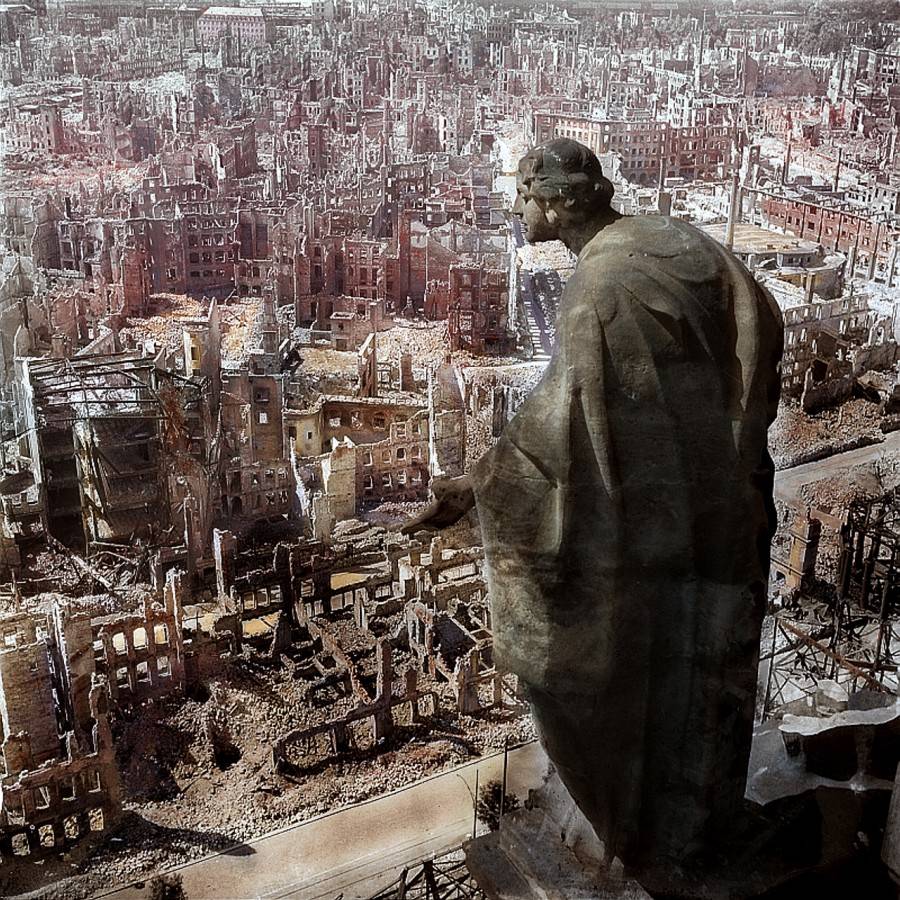
Buchanan also heavily critiques Winston Churchill’s leadership during World War II, focusing on how his decisions escalated the conflict and contributed to Britain’s long-term decline in power. While Churchill is often lauded as the indomitable wartime leader, Buchanan contends that his aggressive policies and overzealous commitment to fighting Hitler played a significant role in prolonging the conflict and exacerbating the suffering of the British people.
One of Buchanan’s central arguments is that Churchill’s refusal to negotiate with Hitler, even when opportunities arose, pushed Britain into a protracted and ultimately unnecessary war. Buchanan contrasts Churchill’s stance with the more pragmatic approach of other European leaders, such as Neville Chamberlain, who sought to avoid war through diplomacy. Buchanan suggests that Churchill’s belief in the righteousness of Britain’s cause, while admirable, blinded him to the realities of the situation. In his eagerness to confront Hitler, Churchill ignored the possibility that a negotiated peace could have spared Europe the catastrophic consequences of war.
Another key critique Buchanan makes is Churchill’s strategy of unrestricted bombing of German cities. Buchanan argues that this tactic, which aimed to break the will of the German people, was morally indefensible and counterproductive. Rather than weakening Germany’s resolve, the bombing campaign galvanized civilian support for Hitler’s regime and led to massive loss of life on both sides. Buchanan asserts that these actions were emblematic of Churchill’s reckless approach to war, prioritizing vengeance over a more thoughtful strategy for peace.
Additionally, Buchanan explores the alliance between Britain and the Soviet Union, which he considers one of the war’s most politically compromising and morally questionable aspects. Churchill’s decision to ally with Joseph Stalin, a brutal dictator responsible for the deaths of millions, is seen by Buchanan as a necessary evil to defeat Hitler, but one that ultimately undermined Britain’s post-war credibility. Buchanan argues that Churchill’s moral flexibility in this regard, while pragmatic in the short term, had long-lasting implications for the world order after the war.
Buchanan’s analysis of Churchill’s leadership is critical but not entirely dismissive. He acknowledges Churchill’s courage and the difficult circumstances under which he led Britain, but he ultimately concludes that Churchill’s decisions were, in many cases, driven more by personal ambition and ideological conviction than by sound strategic thinking. For Buchanan, Churchill’s legacy is one of missed opportunities for peace and unnecessary escalation that contributed to the war’s extraordinary cost in terms of both human life and global stability.
8
8/ The Collapse of the British Empire
Buchanan’s examination of the collapse of the British Empire is a critical aspect of his broader argument about the consequences of World War II. In his view, the war not only destroyed Europe but also irrevocably weakened the global dominance of the British Empire. He asserts that the British decision to enter the war, along with their refusal to seek peace with Hitler, hastened the decline of Britain’s imperial power, which had already begun to show signs of fragility before the war.
At the heart of Buchanan’s analysis is the idea that the war marked the end of Britain’s centuries-long dominance over global affairs. Prior to World War I, Britain was the undisputed superpower, controlling vast territories across the globe. By the end of World War II, however, the empire was in ruins, and Britain was dependent on American financial aid to survive. Buchanan argues that the British Empire’s collapse was not merely a consequence of military defeat but the result of a series of misguided policies, including the decision to commit to war against Germany in 1939.
Buchanan critiques the British leadership’s failure to adapt to the shifting geopolitical landscape in the interwar years. He suggests that the British leadership, particularly Winston Churchill, was more focused on maintaining Britain’s imperial influence than on recognizing the growing threat posed by rising powers like Germany and the Soviet Union. In his view, Britain’s attempts to hold onto its empire at all costs ultimately led to its downfall. Instead of pursuing a more realistic approach to preserving British interests, the British government was caught up in a costly and futile war that drained its resources and undermined its global position.
The war, according to Buchanan, also accelerated the process of decolonization. As Britain weakened, former colonies began to assert their independence, and the empire’s once-vast territories gradually unraveled. Buchanan points to India’s independence in 1947 and the subsequent wave of decolonization as evidence of the empire’s irreversible decline. The British were no longer in a position to maintain their imperial holdings, and the post-war world saw the emergence of new superpowers, most notably the United States and the Soviet Union, while Britain was relegated to a secondary role in international affairs.
Buchanan’s analysis is not only a critique of Britain’s wartime decisions but also a warning to the United States. He draws parallels between Britain’s overextension during the war and America’s post-Cold War foreign policy, particularly its military interventions in the Middle East. Buchanan warns that, like Britain, the United States could find itself caught in a cycle of overreach that leads to a decline in power and influence. Just as the British Empire crumbled in the wake of World War II, Buchanan suggests that American imperial ambitions could have similarly destabilizing consequences in the future.
Buchanan’s examination of the collapse of the British Empire is a critical aspect of his broader argument about the consequences of World War II. In his view, the war not only destroyed Europe but also irrevocably weakened the global dominance of the British Empire. He asserts that the British decision to enter the war, along with their refusal to seek peace with Hitler, hastened the decline of Britain’s imperial power, which had already begun to show signs of fragility before the war.
At the heart of Buchanan’s analysis is the idea that the war marked the end of Britain’s centuries-long dominance over global affairs. Prior to World War I, Britain was the undisputed superpower, controlling vast territories across the globe. By the end of World War II, however, the empire was in ruins, and Britain was dependent on American financial aid to survive. Buchanan argues that the British Empire’s collapse was not merely a consequence of military defeat but the result of a series of misguided policies, including the decision to commit to war against Germany in 1939.
Buchanan critiques the British leadership’s failure to adapt to the shifting geopolitical landscape in the interwar years. He suggests that the British leadership, particularly Winston Churchill, was more focused on maintaining Britain’s imperial influence than on recognizing the growing threat posed by rising powers like Germany and the Soviet Union. In his view, Britain’s attempts to hold onto its empire at all costs ultimately led to its downfall. Instead of pursuing a more realistic approach to preserving British interests, the British government was caught up in a costly and futile war that drained its resources and undermined its global position.
The war, according to Buchanan, also accelerated the process of decolonization. As Britain weakened, former colonies began to assert their independence, and the empire’s once-vast territories gradually unraveled. Buchanan points to India’s independence in 1947 and the subsequent wave of decolonization as evidence of the empire’s irreversible decline. The British were no longer in a position to maintain their imperial holdings, and the post-war world saw the emergence of new superpowers, most notably the United States and the Soviet Union, while Britain was relegated to a secondary role in international affairs.
Buchanan’s analysis is not only a critique of Britain’s wartime decisions but also a warning to the United States. He draws parallels between Britain’s overextension during the war and America’s post-Cold War foreign policy, particularly its military interventions in the Middle East. Buchanan warns that, like Britain, the United States could find itself caught in a cycle of overreach that leads to a decline in power and influence. Just as the British Empire crumbled in the wake of World War II, Buchanan suggests that American imperial ambitions could have similarly destabilizing consequences in the future.
9
9/ The Cold War, New World Order, and Lessons for the United States
Buchanan argues that World War II directly contributed to the division of Europe and set the stage for Soviet dominance in Eastern Europe. After the war, Europe was divided into spheres of influence, with the Soviet Union controlling much of Eastern Europe while the United States emerged as the dominant global superpower. Buchanan critiques the events that led to this outcome, suggesting that British and American missteps—particularly their decisions regarding the Soviet Union—were key to this new global order.
Buchanan draws striking parallels between the failures of Britain before World War II and the actions of the United States in the post-Cold War era. Just as Britain’s misguided entanglements in European conflicts led to the destruction of its empire, Buchanan warns that the United States’ interventions and alliances in the post-Cold War period could lead to a similar decline. Specifically, Buchanan critiques the U.S. policy of expanding NATO and becoming involved in distant conflicts that serve little direct national interest. In his view, the United States risks overextending itself, much like Britain did, and potentially weakening its global standing.
Central to Buchanan’s argument is the idea of "Churchillian" hubris—an overconfidence in one’s ability to control international events. He contends that, just as Churchill’s vision of Britain’s role in the world led to unnecessary wars, the U.S. may be falling into the same trap. He cautions against the belief that the United States can single-handedly maintain a global order through military and diplomatic means.
Buchanan’s cautionary message for American foreign policy emphasizes the dangers of geopolitical overreach, unnecessary alliances, and being drawn into conflicts that do not align with national interests. He stresses that the U.S. should reassess its role in the world, focusing on pragmatic and strategic policies rather than pursuing expansive and potentially destructive objectives. Buchanan urges the United States to avoid the mistakes of the past, particularly the British Empire’s failure to recognize its limits, in order to preserve its global influence without succumbing to the same fate of decline and fragmentation.
By drawing these comparisons, Buchanan delivers a compelling critique of contemporary U.S. foreign policy and a stark warning for the future. He argues that if the U.S. fails to change course, it risks repeating the fate of the British Empire: overextending its imperial ambitions, eroding its global power and influence, and ultimately sowing the seeds of its own collapse.
Buchanan argues that World War II directly contributed to the division of Europe and set the stage for Soviet dominance in Eastern Europe. After the war, Europe was divided into spheres of influence, with the Soviet Union controlling much of Eastern Europe while the United States emerged as the dominant global superpower. Buchanan critiques the events that led to this outcome, suggesting that British and American missteps—particularly their decisions regarding the Soviet Union—were key to this new global order.
Buchanan draws striking parallels between the failures of Britain before World War II and the actions of the United States in the post-Cold War era. Just as Britain’s misguided entanglements in European conflicts led to the destruction of its empire, Buchanan warns that the United States’ interventions and alliances in the post-Cold War period could lead to a similar decline. Specifically, Buchanan critiques the U.S. policy of expanding NATO and becoming involved in distant conflicts that serve little direct national interest. In his view, the United States risks overextending itself, much like Britain did, and potentially weakening its global standing.
Central to Buchanan’s argument is the idea of "Churchillian" hubris—an overconfidence in one’s ability to control international events. He contends that, just as Churchill’s vision of Britain’s role in the world led to unnecessary wars, the U.S. may be falling into the same trap. He cautions against the belief that the United States can single-handedly maintain a global order through military and diplomatic means.
Buchanan’s cautionary message for American foreign policy emphasizes the dangers of geopolitical overreach, unnecessary alliances, and being drawn into conflicts that do not align with national interests. He stresses that the U.S. should reassess its role in the world, focusing on pragmatic and strategic policies rather than pursuing expansive and potentially destructive objectives. Buchanan urges the United States to avoid the mistakes of the past, particularly the British Empire’s failure to recognize its limits, in order to preserve its global influence without succumbing to the same fate of decline and fragmentation.
By drawing these comparisons, Buchanan delivers a compelling critique of contemporary U.S. foreign policy and a stark warning for the future. He argues that if the U.S. fails to change course, it risks repeating the fate of the British Empire: overextending its imperial ambitions, eroding its global power and influence, and ultimately sowing the seeds of its own collapse.
10
10/ Reckless Brinkmanship, Not Measured Diplomacy
I often post replies in this format for greater visibility. Please see my response to a commenter below:
I’m fairly certain you haven’t read this thread or Buchanan’s book. Nonetheless, I’ll assume your question is sincere and not just moral posturing.
Your framing of "appeasement" is entirely off the mark. I touched on this briefly, but Buchanan explores it in depth. The issue isn’t "more appeasement"—it’s the failure of statesmen to adopt a balanced, measured approach to policy. Britain’s decision to guarantee Poland’s borders—without any realistic way to enforce it—turned what might have remained a localized conflict into a global war.
Buchanan argues that the true catalysts of WWII were the punitive Treaty of Versailles, which humiliated Germany, and the hardline policies that escalated tensions rather than diffused them. Britain’s reckless commitments transformed its geopolitical position from an arbiter of balance to a co-belligerent in a war it wasn’t prepared to fight.
Mislabeling diplomacy or restraint as "appeasement" distorts the reality Buchanan critiques. Reckless brinkmanship, not caution, set Europe on fire. If you actually read his work, you’d understand his thesis: Avoidable wars are made inevitable by bad strategy, not measured diplomacy.
I often post replies in this format for greater visibility. Please see my response to a commenter below:
I’m fairly certain you haven’t read this thread or Buchanan’s book. Nonetheless, I’ll assume your question is sincere and not just moral posturing.
Your framing of "appeasement" is entirely off the mark. I touched on this briefly, but Buchanan explores it in depth. The issue isn’t "more appeasement"—it’s the failure of statesmen to adopt a balanced, measured approach to policy. Britain’s decision to guarantee Poland’s borders—without any realistic way to enforce it—turned what might have remained a localized conflict into a global war.
Buchanan argues that the true catalysts of WWII were the punitive Treaty of Versailles, which humiliated Germany, and the hardline policies that escalated tensions rather than diffused them. Britain’s reckless commitments transformed its geopolitical position from an arbiter of balance to a co-belligerent in a war it wasn’t prepared to fight.
Mislabeling diplomacy or restraint as "appeasement" distorts the reality Buchanan critiques. Reckless brinkmanship, not caution, set Europe on fire. If you actually read his work, you’d understand his thesis: Avoidable wars are made inevitable by bad strategy, not measured diplomacy.
11
11/ The Perils of Moral Posturing in U.S. Foreign Policy
I often post replies in this format for greater visibility. Please see my response to a commenter below:
This is precisely the type of moral posturing Buchanan warns about—a mindset that has defined international relations since WWII and, even more so, since the Cold War. Geopolitical realities are subordinated to a self-righteous narrative where American interventions are justified not by strategic necessity but by a veneer of moral superiority.
The U.S. invaded Iraq under the guise of moral righteousness, claiming to bring democracy and end tyranny, yet it destabilized an entire region, leading to chaos and countless lives lost. Was Saddam a dictator? Certainly. But does the U.S. claim the moral high ground when it acts unilaterally, toppling governments and ignoring international norms in the name of peace? Buchanan’s point is clear: when nations see themselves as arbiters of moral justice, they often sow discord rather than stability.
As for the "defensive necessity" of NATO—its expansion eastward, in direct violation of assurances given to Russia after the Cold War, has stoked the very hostility it claims to defend against. NATO, far from being purely defensive, has become an instrument of Western hegemony, antagonizing rival powers instead of fostering peace.
To claim dictatorships alone cause wars is historically inaccurate. Wars are rooted in complex causes—power, security concerns, and failed diplomacy. Buchanan doesn't absolve "dictators" of blame, but he highlights how moral grandstanding, reckless entanglements, and hubris have led ostensibly "free" nations like the U.S. to ignite and prolong wars of their own making.
If the U.S. is truly committed to peace, it must confront the uncomfortable truth Buchanan lays bare: self-righteous interventions have done more harm than good, not just abroad but to its own standing in the world.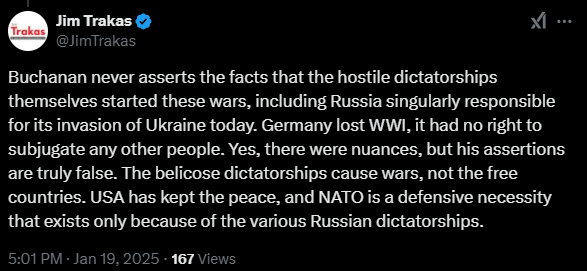
I often post replies in this format for greater visibility. Please see my response to a commenter below:
This is precisely the type of moral posturing Buchanan warns about—a mindset that has defined international relations since WWII and, even more so, since the Cold War. Geopolitical realities are subordinated to a self-righteous narrative where American interventions are justified not by strategic necessity but by a veneer of moral superiority.
The U.S. invaded Iraq under the guise of moral righteousness, claiming to bring democracy and end tyranny, yet it destabilized an entire region, leading to chaos and countless lives lost. Was Saddam a dictator? Certainly. But does the U.S. claim the moral high ground when it acts unilaterally, toppling governments and ignoring international norms in the name of peace? Buchanan’s point is clear: when nations see themselves as arbiters of moral justice, they often sow discord rather than stability.
As for the "defensive necessity" of NATO—its expansion eastward, in direct violation of assurances given to Russia after the Cold War, has stoked the very hostility it claims to defend against. NATO, far from being purely defensive, has become an instrument of Western hegemony, antagonizing rival powers instead of fostering peace.
To claim dictatorships alone cause wars is historically inaccurate. Wars are rooted in complex causes—power, security concerns, and failed diplomacy. Buchanan doesn't absolve "dictators" of blame, but he highlights how moral grandstanding, reckless entanglements, and hubris have led ostensibly "free" nations like the U.S. to ignite and prolong wars of their own making.
If the U.S. is truly committed to peace, it must confront the uncomfortable truth Buchanan lays bare: self-righteous interventions have done more harm than good, not just abroad but to its own standing in the world.
12
12/ Selective Morality: Challenging the Myths of War and Power
I often post replies in this format for greater visibility. Please see my response to a commenter below:
The post-1945 narrative distills World War II into a simplistic good-versus-evil binary, erasing the complex geopolitical dynamics that shaped the conflict. Buchanan doesn’t argue Hitler was merely "fixing Versailles." Instead, he highlights how the Western powers ignored alternative diplomatic paths that could have prevented escalation. Churchill’s belligerent stance was instrumental in turning localized disputes into a global war, framing it as a moral crusade while sidelining potential negotiations.
Consider Britain and France’s stated justification for declaring war: the defense of Poland’s sovereignty. This pretext falls apart under scrutiny. When the Soviet Union invaded Poland weeks after Germany, there was no comparable declaration of war. Why? The inconsistency reveals the Allies’ selective moral priorities and undermines the notion that this was a principled stand for Polish independence. The broader geopolitical game, including fears of German dominance in Europe, drove their actions far more than any genuine concern for Poland.
This selective application of moral outrage has echoes in modern Western foreign policy. The United States, for instance, invaded Iraq and Afghanistan under the banner of democracy and security but turned a blind eye to the actions of Pakistan, whose harboring of extremists was well-documented. Similarly, the toppling of Libya’s government under the guise of humanitarian intervention left the country in chaos, yet no such zeal was directed toward nations with equally egregious abuses that didn’t challenge Western strategic interests. These inconsistencies mirror the contradictions of the World War II era, where high-minded rhetoric cloaked raw realpolitik.
Challenging these overly simplistic narratives is of paramount importance. Western historiography was once grounded in skepticism and a willingness to question orthodoxies. Buchanan’s analysis, whether one agrees with it or not, serves as a corrective to the pseudo-religious mythos that now dominates discussions of the war. By reducing the conflict to a black-and-white morality play, we blind ourselves to the lessons of history, the realities of power, and the consequences of moral inconsistency in both past and present.
I often post replies in this format for greater visibility. Please see my response to a commenter below:
The post-1945 narrative distills World War II into a simplistic good-versus-evil binary, erasing the complex geopolitical dynamics that shaped the conflict. Buchanan doesn’t argue Hitler was merely "fixing Versailles." Instead, he highlights how the Western powers ignored alternative diplomatic paths that could have prevented escalation. Churchill’s belligerent stance was instrumental in turning localized disputes into a global war, framing it as a moral crusade while sidelining potential negotiations.
Consider Britain and France’s stated justification for declaring war: the defense of Poland’s sovereignty. This pretext falls apart under scrutiny. When the Soviet Union invaded Poland weeks after Germany, there was no comparable declaration of war. Why? The inconsistency reveals the Allies’ selective moral priorities and undermines the notion that this was a principled stand for Polish independence. The broader geopolitical game, including fears of German dominance in Europe, drove their actions far more than any genuine concern for Poland.
This selective application of moral outrage has echoes in modern Western foreign policy. The United States, for instance, invaded Iraq and Afghanistan under the banner of democracy and security but turned a blind eye to the actions of Pakistan, whose harboring of extremists was well-documented. Similarly, the toppling of Libya’s government under the guise of humanitarian intervention left the country in chaos, yet no such zeal was directed toward nations with equally egregious abuses that didn’t challenge Western strategic interests. These inconsistencies mirror the contradictions of the World War II era, where high-minded rhetoric cloaked raw realpolitik.
Challenging these overly simplistic narratives is of paramount importance. Western historiography was once grounded in skepticism and a willingness to question orthodoxies. Buchanan’s analysis, whether one agrees with it or not, serves as a corrective to the pseudo-religious mythos that now dominates discussions of the war. By reducing the conflict to a black-and-white morality play, we blind ourselves to the lessons of history, the realities of power, and the consequences of moral inconsistency in both past and present.
13
13/ Revisiting Buchanan's Critique
I often post replies in this format for greater visibility. Please see my response to a commenter below:
The notion that Buchanan’s argument lacks grounding in fact overlooks the core of his critique: not Britain’s historical foreign policy of balancing against continental powers, but the specific missteps and failures of British diplomacy in the lead-up to World War II. Buchanan doesn’t dispute Britain’s 400-year record of opposing European hegemons. What he challenges is whether Churchill’s, or even Chamberlain’s, decisions were strategically sound or served Britain’s long-term interests.
Guaranteeing Poland was not a masterstroke of statecraft; it was a reckless gamble. Poland’s security was a geopolitical impossibility without the Soviet Union’s cooperation—a fact ignored by Britain’s leadership. Far from deterring Hitler, this guarantee merely emboldened him to strike a deal with Stalin, ensuring Poland’s destruction and dooming Britain to a war it was ill-prepared for. Buchanan’s critique centers on this: the failure to recognize the changing realities of power in Europe and the limits of Britain’s ability to act as a global arbiter.
The claim that war was "inevitable" by the time Hitler moved on Austria or Czechoslovakia is, at best, a post hoc rationalization. The Anschluss and the Sudetenland crisis were not greeted with automatic declarations of war. Rather, they were opportunities for diplomacy—opportunities squandered not because of inevitability, but because of a failure to adapt to new geopolitical realities. Buchanan argues that the British establishment, including Churchill, pursued policies that turned what could have remained a regional conflict into a global catastrophe.
As for Churchill’s memoirs, they are valuable, but hardly unbiased. He was a politician justifying his legacy, not a neutral observer. Treating them as the definitive account risks taking propaganda as gospel. Meanwhile, Buchanan doesn’t write as a Churchill hater, but as someone who critiques the consequences of Britain’s actions. His perspective doesn’t diminish Britain’s historical achievements but questions whether its leaders understood the costs of their choices in the 20th century.
Revisionism is not inherently flawed—Western historiography was built on questioning orthodoxies, not treating them as sacrosanct. Ignoring Buchanan’s arguments because they challenge the status quo is no different than dismissing Manchester or Churchill for their biases. Engaging with different perspectives, particularly those grounded in careful analysis of diplomatic failures, is the mark of a serious thinker, not an apologist for flawed policies.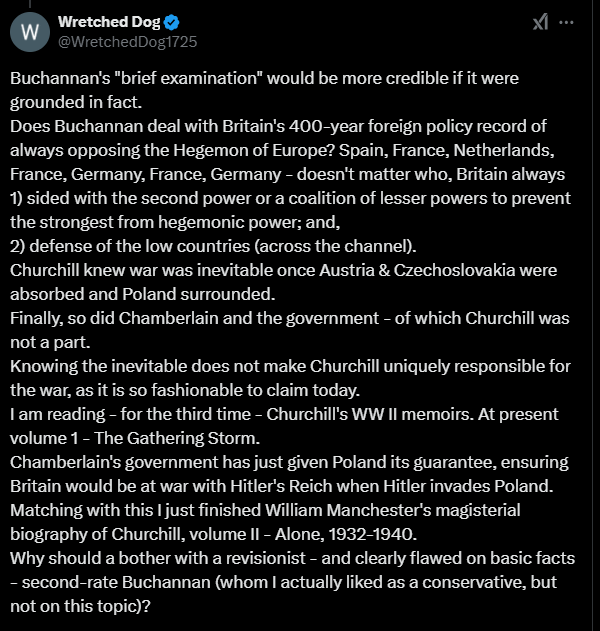
I often post replies in this format for greater visibility. Please see my response to a commenter below:
The notion that Buchanan’s argument lacks grounding in fact overlooks the core of his critique: not Britain’s historical foreign policy of balancing against continental powers, but the specific missteps and failures of British diplomacy in the lead-up to World War II. Buchanan doesn’t dispute Britain’s 400-year record of opposing European hegemons. What he challenges is whether Churchill’s, or even Chamberlain’s, decisions were strategically sound or served Britain’s long-term interests.
Guaranteeing Poland was not a masterstroke of statecraft; it was a reckless gamble. Poland’s security was a geopolitical impossibility without the Soviet Union’s cooperation—a fact ignored by Britain’s leadership. Far from deterring Hitler, this guarantee merely emboldened him to strike a deal with Stalin, ensuring Poland’s destruction and dooming Britain to a war it was ill-prepared for. Buchanan’s critique centers on this: the failure to recognize the changing realities of power in Europe and the limits of Britain’s ability to act as a global arbiter.
The claim that war was "inevitable" by the time Hitler moved on Austria or Czechoslovakia is, at best, a post hoc rationalization. The Anschluss and the Sudetenland crisis were not greeted with automatic declarations of war. Rather, they were opportunities for diplomacy—opportunities squandered not because of inevitability, but because of a failure to adapt to new geopolitical realities. Buchanan argues that the British establishment, including Churchill, pursued policies that turned what could have remained a regional conflict into a global catastrophe.
As for Churchill’s memoirs, they are valuable, but hardly unbiased. He was a politician justifying his legacy, not a neutral observer. Treating them as the definitive account risks taking propaganda as gospel. Meanwhile, Buchanan doesn’t write as a Churchill hater, but as someone who critiques the consequences of Britain’s actions. His perspective doesn’t diminish Britain’s historical achievements but questions whether its leaders understood the costs of their choices in the 20th century.
Revisionism is not inherently flawed—Western historiography was built on questioning orthodoxies, not treating them as sacrosanct. Ignoring Buchanan’s arguments because they challenge the status quo is no different than dismissing Manchester or Churchill for their biases. Engaging with different perspectives, particularly those grounded in careful analysis of diplomatic failures, is the mark of a serious thinker, not an apologist for flawed policies.