I suppose we're doing this again. This is incorrect: the Roman army...

"Online Rent-a-Sage" Bret Devereaux@BretDevereaux
43 views
Oct 08, 2024
~5 min read
Advertisement
1
I suppose we're doing this again.
This is incorrect: the Roman army relied heavily on non-citizens throughout nearly the whole of Roman history, including the periods of its greatest success in the third and second centuries, when Rome came to dominate the Mediterranean. 1/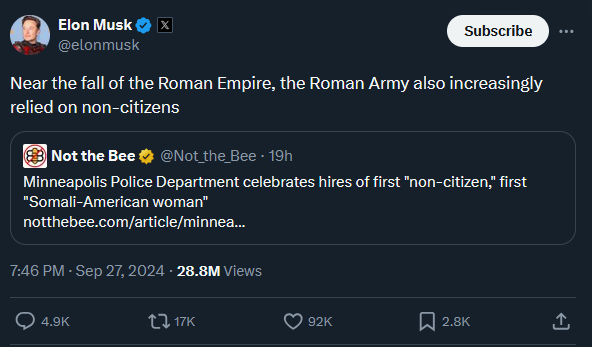
This is incorrect: the Roman army relied heavily on non-citizens throughout nearly the whole of Roman history, including the periods of its greatest success in the third and second centuries, when Rome came to dominate the Mediterranean. 1/
2
Indeed, Roman armies were at least half non-citizen for most of Roman history.
I've discussed this in more detail on the blog (link below) but let's do the basic details, so that you can be better informed than the manchild that owns this website. 2/
acoup.blog/2021/06/25/col…
I've discussed this in more detail on the blog (link below) but let's do the basic details, so that you can be better informed than the manchild that owns this website. 2/
acoup.blog/2021/06/25/col…
3
We struggle to see the very early Roman army (under the kings or the early republic) at all - the Romans don't begin writing their history until much later and descriptions of the royal army (Livy 1.43; Dion. Ant. Rom. 4.16) are much later and not necessarily reliable. 3/
4
Instead, the earliest we can talk about the Roman army is really in the late fourth century, moving into the third century, by which point the Romans are already heavily reliant on non-citizen in Italy euphemistically called 'socii' or allies. 4/
acoup.blog/2023/10/20/col…
acoup.blog/2023/10/20/col…
5
The roots of this system go pretty far back, to the Foedus Cassianum of 493 BC (Livy 2.18ff, Dion. Hal. Ant. Rom. 6.95). What emerged over time was a system where Rome forcibly enrolled communities in Italy as 'allies' whose soldiers - not citizens! - had to fight for Rome. 5/
6
These socii - we'll have to discuss pre-Roman Italic cultural diversity another day, but they were not just legally, but also culturally and linguistically distinct (acoup.blog/2021/06/11/col…) - made up a bit more than half of every Roman army from at least the third century BC. 6/
7
When the Romans raised new legions - which in this period they did every year - they also sent instructions for how many soldiers the socii were to furnish. @DrMichaelJTayl1 notes that socii outnumbered Roman citizens narrowly, about 2:3 (in Soldiers&Silver (2020). 7/
8
The socii were tough fighters and supplying more than half of Roman manpower were absolutely indispensable in allowing Rome to face down the other great empires of this period through the Punic (264-241, 218-201, 149-146), Macedonian (214-205, 200-196, 172-168, 150-148)...8/
9
...and Seleucid (192-188) wars, while at the same time managing significant other military actions in Spain, S. Gaul and elsewhere.
Without the socii, that wouldn't have been remotely possible. 9/
Without the socii, that wouldn't have been remotely possible. 9/
10
That said, Roman conquests outside of Italy changed the nature of 'the deal' with the socii and the Roman Republic's failure - due to political gridlock - to address the socii's complaints led to the Social War (91-87); Rome won by offering citizenship to the rebelling socii. 10/
11
For a brief moment, the Roman army would have been majority citizen, but it's not exactly a great moment in Roman history: this is the first century BC, the period of the civil wars and the fall of the Roman Republic, a product of political dysfunction within Rome. 11/
12
That leads to the establishment of the empire and we're told that already by the end of the reign of the very first emperor (Augustus, r. 31BC-14AD), the Roman army was again roughly half non-citizen, this time men drawn from the provinces and called auxilia (Tac. Ann. 4.5). 12/
13
Now, a lot of empires use conquered people in their armies, but what marks the Romans as unusual is that, as with the socii, the deal with the auxilia is fairly generous.
They're well paid and beginning under Tiberius (r. 14-37AD) they get grants of citizenship on discharge. 13/
They're well paid and beginning under Tiberius (r. 14-37AD) they get grants of citizenship on discharge. 13/
14
(The book to read on these fellows is I. Haynes, Blood of the Provinces (2013)).
So half of the army were citizens (the legions) and half non-citizens (the auxilia). This was the system that held Rome at its height for the first two centuries AD. 14/
So half of the army were citizens (the legions) and half non-citizens (the auxilia). This was the system that held Rome at its height for the first two centuries AD. 14/
15
And the auxilia have all sorts of effects expanding Roman manpower, minting new citizens and so on (discussed here: acoup.blog/2021/07/30/col…). 15/
16
That system holds until the Constitutio Antoniniana (212) issued by Caracalla (r. 198-217), which extended citizenship to all free persons in the Roman Empire.
That probably brings on the second period of a more or less all-citizen military, but we can't see it very well. 16/
That probably brings on the second period of a more or less all-citizen military, but we can't see it very well. 16/
17
The problem is that starting in 235, Rome enters the Crisis of the Third Century (235-284), a period of unrelenting disruption and civil war. Rome is stabilized by the reigns of Diocletian (r. 284-305) and Constantine (r. 306-337), but in a weakened form. 17/
18
Beginning probably in the 330s (certainly by the 350s) we start to see a new kind of soldier, the foederatus ('treaty-man') in Roman armies. These are non-Romans - often Germanic 'barbarians' - recruited by treaty as whole societies into the Roman army... 18/
19
...in exchange for being allowed to settle within the borders of the (safer, more prosperous) Roman Empire.
But the Romans seem to have lost some of the key 'muscle memory' that enabled them to incorporate the socii and auxilia so well. 19/
But the Romans seem to have lost some of the key 'muscle memory' that enabled them to incorporate the socii and auxilia so well. 19/
20
Foederati weren't incorporated into the Roman army proper, but kept as societies-within-a-society; the relatively generous 'deals' the Romans had used before do not reappear and so the loyalty of these foederati is never secured. 20/
21
At the same time, Roman society is getting less flexible in this period, in part due to efforts to enforce religious conformity, first anti-Christian (250, 303-305) and then anti-non-Christian (basically everything post 363) damaged the unity of the empire. 21/
22
These failures and the divisions they produced would eventually lead to the fragmentation of the Roman Empire in the west in the fifth century and the vulnerability of the Roman empire in the East (=Byzantines) to the advance of the Rashidun Caliphate in the 7th century. 22/
23
In short, then, the Roman army was around half non-citizen for most of its history, including the periods of greatest success (the great conquests from 280-91BC and the height of power from 14-212AD). 23/
24
By contrast, while I don't think the link is causal, it is periods of Roman division and chaos (91-31BC, 235-284AD) that are the ones marked by nearly 'all-citizen' armies. 24/
25
The deeper point is that an enormous part of why the Romans were so successful is that they were unusually good at employing diversity and running a multi-ethnic polity.
Roman power declined when they lost this habit.
For more, read this series: acoup.blog/2021/06/11/col…
/end
Roman power declined when they lost this habit.
For more, read this series: acoup.blog/2021/06/11/col…
/end
