One of the things in visual representations of the past, especially...

"Online Rent-a-Sage" Bret Devereaux@BretDevereaux
44 views
Aug 05, 2024
~7 min read
Advertisement
1
One of the things in visual representations of the past, especially a 'fantastic' past (e.g. fantasy medieval Europe) is the tendency to skip over the period when mail was the dominant heavy armor, from roughly the second century BC to the 13th century AD.
So let's talk mail. 1/
So let's talk mail. 1/
2
Part of this is noticing that House of the Dragon, visually, has decided that even though its events take place 200 years earlier than GoT, the dominant armor is plate, not mail, but you also see this in Tolkien adaptations; Book!LotR is all mail, screen!LOTR is mostly plate. 2/
3
So this is a mail appreciation thread. First, terminology: chainmail or worse ringmail are both modern terms and scholars thus tend to avoid them, preferring the medieval 'mail.' Roman mail armor tends to get called 'lorica hamata' which *may* have been a proper ancient term. 3/
4
Mail looks to have been invented some time in the late 400s or early 300s BC; it's hard to date precisely because archaeology is hard and dating is hard.
What's really interesting is that the basic structure the armor will take for two millennia solidifies very fast. 4/
What's really interesting is that the basic structure the armor will take for two millennia solidifies very fast. 4/
5
Early mail armors feature end-abutted shirts (Ciumești ) and six-in-one patterns (Tiefenau), but by the second century the design standardizes around a 4-in-1 pattern (each ring links to four other rings), with half of the rings being solid and half being riveted shut. 5/
6
Production is also fairly standard fairly quickly: riveted rings are (almost) always made by producing a wire, bending it into a circle, flattening the overlapping ends and punching a rivet into them.
Solid rings are punched out of sheet metal. 6/
Solid rings are punched out of sheet metal. 6/
7
(Welded solid rings also exist, but tend to show up in low-quality armor and with low-quality welds).
That pattern is visible in some of the earliest mail armors, which all come from La Tene material culture contexts, often associated with Gallic peoples. 7/
That pattern is visible in some of the earliest mail armors, which all come from La Tene material culture contexts, often associated with Gallic peoples. 7/
8
But at least to me what seems to fix the pattern is that the 4-in-1 wire-riveted and solid-punched ring formula is the one the Romans adopt.
And the Romans go *gangbusters* with this armor. 8/
And the Romans go *gangbusters* with this armor. 8/
9
The great limiting factor of mail is that it is very expensive to make: it requires a lot of expensive iron and also a TON of labor. c. 2000 hours to assemble a single armor (split between semi-skilled workers making rings and the master armorer putting them together). 9/
10
The average price of a mail shirt in Bruges in 1304, for instance, was more than a quarter of a year's wage for a skilled artisan. in the 7th century, in law (the Lex Ripuaria) the statutory value of a mail shirt was the same as an entire damn warhorse. Expensive! 10/
11
Consequently in Gaul where this stuff was invented, it was worn almost entirely by wealthy mounted elites. The Romans, by contrast, think "this is great!" and start putting it on their infantry.
First just the well-off infantry, but eventually most of the infantry. 11/
First just the well-off infantry, but eventually most of the infantry. 11/
12
By the first century BC, the Roman army's citizen infantry seems to have been functionally standardized around mail; they'll also pick up a few eastern armor types (scale and eventually segmented plate armor) which will co-exist, but mail remains very common. 12/
13
Indeed, I'd argue mail was probably the majority metal-armor-type for the Romans throughout the empire, though the other armors above are quite common.
The Roman adoption spreads the tech over the empire and beyond it. 13/
The Roman adoption spreads the tech over the empire and beyond it. 13/
14
Consequently, the form everyone *else* gets mail in is the form the Romans took it up in, and it sticks. From Spain to China, 4-in-1 Gallo-Roman style mail is the mail that shows up; Japan is the odd exception, w/ their own ring-armor tradition (different join pattern). 14/
15
In Europe, mail is the go-to armor of the rich-enough-to-get-it from the fall of the Roman Empire in the West until the emergence of transitional armors in the 1400s. in the Eastern Med and beyond, mail co-exists with scale and lamellar armors, but remains 'competitive.' 15/
16
And those alternative armors could of course be layered over a mail defense and clearly often were.
Now the basic structure doesn't change, but the *pattern* of the armor does. This is a really cool point made by M. Wijnhoven - armor making follows tailoring! 16/
Now the basic structure doesn't change, but the *pattern* of the armor does. This is a really cool point made by M. Wijnhoven - armor making follows tailoring! 16/
17
Most ancient Mediterranean garments were minimally 'tailored' - they were 'woven to shape' and things like belts or pins were used to create shapes and gathers. But the 'dress' or 'tunic' was typically just some rectangular panels of fabric, no fancy structure. 17/
18
And so ancient mail was made the same way: big rectangles of linked armor rings, which could then be joined at the sides to make a 'tunic' of mail. That made having true sleeves really hard, so they mostly didn't. 18/
19
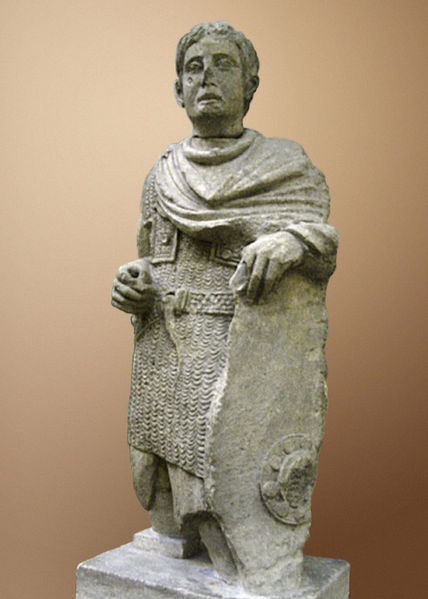
Instead arms were covered by an extra mail flap extending from the shoulders or a second layer of mail ('shoulder doubles') extending from the back of the armor. This fellow, the Vacheres Warrior, has both (image wikimedia commons commons.wikimedia.org/wiki/File:Gaul…) : 19/
20
As you get into the Middle Ages, you see more experimentation with more complexly shaped garments, with cutouts and extra fabric panels to produce fullness or gathers and so on. And as Wijnhoven shows (source below) armorers follow suit and begin making more complex shapes! 20/
21
And so while Roman mail was essentially a long tunic (almost to the knees) with shoulder flaps, by 1066 we see mail protection for the legs (chausses) and arms; you can see the difference by looking at the fellows on the Bayeux Tapestry (via wikipedia): 21/

22
You also start to see a bit later the emergence of mail coifs - a hood of mail worn under a rigid metal helmet - which by the 14th century are being directly attached to the helmet to make what is called an 'aventail.' 22/
23
I should note that Hollywood often gets the aventail pretty wrong visually, representing it as a loose hanging 'sheet' of mail, but in Europe at least (where I am most familiar) an aventail was almost always sewn into a padded fabric backing and fit snugly under the chin. 23/
24
The tremendous popularity of this armor, despite its tremendous expense, should suggest that it worked really well. And it did! Mail provides functional immunity to cutting attacks and when worn with padding substantially lessens blunt-force impacts. 24/
25
It is more vulnerable to piercing attacks (spears, sword-thrusts, arrows) but even in this cases seems to have hardly been useless (and arrows is what you have a shield for!). It's a fairly heavy armor (5-10kg depending on quality and coverage) but not burdensomely so. 25/
26
But the huge advantage mail has is *coverage* - it's a flexible metal fabric, so you can cover practically the entire body with it. Unless you get very clever with articulated plates (15th cent. and later, really), large parts of the body can't be covered by a rigid armor. 26/
27
And contrary to popular belief, mobility was really important in close-in combat; armor that reduced mobility was a no-go. Mail, however, could cover the whole body and when later rigid armors did emerge, it could cover the gaps. 27/
28
This is, I assume, why the Romans seemed to ditch both Greek-style breastplates and linothoraces (to the degree they ever used them) and also Italic pectoral-harnesses (made of several plates with substantial gaps between them) for mail with lightning speed. 28/
29
It's a really fascinating armor and I wish we saw more of it in film and TV and video games. I suspect part of why we don't is that it's expensive to make for props and hard to animate convincingly in video games.
Alas! 29/
Alas! 29/
30
If you want to read more about the origins of mail, I cannot recommend enough M.A. Wijnhoven, European Mail Armour (2022); it's a very comprehensive look at the armor. Alas, it is also very expensive, so maybe try to get your library to get a copy. 30/
31
I also have an article about the adoption of mail armor by the Romans, why I think they went gangbusters with it so hard and how that impacted Rome's wars in the second century due out in Chiron later this year (alas, not open access).
Mail is cool! /end
Mail is cool! /end
32
And since this thread is apparently blowing up, it might be a good place to note that I have a blog and I discuss armor and armor penetration (inc. mail) at some length here: acoup.blog/2019/06/21/col… and here acoup.blog/2019/07/04/col…
