Here we are. After a prolonged inversion, the US yield curve just...

Alf@MacroAlf
22 views
Sep 28, 2024
~2 min read
Advertisement
1
Here we are.
After a prolonged inversion, the US yield curve just dis-inverted.
Here is why it matters.
Thread 1/
After a prolonged inversion, the US yield curve just dis-inverted.
Here is why it matters.
Thread 1/
2
Many are familiar with the yield curve slope as the predictor of recessions: the track record is almost perfect, and there are good reasons why.
2/
2/
3
An inverted yield curve often leads towards a recession because it chokes real-economy agents off with tight credit conditions (high front-end yields) which are reflected in weak future growth and inflation expectations (lower long-dated yields).
3/
3/
4
A steep yield curve instead signals accessible borrowing costs (low front-end yields) feeding into expectations for solid growth and inflation down the road (high long-dated yields).
4/
4/
5
Understanding the yield curve is crucial to become a better macro investor.
The recent bull steepening is happening late-cycle when nominal growth is slowing down.
Here is what that combination means for markets:
5/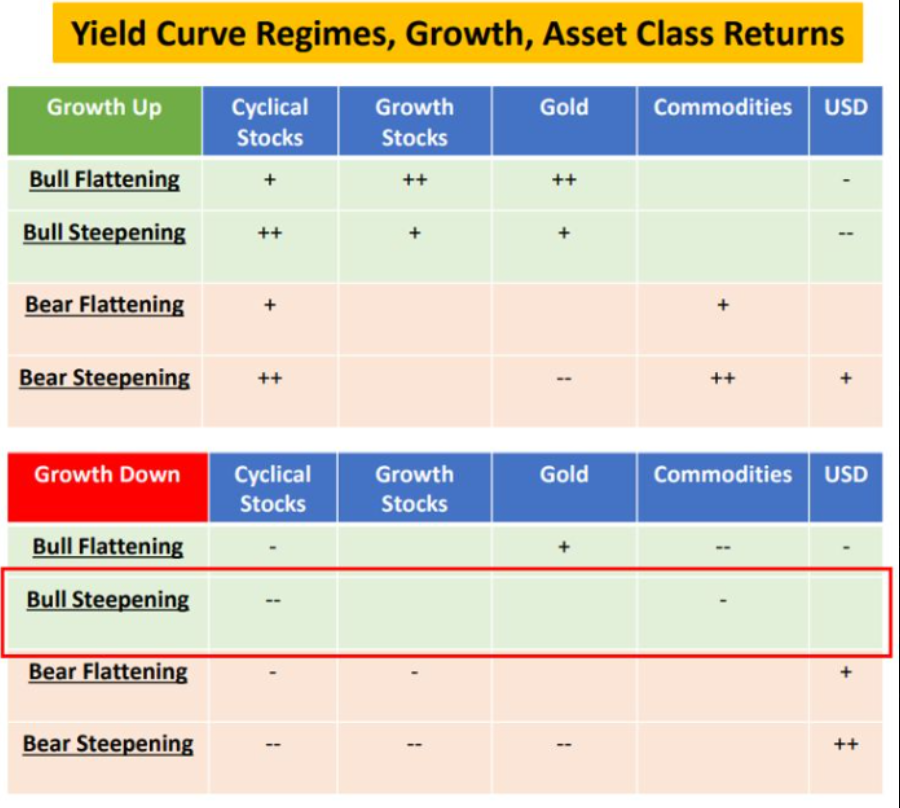
The recent bull steepening is happening late-cycle when nominal growth is slowing down.
Here is what that combination means for markets:
5/
6
Specifically, a dis-inversion which happens after a long period of yield curve inversion is THE macro signal that has historically indicated weak growth ahead.
Take a look at the chart below: it's the dis-inversion investors should watch closely, not the initial inversion.
6/
Take a look at the chart below: it's the dis-inversion investors should watch closely, not the initial inversion.
6/
7
The historical patterns goes like:
1) Every recession since the 1970s was preceeded by a yield curve inversion
2) The timing between the initial inversion and the start of a recession varies: in the early 80s or 2000s recession it was as little as 12 months, while in 2008 it took 27 months (!) for the macro lags to appear
7/
1) Every recession since the 1970s was preceeded by a yield curve inversion
2) The timing between the initial inversion and the start of a recession varies: in the early 80s or 2000s recession it was as little as 12 months, while in 2008 it took 27 months (!) for the macro lags to appear
7/
8
And the final step:
3) The yield curve dis-inversion happens, and soon after the macro lags kick in and the US economy slows down more aggressively
Where are we today?
Yield curve inverted for 27 months, and now dis-inverting with the job market slowing down.
8/
3) The yield curve dis-inversion happens, and soon after the macro lags kick in and the US economy slows down more aggressively
Where are we today?
Yield curve inverted for 27 months, and now dis-inverting with the job market slowing down.
8/
9
The lags are particularly long in this cycle because of how the US economy is structured: fixed rate mortgages and corporate borrowing have shielded the private sector from higher rates.
Macro lags are long.
But they haven't disappeared.
9/
Macro lags are long.
But they haven't disappeared.
9/
10
P.S. Enjoyed this macro analysis?
Request a FREE TRIAL to my Institutional Macro Research.
Join the biggest institutional investors in the world reading my macro analysis every day.
Link here: forms.gle/AJan4RnsSmbgRp…
10/10
Request a FREE TRIAL to my Institutional Macro Research.
Join the biggest institutional investors in the world reading my macro analysis every day.
Link here: forms.gle/AJan4RnsSmbgRp…
10/10