In August 1999, President Yeltsin appointed his FSB Chief Putin as...

Kamil Galeev@kamilkazani
33 views
Mar 23, 2024
~4 min read
Advertisement
1
In August 1999, President Yeltsin appointed his FSB Chief Putin as the new Prime Minister. Same day, he named him as the official successor. Yet, there was a problem. To become a president, Putin had to go through elections which he could not win.
He was completely obscure.
He was completely obscure.
2
Today, Putin is the top rank global celebrity. But in August 1999, nobody knew him. He was just an obscure official of Yeltsin's administration, made a PM by the arbitrary will of the sovereign. This noname clerk had like 2-3% of popular support
Soon, he was to face elections
Soon, he was to face elections
3
By the time of Putin's appointment, Russia already had its most favoured candidate. It was Primakov. A former Yeltsin's Prime Minister who broke with Yeltsin to contest for power. The most popular politician in Russia with massive support both in masses and in the establishment.

4
Back in 1999, Primakov had a nearly universal support. With 84 out of 89 governors backing him, his victory seemed all but predetermined. Total bipartisan support in the political establishment combined with the wide popularity in masses seemed like a winning combination.

5
With all the support of Kremlin, and with the FSB behind him, Putin was still an underdog. He was to face more popular (like 20 times more popular) candidate backed by almost the entire regional elite. That seemed like an impossible bid
Unless he would play some magic trick
Unless he would play some magic trick
6
In September 1999, Russia saw four major apartment bombings. 1 in Dagestan, 1 in Volgodonsk, 2 in Moscow. All the four attacks targeted large residential buildings (the standard type of accommodation in the country)
All four were allegedly performed by the Chechen separatists
All four were allegedly performed by the Chechen separatists
7
The apartment bombings involved massive civilian casualties. More than 300 dead, more than 1700 wounded. As the attacks apparently targeted "normal" residential buildings, pretty much everyone in the country could see themselves in danger.
The atmosphere was somewhat psychotic.
The atmosphere was somewhat psychotic.
8
September 1999 timeline
4-16 - the apartment bombings
16 - the Parliament confirms Putin as the Prime Minister
24 - Putin makes his famous speech, promising to kill terrorists everywhere he can find them, including in the toilet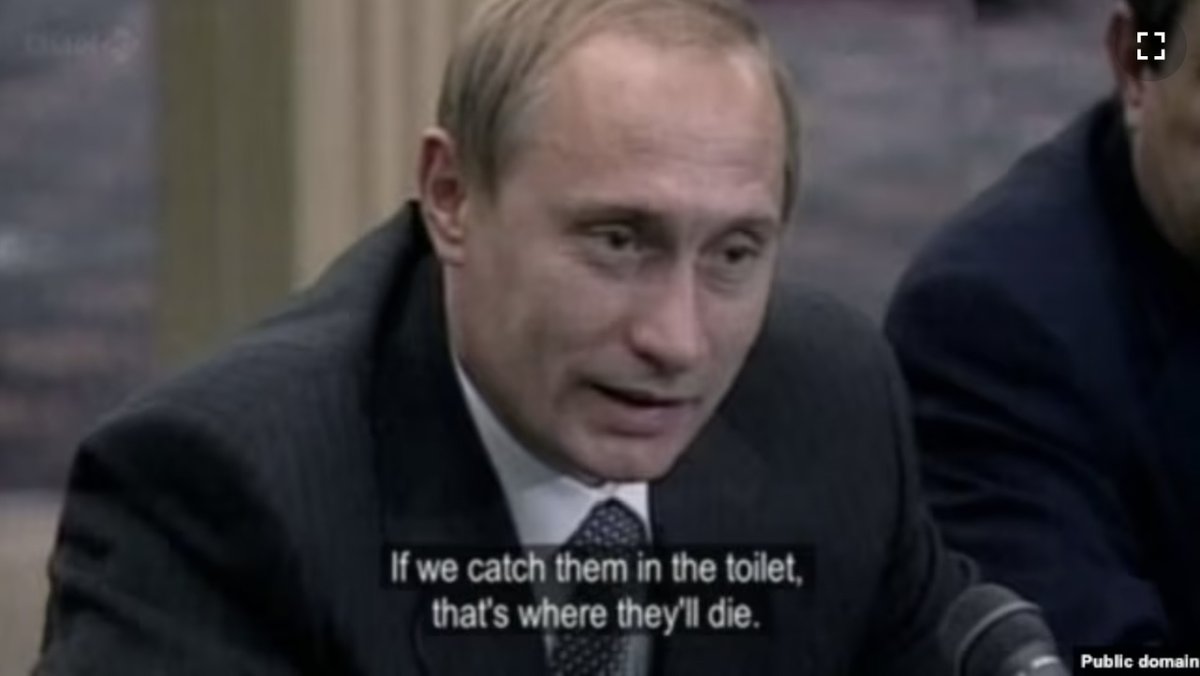
4-16 - the apartment bombings
16 - the Parliament confirms Putin as the Prime Minister
24 - Putin makes his famous speech, promising to kill terrorists everywhere he can find them, including in the toilet
9
October 1, 1999, Russia troops cross the border of Chechnya, aiming to topple the separatist regime in Grozny. This short victorious war boosted Putin out of nothing. In August, he was a noname. By December, he was the national hero, and the saviour of the motherland.

10
The war made Putin popular. By the time Yeltsin stepped down, he was already the most popular politician in the country. In 2000 he score an easy victory on the presidential elections, succeeding his patron.
Without the war, he would have never made it. He needed the war badly.
Without the war, he would have never made it. He needed the war badly.
11
That's why the entire story with the apartment bombings looked suspicious. The bombings came too timely and were just too convenient for the obscure, unknown Putin, who needed the popularity for his forthcoming Presidential elections
Especially in the light of the Ryazan sugar
Especially in the light of the Ryazan sugar
12
Of all the real or alleged terrorist attacks in Russia, the Ryazan story looked the shadiest. As terrorists seemed to target "normal" buildings, the country got increasingly terrified, vigilant and psychotic. Regular citizens were checking their basements looking for explosives
13
On September 22, 1999 Alexey Kartofelnikov living on Novoselov 14/16 in a provincial city of Ryazan noticed an unfamiliar car parked nearby his residential building. Its passengers took several white bags and carried them into the basement of his house.

14
As the strangers left, inhabitants called the police. Police came and found several large bags from sugar - with a detonator. Police evacuated the inhabitants, announcing that these "sugar" bags contained hexagon. Next day, it was all in the news.

15
Same night the police arrested two suspects. To their surprise they showed the FSB id cards. Soon, the Moscow FSB office called the Ryazan police and ordered a release of their agents.

16
What was in the bags? The authorities gave different versions. Before the FSB agents were arrested, Putin told these were the real explosives and thanked the Ryazan citizens for their vigilance. They helped to prevent a real terrorist attack.
17
After the arrest, the official version changed. Putin's deputy Patrushev explained these were no explosives, but the normal sugar. The FSB agents drove to Ryazan, bought sugar, and put it to the basement checking the vigilance of the locals. So, it was only the training.
18
Some believed in the official explanation, others did not. Felshtinsky and Litvinenko wrote a book, claiming that the 1999 bombings that brought Putin to power, were all the FSB false flag operation. They blew up the houses, and blamed in on Chechens to start the war

19
Here you can find a pretty good summary of these events + useful links and materials. It's all in Russian, but understandable with the Google Translate
svoboda.org/a/30172990.html
svoboda.org/a/30172990.html
20
And the last detail. What was interesting about the Moscow bombings, is that they targeted poorer, non affluent districts of the East and South. If it was a false flag operation, then it was designed in a way that the elite/upper class would not get hurt even accidentally