Been seeing this video go around a lot, so as good a time as any to...

jeff ruberg@jeffinitelyjeff
33 views
Sep 15, 2026
~4 min read
Advertisement
1
Been seeing this video go around a lot, so as good a time as any to talk about something I’ve thought about a lot:
I would contest we have absolutely 0 mathematical evidence for how many *sleeved* shuffles are actually required for sufficient randomness.
I would contest we have absolutely 0 mathematical evidence for how many *sleeved* shuffles are actually required for sufficient randomness.

2
First, some quick definitions because I know that claim is controversial before I lay down some qualifiers.
There is such a thing as “true randomness” in theory — a deck is truly random if the odds of drawing each card are all exactly equal. That is *just in theory*, though.
There is such a thing as “true randomness” in theory — a deck is truly random if the odds of drawing each card are all exactly equal. That is *just in theory*, though.
3
In practice, there is no fixed shuffling strategy (and no fixed number of times to repeat that shuffle) which will *ever* reach that theoretical ideal of true randomness. The goal is just to approach that goal with *sufficient randomness* as efficiently as possible.
4
That’s where the general guideline of 7 shuffles comes from: that after 7 there is a significant drop off where the additional randomness is so small it’s not worth the effort.
But 7 is not some magic number that flips a switch where the deck suddenly becomes truly, 100% random.
But 7 is not some magic number that flips a switch where the deck suddenly becomes truly, 100% random.
5
BUT that guideline of 7 shuffles is based on a 1986 paper & several subsequent papers, most authored by this mathematician/magician: youtu.be/AxJubaijQbI?si…
And all of the scholarship has 2 BIG assumptions that are almost never true for TCGs:
- nonsleeved cards
- riffle shuffle
And all of the scholarship has 2 BIG assumptions that are almost never true for TCGs:
- nonsleeved cards
- riffle shuffle
6
Let’s talk about riffle shuffling!
It’s this technique you’re familiar with from playing cards. The 1986 paper was based on a mathematical model that the authors found mirrored real-world shuffling they observed.
It’s this technique you’re familiar with from playing cards. The 1986 paper was based on a mathematical model that the authors found mirrored real-world shuffling they observed.
7
The core of that model is that we think of which stack the next card will “fall” from, and that the odds match the relative stack sizes. The details of that are too complex for here, but essentially think of it as a series of coin flips for which stack the next card comes from.
8
The key detail is that they established this model, observed players riffle shuffling, and then felt confident that the model aligned with how players typically riffle shuffle.
But they were observing players of games like Bridge, Poker, etc.
But they were observing players of games like Bridge, Poker, etc.
9
For obvious reasons, almost no TCG players riffle shuffle with that standard card-bending technique.
Some people use an approach where they effectively riffle both stacks at the corners without bending the cards, but it’s a very tricky technique and pretty rare in my experience
Some people use an approach where they effectively riffle both stacks at the corners without bending the cards, but it’s a very tricky technique and pretty rare in my experience
10
So here’s what most TCG players (myself included) do:
The Mash Shuffle — just shoving the piles together.
This *feels* similar to riffle (minus some clumping at the top/bottom), so this is where I’ve seen most people stop and just assume the 7 number holds true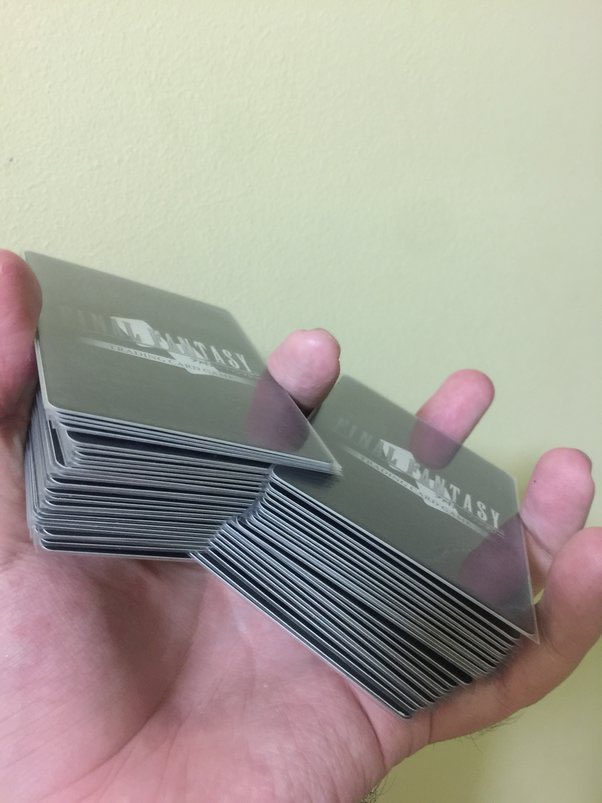
The Mash Shuffle — just shoving the piles together.
This *feels* similar to riffle (minus some clumping at the top/bottom), so this is where I’ve seen most people stop and just assume the 7 number holds true
11
But here’s the problem: the threat of a Perfect Shuffle.
A perfect shuffle is where the shuffle is so uniform there isn’t actually any randomness. Imagine a coin that *always* came up H, T, H, T, etc. The odds are the same, but it’s not random.
A perfect shuffle is where the shuffle is so uniform there isn’t actually any randomness. Imagine a coin that *always* came up H, T, H, T, etc. The odds are the same, but it’s not random.
12
A perfect riffle shuffle is actually very difficult to execute. In that 1986 paper, the authors mention this possibility, but dismiss it as a concern because it’s a skill limited to stage magicians.

13
But a perfect *mash* shuffle is not difficult. It’s extremely easy.
Aside from some clumps at the beginning/end of the pile (if one stack is larger than the other), I’ve found that most of my unconscious mash shuffles result in *almost* perfect shuffles.
Aside from some clumps at the beginning/end of the pile (if one stack is larger than the other), I’ve found that most of my unconscious mash shuffles result in *almost* perfect shuffles.
14
Tying this all back around to the original video of that extremely smooth shuffle that everyone is envious of, look how uniform it is:
There are clumps at the beginning/end, but the vast majority of the cards are L/R/L/R/L/R perfectly shuffled
There are clumps at the beginning/end, but the vast majority of the cards are L/R/L/R/L/R perfectly shuffled
15
As a comparison~
L: 1 unsleeved riffle shuffle
R: 1 sleeved mash shuffle (that I did unconsciously w/o looking, as if chatting with an opponent)
Look how much variability there is in the riffle!
The mash’s center has a total of THREE (3!) cards that aren’t uniformly shuffled
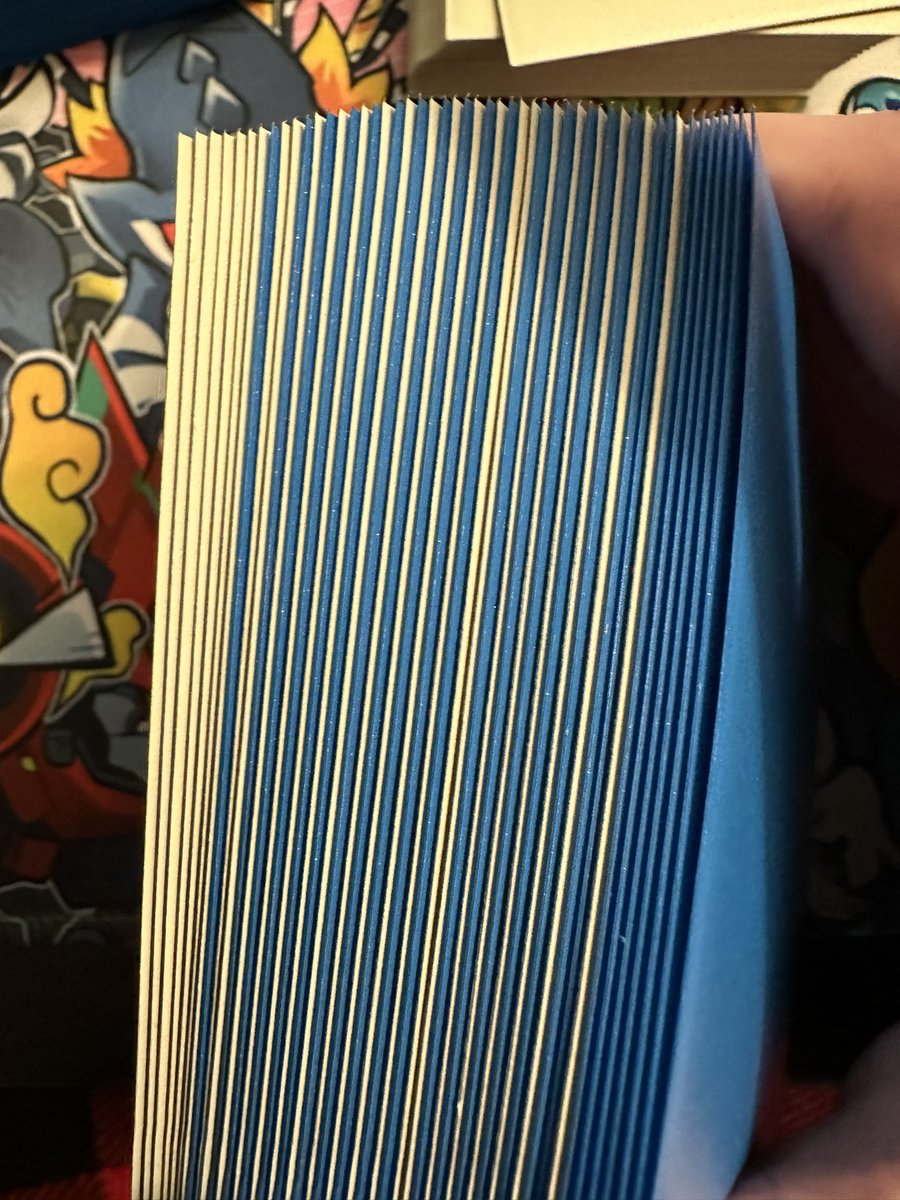
L: 1 unsleeved riffle shuffle
R: 1 sleeved mash shuffle (that I did unconsciously w/o looking, as if chatting with an opponent)
Look how much variability there is in the riffle!
The mash’s center has a total of THREE (3!) cards that aren’t uniformly shuffled
16
In conclusion, there’s tons of scholarship on shuffling in the playing card / stage magician world, but none that I can find actually analyzing the sleeved / TCG world, and I think it’s a huge stretch to assume unsleeved findings apply despite radically different physics/behavior
17
@T0Psycho I’m not sure if that methodology would model reality enough to be accurate, but it seems like it’d be relatively easy to verify by doing the same methodology on ~30 unsleeved riffle shuffles and seeing if the results reproduce the classic papers