Yesterday, @a16zcrypto dropped their list of narratives for 2024....

Stacy Muur@stacy_muur
61 views
Mar 02, 2024
~4 min read
Advertisement
1
Yesterday, @a16zcrypto dropped their list of narratives for 2024.
Normie's explainer + list of protocols to watch ↓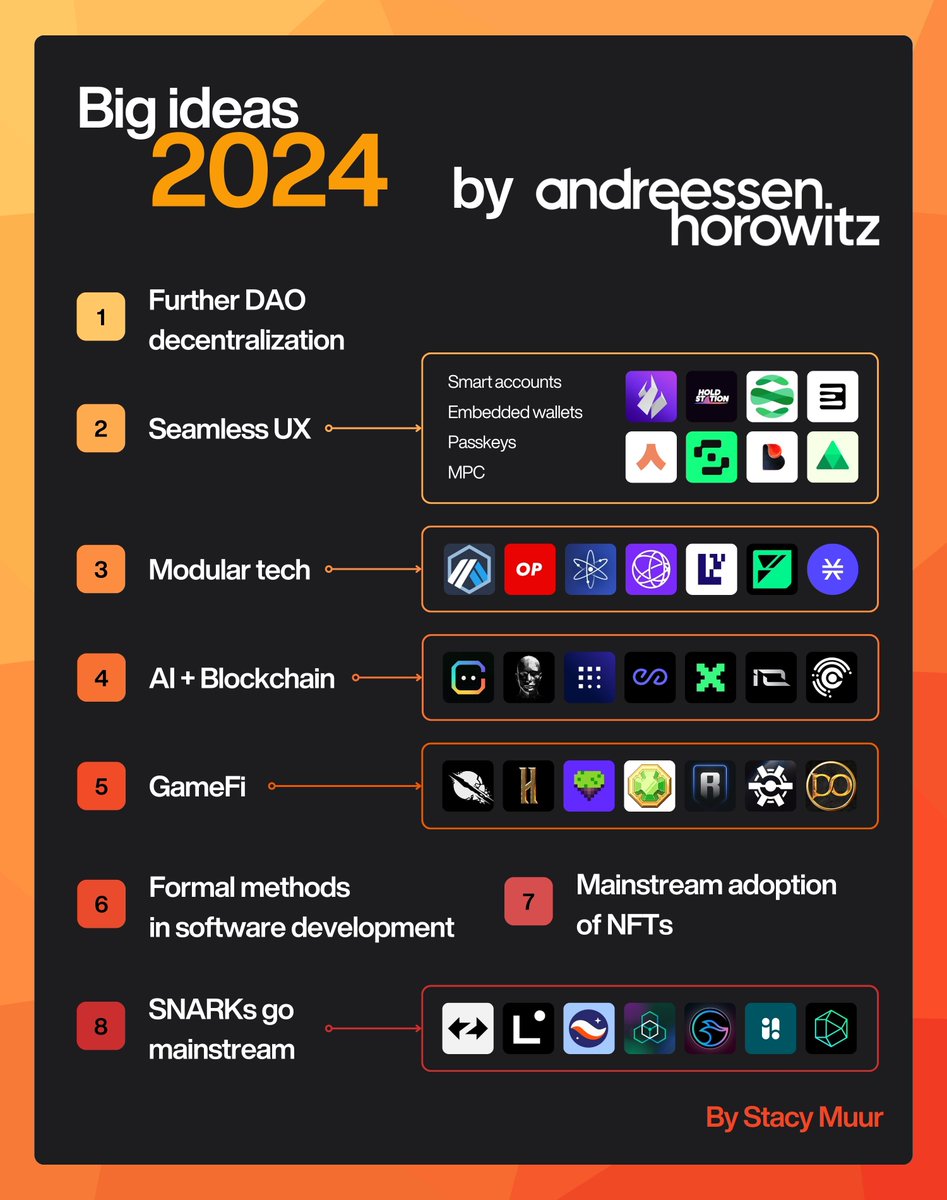
Normie's explainer + list of protocols to watch ↓
2
❯ Further DAO decentralization
Decentralization is crucial for ensuring user freedom by reducing the control a few have over systems and platforms. It enables a more democratic internet infrastructure, fostering competition and diversity.

Decentralization is crucial for ensuring user freedom by reducing the control a few have over systems and platforms. It enables a more democratic internet infrastructure, fostering competition and diversity.
Stacy Muur@stacy_muur
The evolution of Web3 governance reward systems, straight from a16z.
In mid-October, @a16z dropped an unnoticed gem: a comprehensive exploration of DeFi governance models.
Which gov systems will drive the next-gen DeFi protocols and what options do they unlock?
Deep dive ↓
An essential challenge in democratizing online governance systems is figuring out how to incentivize long-term user participation through rewards.
Traditionally, web3 governance has hinged on transferable tokens. However, these tokens, while popular, present certain limitations:
• Tendency toward plutocracy;
• Low sybil resilience;
• Incentives to sell tokens and exit;
• Whales are better at successfully executing decisions than large groups of small-holders.
A potential solution?
Moving beyond coin voting governance as proposed by @VitalikButerin back in 2021.
Comparing Reputation-Based and Token-Based Reward Systems
While token-based rewards can be transferred, reputation-based ones cannot.
The web3 governance initially adopted token-based systems, but it is now shifting its focus towards reputation-based systems due to their unique advantages.
When it comes to choosing a system that rewards community involvement and loyalty, reputation-based governance is the way to go.
However, if scalability and financial flexibility are the priorities, token-based governance is the ideal choice.
Each approach has its own advantages and disadvantages:
• Reputation-based systems tend to favor early community members but may pose challenges for wealthy individuals seeking to gain an advantage.
• Token-based systems are susceptible to specific hacks, whereas reputation-based systems are linked to a person's identity, potentially raising privacy concerns. These challenges could be addressed through the implementation of advanced technological solutions.
In real-world applications, a combination of token and reputation systems can be the most effective approach.
For example, @optimismFND utilizes a two-house model: one house operates based on reputation, while the other relies on tokens.
Some experts propose incorporating two types of tokens in reputation systems: one to indicate reputation and another to provide financial liquidity.
Projects like @LidoFinance employ two transferable tokens, but there is also potential for exploring non-transferable tokens that are reputation-based.
Token-based systems
Token-based governance means that rewards or decisions are connected to owning or trading tokens, like @Uniswap's $UNI tokens used for voting.
The key points are:
• These tokens are easy to buy, sell, and use for governance.
• Token owners usually vote for their own financial benefit, but this may not always be in the community's best interest.
• Common token types are ERC-20 (Ethereum), ICS-20 (Cosmos), and SPL (Solana).
• People with more tokens might have more influence, which could lead to imbalances.
• Typically, the more tokens you have, the more power you have in voting.
For instance:
→ In @MakerDAO, $MKR token owners vote on changes.
→ In @AaveAave, $AAVE token holders decide which projects get funded.
→ In @Uniswap, $UNI token holders vote on fee structures.
Different ways to distribute tokens:
• Airdrops: Give tokens to specific wallet holders at a certain time. It’s a way to encourage certain actions, promote new ventures, or spread ownership in a community. Many projects, from DeFi protocols to NFTs, have used this method.
• Retroactive Rewards: Used by platforms like Optimism, where tokens are given to users who have contributed in the past to support the project. Selection is often through community voting.
• Liquidity Mining: Users get tokens for adding funds to a platform. It’s like continuous rewards for participation. Platforms like @compoundfinance and @synthetix have used this method.
• Vote Escrow: For voting, users lock up their tokens. Locking them for longer can give more voting power. @CurveFinance and @fraxfinance is an example where users can get more benefits by locking tokens longer, which also helps protect against certain attacks.
Reputation-based systems
Unlike tokens that can be bought, reputation is something you earn. While it can be a type of token, it's not like the regular ones that you can trade. Often, they use unique tokens, known as NFTs, like Ethereum's ERC-5114 or badges in the Optimism citizen’s house.
There are many ways reputation can be determined, such as by peer opinions, behavior scores, or chosen by a central group.
Reputation could also be a non-tradable standard token. This might allow for more detailed ratings, like giving fractional tokens for specific tasks.
Reputation-based systems are seen as more fair since they don't just favor those with money. However, they also have problems like measuring what's a good contribution and handling lots of users.
There are different ways to earn reputation:
• Automated Behavior Metrics: Reputation is given based on actions. For instance, attending an event might give you a point. But, it's challenging to know the real value of these actions. Just because someone goes to every event doesn’t mean they’re committed – they might just have free time.
• Peer Attestations: Your reputation comes from what others think about you. It focuses on the quality of participation. However, this method might be gamed, like people bribing others for good reviews. @BoysClubWorld DAO and @GovrnHQ, for example, use this method for members to recognize each other's contributions.
• Centralized Selection: A core team picks the initial high-reputation members. Over time, the system can become more decentralized.
Since you can't just buy a good reputation, designing these systems offers a lot of possibilities.
What do rewards grant?
Rewards can grant various benefits. Most web3 systems give voting power to token holders, with each token representing one vote. Whether the rewards can be traded (token-based) or not (reputation-based) affects the kind of benefits they offer.
Potential benefits from rewards:
• Governance Power: Rewards can provide voting rights, representation, proposal-making abilities, and more.
• Online Benefits: They can give special online privileges like exclusive access to groups, priority in staking, or unique community symbols. An example might be a special digital badge for active participants.
• Real-World Perks: Rewards can offer real-life benefits, like invitations to events, merchandise, or other physical items.
Effective reward systems could combine these benefits depending on the project's goals. Rewards might give a mix of voting power, online privileges, and real-world perks.
Whether a project should use token-based governance depends on its civic or economic focus. There are pros and cons to each system, like ease of use and potential for abuse.
Some argue for token-based systems because holders have a vested interest. But, there are concerns about undue influence by the rich, which goes against web3 principles. Also, when token prices rise, participants might just sell off.
Reputation-based systems aim for fairness by linking governance to earned reputation. However, these systems can be complex due to the challenge of measuring reputation.
The field of reputation-based governance is still developing, and it's an exciting area to explore. The future holds more discussions and trials to find the best online governance models.
***
I hope you've had an intriguing journey exploring the evolution of token model designs.
Special credits go to @a16zcrypto for sharing these insightful articles, with a special mention to Eliza Oak, the writer of this particular article.
You can find the original research link below ↓
3
However, implementing decentralization at a large scale has been challenging, especially against the efficiencies of centralized systems. Web3 governance, often through DAOs, has struggled with effective decentralized governance.
4
But recent developments in web3 have led to better practices for decentralization, including more sophisticated governance models that promote accountability and effective leadership, pointing towards a future with more decentralized coordination and innovation.
5
❯ Improved Web3 UX
Crypto user experience hasn't improved much since 2016, remaining complex for new users. However, developers are now creating tools to improve this.
Crypto user experience hasn't improved much since 2016, remaining complex for new users. However, developers are now creating tools to improve this.
6
These include passkeys for easier app logins, smart accounts for more manageable accounts, embedded wallets for seamless integration into apps, MPC for secure third-party signing support, and advanced RPC endpoints for smarter user interactions.
7
A few notable protocols in this field:
• @AmbireWallet
• @HoldstationW
• @avowallet
• @safe
• @PlenaFinance
• @biconomy
• @argentHQ
• @dappOS_com
Additional reading ↓

• @AmbireWallet
• @HoldstationW
• @avowallet
• @safe
• @PlenaFinance
• @biconomy
• @argentHQ
• @dappOS_com
Additional reading ↓
Stacy Muur@stacy_muur
Intents in Focus: Paving the Road for a Better Web3 UX.
ERC-4337 smart account transactions:
❯ April 2023: 7,511
❯ June 2023: 56,844
❯ September 2023: 892,524
We just cannot afford to ignore it.
All you need to know about the intent-centric approach, short and simple ↓
What are Intents?
Think of intents as a simple way to tell the system what you want to achieve, without getting bogged down in the 'how'.
It's like ordering a dish at a restaurant without worrying about the cooking process.
Intents vs Transactions
Imagine ordering a coffee. Do you care about how it's made, or do you just want your coffee?
A transaction is like telling the barista every step to make your coffee.
An intent is simply saying, "I'd like a latte!" and letting the barista do their thing.
Solvers are like chefs in the restaurant analogy.
They take your intent (order) and handle the technical stuff to ensure you get what you want. They compete to give you the best service at the best price.
For a restaurant to work smoothly, the chefs need to be motivated, right?
In Web3, solvers (our chefs) need the right incentives. Ensuring they're rewarded properly will guarantee they work efficiently and fairly.
Account Abstraction is like the gateway to our restaurant.
It's a way to make transactions smoother and more user-friendly. But it's mainly designed for one specific chain, and that's where intents come in, helping us navigate multiple chains seamlessly.
AI: The Super Chef
Imagine if our cafe had a robot chef who knew your order even before you said it?
That's what introducing AI to intents is like! They can help make the process smoother and more intuitive. But, like any new tech, there are things to iron out to make sure our robot chef doesn't spill spices everywhere.
So why Intents?
Intents simplify what users want.
They enhance the user experience, making transactions smoother and more efficient. They help users navigate the increasingly complex landscape of multiple chains and Layer-2 solutions.
The Intent Landscape
❯ General Purpose: Think of this as the basic infrastructure. It's like the espresso machine, beans, and milk needed to make coffee.
❯ Intent-Specific: These are your special lattes, mochas, and cappuccinos. Platforms make unique offers based on specific user intents.
Real-life use cases of intents
❯ Limit Orders: Users set a price, and solvers find the best deal across different platforms.
❯ Smart Orders: Set specific conditions for your transactions, like buying a stock only when it reaches a certain price.
❯ Automated Actions: Schedule actions, like regular investments or portfolio rebalancing.
❯ Cross-chain bridging: Move assets across different blockchain networks without the headache.
❯ Crowdfunding: Pledge funds only when a project meets certain milestones.
❯ Peer-to-Peer (P2P): Directly transact with others for better prices, like P2P lending.
❯ Security: Restrict interactions to ensure they're safe and have passed specific checks.
Notable protocols
General-purpose solutions:
❯ @anoma – an intent-centric architecture for decentralized counterparty discovery, solving, information flow control, & multi-chain atomic settlement.
❯ @intentessential – an intent-based infrastructure & tooling to accelerate the transition from value extraction to intent satisfaction.
❯ @dappOS_com – the first intent-centric operating protocol.
❯ Flashbots SUAVE – strives to give more value for users whilst increasing decentralization in public blockchains.
Intent-specific aggregation & limit orders:
❯ UniswapX
❯ 1inch Fusion
❯ @matchaxyz
❯ @BrinkTrade
❯ @paraswap
❯ @ApertureFinance
Intent-specific wallets (gas sponsorship, transaction batching, delegation):
❯ @avowallet by Instadapp
❯ @AmbireWallet
❯ @argentHQ
❯ @safe
❯ @biconomy
❯ @0xsequence by HorizonDEX
Infrastructure solutions:
❯ @HyperOracle
❯ @PropellerSwap
❯ @thekeep3r
❯ @blockswap_team
❯ @dflow
Find more in my infographic!
8
❯ Modular solutions:
Monolithic architectures offer performance benefits through deep integration, but an open-source, modular approach is advantageous for encouraging permissionless innovation, specialization, and competition, which are highly valued in technology development.
Monolithic architectures offer performance benefits through deep integration, but an open-source, modular approach is advantageous for encouraging permissionless innovation, specialization, and competition, which are highly valued in technology development.
9
Some developments:
• Ethereum L2s: @arbitrum, @optimismFND, @zksync, etc.
• @babylon_chain and @stacks on Bitcoin
• @cosmos, @Neutron_org, and @osmosis
• @CelestiaOrg
• @alt_layer
• @fuel_network
• @eigencloud
Additional reading ↓
• Ethereum L2s: @arbitrum, @optimismFND, @zksync, etc.
• @babylon_chain and @stacks on Bitcoin
• @cosmos, @Neutron_org, and @osmosis
• @CelestiaOrg
• @alt_layer
• @fuel_network
• @eigencloud
Additional reading ↓
Stacy Muur@stacy_muur
The race for blockchain security supremacy is gaining momentum.
EigenLayer → Restaking.
Cosmos → Replicated Security model.
Osmosis → Mesh Security.
Stacks → Proof-of-Transfer.
Babylon → Bitcoin to secure PoS.
One thread to navigate all modular chain developments.
🧵 1/33
EigenLayer → Restaking.
Cosmos → Replicated Security model.
Osmosis → Mesh Security.
Stacks → Proof-of-Transfer.
Babylon → Bitcoin to secure PoS.
One thread to navigate all modular chain developments.
🧵 1/33
10
❯ AI + Blockchain
Decentralized blockchains offer a balance to centralized AI. Currently, AI models like ChatGPT are primarily in the realm of big tech companies due to high costs for computing and data.
Decentralized blockchains offer a balance to centralized AI. Currently, AI models like ChatGPT are primarily in the realm of big tech companies due to high costs for computing and data.
11
Crypto enables the creation of global markets where anyone can contribute resources like computing power or data, making AI more affordable and accessible. Furthermore, crypto can help track the origins of online content, including AI-generated material like deep fakes.
12
Some notable projects ↓
• @Chain_GPT
• @AITECHio
• @Fetch_ai
• @peaqnetwork
• @CharacterXAI
• @graphlinq_proto
• @KvantsAI
• @openfabricai
• @ionet_official
• @oraichain
More great picks in this thread by @ardizor ↓


• @Chain_GPT
• @AITECHio
• @Fetch_ai
• @peaqnetwork
• @CharacterXAI
• @graphlinq_proto
• @KvantsAI
• @openfabricai
• @ionet_official
• @oraichain
More great picks in this thread by @ardizor ↓
ardizor 🧙♂️@ardizor
Artificial Intelligence is the biggest narrative of the near future.
It's time to seize that 10-100x opportunity.
Keep reading and find out the top 13 AI tokens 👇🧵
It's time to seize that 10-100x opportunity.
Keep reading and find out the top 13 AI tokens 👇🧵
13
❯ GameFi
In "play to earn" (P2E) games, players can earn real money based on their in-game activities, reflecting broader changes in the gaming industry and the creator economy.
In "play to earn" (P2E) games, players can earn real money based on their in-game activities, reflecting broader changes in the gaming industry and the creator economy.
14
Web3 challenges the norm of gaming profits solely benefiting companies, advocating for player compensation. However, games aren't primarily workplaces. The focus is shifting towards creating enjoyable games that also enable players to earn, balancing fun and financial benefit.
15
Notable project within the GameFi narrative:
• @Ronin_Network
• @pixels_online
• @TheTreeverse
• @playSHRAPNEL
• @DeFiKingdoms
• @heroesofnft
• @HeroesChained
• @DomiOnline
Recommended @a16z podcast on Web3 Gaming ↓
web3-with-a16z.simplecast.com/episodes/web3-…
• @Ronin_Network
• @pixels_online
• @TheTreeverse
• @playSHRAPNEL
• @DeFiKingdoms
• @heroesofnft
• @HeroesChained
• @DomiOnline
Recommended @a16z podcast on Web3 Gaming ↓
web3-with-a16z.simplecast.com/episodes/web3-…
16
❯ Formal methods
Formal methods, often used in hardware, are less common in software due to complexity and potential extra costs. However, they're crucial for smart contract development where errors can have severe financial consequences.
Formal methods, often used in hardware, are less common in software due to complexity and potential extra costs. However, they're crucial for smart contract development where errors can have severe financial consequences.
17
Recently, new tools have been developed that are simpler and more efficient for smart contracts, thanks to their straightforward architecture and improvements in SMT solver technology. These advancements make smart contracts more reliable and less prone to costly mistakes.
18
❯ Mainstream NFTs
Established brands are introducing NFTs to mainstream consumers, like Starbucks' gamified loyalty program and Nike and Reddit's digital collectibles.
Established brands are introducing NFTs to mainstream consumers, like Starbucks' gamified loyalty program and Nike and Reddit's digital collectibles.
19
NFTs offer opportunities beyond just collecting: they can represent customer identity, link to physical products, and involve customers in co-creation. The trend includes affordable NFTs for mass collection, often via custodial wallets and low-cost "Layer 2" blockchains.
20
❯ SNARKs
Historically, verifying computational workloads involved re-executing the compute, using trusted execution environments (TEEs), or blockchain. These methods had cost or scalability limits.
Historically, verifying computational workloads involved re-executing the compute, using trusted execution environments (TEEs), or blockchain. These methods had cost or scalability limits.
21
Now, SNARKs (Succinct Non-interactive Arguments of Knowledge) are emerging as a more practical solution. They allow creating a secure, unforgeable cryptographic receipt of compute work with significantly reduced overhead.
22
This makes SNARKs suitable for situations where re-execution or data storage isn't feasible, leading to applications in IoT, media editing, meme creation, and more, ensuring authenticity and security.
23
Notable protocols within the SNARKs (ZK) narrative:
• @zksync
• @MantaNetwork
• @PolyhedraZK
• @subsquid
• @zkp2p
• @zkemail
• @ZorpZK
• @zkLink_Official
• @LineaBuild
• @zkPass
• @zkme_
Additional reading ↓
a16zcrypto.com/posts/article/…
• @zksync
• @MantaNetwork
• @PolyhedraZK
• @subsquid
• @zkp2p
• @zkemail
• @ZorpZK
• @zkLink_Official
• @LineaBuild
• @zkPass
• @zkme_
Additional reading ↓
a16zcrypto.com/posts/article/…
24
I hope you found it useful and added a few protocols to your to-watch list.
Don't forget to join my Telegram channel for more nerdy content like this ↓
t.me/muur_posts
Don't forget to join my Telegram channel for more nerdy content like this ↓
t.me/muur_posts