The most creative company of the last 30 years: Pixar. Back in...

Dickie Bush@dickiebush
93 views
Nov 29, 2024
~6 min read
Advertisement
1
The most creative company of the last 30 years:
Pixar.
Back in 2011, Pixar storyboard artist Emma Coats shared their "22 Rules For Storytelling."
And the rules are a must-read for writers, entrepreneurs, and anyone who wants to tell captivating stories.
Here's the breakdown:
Pixar.
Back in 2011, Pixar storyboard artist Emma Coats shared their "22 Rules For Storytelling."
And the rules are a must-read for writers, entrepreneurs, and anyone who wants to tell captivating stories.
Here's the breakdown:
2
You might be thinking:
Why should I study lessons from an animated film company?
Because whatever your job is, you're in the business of storytelling.
Communication is the essence of winning people to your way of thinking.
And storytelling is the essence of communication.
Why should I study lessons from an animated film company?
Because whatever your job is, you're in the business of storytelling.
Communication is the essence of winning people to your way of thinking.
And storytelling is the essence of communication.
3
Now let's get to the 22 rules (full recap at the bottom)
Rule #1: You admire a character for trying more than for their successes.
Your audience loves the story - the path - the ups and downs.
For stories, brands, and products - focus on the how and why (and less on the what).
Rule #1: You admire a character for trying more than for their successes.
Your audience loves the story - the path - the ups and downs.
For stories, brands, and products - focus on the how and why (and less on the what).
4
Rule #2: You gotta keep in mind what’s interesting to you as an audience, not what’s fun to do as a writer. They can be very different.
This is similar to @craigclemens first rule of writing:
You, the writer, are completely irrelevant.
Focus on delivering to the audience.
This is similar to @craigclemens first rule of writing:
You, the writer, are completely irrelevant.
Focus on delivering to the audience.
5
Rule #3: Trying for theme is important, but you won’t see what the story is actually about til you’re at the end of it. Now rewrite.
Your original idea rarely ends up the same as your final idea.
So don't overthink it - take something, get it going, then refine it.
Your original idea rarely ends up the same as your final idea.
So don't overthink it - take something, get it going, then refine it.
6
Rule #4: Once upon a time there was ___. Every day, ___. One day ___. Because of that, ___. Because of that, ___. Until finally ___.
This one is my favorite.
Whether you're a writer, an entrepreneur, or a brand, you can use this "story spine" to effortlessly create a narrative.
This one is my favorite.
Whether you're a writer, an entrepreneur, or a brand, you can use this "story spine" to effortlessly create a narrative.
7
Rule #5: Simplify. Focus. Combine characters. Hop over detours. You’ll feel like you’re losing valuable stuff but it sets you free.
This goes far beyond storytelling.
The goal for every writer, marketer, or entrepreneur should be to add constraints and do more with less.
This goes far beyond storytelling.
The goal for every writer, marketer, or entrepreneur should be to add constraints and do more with less.
8
Rule #6: What is your character good at, comfortable with? Throw the polar opposite at them. Challenge them. How do they deal?
Think of this like the inversion technique.
What is everyone in your niche saying?
How can you say the same things, but in different ways?
Think of this like the inversion technique.
What is everyone in your niche saying?
How can you say the same things, but in different ways?
9
Rule #7: Come up with your ending before you figure out your middle. Seriously. Endings are hard, get yours working up front.
Stories, sales pages, brand pitches - always start with the end in mind and work backward from there.
Stories, sales pages, brand pitches - always start with the end in mind and work backward from there.
10
Rule #8: Finish your story, let go even if it’s not perfect. In an ideal world you have both, but move on. Do better next time.
Reminds me of this famous quote:
"No book is ever finished, it is merely abandoned."
Don't let perfectionism keep you from publishing.
Reminds me of this famous quote:
"No book is ever finished, it is merely abandoned."
Don't let perfectionism keep you from publishing.
11
Rule #9: When you’re stuck, make a list of what WOULDN’T happen next. Lots of times the material to get you unstuck will show up.
This is the ultimate hack to overcome writer's block.
Make a list of everything you *don't* want to write about to get the juices flowing.
This is the ultimate hack to overcome writer's block.
Make a list of everything you *don't* want to write about to get the juices flowing.
12
Rule #10: Pull apart the stories you like. What you like in them is a part of you; you’ve got to recognize it before you can use it.
90% of being a good writer or storyteller is being a good *noticer*
Notice when things resonate with you and start asking why.
90% of being a good writer or storyteller is being a good *noticer*
Notice when things resonate with you and start asking why.
13
Rule #11: Putting it on paper lets you start fixing it. If it stays in your head, a perfect idea, you’ll never share it with anyone.
Your head is the worst place to store ideas.
This is why @tferriss commits to writing 2 crappy pages per day.
Focus on getting the raw material.
Your head is the worst place to store ideas.
This is why @tferriss commits to writing 2 crappy pages per day.
Focus on getting the raw material.
14
Rule #12: Discount the 1st thing that comes to mind. And the 2nd, 3rd, 4th, 5th – get the obvious out of the way. Surprise yourself.
This reminds me of @julian's Creativity Faucet idea.
To find your best ideas, you need to unclog all the junk first.

This reminds me of @julian's Creativity Faucet idea.
To find your best ideas, you need to unclog all the junk first.
Julian Shapiro@Julian
Ed Sheeran, Taylor Swift, and Drake generate non-stop hits for years.
What are they doing differently?
Thread: How to generate way more ideas
What are they doing differently?
Thread: How to generate way more ideas
15
Rule #13: Give your characters opinions. Passive/malleable might seem likable to you as you write, but it’s poison to the audience.
Your opinions should make your audience take a stand.
No "it seems" or "maybes" or "potentiallys" - take a stand and don't hedge.
Your opinions should make your audience take a stand.
No "it seems" or "maybes" or "potentiallys" - take a stand and don't hedge.
16
Rule #14: Why must you tell THIS story? What’s the belief burning within you that your story feeds off of? That’s the heart of it.
Nothing to add on this one.
It's one of the best reflection questions I've ever come across.
Nothing to add on this one.
It's one of the best reflection questions I've ever come across.
17
Rule #15: If you were your character, in this situation, how would you feel? Honesty lends credibility to unbelievable situations.
The best writers and storytellers strike the balance of authenticity (like telling personal stories) while still providing value to the audience.
The best writers and storytellers strike the balance of authenticity (like telling personal stories) while still providing value to the audience.
18
Rule #16: What are the stakes? Give us a reason to root for the character. What happens if they don’t succeed? Stack the odds against.
"Stakes" are part of the foundation on which every good story is built.
For more, check out @matthewdick's Storyworthy

"Stakes" are part of the foundation on which every good story is built.
For more, check out @matthewdick's Storyworthy
Dickie Bush@dickiebush
Before you can craft and tell great stories, you need to learn to spot them.
And in his hit book Storyworthy, @matthewdicks explains three frameworks to build your story-spotting muscle:
• Homework for Life
• Crash and Burn
• First, Last, Best, Worst
Here's how to use them:
And in his hit book Storyworthy, @matthewdicks explains three frameworks to build your story-spotting muscle:
• Homework for Life
• Crash and Burn
• First, Last, Best, Worst
Here's how to use them:
19
Rule #17: No work is ever wasted. If it’s not working, let go and move on - it’ll come back around to be useful later.
You won't always put our your best stuff.
And trying to do so is impossible (and leads to burnout).
So focus on showing up - consistency creates competence.
You won't always put our your best stuff.
And trying to do so is impossible (and leads to burnout).
So focus on showing up - consistency creates competence.
20
Rule #18: You have to know yourself: the difference between doing your best & fussing. Story is testing, not refining.
Too often people get caught up in trying to plan every step from A to Z.
And this "planning" is really procrastination in disguise.

Too often people get caught up in trying to plan every step from A to Z.
And this "planning" is really procrastination in disguise.
Dickie Bush@dickiebush
I used to have one severe addiction:
Planning.
My brain loved the cheap dopamine of gathering books to read, tasks to complete, and videos to watch.
But when it came to taking action, the euphoric rush faded.
What ended my addiction?
This story of two men learning to fish:
Planning.
My brain loved the cheap dopamine of gathering books to read, tasks to complete, and videos to watch.
But when it came to taking action, the euphoric rush faded.
What ended my addiction?
This story of two men learning to fish:
21
Rule #19: Coincidences to get characters into trouble are great; coincidences to get them out of it are cheating.
22
Rule #20: Exercise: take the building blocks of a movie you dislike. How would you rearrange them into what you DO like?
You can use this for every creative medium.
When something doesn't resonate with you (an article, a tweet, an ad, a story) ask why.
Then, make it better.
You can use this for every creative medium.
When something doesn't resonate with you (an article, a tweet, an ad, a story) ask why.
Then, make it better.
23
Rule #21: You gotta identify with your situation/characters, can’t just write ‘cool’. What would make YOU act that way?
This goes both ways - you need to put yourself in your character's shoes AND your audience's shoes.
Make your listener feel understood (through authenticity).
This goes both ways - you need to put yourself in your character's shoes AND your audience's shoes.
Make your listener feel understood (through authenticity).
24
Rule #22: What’s the essence of your story? Most economical telling of it? If you know that, you can build from there.
And the best for last - ask yourself: what are you *really* trying to say (in as few words as possible).
Strip away everything that distracts from that goal.
And the best for last - ask yourself: what are you *really* trying to say (in as few words as possible).
Strip away everything that distracts from that goal.
25
And that's it!
I find myself rereading these rules quite often - and every time I reread them, I come away with a new golden nugget.
So if you enjoyed these, jump back to the top and retweet them to help the next generation of storytellers:
I find myself rereading these rules quite often - and every time I reread them, I come away with a new golden nugget.
So if you enjoyed these, jump back to the top and retweet them to help the next generation of storytellers:
Dickie Bush@dickiebush
The most creative company of the last 30 years:
Pixar.
Back in 2011, Pixar storyboard artist Emma Coats shared their "22 Rules For Storytelling."
And the rules are a must-read for writers, entrepreneurs, and anyone who wants to tell captivating stories.
Here's the breakdown:
Pixar.
Back in 2011, Pixar storyboard artist Emma Coats shared their "22 Rules For Storytelling."
And the rules are a must-read for writers, entrepreneurs, and anyone who wants to tell captivating stories.
Here's the breakdown:
26
And if you enjoyed these rules (and want to improve your writing and storytelling) follow me → @dickiebush
I write weekly threads like this on digital writing and digital leverage.
I write weekly threads like this on digital writing and digital leverage.
27
And if you're interested in learning how to craft stories online (along with dozens of other frameworks for writing effectively), check out this free ultimate guide:
startwritingonline.com
startwritingonline.com
28
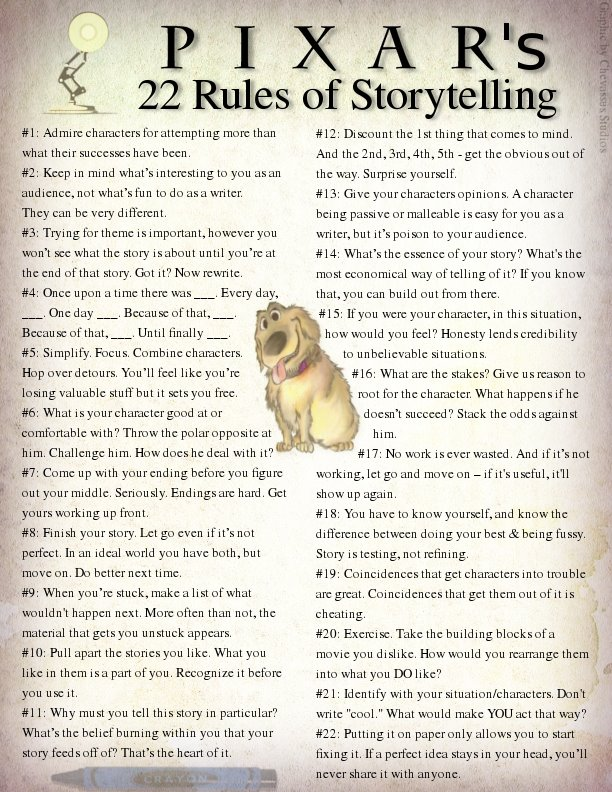
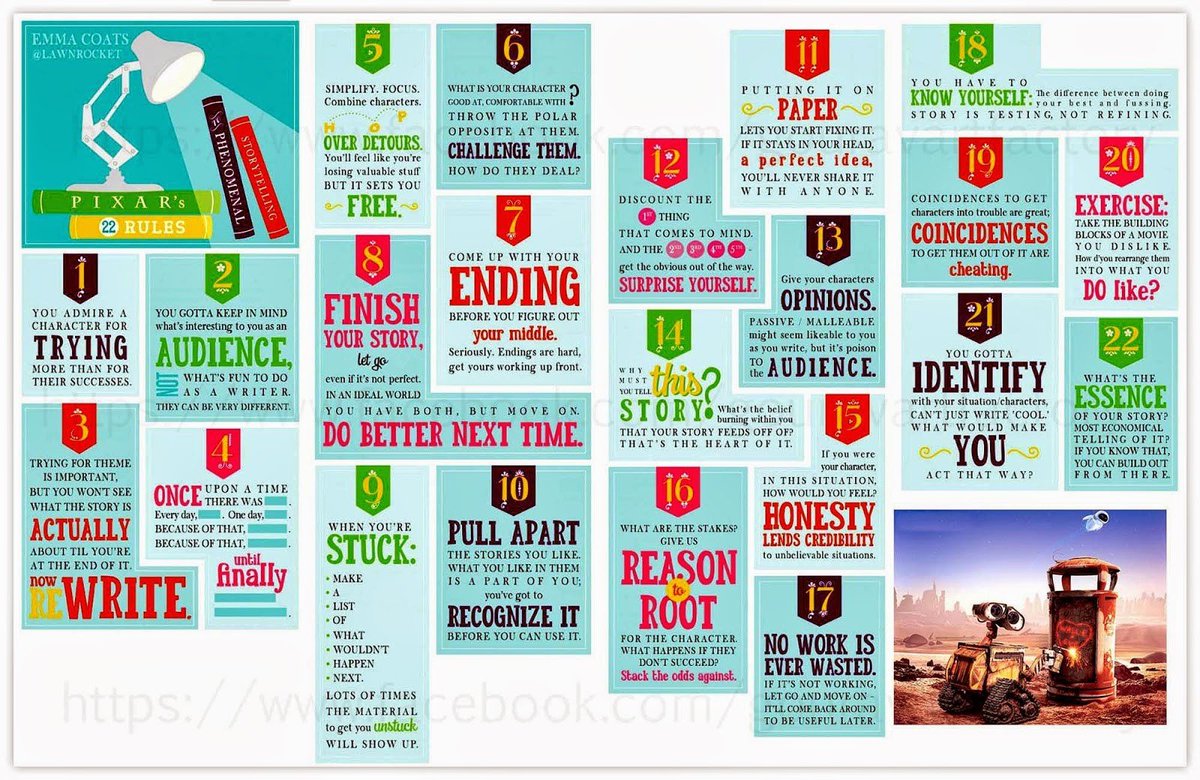
And here are some nice infographics with each of the rules for you to download:
29
All credit on these rules goes to @lawnrocket who wrote them all the way back in May, 2011.
You couldn’t even make Twitter threads back then!
Here’s the link to see all the originals:
x.com/search?q=from%…
You couldn’t even make Twitter threads back then!
Here’s the link to see all the originals:
x.com/search?q=from%…
