India’s rise will be messy. But inevitable.

Every Indian remembers how a few decades ago China was almost unanimously thought of as the “ripoff capital” of the world. We now know that China was just learning how to make things, and then how to make amazing things, then how to make them at an awe-inspiring scale. I started writing this piece mostly as a response to the recent spate of criticism about India and why India’s marketing is running far ahead of India’s product. As our coin rises, we should expect to be on the receiving end of a lot more. The reality is that if you weren’t in India in the 80s/90s/early 2000s, it will be hard to articulate what is so different about the country because everywhere you go, things still seem broken.
But another reality is that growing up, I remember trains that ran a full day late. I remember lines for everything: tickets, bills, the bank. Getting a phone in our house would take 1-2 years! Then I left, and stayed away for 15 years in the US and returned in 2018. Today, 8 years later, I forget my wallet at home for days and it doesn’t matter, because everyone takes UPI. I haven’t stood in a bank line in those 8 years. I’ve driven on pot-holed road in big cities but also on highways in the middle of nowhere that were world class. Most things digital, India feels far more convenient, far more advanced that most countries I’ve been to. So what’s wrong with our growth story? What are people seeing, criticizing, and what are they missing?

Walt Whitman, in Song of Myself:
Do I contradict myself?
Very well then I contradict myself,
(I am large, I contain multitudes.)
I can’t think of a better line for India. We set targets that are too big and too round. People game them. The outcomes lag the numbers, sometimes by years. And while things are way more jagged than they are uniform, I expect the country will keep getting richer, faster than almost anyone gives it credit for. India does things that are broadly right and specifically wrong. This is therefore as much a piece about how India has set and missed targets as it is about how a very large country actually gets things done, and why I’ve made my peace with it.
1: incentives drive outcomes
There’s an old story from Delhi under British rule. The administration had a cobra problem, so it put a bounty on dead cobras. People started breeding cobras to collect it. When the British caught on and scrapped the bounty, the breeders let their snakes go, and Delhi ended up with more cobras than before. This isn’t just India btw. In 1902, the French were having a massive rat infestation problem in occupied Vietnam so they started a bounty paid per rat tail. Within months the city was full of rats with no tails. Turns out people just caught the rats, clipped their tails, and let the rats go to breed more so they can get even more rats with more tails. Give people a target and they will hit it, one way or another. Incentives drive outcomes.
On Aug 31 India’s IT minister announced Semicon 2.0 and a target of 1 lakh more semiconductor engineers. In February of this year the ministry had the count at 67K and in August we hit 85K (which was the previous target) “achieved” in just 4yrs. So ~18K chip engineers showed up in six months in a country that has yet to make a chip.
I am a semiconductor engineer myself. I spent ~6 yrs at AMD learning what it takes to make one good chip, and before that spent several years just learning how to be a good chip engineer. It doesn’t happen in a semester or two and certainly not without you having been part of an end-to-end chip design at least once. If you set a headcount, you get a headcount: colleges will introduce and run the course, students will clear the exam, and 4yrs later, a number will go up. My guess is maybe a fifth of those 85K can actually close circuit timing on a real chip design. I’m not mocking the target. The world will be short ~1M chip workers by 2032 and India should absolutely be in this game. But you can see the shape of what happens next from a long way off.
2: the scorecard
It’s always easier to keep the letter of a promise than its spirit. Let's look at four of India’s biggest ones promises over the last 10yrs.
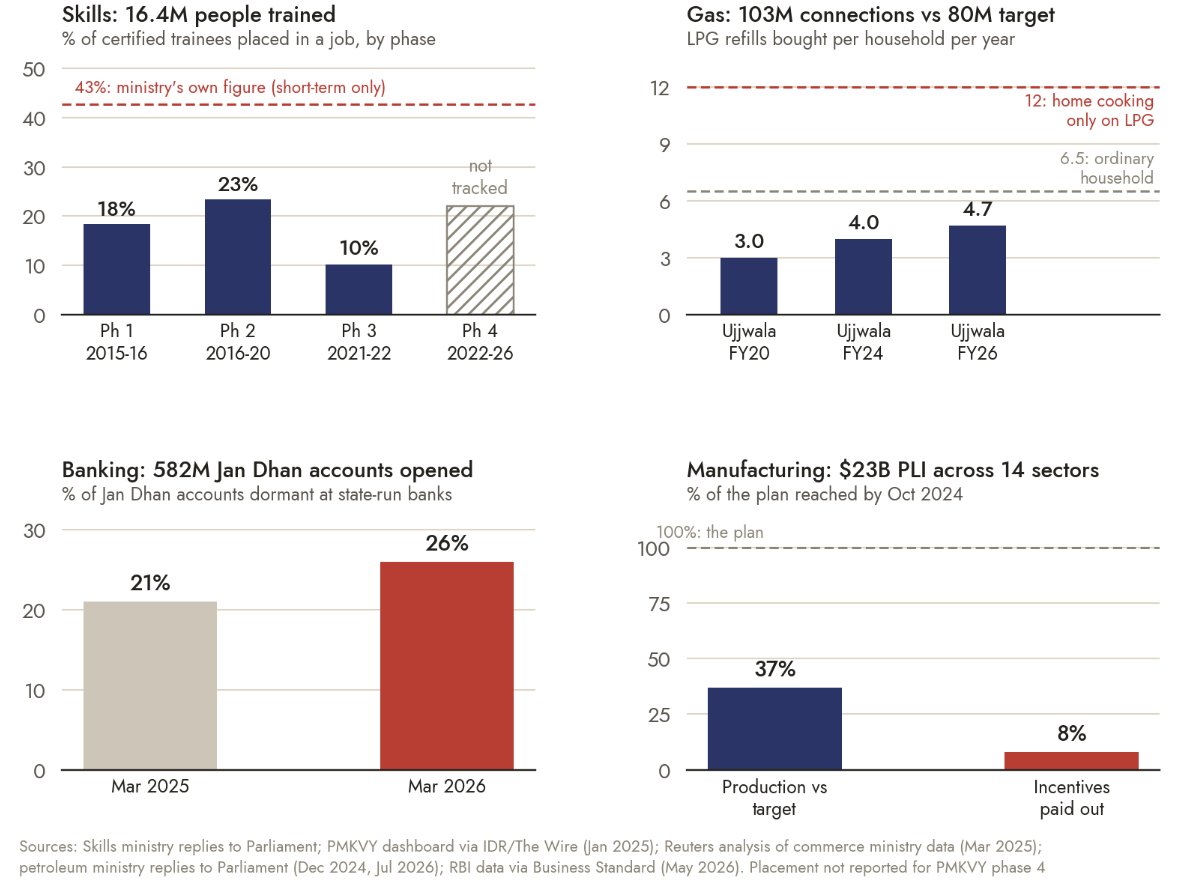
Skill India trained or “oriented” 16.4M people since 2015. Independent reads of the ministry’s own dashboard put placement at 18%, 23% and 10% across the first three phases. Phase 4 stopped tracking placement altogether. Ujjwala, a program to shift Indian households to LPG based cooking, ran into the same problem. 103M poor households got an LPG connection against a target of 80M. But just as a downloaded product doesn’t necessarily translate to an engaged user, an LPG connection isn’t necessarily a family actually cooking on gas. Ujjwala homes bought ~4.7 refills in FY26, vs ~6.5 for an ordinary household and ~10-12 for one that cooks exclusively on LPG. In July the govt cut subsidised refills from 9 to 4 a year, citing low usage. The data showing that the scheme was half working became the reason to shrink it.
Jan Dhan opened 582M bank accounts; ~26% of those at state-run banks are now dormant, up from ~21% a year ago. PLI, the $23B manufacturing push across 14 sectors, had reached 37% of its production target by late 2024 and paid out <8% of the money. Manufacturing’s share of GDP fell during the very scheme meant to take it to 25%. From the outside, all this would look like failure or, if you are being generous, only partial success.
3. Coda
There’s a law in our business that every VC learns the hard way: the power law. Most of your bets go to zero, a few return your money, and one returns the fund. You don’t get the big one without the zeroes. India’s scorecard looks a lot better once you read it like a portfolio instead of a report card.
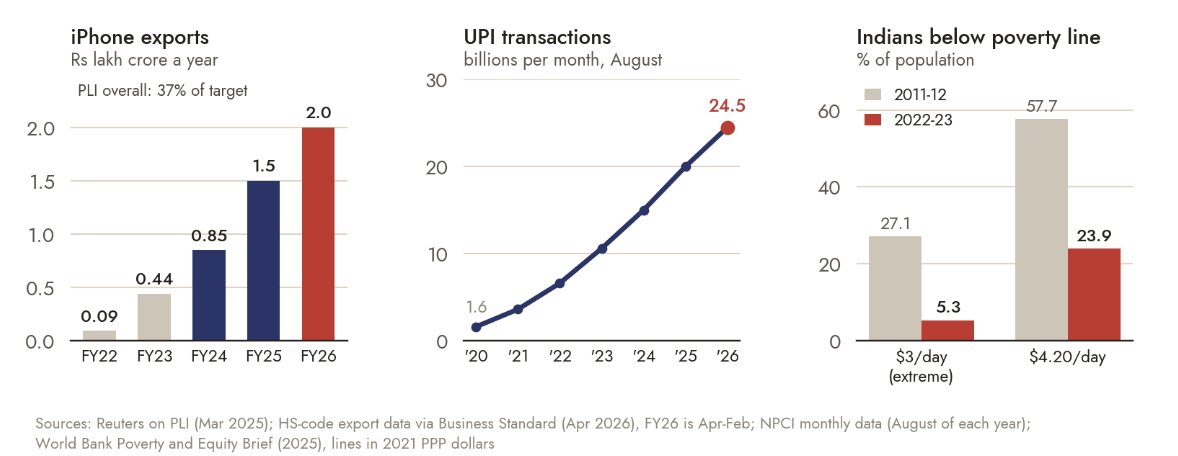
PLI missed in most of its 14 sectors and worked spectacularly in one. The same 582M Jan Dhan accounts, a quarter of them asleep, became the rails for direct cash transfers and for UPI. Ujjwala’s 4.7 refills aren’t 12, but they’re 4.7 more than zero, in homes that used to cook on wood and dung. The green shoots, if you know where to look:
Much of this ran through the same schemes I just spent a page complaining about.
Big countries build the same way and China is the best proof we know. Wuhan’s HSMC promised 7nm chips on a $19B plan, with a chairman who had no chip experience; it made nothing and was one of a dozen zombie fabs. But China also outspent the US ~3.6x on chip subsidies over the decade and came out with SMIC, YMTC, CXMT and an equipment base that is now world-class. Beijing couldn’t build like Singapore at 1.4B people, and neither can Delhi.
Goodhart told us that a measure that becomes a target stops being a good measure. Singapore can manage that risk. India cannot do what a Taiwan or a Singapore does. Delhi has to push intent through 28 states, ~780 districts and officers who rotate every couple of years, to a population ~240x Singapore’s. Most of the nuance falls off along the way. The only thing that survives the trip intact is a number. So we get numbers, and then the numbers get gamed.
India’s real skill is moving the target once people learn to game it.
85K becomes 1 lakh more. PMKVY 1.0 becomes 4.0. PLI becomes a Rs 40,000 cr components scheme aimed at what PLI missed. And yes, democracy at this size runs on round numbers. Nobody wins Bihar on “we improved process engineering competence”. You win it on 1 lakh engineers and 10 crore gas connections. That’s the price of keeping voters on board for a 20-yr bet.
Epilogue
On the night of Aug 14, 1947, Nehru told the Constituent Assembly that India would redeem its pledge “not wholly or in full measure, but very substantially.” It’s probably the best description of how India has worked ever since.
The British answer to the cobra problem was to scrap the bounty. India’s answer, over and over, is to keep the bounty and change what it pays for. So I don’t watch whether India hits its targets. It will. I watch whether the targets keep moving closer to outcomes: from engineers trained to wafers shipped, from connections to refills, from accounts opened to money actually moving.
The kid who once waited a full day for a late train now takes it for granted that trains and flights mostly run on time. Things are never perfect here, and they won’t be for a long time. Singapore will keep doing it the neat way, and that works for Singapore. India will stay messy for the next 20 yrs, missing in the details and hitting in aggregate, very substantially if not in full measure.
A few years ago I wrote that the next ten years are India’s to lose. I’d write it again today. Come home and build.