The Useful Idiot: A Natural History Specimen: Western, educated,...

Krzysztof Szczawinski 🇵🇱@Kristof_Poland
37 views
Oct 20, 2026
~4 min read
Advertisement
1
The Useful Idiot: A Natural History
Specimen: Western, educated, well-meaning.
Habitat: universities, NGOs, quality newspapers, dinner parties where the wine is good and the opinions are better.
Status: abundant.
The useful idiot is not exactly stupid. This is the first and most important thing to understand. Stupidity would be a defense. The more precise diagnosis is what we in Poland call pół-inteligent – the half-wit. Not the bottom of the intelligence distribution, which is too obviously lost to be useful. Not the genuine top, which tends to develop the inconvenient habit of following arguments wherever they actually lead. The sweet spot: smart enough to absorb a complex ideological framework, to deploy its vocabulary with confidence, to feel the social rewards of appearing sophisticated – but not quite sharp enough to interrogate the framework itself. Enough horsepower to run the program. Not enough to question who wrote it. The pół-inteligent is the useful idiot’s technical specification. And the specimen is typically convinced – this is crucial – that it is among the most independent thinkers in the room. The delusion is important. Remove it and the whole architecture collapses.
The species emerges in conditions of comfort and safety, which is why it proliferates in precisely the societies it works to undermine. It requires a baseline of security – enough that the consequences of being wrong about power remain abstract, theoretical, someone else’s problem. Eastern Europeans, who paid in flesh and decades for the privilege of understanding what the useful idiot enables, are able to see this as naivety so profound it becomes a moral failure. Not innocence. Culpable ignorance dressed as virtue.
Observe the specimen in its natural habitat. It discovers The Cause sometime between the ages of 18 and 24, usually at an institution of higher education, usually through social contagion rather than solitary reasoning. The Cause varies by generation – Soviet sympathies, third-worldism, postcolonial theory, current-year identity grievance – but the structure is invariant: a clean division of the world into oppressors and oppressed, a designated villain class, and a role for the specimen as enlightened ally. The emotional reward is immediate and substantial. Belonging. The claim of moral clarity. The warm superiority of the awake among the sleeping.
What the specimen does not perceive – what it is structurally prevented from perceiving – is that it is being used. Lenin coined the phrase, and he meant it with cold precision. The useful idiot is not a partner in the project. It is infrastructure. It provides legitimacy laundering: translating raw power-seeking into the language of justice, making the predatory appear compassionate, and doing so with enough genuine conviction to be convincing. The cynics who run the operation cannot do this themselves – cynicism is legible. True believers are required. The useful idiot’s sincerity is its primary value to those who deploy them. And so Lenin used them – and so does Islam now.
The specimen’s lifecycle has a melancholy third act that it rarely anticipates. When the project advances far enough – when the institutions are captured, when the Overton window has moved sufficiently – the useful idiot becomes inconvenient. It knows too much about the earlier, more honest phase. It has friendships across the new fault lines. It retains, sometimes, inconvenient principles from when principles were the point. The revolution, as it industrializes, prefers newer models: fully formed apparatchiks with no memory of idealism to complicate their loyalty. The useful idiot is retired, marginalized, occasionally denounced by the very movement it spent decades building. It dies puzzled. It never quite understands what happened.
We've all seen the very surprised lady in Paris...
History is littered with these figures. Western intellectuals who defended the Soviet project through the show trials, the Holodomor, the Gulag – and who spent the rest of their lives in various stages of retrospective rationalization. Fellow travelers who called Solidarity troublemakers, who thought the dissidents were exaggerating, who trusted the official version over the testimony of people who had lived it. Their names are recorded. Their counterparts today are producing content, signing letters, and occupying endowed chairs.
The useful idiot is not the enemy. It is the weapon. Understanding the difference matters – because the weapon can, in principle, be disarmed. It requires only one thing: contact with reality at sufficient intensity and duration to override the social rewards of the delusion. This happens. Some recover. Eastern European experience – the unignorable, undeniable, lived reality of what the project actually produces – has cured more than a few.
The cure is not pleasant. It requires admitting that one’s most cherished moral identity was constructed by people who found it useful. That the independence one prided oneself on was curated. That the dinner party consensus was not wisdom but a lie. Most cannot make this admission. The identity investment is too great. They double down instead – find new framings, new rationalisations, new ways to explain why this time is different, why the critics are the real problem.
They remain, to the end, useful.
Krzysztof Szczawinski 🇵🇱@Kristof_Poland
The look of someone discovering reality.
This young woman stood in front of a smashed shop window in Paris last night and said the smashing and looting are not what the cause is about. She still believes the people who broke the glass share her cause. They don’t. They have their own.
This is not how she imagined it. It has a name: cognitive dissonance – the pain of watching reality contradict what you were told to believe.
She learned it last night, in pain. Millions of others will learn it in the coming months – the same way. Because reality doesn’t need the media. It comes through the window.
We were right all along.👇🏻
And they were wrong.
So will they admit it now, and let go of their delusions? Or will they double down?
In 1954, an American psychologist infiltrated a small cult that had predicted the end of the world on a precise date. The date came. Nothing happened. Did the believers give up? The most committed did the opposite: they started preaching harder than ever.
That is what most true believers will do. Admitting the error would cost them their friends, their careers and their image of themselves. So they will blame the police, the "far right," the economy, the weather – anything but the idea.
For them to change their minds, their whole system will have to collapse – the salaries, the institutions, the friends who all think alike. Belief survives as long as the group survives. We have seen it before: in 1989, when the system fell, Poland’s communists woke up one morning as social democrats – and a good number of them as businessmen.
But the believers are not the audience. The people watching are. Reality rarely converts the priests. It converts the congregation – one broken window at a time.
And yesterday was much more than a broken window. A day like that must have opened the eyes of millions. Events like that change history.
The priests will keep preaching. The congregation has already started to leave.
2
Krzysztof Szczawinski 🇵🇱@Kristof_Poland
Yuri Bezmenov – The Long March in Four Stages.
In 1984, a former Soviet KGB propagandist sat in front of a camera in Los Angeles and explained how to destroy a country without firing a shot: by sowing demoralization and unrest, using its own local socialists, useful idiots and the like. Most people laughed. Today the clip goes viral every other week.
1. Born in 1939 near Moscow, the son of a Soviet army officer. He studied Indian languages and joined the Novosti press agency – in his account, a front for the KGB. Posted to India, his job was deception and subversion: handle foreign journalists and intellectuals, show them what they were supposed to see, and shape what they wrote home.
2. In 1970 he defected – disguised as a hippie, slipping out of India with a group of Western travelers. He settled in Canada under a new name and worked in radio. In 1984 he gave the interview that made him famous.
3. His core claim: espionage is the small part. The big part is subversion – and it works through demoralization: changing a society’s perception of reality so that, despite an abundance of information, nobody can reach sensible conclusions in defense of themselves, their family or their country. And it isn’t carried out by spies. It is carried out by the country’s own people – local socialists, useful idiots and the like: professors, teachers, journalists, entertainers, activists, most of whom have no idea whose work they are doing.
4. Stage one: demoralization. It takes fifteen to twenty years – the time needed to educate one generation. The targets are the schools, the universities, the media, the churches, the culture: Gramsci’s institutions. The result is a person who can no longer process facts. Show him the evidence, and he refuses to believe it.
5. Stage two: destabilization – a few years of sowing unrest in the economy, the defense, the institutions and the streets. Stage three: crisis – a few weeks of breakdown, after which a new power arrives promising salvation.
6. Stage four: normalization. Central Europe knows that word. After Soviet tanks crushed the Prague Spring in 1968, Moscow called the occupation "normalization." Poland lived its own version after martial law. The abnormal, declared normal. And the useful idiots who helped the revolution? Bezmenov said they would be the first to be discarded once it won. The revolution devours its own.
7. Not every number he gave can be verified – he was a dramatic witness. But the mechanism holds. And there is one thing he missed. The Soviet Union died in 1991. The demoralization didn’t. It no longer needs the KGB. It runs on its own fuel now – grants, careers, NGOs, prizes. Münzenberg’s machine outlived him; so did Moscow’s.
In 2020 his interview opened a Call of Duty trailer. A new generation met him through a video game – and recognized its own world.
The interview is linked below. If you haven’t watched it, you have to.
Poles lived stage four. The West has been living stage one for half a century.
Demoralization takes a generation. So does the cure. It starts at the kitchen table: tell the truth, teach the children, have courage and refuse to call the abnormal normal.

3
Krzysztof Szczawinski 🇵🇱@Kristof_Poland
It's the Civilization, stupid.
And France has lost its own.
That young woman in Paris thought she and the people breaking the windows stood for the same thing. Politically, maybe. Ideologically, even, to a degree. Civilizationally – not at all. And civilization is the basis of everything else.
A Polish historian, Feliks Koneczny, put it in one sentence: you cannot be civilized in two ways at once. Two people can share a slogan and still live by opposite rules – about property, about law, about violence, about what you owe a stranger. There can be no stable common ground between them. Only a temporary alliance against a common enemy, which ends the moment the windows break.
France has lost its civilizational values. Or rather, it has lost the ability to state them.
Because saying things openly and plainly was never part of the French way and values. Rhetoric is. The French absorb their rules of civilized life from childhood – the manners, the codes, the unwritten "ça ne se fait pas" – without ever spelling them out. Among themselves, it works. With foreign populations, it fails. You cannot explain a code you have never put into words. You cannot transmit what you cannot say. The rhetoric doesn’t work if you haven’t absorbed it first.
And the government that should defend the French way of life now belongs to another civilization itself – however French it looks. The civilization of mental communism: managers, procedures, slogans. It has no instinct to defend a way of life. Only the instinct to administer it.
You can integrate people into a civilization, possibly. But you have to be able to state the rules clearly.
That is the advantage of plain-spoken cultures: what you can say, you can teach. And what you can teach, you can pass on.
It's the civilization, stupid.

4
5
Krzysztof Szczawinski 🇵🇱@Kristof_Poland
Queen Margot – a wonderful film for understanding who the French once were: amoral, aggressive, hot-headed, violent, treacherous, fanatical, vengeful, murderous, vain debauchees…
No wonder that now that the pendulum has swung the other way, they've become meek lambs to the slaughter.
But the pendulum didn't swing by itself.
On St. Bartholomew's night, Catholics butchered thousands of Protestants – in Paris first, then across France – neighbors killing neighbors, with the king's blessing. From that blood, France drew its fatal lesson: that only an absolute, undivided power could stop a civil war. Margot's husband, Henri IV, changed his religion for Paris. Richelieu broke the nobles. Louis XIV locked them in Versailles, competing for his attention. The Jacobins and Napoleon finished the job. Every regime sold the same bargain: give us your violence, and we'll give you peace.
The French bought it. They didn't become gentle – they handed their violence over to the State, and with it the right to decide anything. Then 1914–1918 bled them white, 1940 humiliated them, and the reflex became instinct: when things get dangerous, hand over more.
So the lamb is not the opposite of the murderer. It is his heir – the same man, who outsourced his violence and forgot that a contract can be terminated. The knife never left the room. He just no longer holds it.
Now contrast that with Polish culture – measured then, measured now.
Reasonable about the way to live.
Poland drew the opposite lesson from the same massacre. A few months later, Polish nobles of every faith signed a pact: no one would be persecuted for religion. Not out of indifference – out of good sense. They had looked at France and decided they would not live like that.
Then they elected a king – and picked Margot's brother, Henri of Anjou, one of the men behind St. Bartholomew's night. But before he could wear the crown, he had to swear to their conditions: religious peace, no new taxes without their consent, and – the best clause – the right of the nobles to refuse obedience if the king broke his word. Where France handed over everything, Poland signed a contract, with the termination clause written in.
In the film you can see the Polish nobles, appalled by the young king’s ways. They had reason. Henri, for his part, found Poland boring – as he did not understand its depth... No poisons, no intrigues, no stabbings in the corridors – just long debates and people who meant what they said. He lasted a few months. When his brother died, he fled Kraków at night to grab the French crown.
He mistook depth for boredom. The oldest French mistake: to think that a life without drama is a life without meaning.
Poland was measured then and is measured now. It never swung from murder to meekness, because it never needed to – its peace didn't come from a knife, held by anyone. It came from moral strength. The French traded the knife for a master. The Poles never needed either. A people that can restrain itself needs no shepherd. Moral strength and clarity allow us not to use the knife. That is harder than being either the murderer or the lamb.

6
Krzysztof Szczawinski 🇵🇱@Kristof_Poland
Why We Know Better 🇵🇱
We, the Poles. Not because we are smarter. Because we remember.
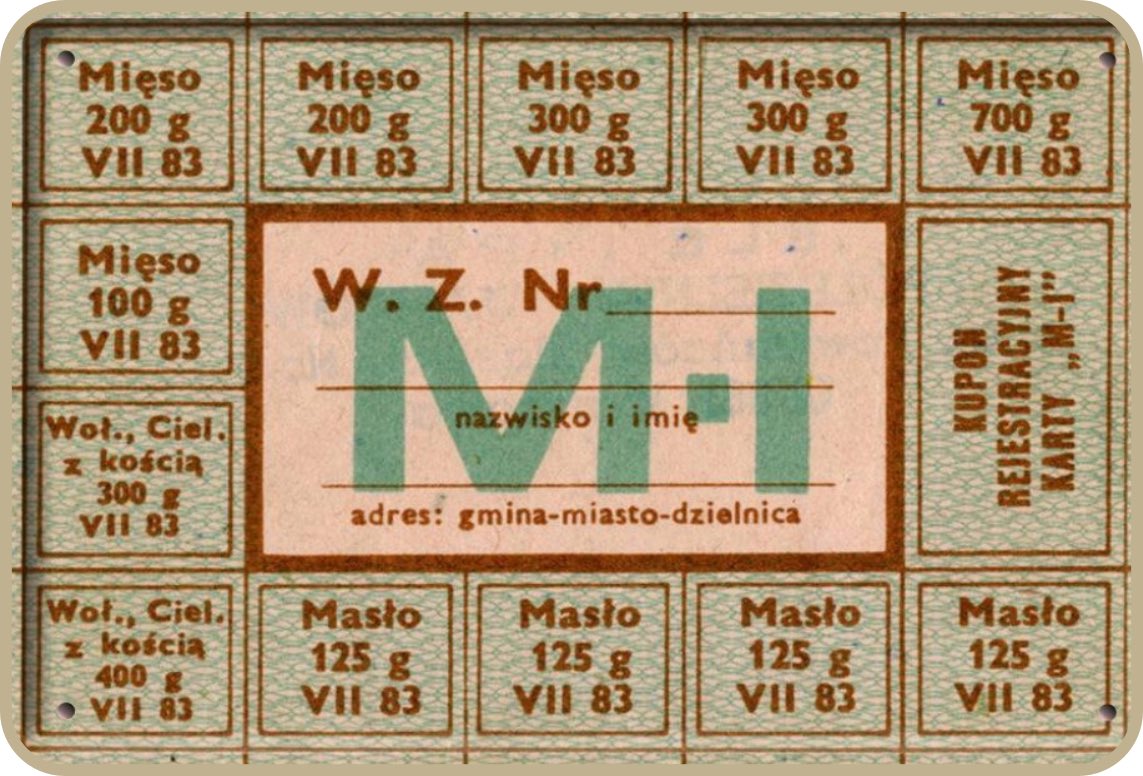
Our grandparents were shot, deported or starved for being on the wrong list, in the wrong city, on the wrong side of a border someone else drew. Our parents queued for meat with ration cards like this one – a month of meat counted in grams, with their name and address on it. They woke up one December morning to tanks in the streets. I saw those tanks as a kid. In the West, communism is an argument. In Poland, it is a family story.
So we know what getting it wrong costs. Not as a theory. As poverty. As a knock on the door.
People who have been comfortable for generations just don’t understand this. Young people who have never struggled can’t imagine it – and don’t have the tools to understand it on a systemic level. And we understand why they don’t understand it: they have never seen the bill.
Our memory comes with fear, and fear is not all good. People here are still afraid – of poverty, of standing out, of falling out of the system. And when the system runs on lies, fear is exactly what keeps it running. The old one lasted forty-five years that way. Parts of it still do.
But at least we KNOW better. We can see the mechanisms. And we think about it way more.
Then let’s be frank about the second reason: Poland is one of the most homogeneous countries in Europe. One language, one history, the same books read at school, the same songs, the same wounds. The same set of references means every conversation starts further – and it goes much further faster.
Add the Polish habit of frankness. We don’t do small talk. We go deep instead. That is training.
But depth has a trap. You can go very deep into your own story and miss the rest of the world. A well is deep too.
That is why the Polish lens needs a second pair of eyes. Millions of Poles worked abroad after 2004, and many came back with one. In my case, two.
Paris. Years in the French elite schools that train the people who run France and much of Europe. That is where I learned where the ideas come from, how the administrative machine thinks, and the language it uses to hide what it does. The genealogy.
London. Twelve years, much of it in the financial markets, where you are right or wrong and the price tells you which by the end of the day. The test. And the lesson that Anglo common sense underestimates ideology: it assumes bad ideas lose arguments. We know they can also win elections and build camps.
Polish to detect, French to explain, Anglo to test. 🇵🇱🇫🇷🇬🇧
The evidence still gets the last word. But we have an advantage in reading it: we have already paid for getting it wrong – for our own mistakes, and for other people’s.
Knowledge is what remains after the bill is paid. We paid.
Once, Poland defended the West with winged hussars. Today knowing is both the armor and the weapon.