AI Co-Pilot for Traders: 10 Questions to Answer Before Every Trade

Use Claude or GPT as a pre-trade checklist, not as a source of buy and sell calls. In a simulated year of 250 trade ideas, a ten-question checklist moved the average result from −3.9R to +3.0R and cut the median worst drawdown from 21.8R to 15.2R. The numbers come from my model with assumed inputs, not from real traders.
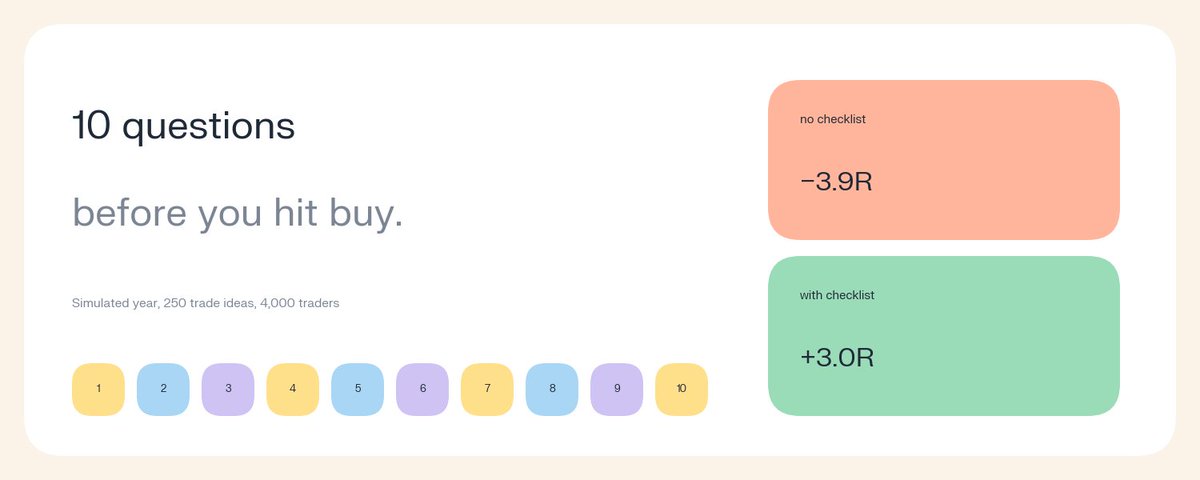
This guide covers the problem, the ten questions and why each one is there, a working AI prompt, a worked example, the simulation results, and the limits.

1. The Problem
Most avoidable losses come from trades that were never in the plan. They appear after a loss, a headline or boredom, and they usually carry a larger position than usual.
The model splits a trader's ideas into two types:
R is the amount you risk on a normal trade. Over 250 ideas, this mix averages −3.9R a year, and only 41% of simulated years end in profit. The planned trades are barely profitable on their own, so a single stream of impulsive ones is enough to turn the year negative.

2. The Ten Questions
Answer in order before every order, and write one line per answer. The right-hand note explains what each question is meant to catch.
| # | Question | What it catches |
|---|---|---|
| 1 | What is the setup, in one sentence, and is it in my written plan? | Trades with no plan behind them |
| 2 | What price or event proves me wrong? | Entries with no exit idea |
| 3 | If I am stopped out, how many dollars do I lose, and what share of the account is that? | Losses larger than you can accept |
| 4 | Is the size calculated from the stop distance, not from my confidence? | Oversized positions on "sure things" |
| 5 | What happened in my last three trades? Am I trying to win a loss back or chasing a win? | Revenge trades and overconfidence |
| 6 | Is there earnings, a data release or news inside my holding period? | Surprise gaps |
| 7 | Are spread, fees and slippage small compared with the move I expect? | Trades that cost more than they can earn |
| 8 | What do I already hold that moves with this trade? | Hidden duplicate risk |
| 9 | Would I take this trade if I were rested, calm and had just opened the screen? | Trading while tired, angry or bored |
| 10 | What are my target, stop and time limit, written before I enter? | Moving the goalposts after entry |
Questions 1 to 4 define the trade. Questions 5 and 9 check you. Questions 6 to 8 check the environment. Question 10 locks the exit before emotion can change it.
3. The AI Setup
The assistant asks questions and checks your answers against your rules. It never gives a buy or sell opinion. Paste this into a new chat:
You are my pre-trade co-pilot. Never tell me to buy or sell.
Ask me these ten questions one at a time and wait for each answer:
setup, invalidation, loss in dollars, position size from the stop,
my last three trades, scheduled events, costs, overlap with my
positions, my emotional state, my exit plan.
If an answer is vague, ask again. If any answer breaks my rules
(risk above 1% of the account, no stop, size set by confidence),
say "BLOCK" and name the rule. Otherwise finish with a one-line
summary of the trade and "PASS".
My rules: max risk per trade 1% of account, stop required,
no new trade within 30 minutes after a loss.
Two limits apply:
Change the rules block to match your own plan. Keep it to three or four rules. A long list of rules gets ignored, by you and by the model.
4. A Worked Example
Say your account is $10,000 and your rule is 1% risk per trade, so you can lose $100. A stock trades at $50, your setup says the idea is wrong below $47.50, and the stop distance is $2.50.
The size follows from the stop: $100 divided by $2.50 gives 40 shares. That is $2,000 of stock, 20% of the account, and still only a $100 risk. This is the answer to question 4. If you had wanted 100 shares because you feel sure, the co-pilot says BLOCK: that would risk $250, which is 2.5% of the account.
A short exchange looks like this:
The assistant did not judge the stock. It caught the state you were in, which is the point.
5. Results
The checklist blocks some impulsive ideas and, by mistake, some good ones. Each scenario below uses 4,000 simulated traders.
| Scenario | Blocks impulsive / planned | Net result | Profitable years | Median worst drawdown | Trades |
|---|---|---|---|---|---|
| No checklist | 0% / 0% | −3.9R | 41% | 21.8R | 250 |
| Moderate | 60% / 10% | +3.0R | 58% | 15.2R | 188 |
| Strict | 80% / 15% | +5.1R | 65% | 12.8R | 164 |
Nearly all of the improvement comes from trades that were not taken. The trader in the moderate scenario placed 62 fewer orders and ended the year 6.9R better.

6. Limits and Common Mistakes
What the model cannot tell you:
Mistakes that make it useless in practice:


