(Warning: Long post about Israel. Possible slow-motion crash out....

Robert Sterling@RobertMSterling
24 views
Oct 09, 2026
~6 min read
Advertisement
1
(Warning: Long post about Israel. Possible slow-motion crash out. Might want to skip this one.)
This statement from @NYCMayor is evil.
There’s no other way to describe it. “Despicable” isn’t nearly strong enough; “lamentable” implies that it’s something over which we might feel sorrow, rather than the outrage it demands.
“Evil” is the only word for it. Deeply, profoundly evil. Perhaps the most vile statement a prominent US elected official has ever released.
On the third anniversary of the worst loss of Jewish life since the Holocaust, Mayor Mamdani—leader of the city with the world’s largest Jewish population outside of Tel Aviv—has released a statement that minimizes the attacks, ignores the severity and depravity of Hamas’s crimes, and—in a manner with just enough skillful subtlety to provide necessary levels of plausible deniability—inverts the day’s attackers and victims, even obliquely blaming the victims themselves. A statement that references the attacks’ perpetrators, Hamas, but once, and the attacks’ target, the Jews of Israel, not at all.
Let me repeat that: The mayor of a city with nearly one million Jews spread across its five boroughs can’t find it within himself to use the word “Jew” on the anniversary of the worst loss of Jewish life since the genocide of Nazi Germany.
Mamdani dedicates one—and only one—paragraph in his statement to the attacks themselves. One perfunctory, halfhearted paragraph; a token gesture of mourning that conveniently omits the savagery of Hamas’s crimes, the widespread sexual violence of the day, the glee with which terrorists butchered young and old alike, and the deplorable conditions in which 251 innocent victims of kidnapping were kept in subterranean tunnels in Gaza.
One paragraph. That’s all. And, with that out of the way, with that box conveniently checked, Mamdani is able to get to his real aim: Condemning Israel.
And this he does with detail and gusto, without pause, reservation, or equivocation.
The entire second paragraph is worth reviewing line by line, for it is rich in subtle but deliberate manipulation.
Sentence 1: “The suffering did not begin or end that day.”
This is the classic Marxist rhetorical tactic of “contextualizing,” in which any actions that might reflect poorly on The Cause (e.g., the mass rape, murder, and kidnapping of innocent Israeli civilians) are positioned in the context of information meant to mitigate their severity, deflect blame, and shift responsibility from the victim to the offender.
In this case, Mamdani wants the reader to subconsciously think that Hamas’s acts of terrorism can only be viewed in the context of Israel’s historical and ongoing oppression of Palestine (hence “did not begin…that day”). And, with that context established, how could anyone hold Hamas at fault? After all, they didn’t start this war; they were only responding to “suffering [that] did not begin…that day.” If anything, it’s Israel that’s at fault, right?
If this sounds like reversing the victim and the offender—the RVO in the DARVO acronym used to describe the gaslighting of domestic violence victims—it’s because it is. It’s subversive, it’s diabolical, and it’s only the first sentence of the paragraph.
Let’s keep going.
Sentence 2: “It instead continued through the Israeli government’s devastating, ongoing genocide in Gaza…”
Hamas’s terrorism was not a de novo act, occurring without cause or justification; rather, it was merely the “ongoing” continuation of a long chain of “suffering” whose origin and fault lie with the state of Israel.
Also, note the choice of the words “devastating” and “genocide” and compare them to Mamdani’s first paragraph. He is condemning Israel’s response to the attacks with language far more forceful than that used to decry the attacks themselves.
Sentence 2, continued: “…in which it has killed more than 74,000 Palestinians—including more than 21,000 children.”
This is additional contextualization. The reader is directed to compare 74,000 dead Palestinians with the aforementioned 1,100 Israelis and come away with the interpretation that Israel is orders of magnitude more violent than Hamas. Note that Mamdani also includes a body count for Palestinian children but not for Israeli children.
Left unsaid, of course, is the proportion of those 74,000 dead Palestinians who were active Hamas fighters. Or whom Hamas was using as human shields. Or who were—unfortunately—collateral damage from being in the vicinity of the Israeli military’s justified airstrikes on Hamas fighters who deliberately intersperse themselves among the civilian populace of Gaza.
Sentence 3: “Even since the so-called ceasefire, more than 1,400 Palestinians have been killed.”
This is more contextualizing. The implicit message is that Israel has killed more Palestinians “since the so-called ceasefire” than Hamas killed in total. Israel’s response must therefore clearly be disproportionate.
Sentence 4: “That suffering has intensified with every Israeli bomb dropped on ambulances waiting outside hospitals, every drone strike targeting a residential building or journalist, and every shipment of food aid turned away at a border crossing.”
Setting aside factual errors and omissions of relevant context (ironic, given all the false contextualizing elsewhere!), note the specificity with which Mamdani condemns Israel. Israel’s response to October 7 warrants vivid detail—its bombs fall on ambulances, its drone strikes target residential buildings and journalists, its soldiers turn away food shipments—while the details of Hamas’s attacks on October 7 are described with…
Nothing.
No mention of the murders. The rapes. The desecration of bodies. The smiles on the terrorists’ faces; their laughter while livestreaming the carnage on social media and while calling their own parents.
Not one word.
When Israel responds to terrorism, graphic details are called for; when Hamas commits the underlying acts of terrorism in the first place, though, it warrants only a cursory mention in the introduction to the statement, no details necessary.
Sentence 5: “Many New Yorkers are reckoning with this unbearable grief, and we mourn alongside them – all while knowing that our tax dollars fund these war crimes.”
Note the similarities in language between this sentence and the final sentence of the first paragraph. The reader is meant to draw parallels between Israel’s dead civilians and Hamas’s dead fighters. The parallel language is meant to convey a false moral equivalence between the two.
Also note the reference to “our tax dollars”: You paid for this. You are morally complicit. Therefore, if you object to the mayor’s statement, you are just trying to willfully ignore your own guilt. How dare you.
The last two paragraphs (yes, he keeps going) are more of the same. More moral equivocation, more inversion of responsibility, more criticism of Israel. The word “apartheid” is thrown in for good measure, of course, because no statement on the anniversary of the worst day in modern Israel’s history would be complete without undermining the nation’s very existence.
Every word of this is shameful, every sentence detestable, every paragraph overflowing with covert lies and overt moral cowardice.
But we should expect nothing less of Zohran Mamdani, a man whose only talent is the ongoing profanation of an office he doesn’t deserve, in a great city he will slowly—or maybe not so slowly—destroy.
This statement—and the man behind it—are worthy of nothing but our scorn and should warrant nothing but our contempt.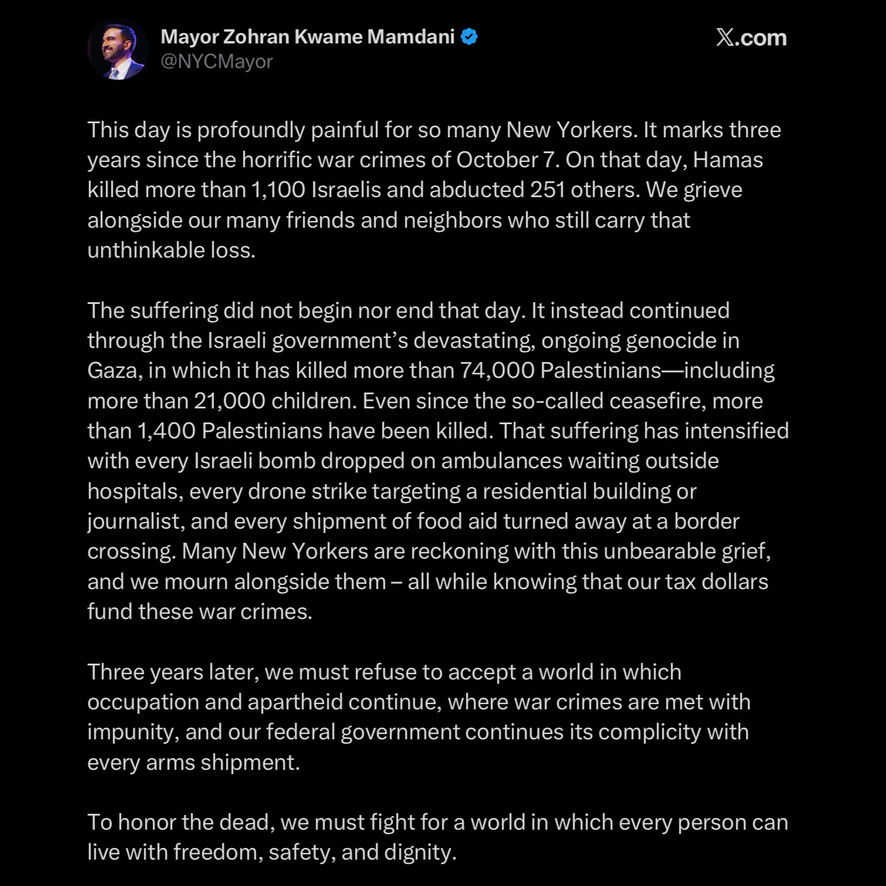
This statement from @NYCMayor is evil.
There’s no other way to describe it. “Despicable” isn’t nearly strong enough; “lamentable” implies that it’s something over which we might feel sorrow, rather than the outrage it demands.
“Evil” is the only word for it. Deeply, profoundly evil. Perhaps the most vile statement a prominent US elected official has ever released.
On the third anniversary of the worst loss of Jewish life since the Holocaust, Mayor Mamdani—leader of the city with the world’s largest Jewish population outside of Tel Aviv—has released a statement that minimizes the attacks, ignores the severity and depravity of Hamas’s crimes, and—in a manner with just enough skillful subtlety to provide necessary levels of plausible deniability—inverts the day’s attackers and victims, even obliquely blaming the victims themselves. A statement that references the attacks’ perpetrators, Hamas, but once, and the attacks’ target, the Jews of Israel, not at all.
Let me repeat that: The mayor of a city with nearly one million Jews spread across its five boroughs can’t find it within himself to use the word “Jew” on the anniversary of the worst loss of Jewish life since the genocide of Nazi Germany.
Mamdani dedicates one—and only one—paragraph in his statement to the attacks themselves. One perfunctory, halfhearted paragraph; a token gesture of mourning that conveniently omits the savagery of Hamas’s crimes, the widespread sexual violence of the day, the glee with which terrorists butchered young and old alike, and the deplorable conditions in which 251 innocent victims of kidnapping were kept in subterranean tunnels in Gaza.
One paragraph. That’s all. And, with that out of the way, with that box conveniently checked, Mamdani is able to get to his real aim: Condemning Israel.
And this he does with detail and gusto, without pause, reservation, or equivocation.
The entire second paragraph is worth reviewing line by line, for it is rich in subtle but deliberate manipulation.
Sentence 1: “The suffering did not begin or end that day.”
This is the classic Marxist rhetorical tactic of “contextualizing,” in which any actions that might reflect poorly on The Cause (e.g., the mass rape, murder, and kidnapping of innocent Israeli civilians) are positioned in the context of information meant to mitigate their severity, deflect blame, and shift responsibility from the victim to the offender.
In this case, Mamdani wants the reader to subconsciously think that Hamas’s acts of terrorism can only be viewed in the context of Israel’s historical and ongoing oppression of Palestine (hence “did not begin…that day”). And, with that context established, how could anyone hold Hamas at fault? After all, they didn’t start this war; they were only responding to “suffering [that] did not begin…that day.” If anything, it’s Israel that’s at fault, right?
If this sounds like reversing the victim and the offender—the RVO in the DARVO acronym used to describe the gaslighting of domestic violence victims—it’s because it is. It’s subversive, it’s diabolical, and it’s only the first sentence of the paragraph.
Let’s keep going.
Sentence 2: “It instead continued through the Israeli government’s devastating, ongoing genocide in Gaza…”
Hamas’s terrorism was not a de novo act, occurring without cause or justification; rather, it was merely the “ongoing” continuation of a long chain of “suffering” whose origin and fault lie with the state of Israel.
Also, note the choice of the words “devastating” and “genocide” and compare them to Mamdani’s first paragraph. He is condemning Israel’s response to the attacks with language far more forceful than that used to decry the attacks themselves.
Sentence 2, continued: “…in which it has killed more than 74,000 Palestinians—including more than 21,000 children.”
This is additional contextualization. The reader is directed to compare 74,000 dead Palestinians with the aforementioned 1,100 Israelis and come away with the interpretation that Israel is orders of magnitude more violent than Hamas. Note that Mamdani also includes a body count for Palestinian children but not for Israeli children.
Left unsaid, of course, is the proportion of those 74,000 dead Palestinians who were active Hamas fighters. Or whom Hamas was using as human shields. Or who were—unfortunately—collateral damage from being in the vicinity of the Israeli military’s justified airstrikes on Hamas fighters who deliberately intersperse themselves among the civilian populace of Gaza.
Sentence 3: “Even since the so-called ceasefire, more than 1,400 Palestinians have been killed.”
This is more contextualizing. The implicit message is that Israel has killed more Palestinians “since the so-called ceasefire” than Hamas killed in total. Israel’s response must therefore clearly be disproportionate.
Sentence 4: “That suffering has intensified with every Israeli bomb dropped on ambulances waiting outside hospitals, every drone strike targeting a residential building or journalist, and every shipment of food aid turned away at a border crossing.”
Setting aside factual errors and omissions of relevant context (ironic, given all the false contextualizing elsewhere!), note the specificity with which Mamdani condemns Israel. Israel’s response to October 7 warrants vivid detail—its bombs fall on ambulances, its drone strikes target residential buildings and journalists, its soldiers turn away food shipments—while the details of Hamas’s attacks on October 7 are described with…
Nothing.
No mention of the murders. The rapes. The desecration of bodies. The smiles on the terrorists’ faces; their laughter while livestreaming the carnage on social media and while calling their own parents.
Not one word.
When Israel responds to terrorism, graphic details are called for; when Hamas commits the underlying acts of terrorism in the first place, though, it warrants only a cursory mention in the introduction to the statement, no details necessary.
Sentence 5: “Many New Yorkers are reckoning with this unbearable grief, and we mourn alongside them – all while knowing that our tax dollars fund these war crimes.”
Note the similarities in language between this sentence and the final sentence of the first paragraph. The reader is meant to draw parallels between Israel’s dead civilians and Hamas’s dead fighters. The parallel language is meant to convey a false moral equivalence between the two.
Also note the reference to “our tax dollars”: You paid for this. You are morally complicit. Therefore, if you object to the mayor’s statement, you are just trying to willfully ignore your own guilt. How dare you.
The last two paragraphs (yes, he keeps going) are more of the same. More moral equivocation, more inversion of responsibility, more criticism of Israel. The word “apartheid” is thrown in for good measure, of course, because no statement on the anniversary of the worst day in modern Israel’s history would be complete without undermining the nation’s very existence.
Every word of this is shameful, every sentence detestable, every paragraph overflowing with covert lies and overt moral cowardice.
But we should expect nothing less of Zohran Mamdani, a man whose only talent is the ongoing profanation of an office he doesn’t deserve, in a great city he will slowly—or maybe not so slowly—destroy.
This statement—and the man behind it—are worthy of nothing but our scorn and should warrant nothing but our contempt.