Generalist: Toward Physical AGI

I’ve been following several robotics AI companies lately, and Generalist is one of the companies I’m watching most closely. It doesn’t build humanoids, and it isn’t known for flashy demo videos. The reason it caught my attention is simple: it was the first company to demonstrate scaling laws in robotics quantitatively, and every announcement since has shown steady progress in the same direction. In this article, I’ll look at who the founders are, the problems that led them to start the company, and how the progression from GEN-0 to GEN-1 to GEN-1.5 is putting their vision to the test.

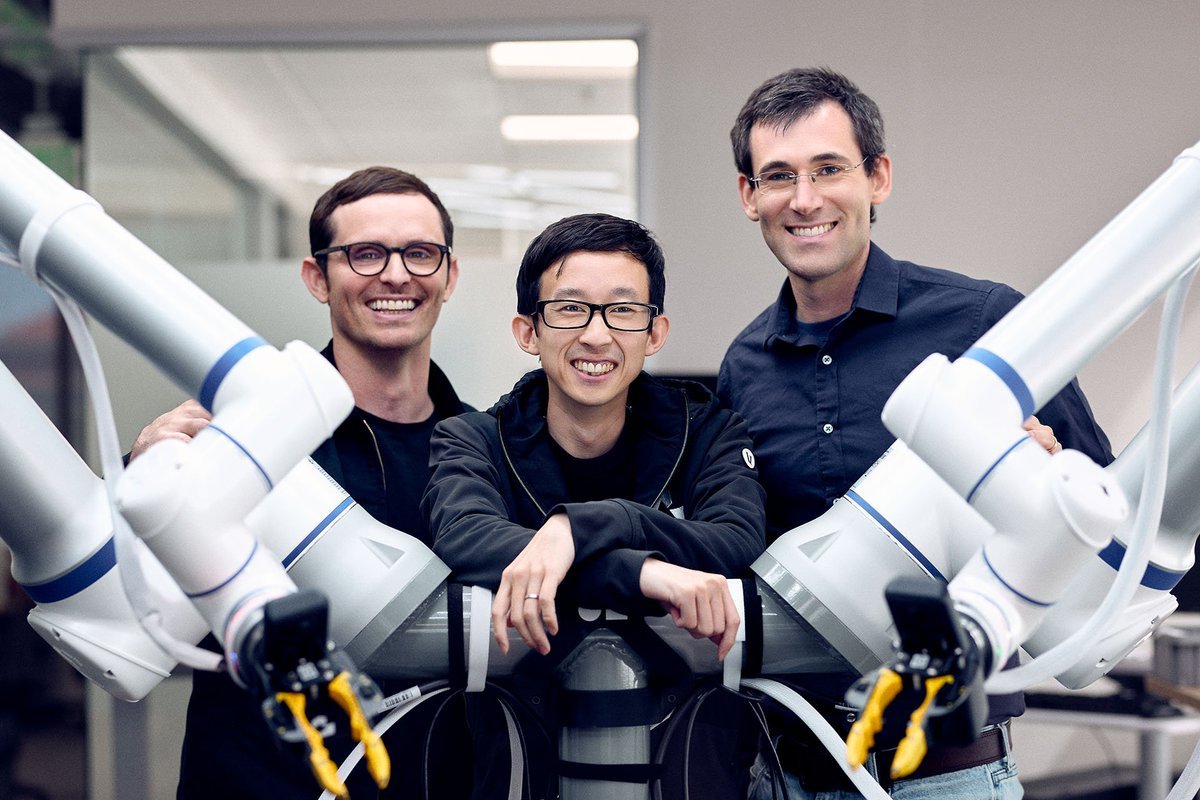
Generalist’s cofounders: Pete Florence (CEO), Andy Zeng (Chief Scientist), and Andrew Barry (CTO).
1. The founders: People who helped invent VLAs
Generalist was founded in the spring of 2024 in San Mateo, California, by three people whose backgrounds largely define the company.
CEO Pete Florence earned his PhD at MIT under Russ Tedrake and worked as a senior research scientist at Google DeepMind. His best-known projects include PaLM-E and RT-2. PaLM-E was one of the first large multimodal language models, and RT-2 introduced the term “VLA,” or Vision-Language-Action. In other words, he helped create the VLA paradigm that dominated robot foundation models from 2023 to 2025. In 2023, he also published a paper on world models for robotics, Video Language Planning. What first makes this company interesting is that someone who helped build both of today’s dominant approaches walked away from both to start it.
Chief Scientist Andy Zeng earned his PhD at Princeton and also worked at DeepMind, where he developed TossingBot, Transporter Networks, SayCan, Code as Policies, and PaLM-E. His role at Generalist is especially important because he has led research into handheld devices that people use to collect data. Generalist’s data engine is essentially the industrialization of that research.
CTO Andrew Barry earned his PhD at MIT CSAIL and spent roughly five years at Boston Dynamics working on Atlas, Spot, and Stretch. Having a hardware-savvy founder at a software-focused company helped make the shipment of “thousands of robot hands,” discussed below, possible. He explains that the company focuses on dexterity “not because it’s the hardest problem, but because it’s the most valuable.” (You can see why he left Boston Dynamics.)
The company remained in stealth until TechCrunch reported NVIDIA’s investment in March 2025, and it first revealed its work in a Research Preview on June 17, 2025. Early investors included boldstart Ventures and NVIDIA, which co-led the inception round, along with Spark Capital, Bezos Expeditions, and NFDG. The line that reportedly convinced boldstart was: “The time has finally come when we can build general-purpose robots.”

The Generalist team when it announced its $400 million funding round in June 2026. The company has offices in the Bay Area and Boston and describes its team as including people who built PaLM-E, RT-2, Gemini Robotics, ChatGPT, GPT-4, Atlas, Spot, and Stretch. (I’ve visited the Boston office myself. It’s in a surprisingly quiet location, which somehow made their commitment feel even more tangible.)
2. The problem: Internet data lacks “physical commonsense”
Pete’s reason for leaving DeepMind follows directly from his background. After bringing multimodal LLMs into robotics, he came to believe that some parts of the robotics problem could never be solved with internet data alone. The company’s blog calls this the “dark matter of robotics”: closed-loop intelligence that responds reflexively to contact, friction, and deformation. Think of nudging a book to make room for your fingers on a shelf, or adjusting your grip on an object as it slips in your hand. Internet videos don’t capture this. In the company’s words, “Internet data has no proprioception, no interventions, and no outcomes.”

The lead image from the “Physical Commonsense” post (January 2026). Nonprehensile manipulation—pushing and rolling objects without grasping them—is something humans do unconsciously, but it is almost absent from robot training data.
The answer, then, is to pretrain directly on data from real physical interactions. But the industry’s prevailing assumption was that “robot data is scarce.” Pete decided to start the company when he became convinced that this constraint could be broken. In the spring of 2024, he left DeepMind, saying, “Now is the time to scale.”
The vision was extraordinarily broad from the outset. In a TechCrunch interview, he spoke of “robots that can do anything” and “a world where the marginal cost of physical labor approaches zero.” The company’s slogan is “General intelligence will be born from the physical world.” The ambition is to build one intelligence that powers every robot: Physical AGI.
Pete’s April 2026 essay, “Going Beyond World Models & VLAs,” makes the company’s central theses clear. As I read it, there are five:
These five theses provide a useful framework for understanding what GEN-0, GEN-1, and GEN-1.5 have each demonstrated.
3. The data engine: Collecting robot data without robots
The data engine is Generalist’s answer to the first thesis. Instead of robot teleoperation, the company collects data using UMI-style handheld grippers equipped with GoPro cameras. Forbes described them as “robot-training gloves.” As people work at their natural pace, the devices record video, position, gripper opening and closing, and motion trajectories. Collection happens in parallel across thousands of homes, warehouses, and factories around the world. It’s inexpensive because no robot body is needed, and without the latency inherent in teleoperation, it captures people’s subtle reflexive movements directly.
By GEN-0’s release in November 2025, the dataset had reached 270,000 hours and was growing by more than 10,000 hours a week. By GEN-1’s release in April 2026, it exceeded 500,000 hours. Behind this is a multimodal data-processing system running on roughly 10,000 cores, tens of petabytes of compressed data, and a training pipeline that absorbs 6.85 years of manipulation experience per day. The data covers roughly 9,000 end-effector variants, with 1.89 million scenes indexed for natural-language search.

The data-scale comparison from the GEN-0 post. Generalist’s dataset is orders of magnitude larger than existing public robot datasets such as Open X-Embodiment.
4. GEN-0 (November 2025): Robotics has scaling laws, too
GEN-0, also written as GEN-theta using the Greek letter θ, demonstrated the third thesis. The company pretrained a model with more than 10 billion parameters directly on 270,000 hours of physical-interaction data, without internet video or simulation, and presented the results in the same form as scaling laws for language models.
The most striking chart is the “ossification” graph below. Even when given the same data, a 1B model stops improving early. The benefits of pretraining begin to appear at 6B, and models must exceed 7B to internalize the large-scale dataset. The company calls this an “intelligence threshold” and claims it is the first observation of ossification in robotics.

GEN-0 Figure 1. Next-action prediction error (y-axis; lower is better) by model size (color). On entirely held-out, long-horizon tasks evaluated zero-shot, the 1B model plateaus early while models with 7B or more parameters continue improving.
For models that cross this threshold, downstream error follows a power law with respect to the amount of pretraining data, D:
L(D) = (D_c / D)^alpha_D
This makes it possible to calculate how much more data is needed to reach a target error rate. The company says it verified this across 16 task suites in three categories—dexterity, real-world applications, and generalization—using different amounts of pretraining data. Success rates on physical robots reportedly followed the same trend.
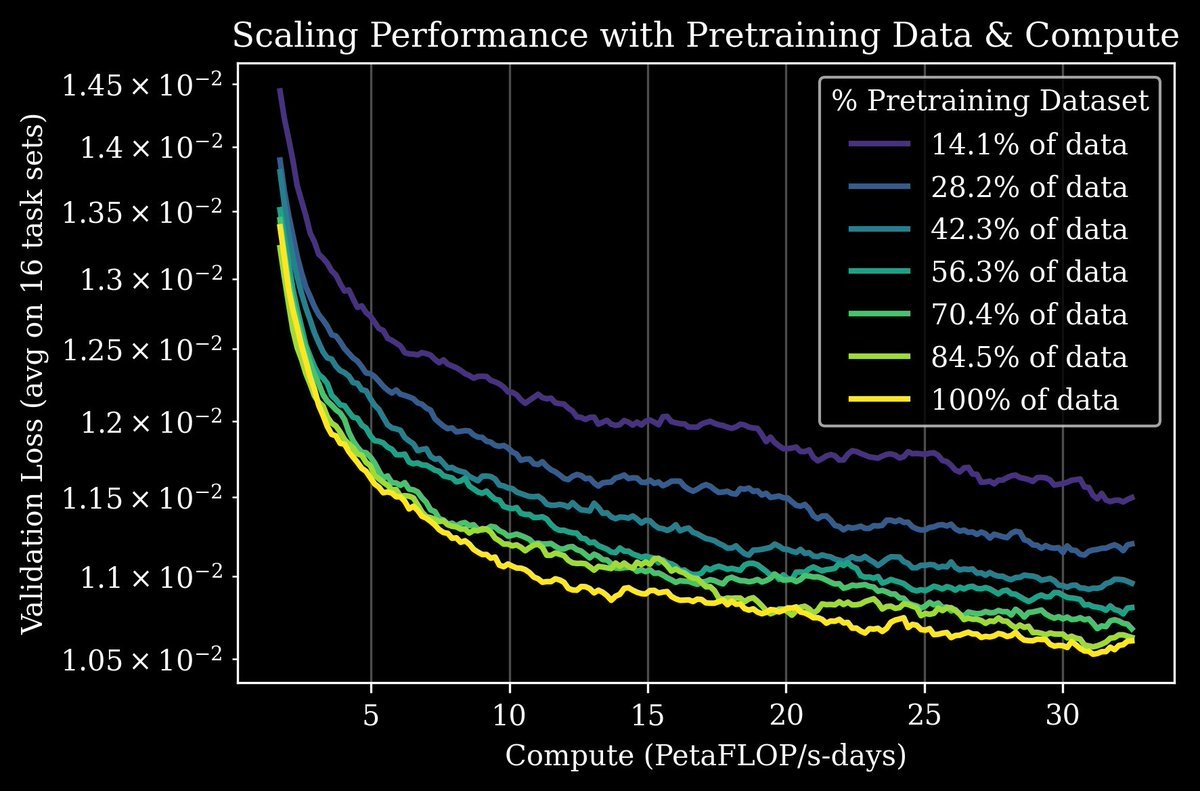
GEN-0 Figure 2a. The power-law relationship between pretraining data volume and validation loss.

GEN-0 Figure 2b. Next-action prediction error for each of the 16 task suites.

GEN-0 Figure 3. Real-world robot task success rates as a function of pretraining data volume.
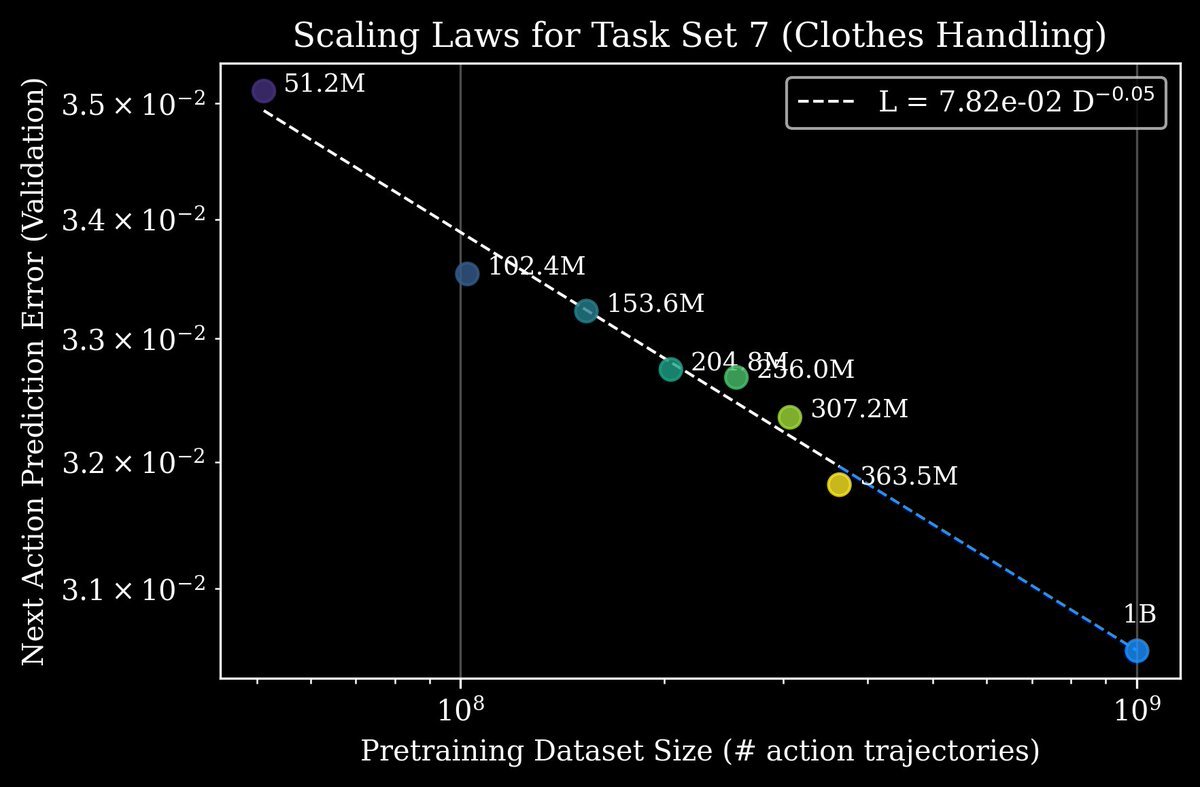
GEN-0 Figure 4. Scaling laws for the Clothes Handling task.
The key architectural concept is “Harmonic Reasoning.” The model processes asynchronous, continuous-time streams of sensing tokens and acting tokens concurrently, allowing it to “think while moving.” The company emphasizes that it operates without a dual System 1/System 2 architecture like Figure’s Helix or inference-time guidance. It was designed to work across embodiments and was tested on platforms with 6 and 7 degrees of freedom, as well as semi-humanoid platforms with 16 or more.
GEN-0 assembling a camera kit. It inserts a cleaning cloth, folds a tray, removes a camera from its plastic wrapping, closes the box and tucks in a small flap, then discards the wrapping—all in one continuous sequence.
Still, performance was not yet good enough to be useful. It required anywhere from 5.6 hours to more than 550 hours of post-training data per task. Comparisons later released with GEN-1 put GEN-0’s average success rate at 64%, versus 19% for a model without pretraining. The company itself described GEN-0 as its “GPT-2 stage”: a model that demonstrated scaling but wasn’t commercially usable. I found that candid assessment more reassuring than anything else.
The GTC demo and the speed of adaptation
What happened at NVIDIA GTC in March 2026 offers a better picture of GEN-0’s capabilities. The company committed to a demo a month in advance, then received an entirely new platform just days before the event: two Universal Robots UR7e arms mounted on a MiR mobile base and a Vention frame. After two days at the Boston office and one day in San Francisco, the box- and phone-packing demo was working. At GTC, it delivered the same performance without collecting even an hour of new data on-site. As the company put it, “The real breakthrough wasn’t the demo, but the speed of generalization and adaptation.”
5. GEN-1 (April 2026): Crossing the threshold into “mastery”
GEN-1 brought the second and fourth theses into practice. The company expanded the dataset to more than 500,000 hours and added post-training, experience-based reinforcement learning, multimodal human guidance, and inference optimizations such as custom kernels and a new form of paged attention. Generalist called GEN-1 “the first general-purpose model to cross a new threshold: mastery of simple physical tasks,” moving its self-assessment to the “GPT-3 stage.”
The official GEN-1 introduction video. The company says all footage is shown at normal speed and is fully autonomous. (I’ve seen it firsthand, and it is indeed fully autonomous.)
The numbers are dramatic. Average success rose from 64% to 99%, speed reached roughly three times the previous state of the art, and all of this came with approximately one hour of robot data per task. In his essay, Pete had identified “99% or higher with roughly one hour of robot data” as the milestone for commercial viability. GEN-1 reached exactly that milestone.

Box folding, GEN-0, at normal speed.
Box folding, GEN-1, at normal speed. At 12.1 seconds, it is 2.8 times faster than GEN-0 and pi0, which take roughly 34 seconds.
The explanation for the speed improvement is interesting. Data collected through teleoperation contains only slow movements because of force-feedback latency. Data collected directly from human hands captures natural speed. As pretraining scales, knowledge of the dynamics involved in performing other tasks quickly transfers to new tasks. In other words, the method of data collection determines the ceiling on performance.
The third dimension of “mastery,” as the company defines it, is improvisation. Behaviors outside the training distribution began to appear: putting a washer down and grasping it again after a fumble, or coordinating both hands to restore a deformed object. The company sees these as emergent results of large-scale pretraining, but also as “side effects that require alignment.” Different users define success differently, so the model needs to be steered precisely.
GEN-1’s improvisational intelligence. A collection of recovery behaviors in response to unexpected situations during automotive-parts kitting.
The second thesis was formally articulated in the essay published five days after the announcement: roughly 99% of GEN-1’s parameters were trained from scratch. It is neither a VLM with actions attached nor a world model. The statement that “we can now ask the question without that constraint,” once the dataset exceeded 500,000 hours, was effectively the company’s own confirmation of its first thesis: data constraints are temporary.
Thousands of hands, one intelligence
In July 2026, Generalist announced that a single GEN-1 model could control five-fingered hands, electric screwdrivers, tongs, whisks, box cutters, potato peelers, spatulas, tape dispensers, and roughly 9,000 variants of two-finger grippers. The explanation is that training on mixed data teaches a general-purpose sensorimotor representation that conditions behavior on “the hand currently in front of it.” I read this as a miniature version of the Physical AGI vision: one intelligence for every robot.
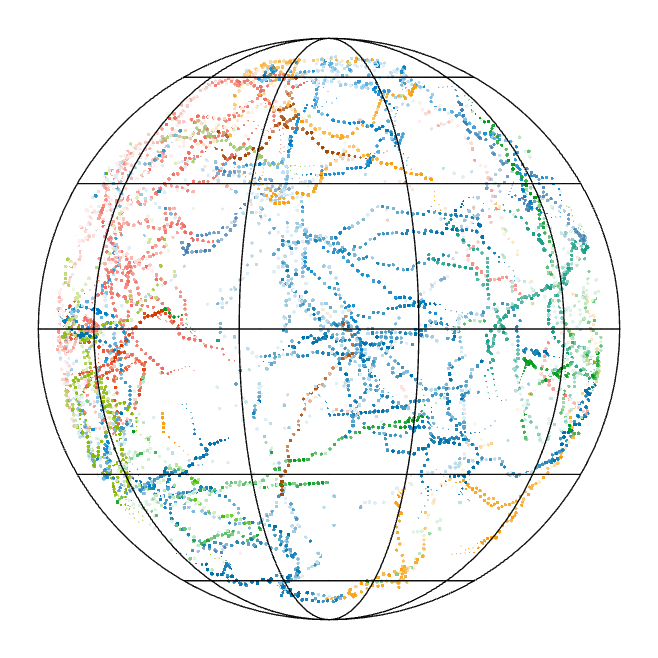
An illustration from “Towards Machines with a Thousand Hands,” showing the organic portion of the space of hands and tools.
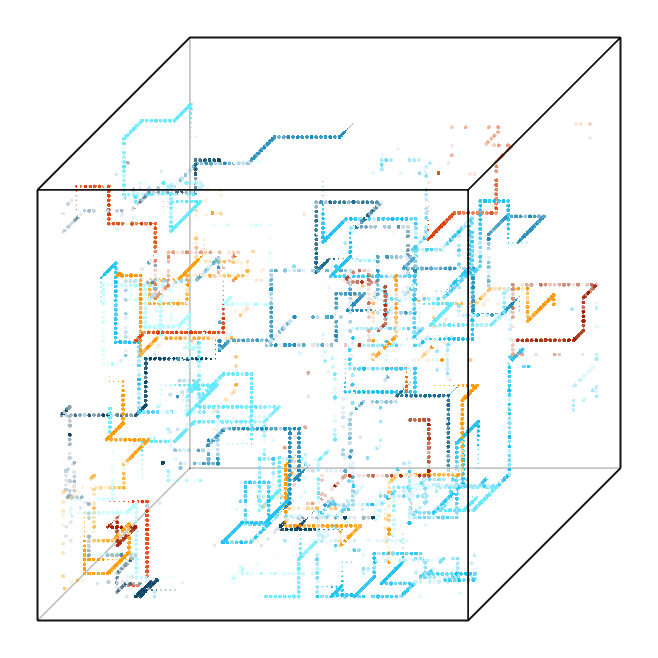
The mechanical end-effector space from the same post.

The lead image from the same post. A single model performs tasks while switching between tools.
6. GEN-1.5 (August 2026): A model that learns from a single demonstration
GEN-1.5 is the next step in the fourth thesis: pushing “robot data per task, X” closer to zero. The post’s title, “Embodied Foundation Models are One-Shot Learners,” directly echoes the GPT-3 paper “Language Models are Few-Shot Learners,” and so does its substance. Put a single 3- to 12-second demonstration—a sensor stream plus an action trajectory—into the context window, and the model can perform a new task within seconds, without updating its weights. The company calls this “physical prompting.”

The official GEN-1.5 video. It shows a physical-prompting interface where a demonstration is dragged and dropped into the system and the robot immediately performs the task.
The model takes video, sensor readings, language, and joint states as input, maintains 30 seconds of context, and outputs action trajectories at 100 Hz. What stood out most to me was that the architecture hadn’t changed. The company continued pretraining for more than eight months using the same data engine, without meta-learning, auxiliary losses, or dedicated one-shot training—and in-context learning emerged. The number of gradient steps needed to adapt to a new task fell from hundreds to tens, then to one, and finally to zero.

Across 10 tasks—including opening a jar lid, unzipping a zipper, opening a pencil case, sweeping cubes into a container with a brush, removing a vacuum-cleaner pad, taking a banknote out of a wallet, and connecting LEGO pieces—the average one-shot in-context success rate was 59%, with a standard deviation of 10 percentage points. With five minutes of data and 10 adaptation steps, success reached 83%, with a standard deviation of 9 percentage points. Even one adaptation step using one minute of data achieved 66.5%. After 10 adaptation steps, the magnitude of the weight change was still less than 0.15%. This suggests that the capabilities are already present in the pretrained weights; adaptation simply brings them out.
The company also presented other capabilities that “emerged without being explicitly trained”:
The company also observed an inverse relationship between the number of adaptation steps and improvisation: fewer adaptation steps led to more improvisation. This points to pretrained prior knowledge as its source.
7. The progression through the lens of emergence: How quickly the cost of task data, X, falls
Looking at the three models as one continuous progression, the clearest quantitative measure is “the cost of teaching one new task.” The company emphasizes this metric over success rates in each announcement because it directly reveals the effect of scaling up pretraining.

The kind of emergence also advances at each stage. With GEN-0, the capacity to absorb data emerged at the 7B threshold. With GEN-1 came reliability, speed, recovery behaviors, and generalization across tools. With GEN-1.5 came the meta-ability to learn tasks without changing weights, along with transfer across domains. Structurally, this mirrors the progression of language models, which acquired grammar, knowledge, and then in-context learning through next-token prediction. The company says that “every metric we tracked continued to improve, and we still haven’t seen where those curves saturate.”
8. Funding and the competitive landscape
The market appears to be reaching a similar conclusion. On June 4, 2026, Generalist raised $400 million in a round led by Radical Ventures at a $2 billion valuation. New investors included 8VC, Union Square Ventures, Hanabi Capital, and Norwest, with participation from NVIDIA, boldstart, Spark Capital, Bezos Expeditions, and NFDG. Angel investors included Eric Yuan, Bin Lin, Fei-Fei Li, and Naval Ravikant. In late August, reports said the company had raised another roughly $200 million in a round led by 8VC, bringing its valuation to $3 billion and total funding to approximately $600 million.
Competitor valuations stand at roughly $11 billion for Physical Intelligence, $14 billion for Skild AI, $3 billion for Genesis AI, and $2 billion for Field AI. By those numbers alone, Generalist isn’t the leader. But I place it among the leaders because of how it demonstrates progress. It has presented scaling laws quantitatively, publicly defined its target metric, X, and reduced that metric with each model. Few robotics AI companies have shown such a predictable trajectory.
The company is pursuing two business models: a turnkey offering that combines models and hardware, and model licensing for customers that already own robots such as those from Universal Robots. Its pricing structure has not yet been finalized. Hardware partners include Universal Robots and Flexiv. At the Automate trade show in June 2026, it simultaneously demonstrated box folding with a UR12e and robot-vacuum maintenance with a Flexiv robot.
9. Limitations and risks
Despite considerable progress, significant limitations remain.
First, it is still good only at “easy tasks.” GEN-1’s 99% figure comes from repetitive tasks lasting tens of seconds, such as folding boxes and packing phones. GEN-1.5’s one-shot learning achieves 59% on short, individual actions such as opening lids and zippers. The company has not demonstrated the same level of mastery on long, interdependent, multistep tasks or in environments with many variables. This is precisely the next step on its roadmap, but we don’t yet know whether it is a threshold that scaling alone can overcome, as with language models, or a different kind of barrier.
Second, improvisation is a double-edged sword in real deployments. A robot that picks up a banana instead of a brush is impressive in a demo, but unpredictable in a factory. The company has identified alignment as its next challenge, yet it has not offered a concrete solution. Success-rate figures don’t capture this problem. The inverse relationship between adaptation steps and improvisation makes it harder: more fine-tuning to gain control comes at the expense of generalization.
Third, we don’t know the limits of the data engine. Results so far have come from handheld-gripper data and robot arms. As the scope expands to five-fingered hands, coordinated dual-arm manipulation, mobile manipulation, and full-body humanoids, the company has yet to show whether it can collect data in the same way—or whether the same scaling behavior will hold even if it can. For a company pursuing Physical AGI, this is ultimately the most important question.
Commercially, Generalist is still working with a small number of customers and has yet to settle on a pricing model. And, of course, all the figures above come from the company itself; there has been no independent replication. That is less a problem unique to Generalist than a reflection of the current state of the field.
10. Closing thoughts: Why I still place it among the leaders
Pete’s destination is X = 0: fully zero-shot performance, where a robot can carry out task categories it has never encountered, with high success rates and speed. He defines this as Physical AGI. GEN-0 showed that scaling laws exist along that path. GEN-1 crossed the commercial threshold at X = one hour. GEN-1.5 performed new tasks from a single 12-second demonstration without updating its weights. In terms of training cost, it is already close to zero. But Pete’s destination requires high success rates and speed without even a demonstration—with no task-specific data at all. GEN-1.5 has reached a 59% success rate in the one-shot setting. For a company barely more than two years old to make this much progress across three announcements is, at least to me, a sign that it is heading in the right direction.
What the company needs to show next is clear: raise the success rate on unfamiliar tasks from 59% to 99%, perform harder and longer tasks after seeing them just once, and steer its emergent improvisation toward what users want. When the next model arrives, I plan to assess it against those three criteria.