Physical AI’s GPT Moment

The basis of competition in robotics AI is shifting.
Until now, the key to robotics AI, or Physical AI, has been collecting task-specific data. Human operators would remotely control robots to repeat a particular task, then use the resulting data to retrain the model. A new task required new data.
This approach allowed robots to reliably perform tasks they had learned. But every new task required the same process: collect data, train the model, and validate it again in the field.
That structure is beginning to change. General-purpose capabilities are emerging in robotics AI.
What will matter going forward is the ability to gather diverse action data and scale general-purpose pretraining. With sufficient training, an AI model that understands physical actions can learn and perform a new task after watching a single human demonstration.
Over the past few weeks, several leading robotics AI companies have demonstrated this possibility almost simultaneously.
Show it once, and it learns
It began with GEN-1.5, announced by Generalist AI on August 19.
GEN-1.5 can perform new physical tasks after watching just one human demonstration, without any task-specific post-training. Give it a demonstration lasting three to twelve seconds as a prompt, and it starts working immediately.
“It can learn a new task in seconds, from a single example, without gradient updates or fine-tuning.”
In other words, it learns a new task within seconds, without gradient descent or fine-tuning.
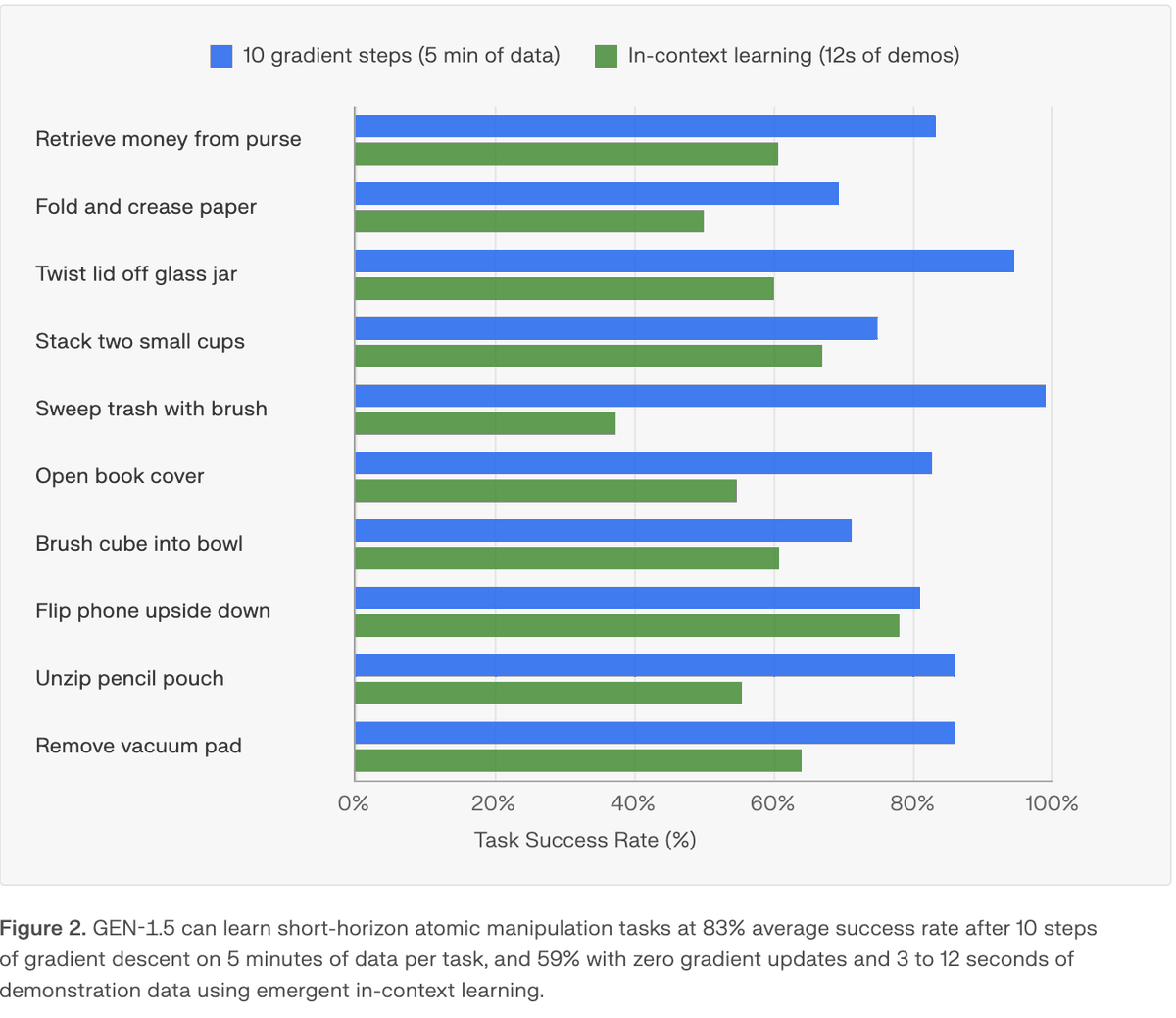
Its average success rate across ten tasks was 59% (±10%). Additional training on approximately five minutes of data raised that to 83% (±9%).
It is not yet ready for commercial deployment. But the learning method matters more than the success rate.
Previously, adding a single new task required collecting data and retraining the model—a process that took weeks or months. GEN-1.5 reduced that time to seconds.

More interesting is the company’s claim that it did not explicitly engineer one-shot in-context learning. The capability emerged naturally as it scaled up pretraining.
The emergence we saw in large language models is beginning to appear in robotics.
Leading companies are converging on the same approach
Skild AI’s S1 can also perform a new task after watching a single video of a human demonstration. No additional post-training is required.
These tasks go beyond simply picking up objects. They include complex activities lasting up to ten minutes, such as making pancakes, repotting plants, and assembling kits. These are tasks the model had never encountered during pretraining.
A demonstration is recorded on a smartphone in the evening. Eleven minutes later, the robot performs the task autonomously. It offers a glimpse of what redeployment in the field could look like without retraining.
Dyna Robotics’ DYNA-2 reached the same conclusion through a different route.
DYNA-2 was pretrained on more than one million hours of first-person human video. In terms of a person’s waking hours, that is roughly 170 years of experience.

As the volume of human video increased, both performance on previously unseen robot data and real-world robot performance improved. Those gains followed predictable scaling curves.
Certain capabilities appeared for the first time at the million-hour scale. Beyond one-shot learning itself, these results provide quantitative evidence that human video can serve as a pretraining resource for general-purpose robotics AI.
The key point is that robots no longer need to be trained exclusively on robot data.
Humans are the largest robotics dataset
These companies are moving beyond data tied to a particular robot and a particular task.

They are bringing data from UMI handheld grippers, robot teleoperation, first-person human video, and simulation into a single pretraining framework. The goal is to build general-purpose foundation models that can transfer knowledge across different robot bodies and working environments.
Jim Fan, NVIDIA’s director of robotics, summed it up in one sentence:
“Humans are the most scalable embodiment on the planet.”
Humans, in other words, are the most scalable source of physical experience on Earth.
Collecting data by remotely operating a robot requires both equipment and an operator. Meanwhile, humans around the world are already picking up objects, using tools, cooking, and assembling things. All it takes is a camera to capture these experiences on video.
There are more humans than robots. That is why human video can scale faster than robot data.
Tesla was the starting point
Tesla was the first company to demonstrate this direction at scale.
In May 2025, Tesla released a demonstration of Optimus performing household chores using capabilities learned from first-person human video. At the time, Tesla explained that it could now transfer a substantial portion of what was learned from human video directly to the robot.

Its data collection process subsequently changed as well, shifting from an approach centered on motion capture and teleoperation to one based on camera footage.
It was the first example to demonstrate the potential of feeding first-person human video into a humanoid model at scale. A year later, Generalist AI, Skild AI, and Dyna Robotics are reporting results that point in the same direction.
It is hard to see this convergence as a coincidence.
Figure wants to control the data supply chain
Index, the data collection platform unveiled by Figure AI, illustrates the next stage of competition.
Index crowdsources videos of real-world tasks from more than 100 countries. It has already collected 16 million videos, with another 30 minutes of footage arriving every second.
Figure plans to invest more than $1 billion in data and compute over the next twelve months.
While its competitors compete on model architectures and algorithms, Figure is trying to own the data supply chain itself. Just as internet data shaped the performance of large language models, first-person human video could shape the performance of general-purpose robotics models.
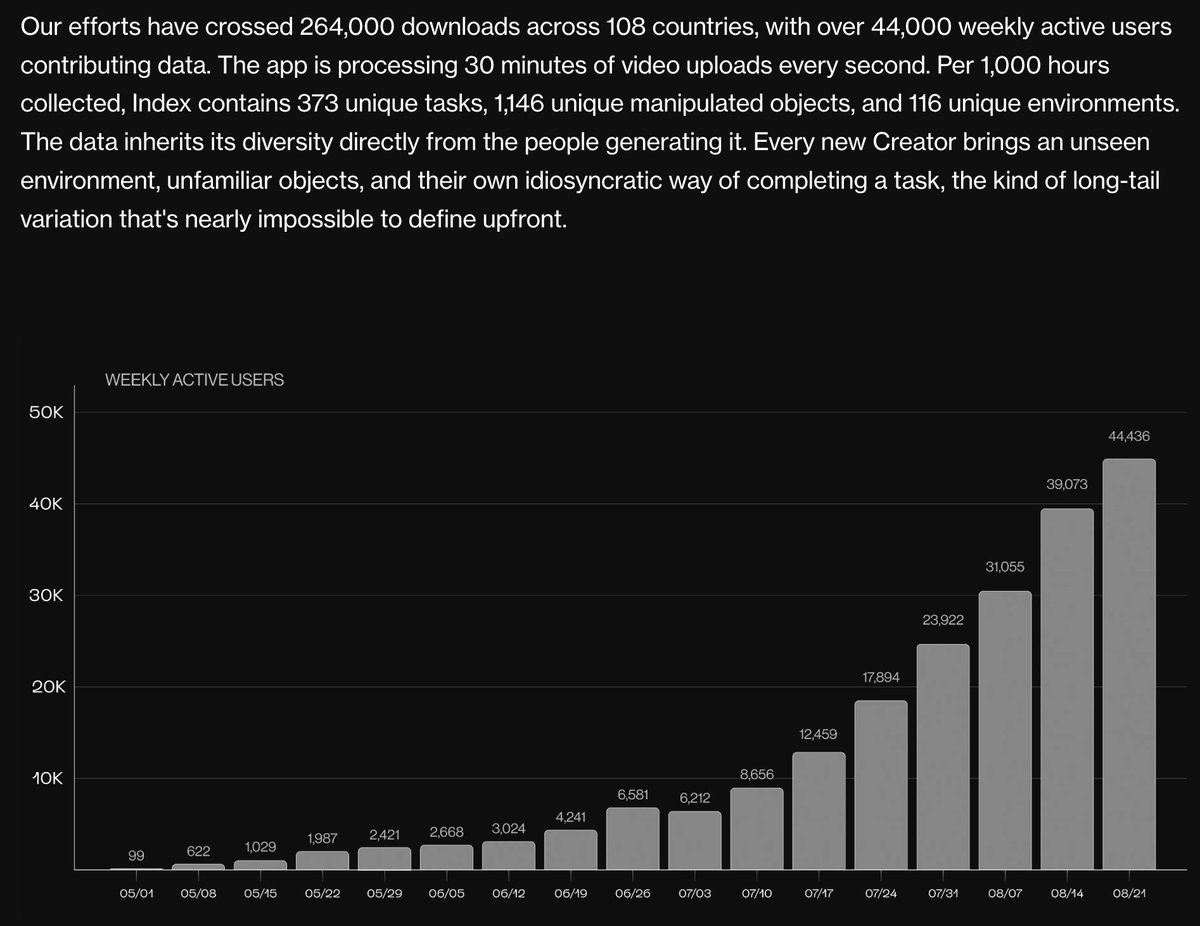
At a rough calculation, 30 minutes per second amounts to approximately six years of footage every day. If that pace continues for a year, the accumulated physical experience will exceed what a single person could watch in a lifetime.
Of course, video volume does not automatically translate into quality. Camera angles, task diversity, action labels, copyright, and privacy remain challenges. Even so, the sheer speed of data collection is difficult to match with conventional teleoperation.
Task-specific data could become less valuable
As general-purpose models become better at generalizing, the relative value of task-specific data declines.

Until now, deploying a robot in a new setting required collecting fresh data for each task. That process was slow and expensive, so even falling hardware prices did not readily translate into wider adoption.
If a general-purpose pretrained model can adapt to a new task from a single demonstration, the economics change. A single AI model could power humanoids, robotic arms, and mobile robots. The same model could move across service work, manufacturing, and household tasks.
For now, however, most of the evidence consists of demonstrations selected by the companies and their own internal evaluations. It is also difficult to compare success rates across different models on a common basis. Reliability over thousands of repetitions in an actual factory—and the cost of failure—are separate questions.
Conclusion
Even so, the direction is clear.
Attention in the humanoid market has recently focused on hardware: mass-production prices, actuators, and gear reducers. If general-purpose pretraining translates into real-world performance, the center of gravity will shift back toward AI.
(Hands 🤲 will become more important, too.)
The robotics industry’s GPT-3 moment is approaching. This time, it is about action rather than language.