Second-order thinking for people who use AI every day

You ask a question. The answer arrives before you finish reaching for your coffee. It sounds sure of itself, and it's probably right. A few weeks of this and the speed starts to feel normal, the way a good tool disappears into the hand that uses it.

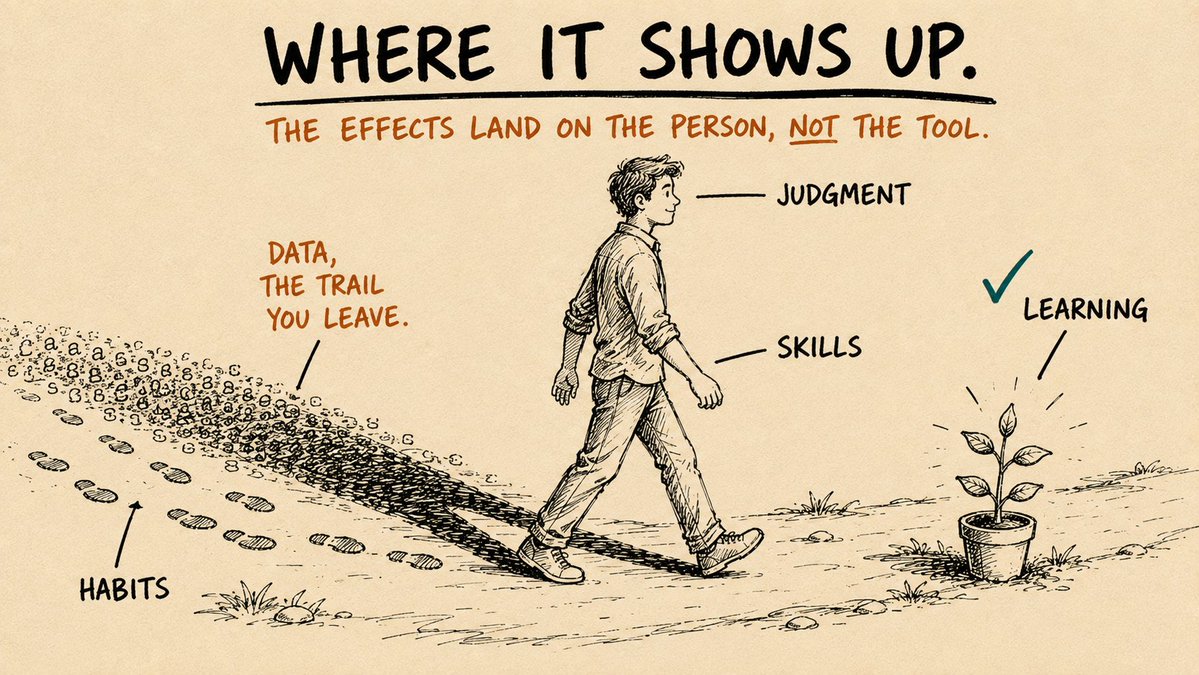
The screen shows you the first effect. The slower ones land elsewhere, in your skills, your judgment, your habits, and your data, over weeks and months.
There's a mental model built for seeing effects like these coming, and it comes from outside the AI world entirely. Second-order thinking.
Investor Howard Marks of Oaktree Capital built a career on it. Shane Parrish of Farnam Street wrote it down as a model anyone can practice. Neither of them was talking about chatbots. Both were describing the pattern that keeps surfacing in research on AI use.
The easy way to judge AI is by the first result. Was the answer good? Was it fast? The second question is the one worth learning to ask, and this guide teaches the habit. No panic nor hype.
Save it. You'll want it around.
So what even is second-order thinking
1. The definition

The simplest version fits in two lines.
→ First-order thinking asks what happens.
→ Second-order thinking asks what happens because that happened.
Shane Parrish and the Farnam Street team define it as considering not just your actions and their immediate results, but the subsequent effects of those results as well. Howard Marks calls the quick kind "first-level thinking," which he describes as simplistic, fast, and available to everyone. The second level is where the important stuff hides.
Every consequence has consequences. The first one is just the loudest.
2. The analogy
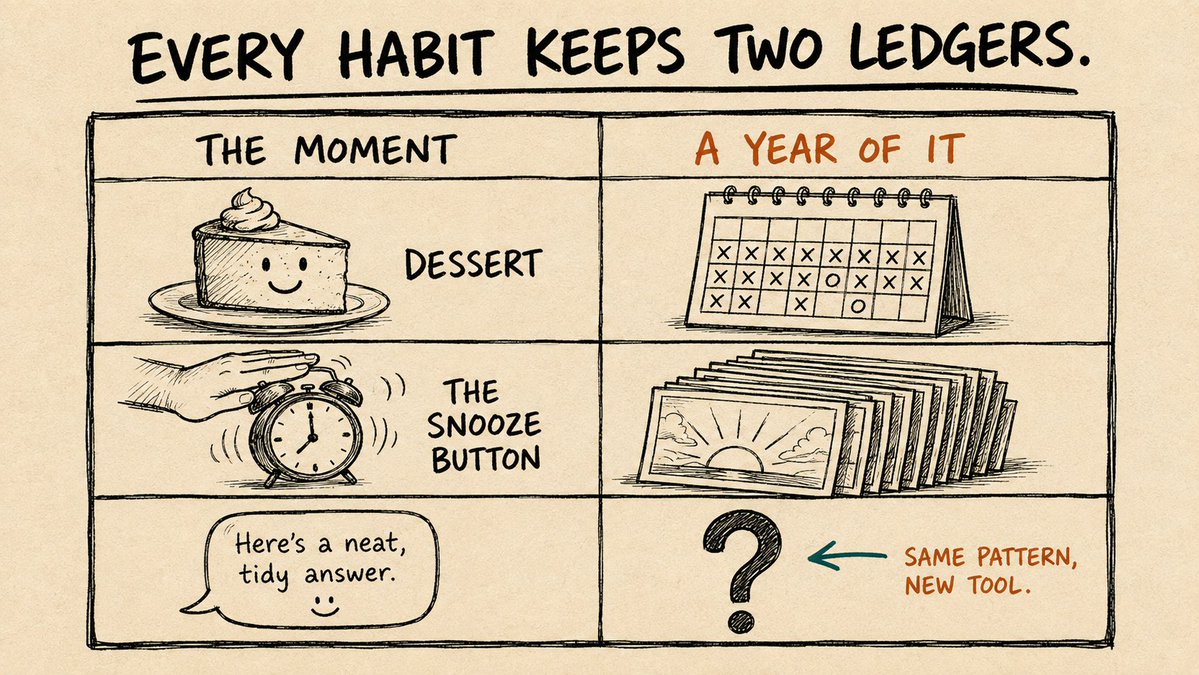
Think of dessert after dinner. The first-order effect is that it tastes wonderful, every time. The second-order effect is what a nightly habit does over a year.
Nobody needs to feel guilty about dessert. The point is smaller and kinder. The first effect is always the pleasant one, because the pleasant part is the thing doing its job. The second effect arrives later, on its own schedule.
AI answers work the same way. The first effect is designed to feel great.
3. Why it keeps showing up around AI
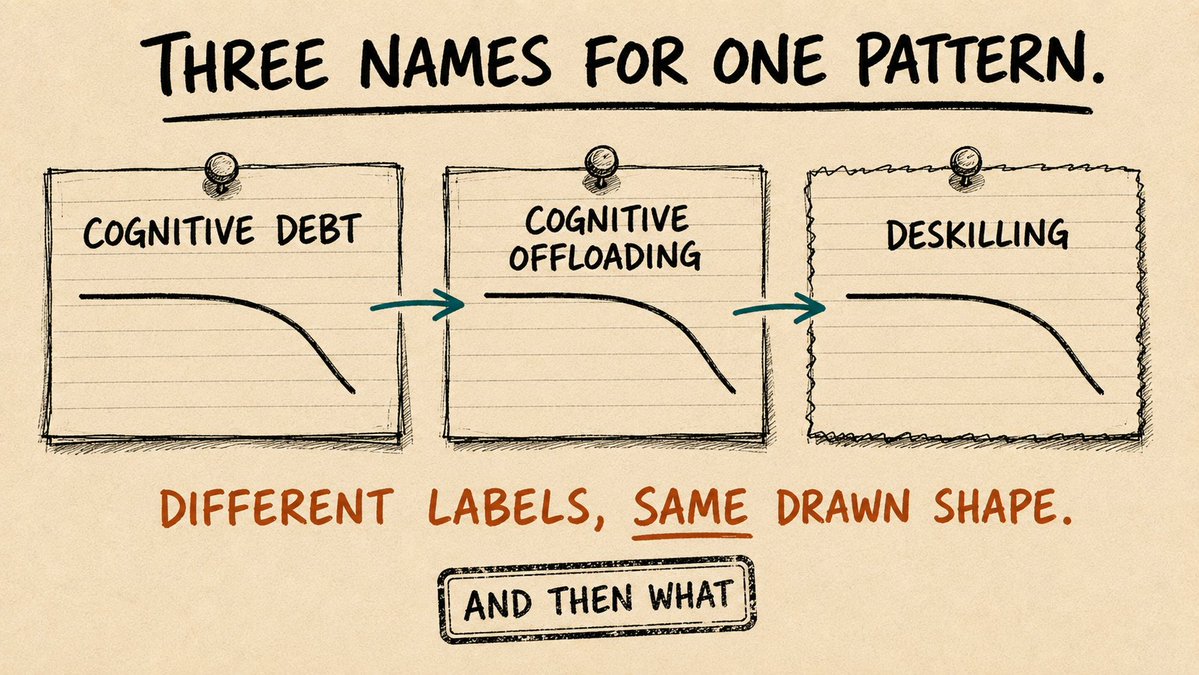
This old investing idea attached itself to AI for a reason. When researchers started measuring what repeated AI use does to people, a cluster of new terms entered the vocabulary almost at once. Cognitive debt. Cognitive offloading. Deskilling.
Different labs, different methods, and the same shape of finding. The effects that mattered were never in the first answer. They lived in what repeated answers did to skills, judgment, habits, and data over time.
You don't need to read the studies. You need the question all of them share. And then what?
The five places second-order effects show up
1. Your skills. A team at the MIT Media Lab led by Nataliya Kosmyna had 54 people write essays, some with an AI assistant, some with a search engine, some with nothing but their own head. The AI group reported the lowest sense of ownership over their essays, and many struggled to quote their own writing minutes after finishing it. One study, a small group, and not yet peer-reviewed, so hold it lightly. But the direction is worth remembering. The words came out fine. The connection to them didn't come out at all.
2. Your judgment. Researchers at Microsoft Research and Carnegie Mellon University surveyed 319 knowledge workers about 936 real AI tasks. The more confidence people placed in the AI, the less critical thinking they reported doing. The more confidence they had in their own abilities, the more they engaged. Where people parked their confidence mattered more than which tool they used.
3. Your habits. Michael Gerlich at SBS Swiss Business School surveyed and interviewed 666 people and found that frequent AI use was associated with lower critical thinking scores, connected through a habit researchers call cognitive offloading, which means handing mental work to the tool by default rather than by decision. This is a correlation, not proof of cause. But offloading by default is a habit, and habits are built by repetition, which is what daily AI use is.
4. Your data. In August 2025, OpenAI removed a ChatGPT feature that let shared conversations be made discoverable by search engines, after thousands of personal chats surfaced in Google results. Deleting a conversation did not delete the public share link. The first-order effect was that sharing a useful chat took one click. The second-order effect was a trail that outlived the conversation. Whatever tool you use, the lesson holds. What you paste in has a longer life than the moment you paste it.
5. Your learning, in the good direction. Second-order effects are not a one-way street. At Harvard, Gregory Kestin and Kelly Miller built an AI tutor for a 194-student physics course, and learning gains in the AI-tutored group were about double those of students in the regular class. The design detail matters. The tutor revealed one step at a time and made students try before showing answers. Same technology, opposite second-order effect. Deliberate use compounded skill instead of borrowing against it.
Six specific moments you'll recognize
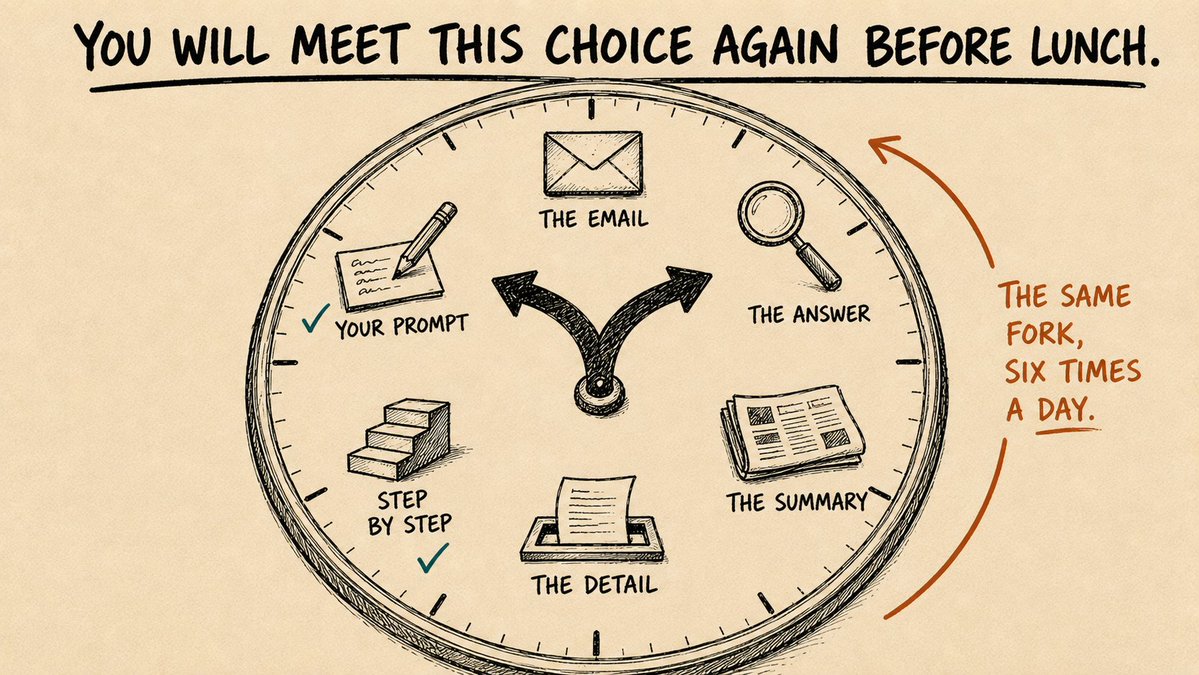
1. The email you didn't write. It went out in ninety seconds and sounded professional. And then what? Months of this, and a blank page starts to feel heavier than it used to. The MIT group's low ownership finding lives here.
2. The answer you didn't check. It was right, and it was right the last ten times too. And then what? The Microsoft and Carnegie Mellon survey suggests checking is what fades as confidence in the tool grows. The checking muscle is the one deciding the quality of your judgment.
3. The article you didn't read. The summary saved you twenty minutes. And then what? What you remember is the summary's shape, not the ideas. You can retell it. You can't argue with it.
4. The personal detail you pasted. The chat gave better advice because it knew more about you. And then what? Ask where that detail lives, who can see it, and for how long. The share-link episode answered that question for thousands of people after the fact. Asking before is cheaper.
5. The concept you made it explain step by step. Slower, because you had to work through each step instead of copying the conclusion. And then what? You can do it without the tool. The Harvard tutor doubled learning by refusing to hand over finished answers.
6. The prompt you structured yourself. You spent two minutes deciding what you actually wanted before asking. And then what? Gerlich's follow-up experiment found that unguided AI use weakened people's reasoning, while structured, deliberate prompting kept them cognitively engaged and produced stronger answers. Thinking before asking keeps you in the driver's seat. This is the compounding direction.
What the research keeps agreeing on

1. The effect follows the use, not the tool. Gerlich found a decline with unguided use and engagement with structured use, inside the same experiment. The Harvard team found doubled learning by wrapping the same technology in guardrails. Different researchers, different fields, same discovery. The tool sets the possibilities. Your way of using it picks the outcome.
2. Where you park your confidence decides how much you think. In the Microsoft and Carnegie Mellon survey, confidence in the AI predicted less thinking. Confidence in yourself predicted more. Trusting the tool feels efficient. Trusting yourself, and using the tool anyway, is what keeps the thinking on.
3. Second-order effects are quiet. A study in The Lancet Gastroenterology & Hepatology followed experienced doctors who screen for bowel cancer. After three months of working with an AI tool that helps spot precancerous growths, their solo detection rate had dropped by 6 percentage points.
Nothing was wrong with the AI. It performed exactly as promised. The change happened in the doctors, and they didn't feel it happening. It took a formal study comparing three-month windows to see it. Second-order effects don't announce themselves. They accumulate below the level where you'd notice, which is why the question has to be a habit rather than a reaction.
The paradox

The tool that makes you faster can make you slower to learn, and both effects come from the same feature. The speed is not a flaw waiting for a fix. Getting finished answers instantly is the entire product. And a finished answer, accepted without engagement, is the condition the studies keep describing, the one where groups showed less ownership, less checking, and less durable skill.
None of this argues for using AI less. The doctors' AI caught more growths. The Harvard tutor doubled learning. The tool is good at what it does.
The fix is timing. Ask "and then what?" earlier, before relying on the output, not after the effects have had months to accumulate.
The habit is one beat long. Before you accept an answer, ask yourself what gets stronger and what gets weaker if you take this without engaging.
→ Sometimes the honest answer is that the task doesn't matter. Take it. That's a decision.
→ Sometimes the answer is to make the tool show its steps. Slower in the moment, yours for good.
→ Offloading by decision instead of by default is the entire skill.
Used deliberately, the same tool compounds what you know instead of borrowing against it. How to set up that compounding loop on purpose is its own guide, and it's the next one in this series.
Everything you just learned
What second-order thinking is
→ First-order asks what happens. Second-order asks what happens because that happened.
→ The first effect is always the pleasant one. It's the thing doing its job.
→ The idea attached itself to AI because the research findings all share its shape.
The five lanes
→ Skills, judgment, habits, data, and learning. Four can drift. One can compound.
The six moments
→ The unwritten email, the unchecked answer, the unread article, the pasted detail, the step-by-step explanation, the structured prompt.
The three agreements in the research
→ The effect follows the use. Confidence placement decides thinking. Second-order effects are quiet.
The paradox
→ Speed and skill-borrowing are the same feature. The fix is asking "and then what?" before relying on the output.
AI answers are the first-order effect.
You are the second-order effect.
Ask "and then what?" while the answer is still cheap.
Follow @free_ai_guides for more write-ups like this one.
Further reading:
If you found this useful, check out my newsletter below
I share one AI superpower every week
Subscribe, it's free