AI adoption is not what you think

Companies have poured $30 to $40 billion into enterprise AI.

One MIT report found that 95% of those pilots produced no measurable profit impact.
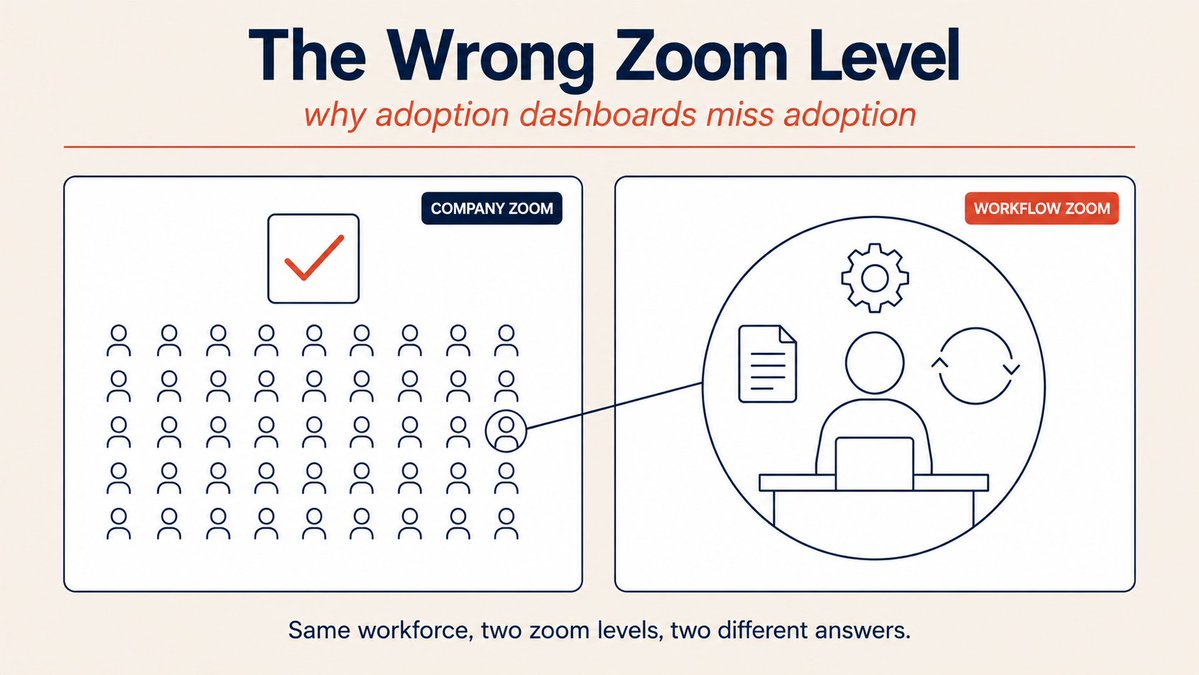
The same report holds a second finding that rarely makes the headlines. Workers at more than 90% of those companies were already using AI on their own. Only 40% of their employers had bought an official subscription.
Adoption never failed. It moved.
It has a name now, which is workflow-level adoption. One person, one model, one repeated task.
MIT's Project NANDA documented it. McKinsey's State of AI survey shows the same gap. Wharton professor Ethan Mollick predicted it back in 2023: "Large Language Models are a breakthrough technology for individual productivity, but not (yet) for organizations."
Three years later, the enterprise data agrees with him.
Adoption dashboards count the wrong unit: the company. This guide explains the right one.
No fluff or jargon. Just the mental model, its parts, and why it works.
Save this. You'll read it twice.
WHAT AI ADOPTION ACTUALLY IS
The Real Definition
The simplest definition:
→ adoption = model + your context + one repeated workflow
Adoption is the distance between a generic model and your specific work shrinking toward zero.
A seat license does not shrink that distance. Tailoring does.
Without tailoring: a login on a dashboard. With tailoring: a capability you use every day.
A tool nobody shaped is a tool nobody adopted.
The Garage Barbell
Think of it like fitness.
→ Enterprise rollout = a company gym membership. Purchased for everyone, appears on a wellness dashboard, used by few.
→ Local model = a barbell in your garage. Sized to your space, always available, nobody can revoke it.
→ Tailoring = your training program. The equipment matters less than the routine built around it.
The membership shows up in a report. The barbell shows up in your life.
That is the whole difference between measured adoption and real adoption.
Why This Became Possible Now
This definition of adoption used to be theoretical. The equipment did not fit in the garage.
Now it does. As of August 2026, a machine with 16 GB of RAM plus either a modest GPU or an Apple Silicon chip runs a capable small model at usable speed. Ollama sets one up with a single terminal command and LM Studio does the same through a desktop app: no API key, no account, no data leaving your machine.
That changes the adoption equation. Individual adoption used to force a trade: pay a vendor and send your work data out, or go without. A local model removes the cost barrier, the permission barrier, and the privacy barrier in one move.
We covered the capability side in "you don't need the frontier models": small open models handle a large share of everyday tasks.
This piece is the next step. Capability was the precondition. Tailoring is the adoption.

THE 4 COMPONENTS OF WORKFLOW-LEVEL ADOPTION
The real cases share the same four parts. To make them concrete, follow one person through all four: a freelance bookkeeper whose client files cannot leave her machine. She is an illustration, not a case study, and every piece of her setup is ordinary.
Open weights, downloaded, sitting on your disk.
What that gets you:
→ no vendor can deprecate it under you
→ no pricing change can hit it mid-year
→ no policy update can revoke your access
As of August 2026, the small open-weight models people run at home include the Qwen, Gemma, and DeepSeek-R1 distill families. Names will rotate. The ownership does not.
The bookkeeper picks a small open model for one reason: client confidentiality rules out sending ledgers to a cloud service. The download settles the question in an evening.
A cloud model is a service. A downloaded model is a possession.
The runner is the unglamorous part that removes the gatekeepers.
→ Ollama: one terminal command, then a local API your other tools can call
→ LM Studio: same idea with a graphical interface
Both are free. Neither asks who you are.
The bookkeeper runs hers on the laptop she already owns, with nothing new to buy and no one to ask.
This is the component that collapses corporate adoption's longest phase, which is permission, into zero minutes.
There is no budget line to argue for, no IT ticket to wait on, no vendor call to sit through.
MIT's diagnosis of why enterprise pilots stall is what the report calls a learning gap: most deployed systems do not retain feedback, adapt to context, or improve with use.
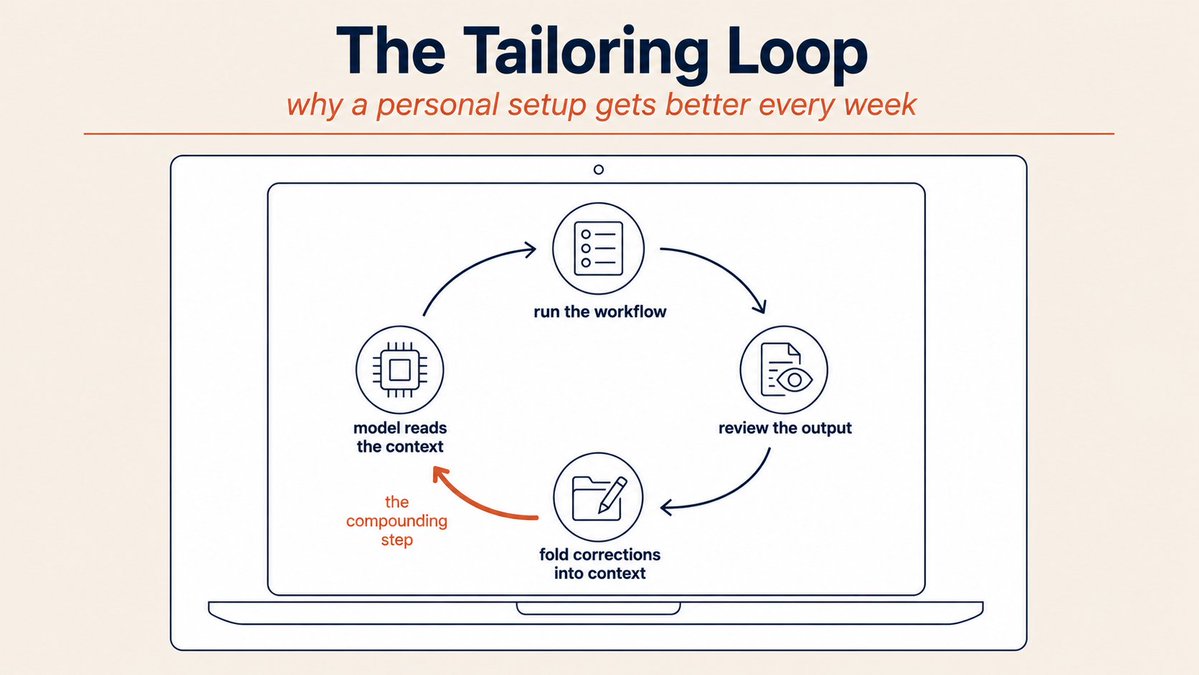
An individual closes that gap by hand.
→ your standing instructions, written once, reused forever
→ your reference files, the documents your work depends on
→ your corrections, folded back in each time the output misses
The bookkeeper feeds hers the chart of accounts, three years of past categorizations, and her notes on each client's quirks. Within a week the model is working from context no off-the-shelf tool ever had.
On a local setup, that accumulated context lives on your disk. A vendor can retire a feature in any product update. A file on your disk stays put.
Whoever holds the context holds the adoption.
The unit of adoption is a task you no longer do by hand.
One repeated task, end to end:
→ the weekly report you assemble from the same three sources
→ the inbox triage you do every morning
→ the first-pass cleanup every document you touch needs
Pick one. Tailor the model to it until the task runs through the model by default.
For the bookkeeper, the workflow is monthly reconciliation. The model drafts the categorizations and flags the mismatches, she reviews and corrects, and each correction goes back into her context files. Reconciliation that took a day now takes a morning, and the model gets a little sharper each month.
One owned workflow is adoption. Forty logins are a statistic.
THE 3 REASONS WORKFLOW ADOPTION IS MORE REALISTIC
The corporate version runs as a sequence: pick a platform, buy seats, roll it out across departments, then work to get thousands of people to change how they work. The individual version is the four components above.
Same technology, opposite shapes. The difference in realism has three parts.
1. Permission
Corporate adoption is a permission chain: budget approval, security review, legal review, vendor negotiation, training rollout. McKinsey's State of AI survey, published November 2025, found nearly two thirds of organizations had not yet begun scaling AI beyond pilots and experiments.
None of that chain is wasted motion. A company answers for data governance and security across thousands of people; you answer only for yourself. The difficulty is structural, and it is the strongest argument for starting where the structure is small.
Individual adoption is a download.
The gap between deciding and doing:
→ corporation: quarters
→ individual: an afternoon
Speed matters because iteration is how tailoring happens, and permission chains kill iteration.
2. Fit
A rollout hands 5,000 people the same generic tool for 5,000 different jobs.
MIT's numbers on what happens next: only 5% of custom enterprise AI tools reached production, while nearly 40% of organizations deployed flexible general-purpose tools. The report's own explanation: chatbots spread because they are easy to try and flexible, then stall in critical workflows without memory and customization.
The tools that spread are the ones people can bend to their own work.
Sounds obvious once stated, but most rollout plans skip it: no central buyer can purchase fit. The only person who knows the shape of your workflow is you.
Tailoring is the substance of adoption.
3. Compounding
Mollick called the split in 2023: a breakthrough for individual productivity, not yet for organizations. He also named the people proving it, secret cyborgs, employees shaping AI around their own jobs without telling their leaders.
Why the individual side compounds:
→ your context grows a little every working day
→ nothing resets it: no reorg, no vendor switch, no license renegotiation
→ each tailored workflow makes the next one faster to build
Corporate deployments restart. Personal setups accrue.
Three years of accrual beats three years of restarts.

THE 3 PRINCIPLES ALL THREE CAMPS KEEP REDISCOVERING
Three camps studied this from different directions: academics, researchers, and the consultants who install enterprise AI for a living. They never coordinated. They converged.
Principle 1: The Tool Must Come to the Work
→ Mollick's secret cyborgs bend AI around their existing jobs
→ MIT's shadow economy: workers at 90% of companies brought in personal tools they could shape themselves
→ even enterprise implementers report the same wall: Varick Agents CEO vasuman writes, from his own client work, that people are not in the market for a tool that helps them do the work, they want the work done
Different words. Same discovery.
The lesson: adoption follows fit, and the person inside the workflow builds the fit.
Principle 2: Whoever Holds the Context Holds the Adoption
Vendor-held context is rented. It lives in someone else's product roadmap.
Locally held context is owned. It lives in your files.
A vendor can reprice, restructure, or retire rented context. Owned context keeps compounding.
Principle 3: Depth Beats Breadth
McKinsey's own data makes the case: 88% of organizations use AI somewhere, only 39% can point to any bottom-line effect.
Breadth without depth is the whole story of that gap.
One workflow adopted fully produces more real change than an org-wide rollout at 1% depth.

THE PARADOX
The Smaller the Deployment, the Deeper the Adoption
Put the honest numbers side by side:
→ enterprise route: $30 to 40 billion spent, roughly 5% of pilots showing measurable value
→ individual route: a free download, a machine you may already own, adoption that compounds from week one
The expensive version is the least likely to take. The cheap version is the one that sticks.
Fit, permission, and compounding produced that result.
What This Does Not Get You
The claim here is realism, not magic. One person plus a local model does not get you:
→ frontier-scale reasoning on the hardest problems
→ a zero-effort setup: tailoring is real work, spread over weeks
→ an org transformed: this is a personal result, by design
If your workflow needs a frontier model, use one. The claim is narrower and stronger: one tailored model is a more realistic form of adoption than a thousand shallow seats.
Realistic beats impressive when your own work is on the line.
The Trend Line
The pattern of the last two years: the hardware floor keeps dropping and the open-weight ceiling keeps rising.
The individual path gets more realistic on a schedule, while the corporate path stays exactly as hard as human organizations are.
Bet on the path that improves by itself.

Everything you just learned
What adoption actually is:
→ adoption = model + your context + one repeated workflow
→ the garage barbell beats the gym membership
→ the equipment now fits in the garage
The 4 components:
→ a model you chose, on your disk
→ a runner that asks no permission
→ context you accumulate and own
→ one workflow the model now runs
The 3 reasons workflow adoption is more realistic:
→ permission collapses to a download
→ fit is built by the person doing the work
→ personal context compounds, corporate deployments restart
The 3 principles:
→ the tool must come to the work
→ whoever holds the context holds the adoption
→ depth beats breadth
The paradox:
→ the smaller the deployment, the deeper the adoption
→ realism, not magic: know what one tailored model cannot do
→ the individual path improves on a schedule
Adoption happens at the scale of one person and one workflow.
The model sits on your machine, shaped around work only you understand.
Start with one workflow. The rest follows.
→ Repost to reach the person still waiting for their company's AI plan
→ Follow @free_ai_guides for free AI guides, tools, and resources every day
→ Bookmark this for the day your rollout stalls and your work still needs doing
If you found this useful, check out my newsletter below
I share one AI superpower every week
Subscribe, it’s free👇
