The Next AI Form Factor: Coworkers

Channel-based agents (agents that live in Slack, WhatsApp…) are the next form factors for AI and are unlocking the mass consumer market.

They do this through 2 key unlocks:
Agents are already super powerful. But how many of your family members regularly use action-taking agents? Hardly any, probably.
If you’re reading this, you’re likely an early adopter and/or programmer. We all know how good agents are... because we're the ones burning tens of billions of dollars in tokens finding out.
And yet outside of early adopter crowds, agents are virtually not used at all.
ChatGPT was one of the fastest growing products to reach 1 Billion users. But as successful as it's been, the vast majority of those users use ChatGPT as a glorified Google Search -- not as the absurdly overpowered knowledge-work engine it actually is.
The big LLM labs noticed this.
And that's why they are shipping agent-native apps — Claude Cowork, ChatGPT Work, and now Grok Bot — all marketed as "AI teammates".
Grok Bot truly introduced the next form factor for AI agents: a team of persistent bots working inside your apps and tools, in parallel, 24/7 even when your laptop is closed - all sharing one machine with its files, sessions, logins.
Yesterday, we launched the open-source version called OpenBot that runs on any agent harness.
Still, even with the best models on earth and wrapped by the best teams, ordinary people aren't using them.
Why? Because of the UI/UX around it.
The invention of the mouse did not make computers more capable, it just changed the form factor (how people reach the machine) and with it, who could use one.
Agents are one jump away from that same moment.
At some point over the next few months, something is going to give — agents will have their ChatGPT moment and the Great Tokenification begins.
I believe this form factor is the Channel-based Coworker agents, because they have two unfair structural advantages that make them uniquely suited for that moment to happen on...

I’ll dive into this more in a bit, but first lets understand how we got here.
The 3 top form factors of AI
Each form factor removed a layer of friction, bringing the agent closer to you.

→ Chatbots are where you copy-paste your context to get the work done. It forgets and then you paste it again.
→ Long-running agents like Claude Code allowed us to give agents full autonomy and let them work in the background. Still bounded by a context window, but far more efficient.
→ Coworkers are now present agents in the channel where you already work. The decisions, the context, everything that happens between the team, the agent sees all of it without anyone pasting it in.
The Coworker is the only form factor where the agent and the same people show up in the same place, repeatedly, over months. All of the accumulated shared context is what powers self-learning coworker agents.

Grok Bot sealed the next form factor for Agents
Every agentic product until now has been rate-limited by the same thing: connecting to external tools. MCP servers, connectors, OAuth scopes... but normal users just want action-taking agents without the manual setup.
Grok Bot routed around integrations by giving Bots a computer of their own. It uses MCP and connectors where they exist, and just drives the browser where they don't.
All you have to do is create a Bot, give it a task, add another - let them work in parallel, collaborate where it makes sense, gain context on how you work and get smarter over time.
A team of collaborative persistent bots can do amazing things:

It saves that workflow as a routine and runs it itself per schedule.
This is why it's the AI product of 2026.
See the launch below.
The early signal from power users
Power users tend to love tools that mass audiences will never touch.
We saw plenty of that with CLI-based agents, and even with coding agents. What the terminal crowd loves rarely predicts what everyone else adopts.
That's what makes the excitement around channel-based coworker agents strange: it's coming from those same power users, about a form factor they would normally dismiss on sight. Normally because any agent in a Slack channel... feels like just another Slack bot.
And yet Andrej Karpathy called Claude in Slack the third major redesign of how we use language models. A persistent, asynchronous, self-directed agent that lives where the work happens, carrying org-wide context and tools.
And the market is voting with him.
One Slack and Teams AI coworker went from launch to a $15M annualized run-rate in ten weeks, then raised $75M. Slack's own cofounders invested in it.
So when power users rave about something the mass market can also pick up, pay attention.
That combination almost never happens.
It's the earliest signal you get that something is about to go mainstream.
Two things Channels have that apps don't
Coworker agents have two structural advantages that make them uniquely suited to unlock mainstream agent use.
1. Reduced friction at every interaction
In mainstream tech adoption, friction is everything. Every step between wanting something and getting it costs you users. If you can reduce friction two-fold, you can increase adoption ten-fold.
Channel-based agents look and act just like your human coworkers, working alongside you in the same apps that billions of people already use every day, and will continue to use.
There is no app to install and no window to switch to.
But that is only the friction of getting started. What matters more is that the friction of every single interaction drops.
Somebody says a good idea - just tag an @ agent and watch it get built, automatically enjoying all the context of the discussion that lead to the idea.

2. Built-in social learning
Interactions with channel-based agents begin identical to interactions with human coworkers (a simple @ agent ping).
But they soon diverge because agents are not people.
As engineers have learned all too well this past year, there is an art and a learning curve to working with powerful agents.
The channel turns that learning curve into a group activity. Pair programming by default. You can see what works and what doesn't, learn by imitation, and then continue to disseminate learning and pass on what you have learned - without even trying to.
Expertise that would stay locked in one person's chat history is public by default. Every hard-won prompt is now reusable by the people who watched it work.

Challenges with Channels adoption
There are few major challenges that could stop channel-based agents from unlocking mainstream agent use.
1. Fear of public agenting
There's an indication that some users are embarrassed to prompt their agents in public in fear of getting judged - this may be a symptom of the fact that everybody feels inadequate at using these tools. Might fade with fluency. Might not.
2. Authentication and permissioning
You do not want your coworkers to accidentally be able to ask the agent about sensitive financial information that should only be available to your CFO.
And you would also not want your CFO to accidentally surface those numbers in a public channel. Both failures are just one message away.
3. Suboptimal UX
On Slack and Teams you can't build custom web apps, only what the platform supports. That's the biggest limit on agents creating visuals on the fly.
4. Not enough to continue with your agents elsewhere
Slack and Teams are often the right place to begin an interaction but that should be able to continue to custom interfaces like Claude Code, Codex app, Figma, into your spreadsheet, into your own app, and carry on where it left off.

So how do you fix all of it?
You need a harness around your agentic app that controls:
We built the open-source infrastructure that lets you plug and play any agent harness and bring it to all channels with one codebase.

Introducing the Channels SDK and OpenTag
Last week we launched the Channels SDK and OpenTag: open-source infrastructure for building pluggable coworker-grade agents that you can bring into Slack, Microsoft Teams, Discord, Telegram, WhatsApp and anywhere else your team already talks.
Backed by all of the top agent frameworks and harnesses (Claude Agents, OpenAI Agents SDK, Langchain, Mastra, Google ADK...) thanks to the standardized Agent-User Interaction Protocol.
Fully self-hostable.
We’ve seen incredible excitement and adoption in this first week. Thousands of daily messages in Slack/Teams, hundreds of installs, and initial adoption by dozens of Fortune 500s.
Here is the setup to create a coworker-grade agents in a single prompt for your coding agent:
Read https://copilotkit.ai/channels-guide.md and help the user build their first channel.
Below is the architecture of Channels SDK.
Everything you need to build this yourself with the open-source SDKs.

What it means to be “Coworker-grade”
1. Auth that follows the person and the room
The agent inherits the access of whoever is asking, and what it can say depends on where it is being asked.
This is also how multiple coworkers share a channel. The engineering team's coworker is not the sales team's: different tools, different permissions, different defaults, decided by who's asking.
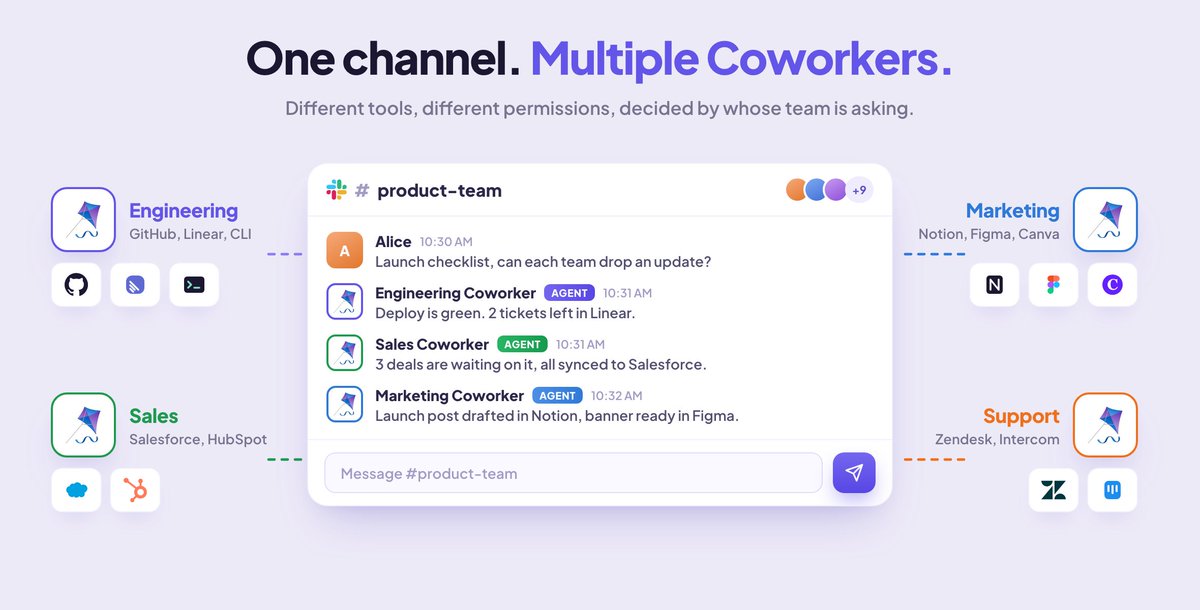
2. Native, interactive UI
With Channels SDK, you write the JSX message and the renderer compiles in the platform's native UI format.
Adaptive Cards in Teams and Block Kit in Slack, including data visualization charts validated against Slack's contract before a message is sent.

3. Continue the conversation anywhere
Because it all runs on the AG-UI Protocol, a conversation that starts in Slack can carry on in your own app, your spreadsheet, or a terminal, with the state intact.

4. Bring your own Harness for all the complexities
The agent is working alongside your whole team, so what it can reach and when it has to stop should be defined by your harness.
This includes sandboxing isolation for multiple agents, shared context, least-privilege scoping, logs of every action and who triggered it.

If the agent is going to live where your team works, learn how your team works, act on your team's behalf and then it accumulates valuable learning - the question is who owns all of that?
In a closed product, the vendor does.
Here your agent makes the model calls, on your infrastructure, with your own provider. So you own everything around it:
@CopilotKitIntelligence adds automatic learning per user and per agent, product analytics so you can see how people actually use their agents, and enterprise hosting including VPC.
Fully self-hostable.
Summary in a nutshell
The Channels SDK is open source and running in production today. Self-host yourself or let CopilotKit Intelligence run Slack and Microsoft Teams managed.
Want a complete coworker-grade agent example? Clone OpenTag on GitHub.

If you are planning to bring Channels SDK to your own team, book a call with our engineers and we will help you set it up and show you a live demo against your actual use case.
Follow @ataiiam for more.

