Making $$$ selling to AI Agents

Cloudflare launched something big around AI agents, and most people scrolled past it. The people who read it closely can build businesses that monetize in a completely new way.

I have no affiliation with Cloudflare. I want to show you the wedge, the customer, and the first version.
The old bargain is ending

For years the trade was simple. Search engines crawled your site, sent you a human, and you monetized that attention with ads, an email capture, a subscription, or an affiliate link.
The crawler got the content. The website got the visitor. That model funded a massive part of the internet.
Agents changed the flow. An AI system reads your page, pulls the answer, hands it to the user, and the visit disappears along with the ad impression, the email, and the affiliate click.
Publishers are loud about this. Publishers are also only the first inning.
The human web monetized attention. The agent web monetizes useful resources.
What Cloudflare actually shipped, in plain English

AI Crawl Control: site owners get visibility into crawler activity. You see who is accessing your content, you allow some crawlers, and you block others.
Pay Per Crawl: the direct monetization piece. A site owner charges AI crawlers for access. The crawler presents payment intent in the request, or it receives a 402 Payment Required response with the price attached.
Monetization Gateway: the bigger version. Any resource behind Cloudflare can carry payment rules: a web page, a dataset, an API, an MCP tool call, a premium endpoint, a file, a search index.
The rail is x402, built on the HTTP 402 status code. The agent requests the resource, the server states the price (usually a fraction of a penny), the agent pays and retries with proof, and Cloudflare verifies at the edge before the request reaches the origin.
The request becomes the transaction.
Ask a human to pay 0.0003 cents to read a page and they close the laptop. A machine pays it, because the data helps it finish the job.
The stack forming underneath
Messy internet → structured data → agent-readable access → payment rules → trust and analytics
Start at the left. Old blog posts, pricing pages, PDFs, YouTube videos, support docs, comparison sites.
Someone cleans that into structured data. Someone exposes it through an API, an MCP tool, a search index, a feed, or an LLMs.txt file. Someone adds payment rules, because some resources stay free for distribution, some get priced, and some stay private.
Then someone adds the trust layer: is the data fresh, is the source reliable, which agents use it, which requests are worth money.
Thousands of companies come out of that stack. So here is the question I keep asking myself: what resource does an agent need badly enough, often enough, and reliably enough to pay for?
Three answers follow.

Idea 01: The niche data refinery

Pick one niche where valuable information is messy, fragmented, changing, and annoying to collect. Turn it into clean fuel for agents.
The raw material already exists. It sits in Google Maps, job posts, reviews, local directories, PDFs, and pricing pages. Your job is refining.
The example: med spas. An owner wants to know what competitors charge, which treatments they offer, what reviews complain about, which clinics are hiring, and how the local market is moving. Today that information lives across Google reviews, competitor sites, Instagram, job posts, meta ad libraries, and a few people's heads.
Give an agent that data cleanly and it says useful things:
The value comes from the data. A generic AI wrapper delivers none of it.
The wedge:
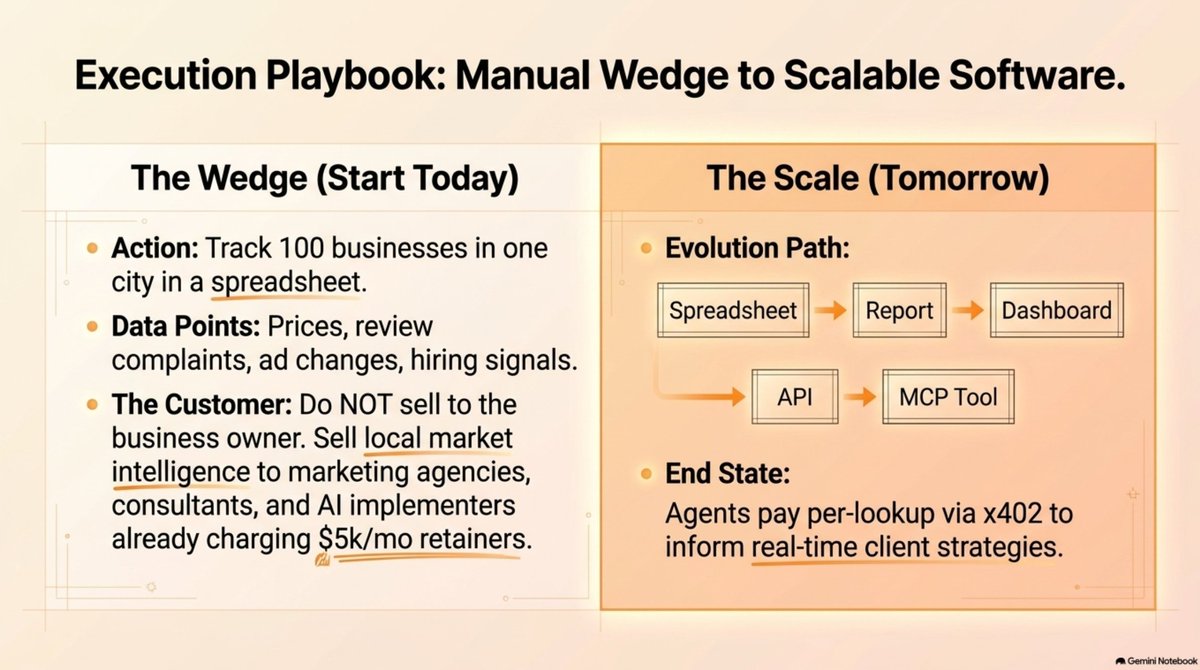
Pick one niche and one city. Track 100 businesses, manually at first.
Build a spreadsheet with business name, website, services, prices, review count, review rating, top review complaints, Instagram links, recent posts, visible ad changes, hiring signals, and booking flow.
Then create 10 outputs from it: a local pricing map, a competitor gap report, a list of offer ideas, a services-to-add recommendation, a review complaint summary, a hiring signal report, and a monthly market movement report.
Your first customer is the person already selling into the niche. Selling "agent-readable competitive analysis" to a med spa owner confuses them. Selling local market intelligence to the med spa marketing agencies, consultants, freelancers, and AI implementation people is a far easier conversation.
An agency charging a client 5K a month for a growth package can pay you $300, $500, or $800 a month when your data helps them close one more client.
Spreadsheet → report → dashboard → API → MCP tool → per-lookup payments
Med spas are one example, because I live in Miami and there are plenty of them here. Roofing works: storm events, permit data, insurance signals, competitor offers, ad angles. Real estate investing works: zoning changes, permits, ownership records, rent comps, tax delinquencies, insurance shifts. E-commerce works: competitor SKUs, pricing changes, review complaints, influencer rates, UGC hooks, Shopify apps, shipping promises.
The filter: the data should be valuable (better decisions make or save money), repeated (they need it again and again), changing (freshness matters), fragmented (one person struggles to collect it), and annoying (that is where your margin lives).
Idea 02: Agent readiness for businesses
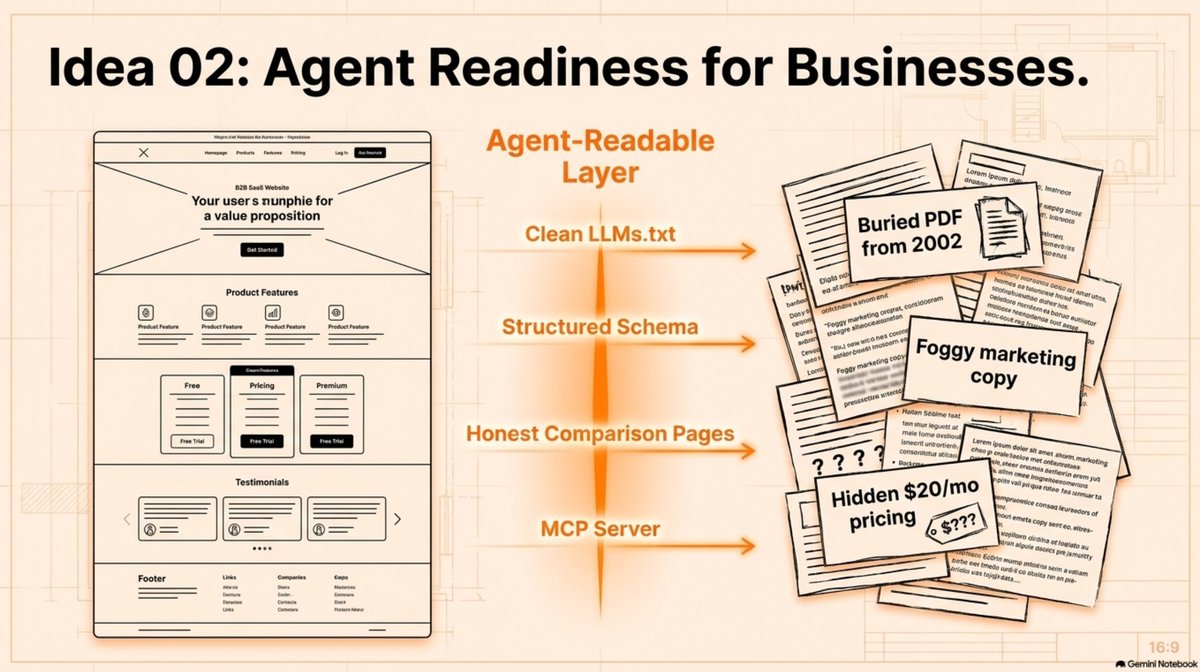
Help companies become easy for agents to understand, trust, compare, and recommend.
A human buyer lands on a homepage, clicks around, checks pricing, skims the docs, and books a demo. Agents compress that entire process into one answer.
Ask an assistant for the best payroll provider for a 15-person company in California and it has to work out who the product is for, what it costs, what it replaces, which integrations exist, what the risks are, and what customers say.
Most websites make that hard. Pricing hides, docs sit deep, comparison pages go stale, key policies live inside PDFs, and the copy stays foggy.
The wedge is a paid audit.
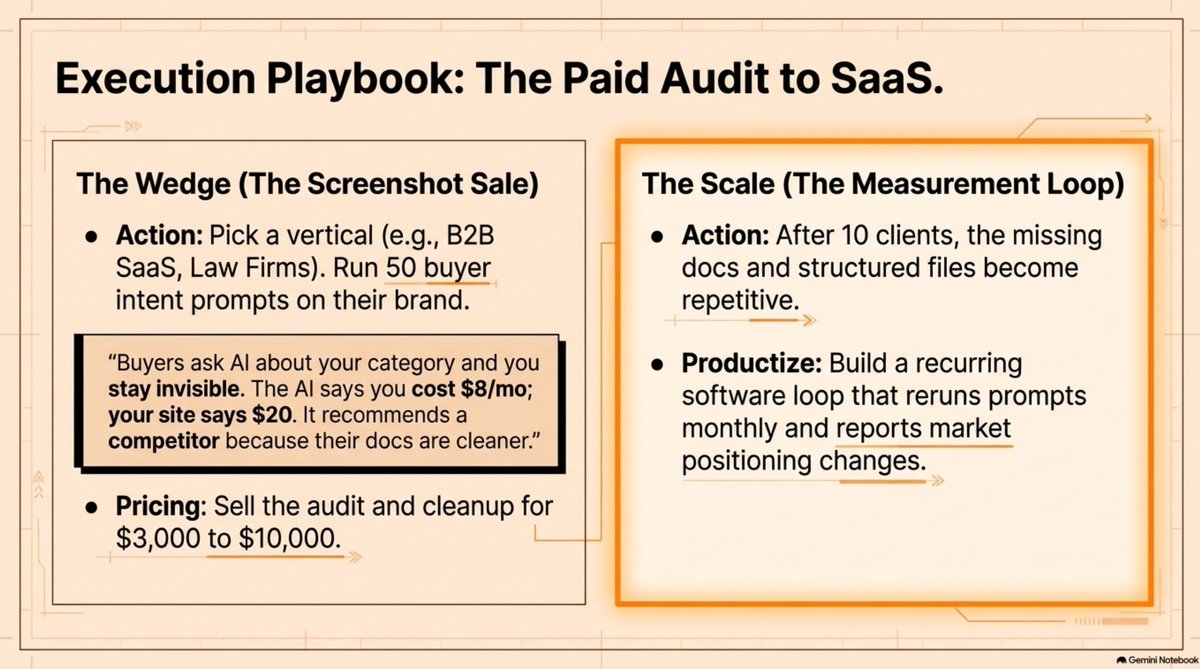
Pick one vertical: B2B SaaS, Shopify apps, law firms, health care clinics, financial advisors, insurance brokers, or home services.
Run 20 to 50 buyer intent prompts across the major AI tools. What is the best software for this use case. Compare this company to top alternatives. What does it cost. Who is it best for. What are the risks. What integrations does it support.
Then show the founder the answers. That is the sales moment:
You sell the screenshot.
The fix is an agent-readable source of truth: a clean LLMs.txt file, a better documentation structure, a pricing page agents can parse, honest comparison pages, use case pages in plain language, customer proof organized by segment, structured FAQs, schema markup, a product feed, a changelog, and a lightweight MCP server or search endpoint when the company has enough useful content.
The recurring product is the measurement loop. Every month you rerun the prompts and report what moved.
Pricing: $3,000 to $10,000 for the audit and cleanup. For larger B2B companies, $10,000 to $20,000.
After 10 clients in the same niche, the repetition shows up. The same docs are missing. The same pricing pages read as unclear. The same structured files need building. That is your moment to turn services into software.
Idea 03: Expert archives into agent tools

This one is the most fun for creators, media companies, analysts, consultants, and researchers sitting on years of content.
Today that archive earns through ads, sponsorships, subscriptions, communities, and consulting. In the agent internet, the archive becomes a tool.
Start with one job. Telling a creator "we will turn your whole brain into AI" sounds creepy and vague. Specific sells:
The build:

Pick an expert with a deep archive and a specific audience. Cold email, Shopify growth, local business acquisitions, tax strategy, and fitness programming all work well.
Collect the archive. Transcribe the videos and podcasts, pull the newsletters, clean the docs.
Tag by job, topic, audience, example, framework, and outcome. A sales archive gets tagged by prospecting, subject line, offer, objection, follow-up, personalization, deliverability, and close. A startup archive gets tagged by idea, market, wedge, distribution, pricing, MVP, community, moat, and examples.
Plenty of people get lazy here. They dump everything into a vector database and call it done, which gives you a search box with confidence. A real product needs structure.
Then build one workflow. Paste your cold email, and the agent critiques it using the expert's principles, cites the source lessons, rewrites it, scores it, and gives you one test to run. That is the product.
We do a version of this at ideabrowser.com. The MCP is one of our most popular features, because it takes your LLM and makes it better with data we have already cleaned.

The creator brings the distribution and the trust. The audience wants the expertise at a price the creator's calendar could never support: $19 a month, $50 a month, bundled into a paid community, used as a lead magnet for consulting, or licensed to agencies.
This is where Cloudflare-style monetization gets interesting. The archive becomes a resource, agents pay per request, and the creator gets paid every time the knowledge gets used. Compare that to hoping someone watches a pre-roll ad before a 47-minute interview from seven years ago.
The mistake to avoid is "chat with an expert." Too broad. "Rewrite the cold email using the sales system" is a job with an outcome.
Action checklist

Final thoughts
All three ideas share one root: agents need clean, trusted, and useful resources to do good work. That resource can be data, structure, access, expert knowledge, a tool, or a payment rule.
Cloudflare is building the access and payment layer. You can start today by building the manual version, selling the human version, and packaging the data while the space stays quiet.
Ask yourself five questions. What decision is expensive? What information is messy? What changes often? Who already pays for help? What would an agent need to do the job better?
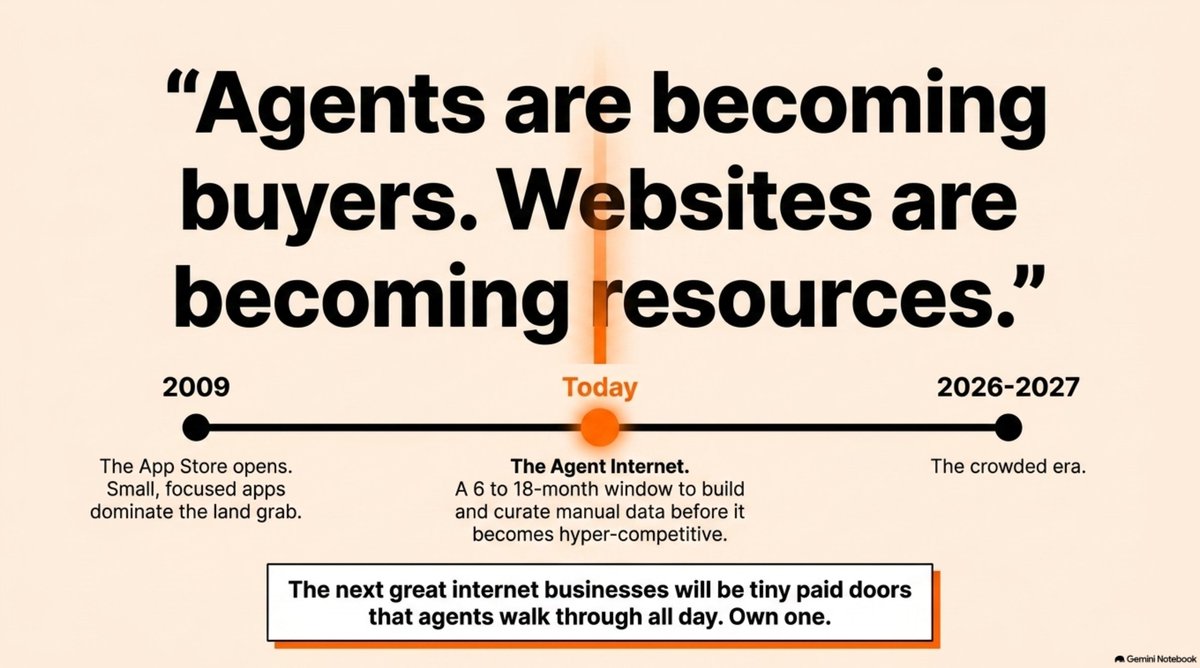
You have 6, 12, maybe 18 months to build and curate before this gets crowded. This feels like building an app when the App Store opened in 2009, and the cohort starting in 2026 and 2027 gets the same window.
The best opportunities look small right now, because the agent internet is still small relative to where it goes next.
"Agents are becoming buyers. Websites are becoming resources."
The next great internet businesses may be tiny paid doors that agents walk through all day. Own one.
