Reverse Prompting 101

Stop rewriting your prompts. Start answering the model's questions.
A sharper prompt buys you one better output. A model that interviews you first collects the context that improves everything after it.
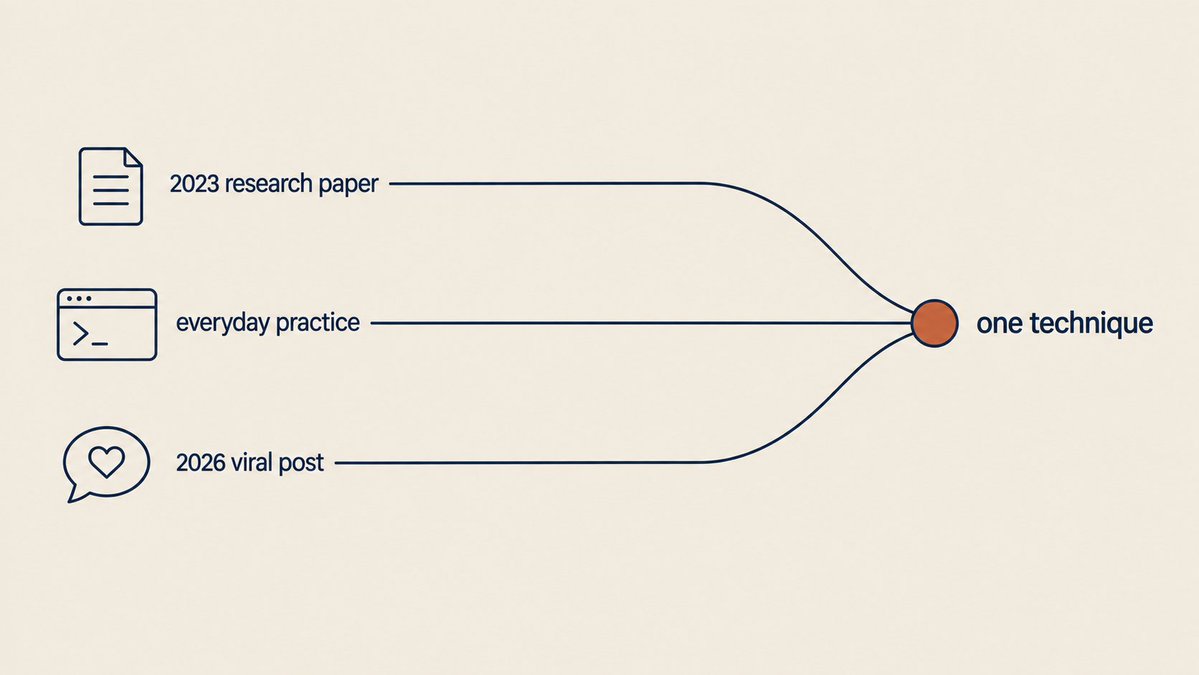
Alex Finn, the founder behind Creator Buddy, put a name on this in a July 31 post that carried the term across AI Twitter. His argument is that the models got capable enough that the bottleneck moved from their answers to your questions. His fix is reverse prompting, letting your AI ask you what it needs instead of guessing what to feed it.
Nine researchers at Vanderbilt gave the same instruction from a different angle, three years earlier. Jules White and his colleagues published a catalog of 16 prompt patterns in February 2023, and one of them, the Flipped Interaction Pattern, is reverse prompting under a lab coat.
Their version tells you to flip the conversation so the LLM drives it, because the model often picks better questions than you'd think to answer on your own. They called it an "inversion of control."
An influencer and an academic team landed on the same move without coordinating. Convergence like that usually marks a real technique, not a naming fad.
Reverse prompting is an interaction pattern. You give the model a goal, tell it to ask you questions until it has what it needs, and only then let it produce the work.
One naming collision to clear before we build. Researchers also use "reverse prompt engineering" for an unrelated practice, inferring from a finished AI output what prompt produced it. Useful field, different skill. This article covers the interview technique, the one on your feed.

What reverse prompting actually is
The Vanderbilt pattern works because the information gap between you and the model runs in both directions.
You know things the model doesn't, like your goals, your constraints, your audience, and the thing you tried last month that failed. The model knows which of those details change the output, and which details you skip because you didn't know they mattered.
A normal prompt forces you to guess what to include. Reverse prompting hands that guess to the party better equipped to make it. The model asks, you answer, and by the end you've dictated a requirements document you never had to sit down and write.
White's team named two ingredients the pattern needs. The model needs a stated goal, so its questions stay aimed at something. The interaction needs a stopping condition, so the interview ends when the model has enough.
Goal in, questions out, output when the questions run dry.

Start with the one-line flip
The simplest version costs you one sentence. Take any task you'd normally prompt and append this line.
Before you answer, ask me the questions you need to do this well. One at a time.
That single line turns a guessing game into an intake session. Run it on the next task where your first instinct is to write three paragraphs of context. The model will ask about half of what you planned to include, plus two things you hadn't considered.
The wider version of the exercise traces back to Finn's post. Brain dump your goals, your career situation, and your current projects into the chat, then run these two prompts in sequence.
Based on everything I just told you, what else do you need to know to help me reach these goals faster?
What tasks could you take off my plate right now to move me toward them?
The first prompt extracts context. The second converts that context into a work queue.
Run the pair once and you'll walk away with a task list you didn't have an hour earlier, drawn from the delegable work you'd mentally filed under "things only I can do."
One guardrail before you scale this. Skip the 20-question intake ritual on day one. A question-first habit applied to your ambiguous tasks beats a folder of saved prompt templates, because templates freeze your best guess and the interview adapts to each task.

Make the flip permanent
The one-line version resets every chat. The compounding version lives in a standing instruction.
Every major AI tool has a slot for persistent instructions, whether that's a custom instructions field, a project file, a system prompt, or a context document. Put the flip there.
For any task that is ambiguous or larger than a single output, interview me before producing anything. Ask one question at a time. Stop when you have what you need.
Once that instruction persists, reverse prompting stops being a technique you remember and becomes the default shape of your sessions.
A developer writing under the handle taarimalta on DEV Community documented years of running this exact setup, and his April 2026 account is worth reading for one detail. He invented the technique on his own, named it reverse prompting on his own, and learned about the Vanderbilt paper mid-article because the AI interviewing him mentioned the academic literature.
That's now three independent origins. Finn, White's team, and a developer who found it by using it.
His workflow adds course correction, the piece most people miss. When the model asks a wrong or lazy question mid-interview, he answers with a correction and extra context, and the session gets back on track. Steering the questions is part of the job, along with answering them.
What the interview sounds like in five fields
The pattern is identical everywhere. The questions it surfaces aren't, and the questions are where the value hides.
Marketing. A strategist asks for a campaign plan. The model's third question was "What did the last campaign for this product spend per acquired customer, and what number makes this one a failure?" She asked for a plan. The model asked for a kill criterion, and the plan that came back had budget gates she wouldn't have specified.
Software. A developer asks for a data-processing script. Question two from the model was "What should happen when a row is malformed, skip it, halt, or log and continue?" That question separates a demo script from one that survives real input, and it's the requirement developers forget to state because the happy path is the only one they picture.
Teaching. Flipped interaction already has a research track record in classrooms, where it powers student-driven peer questioning instead of static Q&A. A teacher planning a unit gets asked what misconception students usually arrive with. The lesson that follows targets the misconception instead of restating the textbook.
Client work. A freelance designer pastes in a client brief and asks the model to interview her before drafting concepts. The fourth question was "The brief says 'modern but timeless.' Which existing brand does the client point at when they say that?" That question is the project. The model asked it in the first five minutes instead of revision round three.
Your own week. The task-audit pair from earlier, run on a Sunday, goals in first, then the plate-clearing prompt. The output that surprises people is the boring middle layer, the follow-up emails, the meeting prep documents, the first drafts of recurring reports, sitting in plain sight the whole time.
Five fields, one pattern. In each case, the question that mattered was one the human wouldn't have volunteered. That's the working test. A good interview should make you pause at least once.

Know when to flip back
Reverse prompting fails in two predictable ways.
Short, unambiguous tasks gain nothing from an interview. "Rewrite this sentence" plus three clarifying questions costs you three turns and returns nothing.
Taarimalta conceded the point when the AI interviewing him pushed back on his claim that the technique never backfired. A method that works for everything is a suspicious claim, and the interview pays off on tasks with enough ambiguity or scope to justify it.
Interviews also drift. Left unsteered, a model can burn turns on obvious questions or wander off the goal. Each fix is already on the page. State the goal, set a stopping condition, take one question at a time, and correct course when a question misses.
As a rule of thumb, flip when the task is fuzzy, big, or new, and prompt normally when it's small and precise. Telling the two apart takes about a week of practice, because the feedback is immediate. A wasted interview is obvious by question two.
What your job becomes
You stop performing a strange ritual of the prompt era, sitting in front of a system built for dialogue and composing a perfect monologue at it. The prompt box stops feeling like a blank page, because the opening move is no longer yours to author. You state a goal and answer what comes back.
The skill that compounds from there is self-knowledge. The interview is only as good as your answers, and you get more out of every question when you know your goals, constraints, and taste well enough to state them.
Prompt libraries depreciate with every model release. Knowing what you want doesn't.
The thinking still belongs to you. What drops away is the transcription of that thinking into prompt format, and your attention moves to the work that needs a human. You judge the answers, steer the interview, and decide what ships.
Two people who never met, an academic team in 2023 and a builder in 2026, handed you the same instruction.
The best prompt you'll write this year ends with a question mark pointed at you.
Start this week, and you're a quarter ahead of everyone still polishing monologues.
LLMs don't think, you do.
If you found this useful, check out my newsletter below
I share one AI superpower every week
Subscribe, it’s free👇


