@teortaxesTex ↔ @SomethingOnSnow ↔ @Dshoopy0 ↔ @problem04783065 conversation

Teortaxes▶️ (DeepSeek 推特🐋铁粉 2023 – ∞)@teortaxesTex
68 views
Aug 02, 2026
~9 min read
Advertisement
Teortaxes▶️ (DeepSeek 推特🐋铁粉 2023 – ∞)@teortaxesTex
Don't get blended, anon…

AuswaertigeAngelegenheiten@AuswaertigeA
Not true. China needs Europe and our market more than anything atm. Don't be blended by the Potemkin village they have built.

Sean@SomethingOnSnow
China has reached such a level of development that westerners believe the pictures they see are of limited areas, the Potemkin village complaint.
What they see as an unbelievable same level of development covers about a billion people.
What they see as an unbelievable same level of development covers about a billion people.

Dshoopy 🇺🇸@Dshoopy0
The pictures are definitely of limited areas, lets not pretend China doesn't have it's rural shitholes and slums.
They are definitely advanced, in some cases even more so then the US, and on a large scale too. But their baseline goes a lot lower then ours.
All of China is not like shanghai or Guangzhou
They are definitely advanced, in some cases even more so then the US, and on a large scale too. But their baseline goes a lot lower then ours.
All of China is not like shanghai or Guangzhou

problem@problem04783065
I was there last year and spent half my time in Shanxi province, a relatively poor part of China (akin to say the rust belt). There were parts that were certainly poor, but no part of it was a "slum", and if anything I would say the North American baseline actually goes lower.
Dshoopy 🇺🇸@Dshoopy0
I am talking about the whole. I have no idea if your specific slice has a higher baseline or not.
Effectively 100% of US households have access to power, with a few exceptions, just to put things into perspective. Complete plumbing isn't far behind.
Effectively 100% of US households have access to power, with a few exceptions, just to put things into perspective. Complete plumbing isn't far behind.
problem@problem04783065
I am talking about the whole as well and your stat is also true of China; effectively 100% have access to power. Plumbing is also widespread, except for some old housing stock that's hard to renovate (e.g. Beijing's hutongs).
tradingeconomics.com/china/access-t…
data.worldbank.org/indicator/EG.E…
tradingeconomics.com/china/access-t…
data.worldbank.org/indicator/EG.E…
Dshoopy 🇺🇸@Dshoopy0
I am not talking about access to electricity, I am talking about effectively all of our homes are outfitted with it to a high degree.
The world bank data is very lenient on what it considers access to electricity. You only have to achieve a tier 1 by their metrics to qualify.
Every home in the US hits a tier 4 or 5.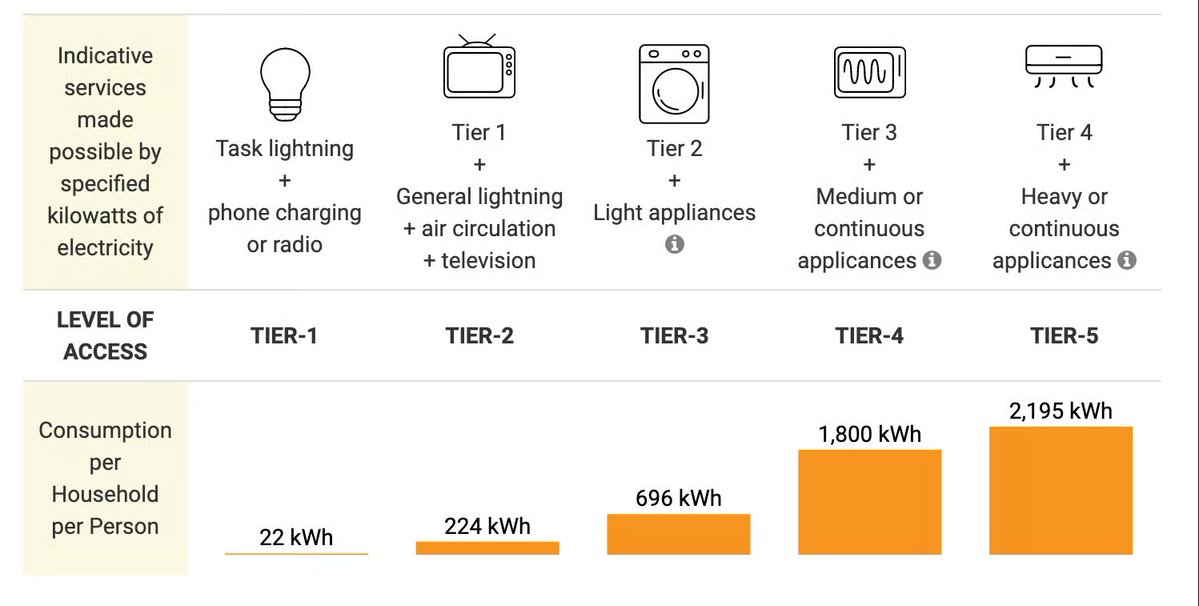
The world bank data is very lenient on what it considers access to electricity. You only have to achieve a tier 1 by their metrics to qualify.
Every home in the US hits a tier 4 or 5.
problem@problem04783065
The problem with using this MTF analysis is that it's mostly applied to developing countries. China isn't included since its level of electrification is so high, and frankly the US hasn't been analysed with this framework. Not sure there's enough data to draw your conclusion.
Dshoopy 🇺🇸@Dshoopy0
I am looking at this from the view of our own infrastructure, my observation is relative to our own baseline which was my original point. Our baseline is a 4 or a 5.
The Worldbank dataset only asks if a household has a connection or uses electricity. It's very loose in it's criteria. Both official Chines and WorldBank criteria are roughly "physical availability of an electricity connection capable of basic use" they do not have stricter criteria such as capacity, reliability, etc.
My point is that the US is verifiable at a level 4 or 5 as a baseline. That cant be said for China, their connection efforts did not have such stringent requirements when connecting their unconnected populace.
I still believe my original point to be true.
The Worldbank dataset only asks if a household has a connection or uses electricity. It's very loose in it's criteria. Both official Chines and WorldBank criteria are roughly "physical availability of an electricity connection capable of basic use" they do not have stricter criteria such as capacity, reliability, etc.
My point is that the US is verifiable at a level 4 or 5 as a baseline. That cant be said for China, their connection efforts did not have such stringent requirements when connecting their unconnected populace.
I still believe my original point to be true.
Dshoopy 🇺🇸@Dshoopy0
"and frankly the US hasn't been analysed with this framework." We don't need to be analysed by this framework. We have building code that is enforced strictly. And any homes that were produced before our building code was created have been retrofit since then by professionals to the same standard.
problem@problem04783065
I'm aware of this limitation of the World Bank dataset. It was relevant to your initial statement of "100% access to electricity", but any claims beyond that cannot be substantiated (yes, including the claim that the US satisfies this as a baseline).
problem@problem04783065
Building codes exist, sure, but then there's the assertion that every single house has been retrofit (an assumption) and also the focus on housing stock when some sizeable proportion of the US poor lives in mobile homes e.g. trailers which can have electricity access issues.
problem@problem04783065
Like it may be possible there's a larger portion of the Chinese population with lower level of electricity access, there's just no good data to suggest that other than your assumptions.
In every aspect that can be objectively verified they are mogging the US in infrastructure.
In every aspect that can be objectively verified they are mogging the US in infrastructure.
Dshoopy 🇺🇸@Dshoopy0
"but then there's the assertion that every single house has been retrofit" I was not specific here, I mean the vast majority have been, there are for sure few exceptions.
"Like it may be possible there's a larger portion of the Chinese population with lower level of electricity access, there's just no good data to suggest that other than your assumptions." This is not correct, this is not my assumption. Our whole country is very thoroughly governed and managed, if they find that you built anything illegally they often force you to destroy the structure.
You basically cant build anything without getting it approved by the government, beyond small things like temporary small scale structures like a shed. This has been the case for a long time, and building created before that are not unaccounted for, that is why we have data to determine how many have been retrofit.
"Like it may be possible there's a larger portion of the Chinese population with lower level of electricity access, there's just no good data to suggest that other than your assumptions." This is not correct, this is not my assumption. Our whole country is very thoroughly governed and managed, if they find that you built anything illegally they often force you to destroy the structure.
You basically cant build anything without getting it approved by the government, beyond small things like temporary small scale structures like a shed. This has been the case for a long time, and building created before that are not unaccounted for, that is why we have data to determine how many have been retrofit.
problem@problem04783065
I am not saying that there's a proliferation of illegally built structures in the US, I am saying that you haven't supported the idea that everything has been retrofitted. Nobody tracks every single out-of-pocket upgrade across your roughly 144 million total housing units.
problem@problem04783065
There is, of course, also the fact that quick and cheap housing that's not always super up to building code serves a useful social function. For example I have never seen any homelessness in China, but they're extremely visible in the urban cores of North American cities.
problem@problem04783065
The persistent overregulation in the West might be making social mobility worse. "Urban villages" might be unsightly, but they're safe places with very low rents and are a pretty big lifeline for those who depend on them, which is why people protest their demolishment.
problem@problem04783065
Besides, the debate was not about the average, but the baseline of development (this does not necessarily always mean infrastructure, either). I can tell you that there are many places in North America I wouldn't step foot in if you paid me, whereas the same isn't true for China.
Dshoopy 🇺🇸@Dshoopy0
Clarification on something I said earlier:
When I said the vast majority of houses have been retrofitted, I was not claiming that every single older home has undergone a full professional upgrade to the absolute latest building code. That was too strong and isn’t something that’s comprehensively tracked.
What the data does support is that most lived-in homes (including older ones) have sufficient electrical capacity and reliability to sit at Tier 4 or 5 on the MTF scale. Panel sizes and outage statistics put the large majority of occupied US housing well above the thresholds for those tiers.
Basically I am just trying to make the argument that the US baseline is higher than China’s purely on a basis of infrastructure based on the evidence available to me. I have no way to prove that the vast majority of lived in Chines homes is at a tier 4 or 5 on the MTF scale.
This is entirely a argument about infrastructure, nothing else, we have our own issues to fix on other metrics.
One comment on our homelessness problem, I believe it's manufactured and full of fraud, in some places they spend as much money per person as the median wage.
For a specific point of reference you can refer to these, they help provide a baseline.
eta-publications.lbl.gov/sites/default/…
aceee.org/sites/default/…
When I said the vast majority of houses have been retrofitted, I was not claiming that every single older home has undergone a full professional upgrade to the absolute latest building code. That was too strong and isn’t something that’s comprehensively tracked.
What the data does support is that most lived-in homes (including older ones) have sufficient electrical capacity and reliability to sit at Tier 4 or 5 on the MTF scale. Panel sizes and outage statistics put the large majority of occupied US housing well above the thresholds for those tiers.
Basically I am just trying to make the argument that the US baseline is higher than China’s purely on a basis of infrastructure based on the evidence available to me. I have no way to prove that the vast majority of lived in Chines homes is at a tier 4 or 5 on the MTF scale.
This is entirely a argument about infrastructure, nothing else, we have our own issues to fix on other metrics.
One comment on our homelessness problem, I believe it's manufactured and full of fraud, in some places they spend as much money per person as the median wage.
For a specific point of reference you can refer to these, they help provide a baseline.
eta-publications.lbl.gov/sites/default/…
aceee.org/sites/default/…
problem@problem04783065
You aren't able to make that conclusion based on the evidence available to you, that epistemology is shit. If you don't have evidence for one half of a comparison then you don't have evidence to make that comparison at all! This is a completely flawed way to draw conclusions.
problem@problem04783065
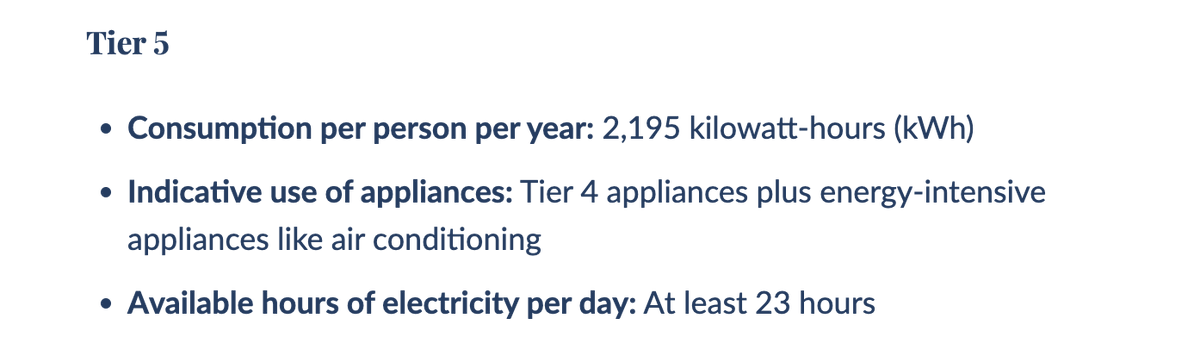
But you do have evidence that the majority of lived in Chinese homes are at a tier 5 on the MTF scale, at least by proxy. Air conditioning ownership by household in China is at about 80%, which means that at least 80% of households are Tier 5 in China.
ourworldindata.org/grapher/househ…
ourworldindata.org/grapher/househ…
problem@problem04783065
Note that Tier 5 in the MTF scale includes usage of "energy-intensive" appliances like air conditioning, and it is a good proxy for energy access. US ownership rates are higher but Northern China is also extremely cold in comparison to the US so that disparity is to be expected.
problem@problem04783065
Chinese households also very much satisfy the "at least 23 hours per day" requirement. Reliability is high in both urban and rural areas, and outages are not common. It's extremely likely that the vast majority of Chinese households are Tier 5 on the MTF scale.

Dshoopy 🇺🇸@Dshoopy0
You need to provide evidence of these claims beyond your personal statement. Provide sources that support your claims. I am not going to take your word for it. "Chinese households also very much satisfy the "at least 23 hours per day" requirement." are you talking about all of them? and if so where is this stated or recorded. If we are going to make the claim that all of china is tier 5 then you need data that supports as much.
problem@problem04783065
BTW, speaking of your data, your specific sources regarding "US households" also only specifically survey single-family homes that are attached or detached. Given that a good portion of America lives in apartment blocks, your data is woefully incomplete.

problem@problem04783065
Consider also that you did not provide evidence for your claim early on, and you continued to make false assertions - including stating that there was some kind of data about how many have been retrofit - I will consider this special pleading.
problem@problem04783065
Consider ALSO that you were the one who made the claim about the baseline of China being lower than the US, and the burden of proof pretty much entirely lies on you, not me, considering I am the one disputing your claim.
problem@problem04783065
You do not get to point to a lack of information on the Chinese end and then claim that proves your point.
problem@problem04783065
With regards to sourcing, most of this is based off Chinese reporting, but here; annual average power outage time per user was 7.83 hours per year, and annual average power outage frequency per user was 2.30 times. This easily falls within Tier 5 access.
nea.gov.cn/2024-06/27/c_1…
nea.gov.cn/2024-06/27/c_1…
problem@problem04783065
Now this is an average and it's likely that average conceals regional variation, but let's say I consider it unlikely that a significant percentage of the Chinese population is falling under Tier 4 levels of availability and reliability (which allows for 14 disruptions per week).