Andoni Iraola still has a lot of question marks around him, but the...

EBL@EBL2017
179 views
Aug 19, 2026
~14 min read
Advertisement
1
Andoni Iraola still has a lot of question marks around him, but the Sunderland game showcased tactical qualities Liverpool haven't seen in a LONG TIME.
Below, in this in-depth thread, I break down how Iraola set Liverpool up to a 🔝 standard on AND off the ball…
THREAD! 🚨👇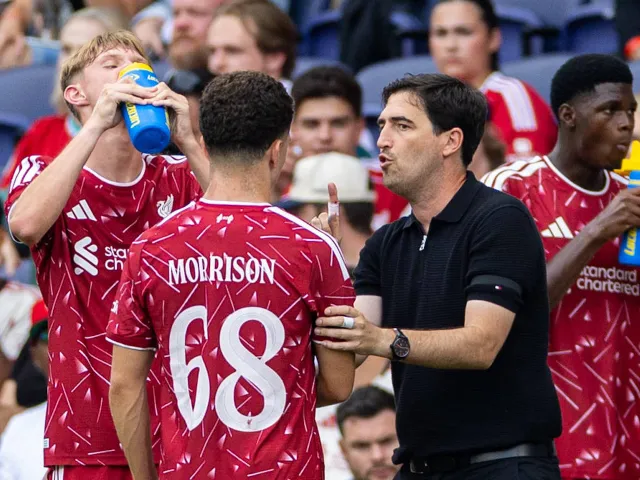
Below, in this in-depth thread, I break down how Iraola set Liverpool up to a 🔝 standard on AND off the ball…
THREAD! 🚨👇
2
Before starting the analysis, I want to address the quality of the personnel that Liverpool on the pitch with much of the first XI not being available to pick from.
Despite that, I can assure you that Iraola will play the EXACT same way when these guys come for pre-season. 100%.
Despite that, I can assure you that Iraola will play the EXACT same way when these guys come for pre-season. 100%.
3
Iraola's identity is EXTREMELY clear, both with and without the ball.
His Bournemouth team played the same way week in, week out.
And, in his first Liverpool game, we saw an exact tactical replica of that idea.
Let's start with the ball as Liverpool built in a fluid 4-2-4.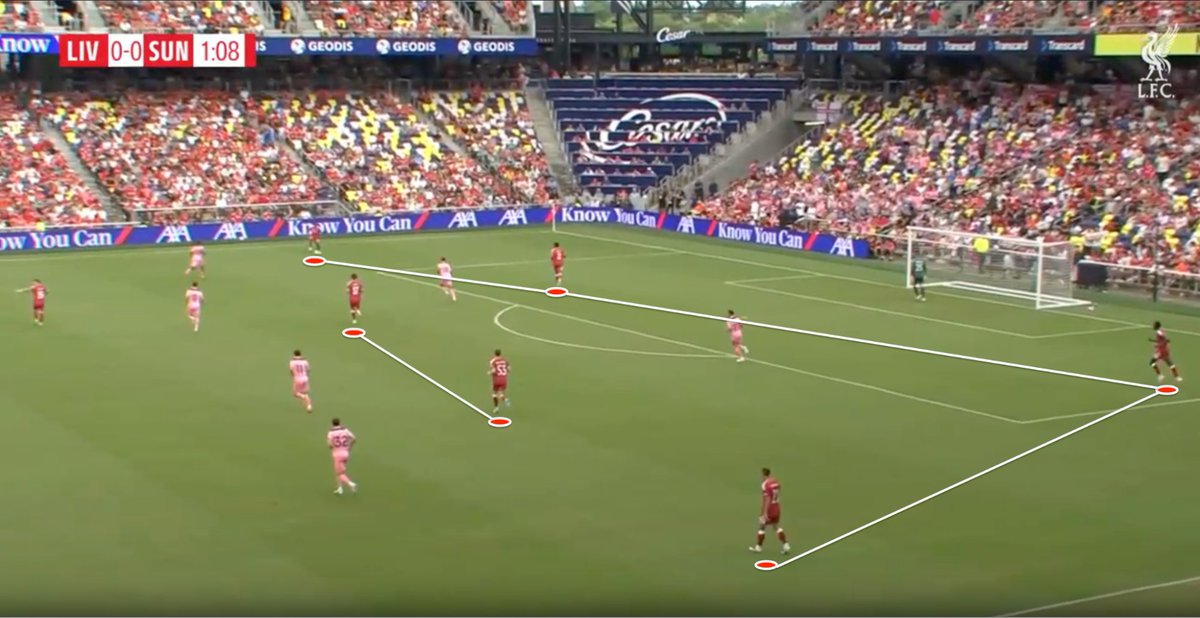
His Bournemouth team played the same way week in, week out.
And, in his first Liverpool game, we saw an exact tactical replica of that idea.
Let's start with the ball as Liverpool built in a fluid 4-2-4.
4
The detail in this moment was good to exploit Sunderland's man-to-man press.
Mamardashvili attracted pressure, McConnell arrived in the #6 to bounce out to the spare man, and Ndukwe took the space ahead of him before playing into 1v1 situations high.
This is very Unai Emery or Roberto De Zerbi esque from Iraola.
Instead of playing one pass short to the goalkeeper and playing direct passes to 1v1's on the top line from there, he wants to progress the ball further up the pitch before playing balls into the front.
Why?
Because the passing distance is shorter if you use an outfield player to find forwards in the top line.
You can deliver more quality into the front with speed as opposed to relying on floated balls from the goalkeeper which can often be difficult to control, predictable for defenders to manage, and it lets the opposition players ahead of that track back to recover.
Of course it makes sense to play direct with the goalkeeper when under pressure, but otherwise it is optimal to increase the quality of the pass into the forwards despite the risk of losing the ball close to your own goal.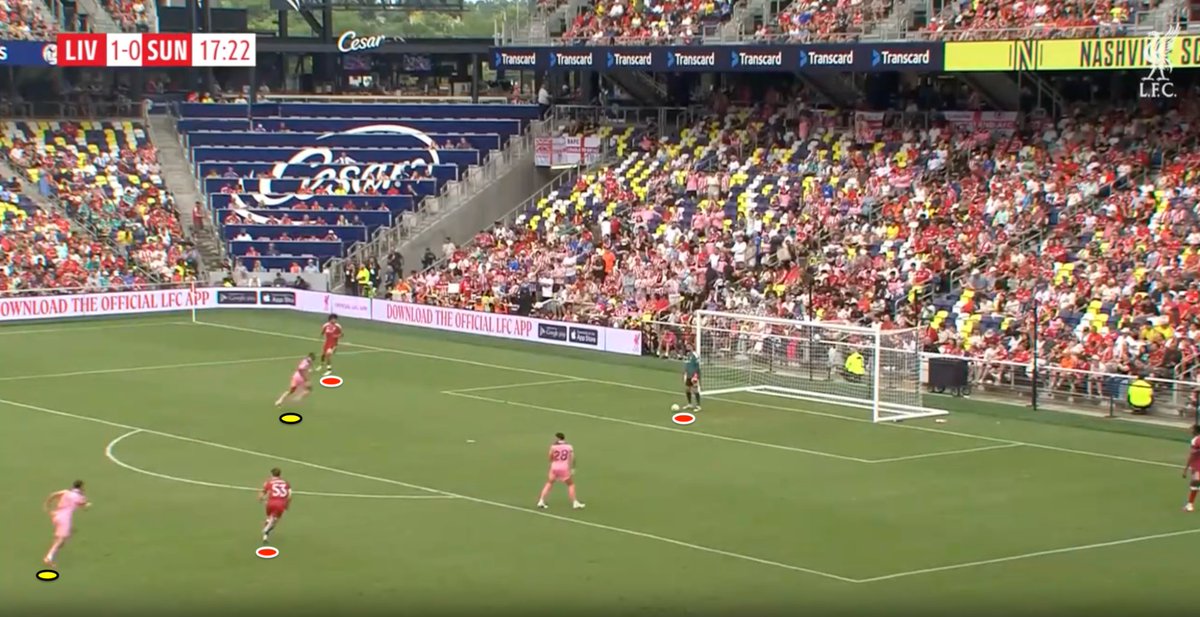


Mamardashvili attracted pressure, McConnell arrived in the #6 to bounce out to the spare man, and Ndukwe took the space ahead of him before playing into 1v1 situations high.
This is very Unai Emery or Roberto De Zerbi esque from Iraola.
Instead of playing one pass short to the goalkeeper and playing direct passes to 1v1's on the top line from there, he wants to progress the ball further up the pitch before playing balls into the front.
Why?
Because the passing distance is shorter if you use an outfield player to find forwards in the top line.
You can deliver more quality into the front with speed as opposed to relying on floated balls from the goalkeeper which can often be difficult to control, predictable for defenders to manage, and it lets the opposition players ahead of that track back to recover.
Of course it makes sense to play direct with the goalkeeper when under pressure, but otherwise it is optimal to increase the quality of the pass into the forwards despite the risk of losing the ball close to your own goal.
5
Higher up, we saw Iraola's classic 4-3-3.
However, unlike most modern coaches, Iraola does not operate through a positional play paradigm.
What do I mean by that?
Iraola prioritises specific player relationships and if those dynamics are adhered to, the collective has balance as a result of that.
Let me explain…
However, unlike most modern coaches, Iraola does not operate through a positional play paradigm.
What do I mean by that?
Iraola prioritises specific player relationships and if those dynamics are adhered to, the collective has balance as a result of that.
Let me explain…
6
Iraola is heavily influence by Bielsa out of possession, but also when his teams have the ball.
Bielsa's Bilbao team were famous for their 'double width' on the sides where the fullback and winger constantly interchange, dribble, combine, and make runs from deep.
A key component of that dynamic is the fullback and winger operating on different lines.
We see that here as Ngumoha has the ball on the touchline with Tsimikas inside the pitch.
Iraola doesn't like straight lines on the side because it is hard for players to combine in straight lines. When you operate diagonally from one another, you create better angles to combine and interchange in whilst also being more unpredictable for the opposition to manage.
We saw a great example of that being successful as it directly lead to Liverpool's first goal.
Rio drifted inside the pitch with Tsimikas wide. Rio then received in an unconventional area for a winger, drove through the centre of the pitch, and Morrison punished Sunderland off the back of a speedy Liverpool attack.
That's the thing about Iraola's idea. He gives players freedom to do what they think is right in each moment, albeit within the confines of the dynamics of the system. That creative license given to the players resulted in the creation of Liverpool's first goal.


Bielsa's Bilbao team were famous for their 'double width' on the sides where the fullback and winger constantly interchange, dribble, combine, and make runs from deep.
A key component of that dynamic is the fullback and winger operating on different lines.
We see that here as Ngumoha has the ball on the touchline with Tsimikas inside the pitch.
Iraola doesn't like straight lines on the side because it is hard for players to combine in straight lines. When you operate diagonally from one another, you create better angles to combine and interchange in whilst also being more unpredictable for the opposition to manage.
We saw a great example of that being successful as it directly lead to Liverpool's first goal.
Rio drifted inside the pitch with Tsimikas wide. Rio then received in an unconventional area for a winger, drove through the centre of the pitch, and Morrison punished Sunderland off the back of a speedy Liverpool attack.
That's the thing about Iraola's idea. He gives players freedom to do what they think is right in each moment, albeit within the confines of the dynamics of the system. That creative license given to the players resulted in the creation of Liverpool's first goal.
7
On the right, we see the same principles albeit within a slightly different dynamic.
First, let's talk about the midfield 3 to help us further understand how Iraola wants his team to play.
The balance is clear - #6, #8, #10.
The #8 is ALWAYS on the left and the #10 is ALWAYS on the right.
The #8 has license to roam vertically from low to high or from high to low whereas the #10 is often much more disciplined positionally to stay high and between the lines. At Bournemouth, the #8 was Alex Scott (a very technical profile) and the #10 was Kroupi (closer to a second-striker than a midfielder). With McConnell being the #8 and Elliott being the #10, we saw the same dynamic in Iraola's first game at Liverpool.
On the right, we see Frimpong and Morrison on the same attacking line and Elliott tucked inside in the half space. Because Frimpong is not low and inside the pitch like many positional play coaches do nowadays with inverted fullbacks, this gives the #6 the license to drift across to the right to occupy that empty central space.
When that happens, the left #8 tucks inside the pitch into the central #6 and Jones supports the right-sided triangle of the right back, the right winger, and the right #10 by giving them an option at the base of their wide triangle whilst allowing Frimpong to push on and play higher as opposed to in front of the opposition's lines.
We see that here as Jones is low, McConnell supports as the #6 in the middle, the fullback and winger are on different lines (with Morrison wide and Frimpong inside), and Elliott is between the lines.
These on-ball patterns are exactly what Iraola used at Bournemouth. It is a DIRECT replica.
We also see the same dynamic on the left when McConnell supports Tsimikas and Rio at the base of their dynamic whilst also having license to combine, interchange, and run beyond himself.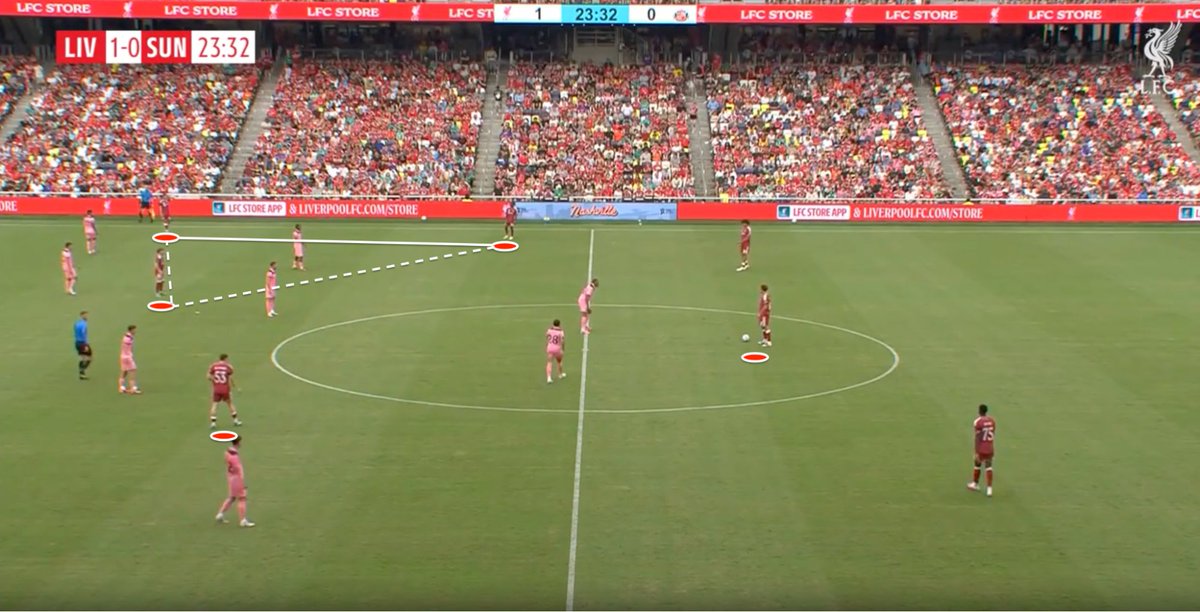

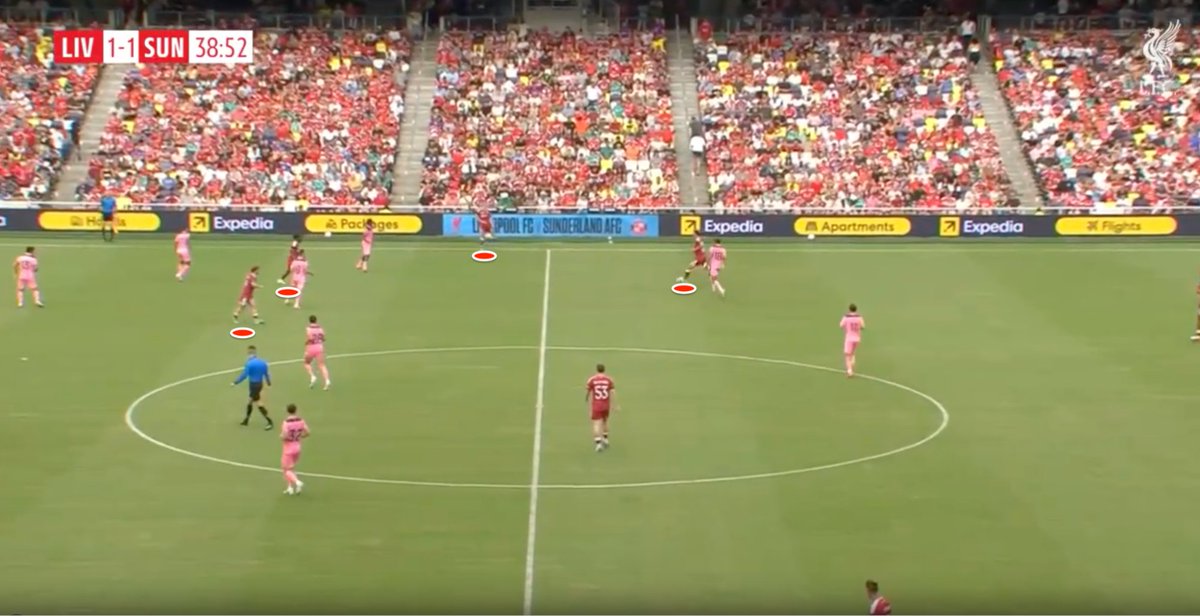
First, let's talk about the midfield 3 to help us further understand how Iraola wants his team to play.
The balance is clear - #6, #8, #10.
The #8 is ALWAYS on the left and the #10 is ALWAYS on the right.
The #8 has license to roam vertically from low to high or from high to low whereas the #10 is often much more disciplined positionally to stay high and between the lines. At Bournemouth, the #8 was Alex Scott (a very technical profile) and the #10 was Kroupi (closer to a second-striker than a midfielder). With McConnell being the #8 and Elliott being the #10, we saw the same dynamic in Iraola's first game at Liverpool.
On the right, we see Frimpong and Morrison on the same attacking line and Elliott tucked inside in the half space. Because Frimpong is not low and inside the pitch like many positional play coaches do nowadays with inverted fullbacks, this gives the #6 the license to drift across to the right to occupy that empty central space.
When that happens, the left #8 tucks inside the pitch into the central #6 and Jones supports the right-sided triangle of the right back, the right winger, and the right #10 by giving them an option at the base of their wide triangle whilst allowing Frimpong to push on and play higher as opposed to in front of the opposition's lines.
We see that here as Jones is low, McConnell supports as the #6 in the middle, the fullback and winger are on different lines (with Morrison wide and Frimpong inside), and Elliott is between the lines.
These on-ball patterns are exactly what Iraola used at Bournemouth. It is a DIRECT replica.
We also see the same dynamic on the left when McConnell supports Tsimikas and Rio at the base of their dynamic whilst also having license to combine, interchange, and run beyond himself.
8
When assessing Iraola's team, it matters much less about numbers and formations than it does dynamics and player relationships.
The 4-3-3 base is clear, sure, but that is far too reductionist of a label to incorporate the left and right-side dynamics which are very clear to see.
The only players that are 'fixed' positionally are the centre backs and the #9.
The 4-3-3 base is clear, sure, but that is far too reductionist of a label to incorporate the left and right-side dynamics which are very clear to see.
The only players that are 'fixed' positionally are the centre backs and the #9.
9
Defensively, Liverpool were set-up in Iraola's classic diamond press.
From the opposition goal kick, you will ALWAYS see Liverpool's #9 and #10 ready to press the centre backs.
Behind that, the press depends on how the opposition shape up in midfield.
If they have a single pivot, Liverpool's #8 will lock onto him with the #6 splitting the #8 and #10.
If they have a double pivot, Liverpool's #8 will split the double pivot with the #6 marking the #10 behind him.
Once again, let me explain…
Sunderland built with a double pivot from goal kicks which saw McConnell position himself in between their two #6's. He does this because it allows him to press the ball-side #6 and to stay close to both of them.
Instead of locking on man-to-man across the pitch, this approach gives Liverpool the opportunity to keep a numerical advantage at the back.
Sunderland go long and Liverpool have a 4v3 overload to manage the direct play.
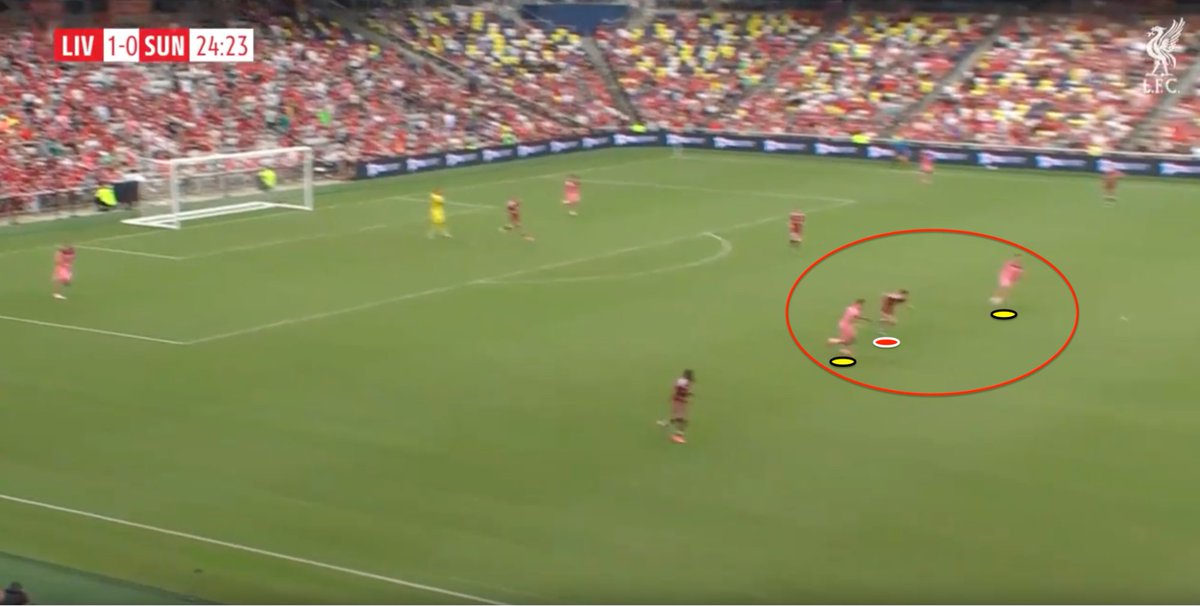
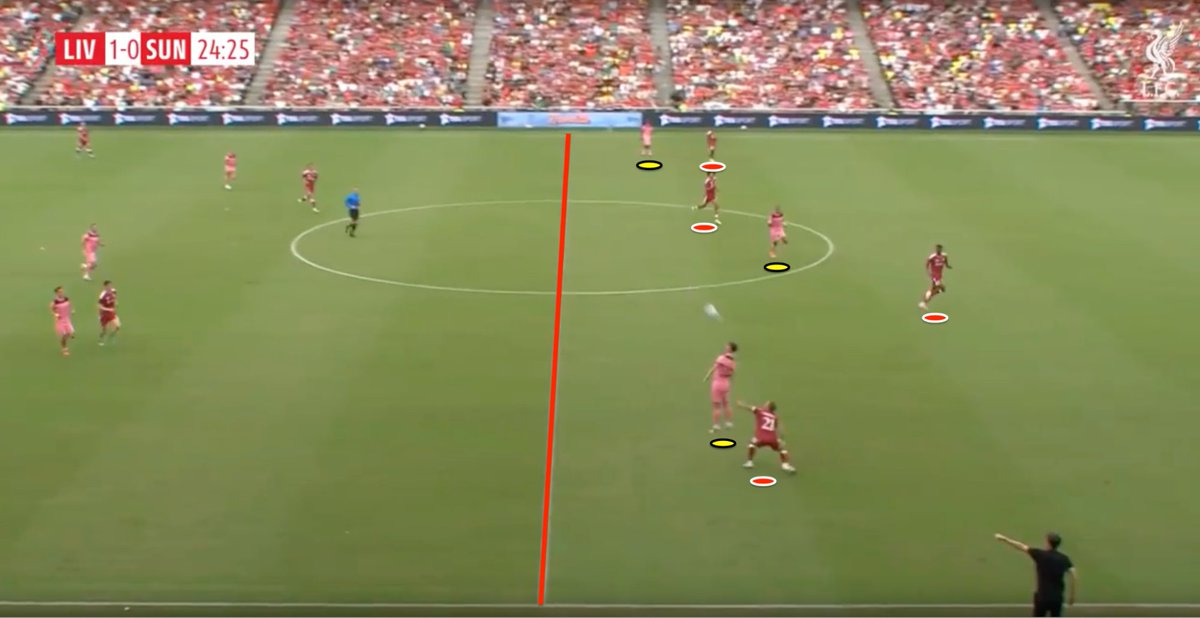
From the opposition goal kick, you will ALWAYS see Liverpool's #9 and #10 ready to press the centre backs.
Behind that, the press depends on how the opposition shape up in midfield.
If they have a single pivot, Liverpool's #8 will lock onto him with the #6 splitting the #8 and #10.
If they have a double pivot, Liverpool's #8 will split the double pivot with the #6 marking the #10 behind him.
Once again, let me explain…
Sunderland built with a double pivot from goal kicks which saw McConnell position himself in between their two #6's. He does this because it allows him to press the ball-side #6 and to stay close to both of them.
Instead of locking on man-to-man across the pitch, this approach gives Liverpool the opportunity to keep a numerical advantage at the back.
Sunderland go long and Liverpool have a 4v3 overload to manage the direct play.
10
On this occasion, Sunderland build out from the back with a single pivot.
Liverpool's #9 and #10 press the centre backs as per usual and McConnell locks onto the #6.
Sunderland play out to their left which means that Rio Ngumoha's tactical role becomes vital.
In a man-to-man defensive system, Rio would not have much responsibility when the ball is played out to the opposite side of the pitch.
But, because Iraola's intention is to primarily defend zonally, Rio has to dig inside the pitch to manage one of the Sunderland #8's as Liverpool's #6 goes across to press the ball-side #8.
The idea behind this is that it leaves Sunderland's right back free but because they are trapped on the left side of the pitch, they are unlikely to find him. Leaving him free lets Liverpool maintain a +1 overload in the defensive line as the centre back does not have to leave to press the #8 because Rio digs inside the pitch to manage him.
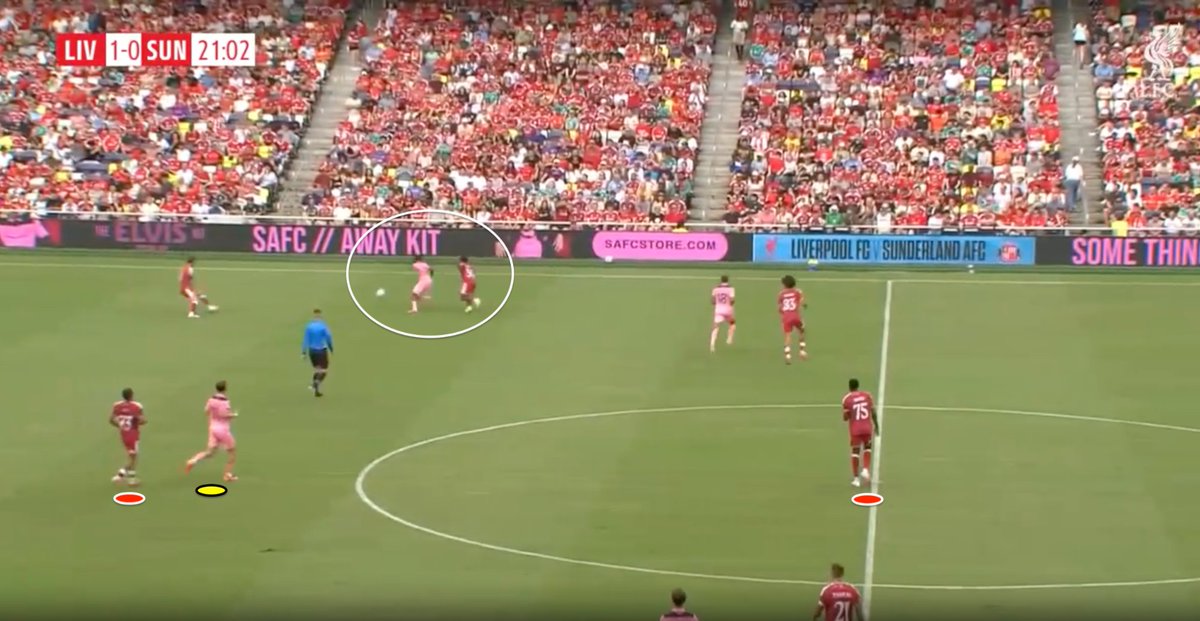
Liverpool's #9 and #10 press the centre backs as per usual and McConnell locks onto the #6.
Sunderland play out to their left which means that Rio Ngumoha's tactical role becomes vital.
In a man-to-man defensive system, Rio would not have much responsibility when the ball is played out to the opposite side of the pitch.
But, because Iraola's intention is to primarily defend zonally, Rio has to dig inside the pitch to manage one of the Sunderland #8's as Liverpool's #6 goes across to press the ball-side #8.
The idea behind this is that it leaves Sunderland's right back free but because they are trapped on the left side of the pitch, they are unlikely to find him. Leaving him free lets Liverpool maintain a +1 overload in the defensive line as the centre back does not have to leave to press the #8 because Rio digs inside the pitch to manage him.
11
Iraola's defensive philosophy is one that is space and ball-oriented.
Because they managed the space well in this moment with Rio digging inside the pitch, Sunderland have few options on the ball with Liverpool having a +1 in defence.
But instead of simply staying with their respective men, Iraola wants his players to hunt in packs and to 'overload the ball'.
We see a great example of that here as Jones and Frimpong gang up on the Sunderland player to retrieve possession.
A successful press, all of which comes from exceptional training ground work from Iraola ✅
Because they managed the space well in this moment with Rio digging inside the pitch, Sunderland have few options on the ball with Liverpool having a +1 in defence.
But instead of simply staying with their respective men, Iraola wants his players to hunt in packs and to 'overload the ball'.
We see a great example of that here as Jones and Frimpong gang up on the Sunderland player to retrieve possession.
A successful press, all of which comes from exceptional training ground work from Iraola ✅
12
An additional benefit to this way of pressing is that because the far-side winger digs inside the pitch defensively, it leaves them in a central position to exploit the opposition if possession is retrieved.
Iraola's players are coached within an inch of their lives defensively and are programmed to look for the diagonal pass off the back of a successful pressing action.
You can see Semenyo in that threatening position as Bournemouth win the ball on the side below.
TOP coaching 👏
Iraola's players are coached within an inch of their lives defensively and are programmed to look for the diagonal pass off the back of a successful pressing action.
You can see Semenyo in that threatening position as Bournemouth win the ball on the side below.
TOP coaching 👏
13
However, Iraola does NOT want to exclusively defend zonally.
Arne Slot also implemented the diamond press at Liverpool, but it was not as well coached, not as aggressive, and it rarely transitioned into a man-to-man press.
One of the biggest reasons why Liverpool fans were so unhappy with Slot was because of the passive play-style, even in the title winning season with games like Chelsea at Anfield standing out like a sore thumb in my memory.
Liverpool won, but it was largely down to individual quality and a bit of luck. That's fine, but it's not a great reflection on the coaching staff. Those issues became increasingly apparent last season as Liverpool's results fell off a cliff.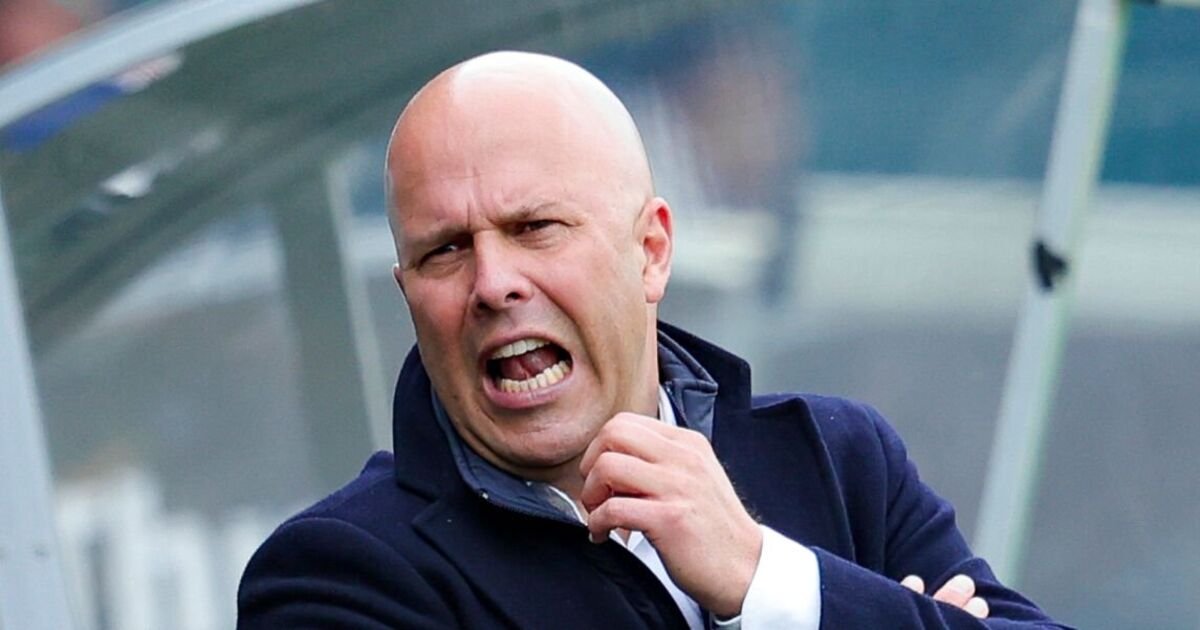
Arne Slot also implemented the diamond press at Liverpool, but it was not as well coached, not as aggressive, and it rarely transitioned into a man-to-man press.
One of the biggest reasons why Liverpool fans were so unhappy with Slot was because of the passive play-style, even in the title winning season with games like Chelsea at Anfield standing out like a sore thumb in my memory.
Liverpool won, but it was largely down to individual quality and a bit of luck. That's fine, but it's not a great reflection on the coaching staff. Those issues became increasingly apparent last season as Liverpool's results fell off a cliff.
14
Tactically and philosophically, Iraola won't have that issue at Liverpool.
His DNA is aligned with Jürgen Klopp when it comes to defending.
Let's look at an example of that.
Liverpool's #9 and #10 are aggressive against the centre backs (as ever).
Behind that, Liverpool's midfield 2 are overloaded by Sunderland's midfield 3.
Typically, as part of the diamond press, the #8 splits the #6's and the #6 manages the opposition #10.
Here, McConnell commits to the ball-side #6 so Jones has a decision to make. Does he jump to the #6 or stay with the #10?
You can see how he turns his head in this moment.
The reason?
He needs a centre back to jump behind him to make up the numbers in midfield.
This is exactly what happens and Liverpool successfully transition from a zonal press into a man-to-man press.
We will see Liverpool do this a LOT under Iraola.
Once again, TOP coaching! 👏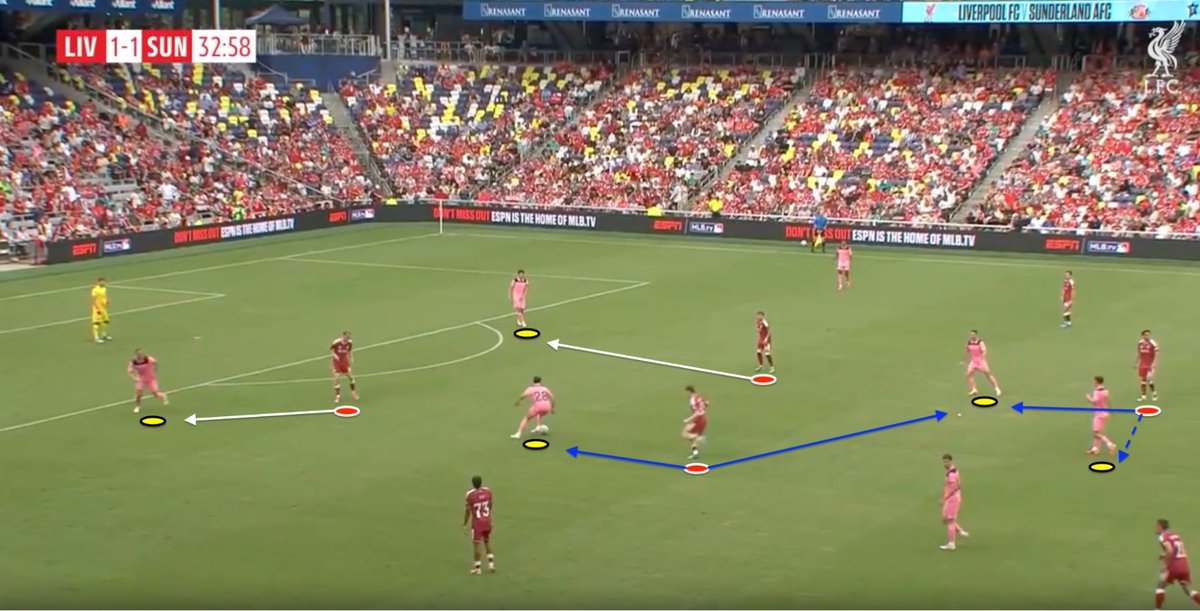

His DNA is aligned with Jürgen Klopp when it comes to defending.
Let's look at an example of that.
Liverpool's #9 and #10 are aggressive against the centre backs (as ever).
Behind that, Liverpool's midfield 2 are overloaded by Sunderland's midfield 3.
Typically, as part of the diamond press, the #8 splits the #6's and the #6 manages the opposition #10.
Here, McConnell commits to the ball-side #6 so Jones has a decision to make. Does he jump to the #6 or stay with the #10?
You can see how he turns his head in this moment.
The reason?
He needs a centre back to jump behind him to make up the numbers in midfield.
This is exactly what happens and Liverpool successfully transition from a zonal press into a man-to-man press.
We will see Liverpool do this a LOT under Iraola.
Once again, TOP coaching! 👏
15
However, there are some issues with Iraola's defensive philosophy despite the success it has.
We CANNOT ignore that.
Part of that is down to this Liverpool group being new under his tutelage, but part of it is also down to the inherent style and the subsequent demands on the players.
Iraola's diamond press works brilliantly when the opposition are positioned predictably, but once they are fluid, dynamic, and do unconventional things, Iraola's philosophy can be exploited in two different ways.
For example, Sunderland drop a #6 into the first line.
Now Liverpool's front 2 are overloaded and they lack pressure on the ball.
We CANNOT ignore that.
Part of that is down to this Liverpool group being new under his tutelage, but part of it is also down to the inherent style and the subsequent demands on the players.
Iraola's diamond press works brilliantly when the opposition are positioned predictably, but once they are fluid, dynamic, and do unconventional things, Iraola's philosophy can be exploited in two different ways.
For example, Sunderland drop a #6 into the first line.
Now Liverpool's front 2 are overloaded and they lack pressure on the ball.
16
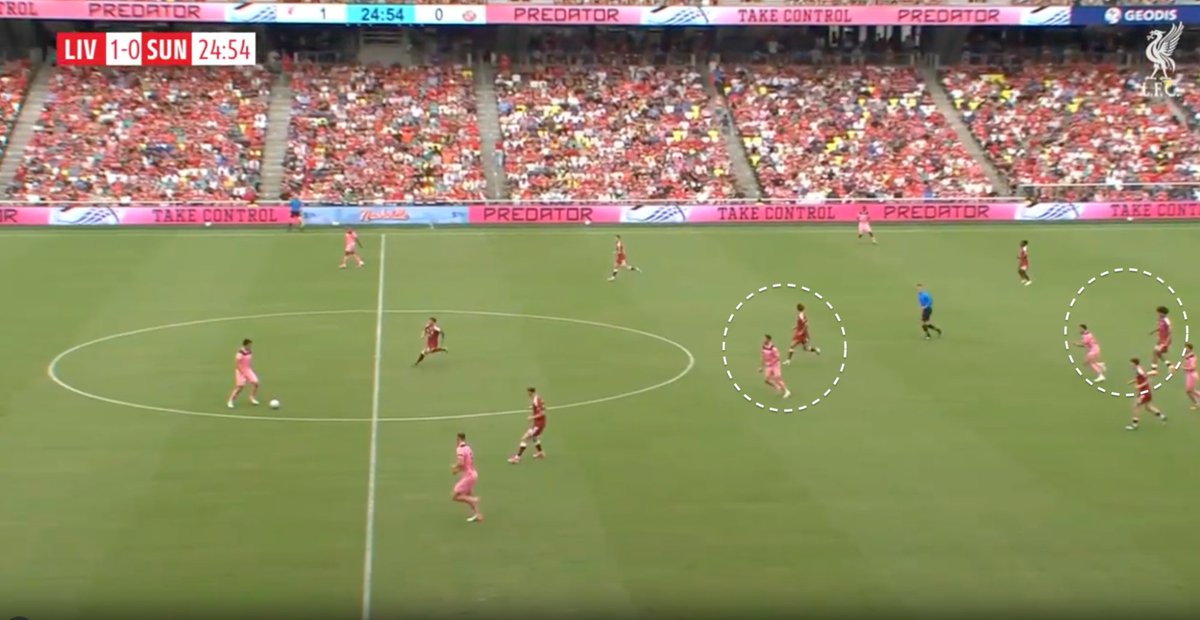
This time, Liverpool do get pressure on the ball as Sunderland build with a 3 and attack in a 3-1-6 shape.
Rio tracks back with Sunderland's right back who has pushed on positionally, Morrison stays high with the conservatively positioned left back, and the #9 + #10 manage the two centre backs.
In midfield, Jones and McConnell match up with Ndukwe backing up the press behind them between the lines.
Liverpool are man-to-man in this moment and have made good decisions across the park to co-ordinate this moment defensively.
Sunderland are forced backwards, Liverpool step up with their pressure, but the press is bypassed because Jones makes a bad decision to jump and Ndukwe doesn't back up the press between the lines which means Sunderland have two spare men in the heart of Liverpool's block.
Press bypassed ❌

Rio tracks back with Sunderland's right back who has pushed on positionally, Morrison stays high with the conservatively positioned left back, and the #9 + #10 manage the two centre backs.
In midfield, Jones and McConnell match up with Ndukwe backing up the press behind them between the lines.
Liverpool are man-to-man in this moment and have made good decisions across the park to co-ordinate this moment defensively.
Sunderland are forced backwards, Liverpool step up with their pressure, but the press is bypassed because Jones makes a bad decision to jump and Ndukwe doesn't back up the press between the lines which means Sunderland have two spare men in the heart of Liverpool's block.
Press bypassed ❌
17
We see another example here.
The #9 and #10 release to get pressure on the ball but neither the #8 or the #6 backs up the press because they are pinned by Sunderland's #8's between the lines.
Even if Liverpool's front 2 were passive here, Sunderland would have had a spare man in front of their block.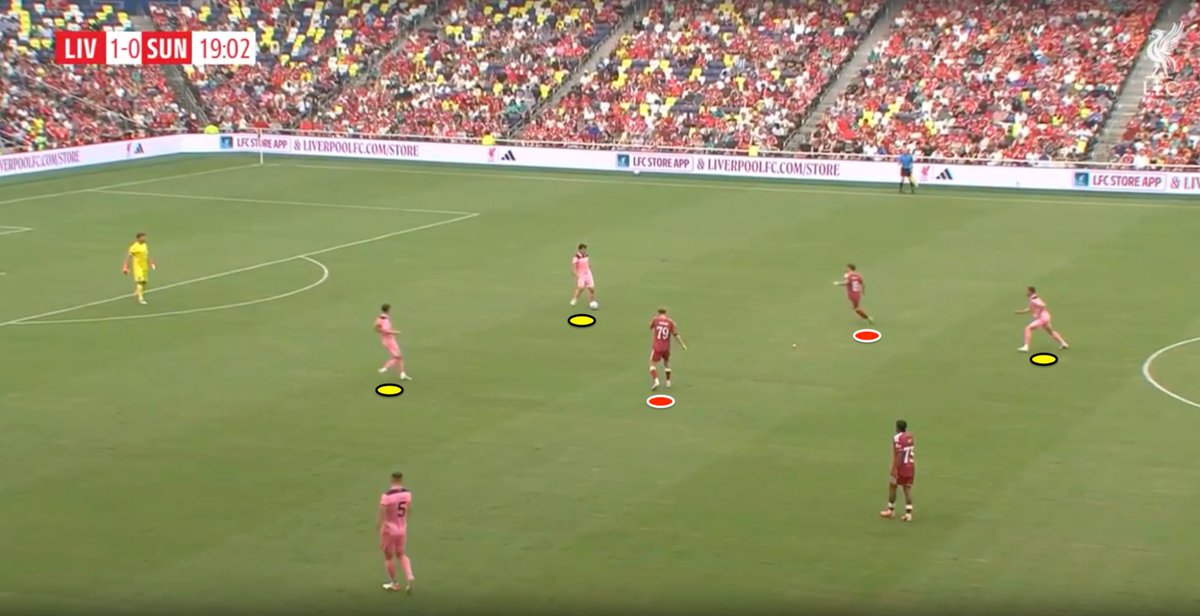

The #9 and #10 release to get pressure on the ball but neither the #8 or the #6 backs up the press because they are pinned by Sunderland's #8's between the lines.
Even if Liverpool's front 2 were passive here, Sunderland would have had a spare man in front of their block.
18
We see it again.
Sunderland are dynamic positionally so Liverpool are unsure how to position themselves.
Liverpool are cut through 3 times in the space of 10 seconds with ZERO pressure on the ball and give up a shot at the edge of their own box.
Not good…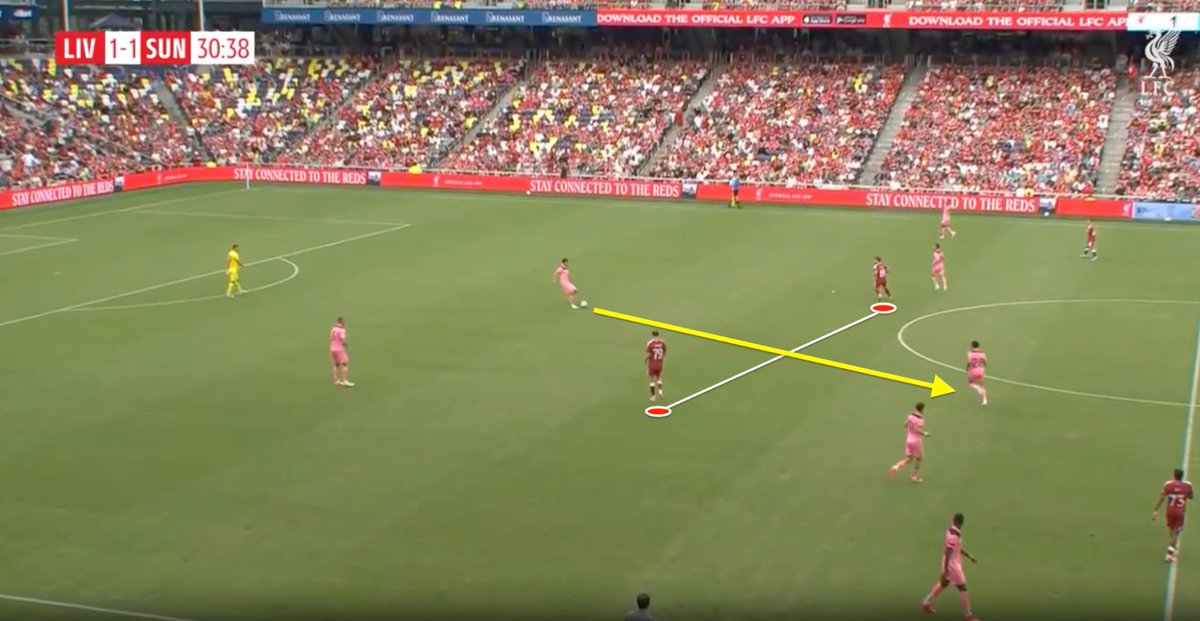


Sunderland are dynamic positionally so Liverpool are unsure how to position themselves.
Liverpool are cut through 3 times in the space of 10 seconds with ZERO pressure on the ball and give up a shot at the edge of their own box.
Not good…
19
Here is one final example.
Here, Sunderland drop their #6 into the first line, a winger is low in midfield, and their fullback is inverted between the lines high.
This causes lots of confusion for Iraola's philosophy, and it is NOT because Liverpool are early in his reign. We saw these issues at Bournemouth as well.
When the opposition are predictable positionally, Iraola's teams press extremely well.
When they are not, they can be exploited, whether that be through a lack of pressure on the ball or with gaps within the defensive shape.
It's in moments like this where the Iraola philosophy can come unstuck because it is caught between pressing and not pressing.
Arsenal are widely regarded as the best defensive team in the world and that's because they have defensive clarity in each moment. They can press effectively zonally or man-to-man, transition into a man-to-man press from a zonal shape via central AND wide connections (Iraola only does it centrally), and when Arsenal lack pressure on the ball they are comfortable getting into a 4-4-2 block before trying to reapply pressure once again.
Iraola's idea doesn't necessarily cater for that and this is why I can see there being issues for Liverpool under his tutelage. Sometimes they will press outstandingly well, and other times they will have issues, just like what happened at Bournemouth.
They were a 'fun' team, but you don't want to be the 'fun' team at Liverpool. You want to win major titles whilst playing attractive football. There is nothing fun about playing attractive football and not winning. The standards are very different at this football club.
Here, Sunderland drop their #6 into the first line, a winger is low in midfield, and their fullback is inverted between the lines high.
This causes lots of confusion for Iraola's philosophy, and it is NOT because Liverpool are early in his reign. We saw these issues at Bournemouth as well.
When the opposition are predictable positionally, Iraola's teams press extremely well.
When they are not, they can be exploited, whether that be through a lack of pressure on the ball or with gaps within the defensive shape.
It's in moments like this where the Iraola philosophy can come unstuck because it is caught between pressing and not pressing.
Arsenal are widely regarded as the best defensive team in the world and that's because they have defensive clarity in each moment. They can press effectively zonally or man-to-man, transition into a man-to-man press from a zonal shape via central AND wide connections (Iraola only does it centrally), and when Arsenal lack pressure on the ball they are comfortable getting into a 4-4-2 block before trying to reapply pressure once again.
Iraola's idea doesn't necessarily cater for that and this is why I can see there being issues for Liverpool under his tutelage. Sometimes they will press outstandingly well, and other times they will have issues, just like what happened at Bournemouth.
They were a 'fun' team, but you don't want to be the 'fun' team at Liverpool. You want to win major titles whilst playing attractive football. There is nothing fun about playing attractive football and not winning. The standards are very different at this football club.
20
On a broader scale, Liverpool have signed Víctor Muñoz (who is very similar to Craig Bellamy as a player), but there remains a lot of work to be done in the transfer market.
Long-term injuries and a lack of squad depth is not a good problem to have when looking ahead to next season, especially with the fixture congestion that Liverpool have with Champions League football on top of what is a physically demanding style of play…
--
With Iraola, assuming his psychological profile can handle the pressure of managing a club like Liverpool, he needs elite quality AND a humble group to make up for the deficiencies in his current game-model.
Once again, let me explain that statement further:
With the ball, the freedom that Iraola gives to his players is something that relies on elite quality due to the lack of systematic methods of chance creation that positional play gives you. Think Michael Carrick at Manchester United. We don't see Pep Guardiola-esque patterns, but it doesn't matter so much because they have world class forwards. That's what Iraola needs at Liverpool.
Plus, in the defensive moment, the lack of defensive clarity at times can result in basketball-type games, but that may work in Liverpool's favour more often than not IF they have elite players who can handle that chaos and supersede tactics (like Salah, van Dijk, Alisson amongst others in 24/25).
His model is also not one that fits an ageing Mo Salah, for example. He needs EVERY player to buy in to work hard and to understand the defensive side of things in his complex system.
Recruitment will play a HUGE factor in whether Iraola succeeds at the club or not. Right now, Liverpool's squad is miles away from competing for major honours, but let's judge it when the window closes.
--
All in all, Iraola fits Liverpool’s DNA and can succeed at the club IF they recruit to an elite standard to make up for the deficiencies in game-model. His game-model is an excellent one, but it is not flawless. But, like I imply, it doesn't need to be flawless to win major titles IF Liverpool sign enough quality to complement it.
We also must acknowledge that Iraola himself can improve as a coach (although I will be surprised to see him do anything other than try to perfect his current way of playing).
Outside of that, he must prove that he has the psychological profile to manage a club like Liverpool. Without that, he cannot succeed, and only time will tell if he is truly a leader of men.
It will be fascinating to see how it all plays out…
🛑
Long-term injuries and a lack of squad depth is not a good problem to have when looking ahead to next season, especially with the fixture congestion that Liverpool have with Champions League football on top of what is a physically demanding style of play…
--
With Iraola, assuming his psychological profile can handle the pressure of managing a club like Liverpool, he needs elite quality AND a humble group to make up for the deficiencies in his current game-model.
Once again, let me explain that statement further:
With the ball, the freedom that Iraola gives to his players is something that relies on elite quality due to the lack of systematic methods of chance creation that positional play gives you. Think Michael Carrick at Manchester United. We don't see Pep Guardiola-esque patterns, but it doesn't matter so much because they have world class forwards. That's what Iraola needs at Liverpool.
Plus, in the defensive moment, the lack of defensive clarity at times can result in basketball-type games, but that may work in Liverpool's favour more often than not IF they have elite players who can handle that chaos and supersede tactics (like Salah, van Dijk, Alisson amongst others in 24/25).
His model is also not one that fits an ageing Mo Salah, for example. He needs EVERY player to buy in to work hard and to understand the defensive side of things in his complex system.
Recruitment will play a HUGE factor in whether Iraola succeeds at the club or not. Right now, Liverpool's squad is miles away from competing for major honours, but let's judge it when the window closes.
--
All in all, Iraola fits Liverpool’s DNA and can succeed at the club IF they recruit to an elite standard to make up for the deficiencies in game-model. His game-model is an excellent one, but it is not flawless. But, like I imply, it doesn't need to be flawless to win major titles IF Liverpool sign enough quality to complement it.
We also must acknowledge that Iraola himself can improve as a coach (although I will be surprised to see him do anything other than try to perfect his current way of playing).
Outside of that, he must prove that he has the psychological profile to manage a club like Liverpool. Without that, he cannot succeed, and only time will tell if he is truly a leader of men.
It will be fascinating to see how it all plays out…
🛑

