Autonomous AI Agents: How They Think and Act

A technical and practical guide to understanding how autonomous AI agents reason, plan, and take actions.
What Are Autonomous AI Agents?
An autonomous AI agent is a system that can pursue a goal with minimal human intervention. Unlike a normal chatbot that waits for your next message, an agent can break down a goal, make a plan, use tools, check its own work, and keep going until the task is complete.
In simple terms:
This difference makes agents much more powerful for real-world tasks like research, coding, data analysis, and customer support. While chatbots are reactive, agents are proactive. They can decide what to do next without constant human input.
In 2026, autonomous agents are being used across industries to automate complex workflows that previously required multiple people or manual effort. However, building reliable agents requires a clear understanding of how they think and act.
How Autonomous Agents Think (Reasoning Process)

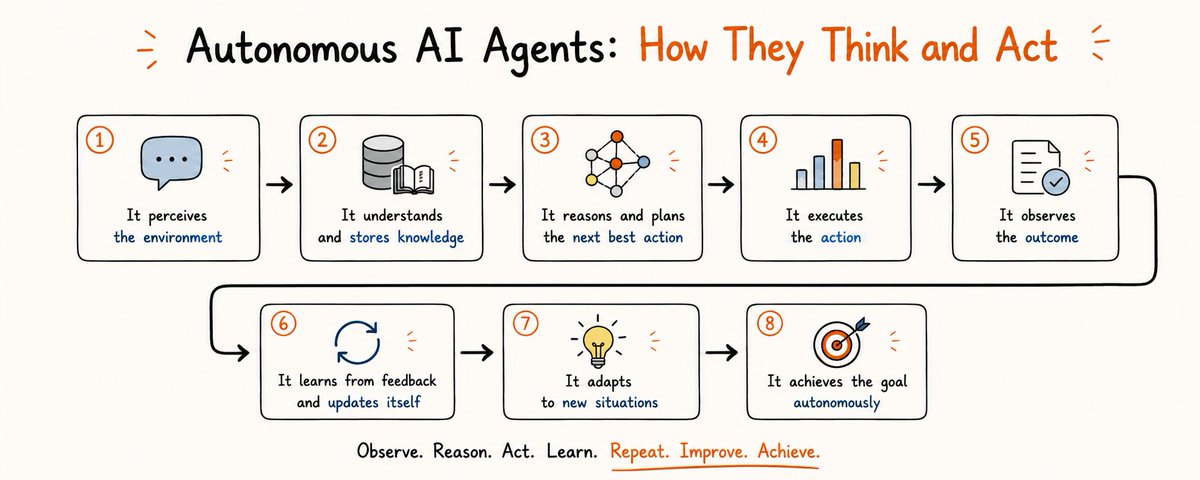
Autonomous agents follow a structured thinking process. This process allows them to handle complex tasks in a logical and organized way. Here’s how they typically work:
Step 1: Goal Understanding
The agent first understands the final objective given by the user. This step is critical because a poorly understood goal leads to poor results.
Step 2: Planning
The agent breaks the goal into smaller, manageable steps. This is called task decomposition. Good planning helps the agent avoid getting stuck on complex problems.
Step 3: Tool Selection
The agent decides which tools (search, calculator, code interpreter, browser, etc.) are needed to complete each step. Tool selection is one of the most important skills of an agent.
Step 4: Action Execution
It performs the selected action using the chosen tool. This is where the agent actually interacts with external systems.
Step 5: Observation & Evaluation
The agent observes the result and checks if it is correct or if more steps are needed. This self-evaluation step helps improve accuracy.
Step 6: Iteration
If the result is not satisfactory, the agent adjusts its plan and repeats the process. This ability to iterate is what makes agents autonomous.
This cycle of Plan → Act → Observe → Adjust is the core of how agents think and act. Without this structured reasoning, agents would behave randomly and produce unreliable results.
Core Components of an Autonomous Agent

A well-designed autonomous agent usually contains these components:
| Component          | Purpose                                      | Example |
|--------------------|----------------------------------------------|--------|
| **Planner**        | Breaks down the goal into steps              | Task decomposition |
| **Memory**         | Stores past actions and results              | Conversation history |
| **Tools**          | Allows the agent to take real actions        | Web search, code execution |
| **Executor**       | Carries out the planned actions              | Clicking buttons, calling APIs |
| **Evaluator**      | Checks the quality of results                | Self-critique or scoring |
| **Orchestrator**   | Manages multiple agents (if needed)          | Supervisor agent |
These components work together to make the agent autonomous and reliable. Without proper memory or evaluation, even a well-planned agent can produce poor results.
Step-by-Step: How an Agent Works

Here’s a practical example of how an agent handles a task:
Goal: “Find the cheapest flight from Delhi to Mumbai next week and book it if the price is under ₹8,000.”
Step-by-step process:
Compare prices
Filter by date and time
Check if price is under budget
Proceed to booking if conditions are met
This step-by-step approach allows the agent to handle multi-step tasks without constant human input. Each step builds on the previous one, making the process more reliable.
Tools and Function Calling

One of the most important features of modern agents is tool use (also called function calling).
Tools allow agents to go beyond just generating text. They can:
Example: Tool Definition
tools = [
    {
        "name": "web_search",
        "description": "Search the internet for information",
        "parameters": {
            "query": "string"
        }
    },
    {
        "name": "calculate",
        "description": "Perform mathematical calculations",
        "parameters": {
            "expression": "string"
        }
    }
]
By giving agents access to tools, we enable them to take real actions instead of just answering questions. This is what makes agents truly autonomous.
Memory in Autonomous Agents
Memory is a critical component that allows agents to perform well over time. There are different types of memory:
Without proper memory, agents repeat mistakes and lose context. Good memory design is essential for building reliable autonomous agents.
Multi-Agent Systems

In many real-world applications, a single agent is not enough. This is where multi-agent systems become useful.
In a multi-agent system, multiple specialized agents work together. For example:
Multi-agent systems are more powerful because they allow specialization. Each agent can focus on what it does best, leading to better overall results.
Practical Code Example
Here’s a simple example of how an autonomous agent can be built using CrewAI:
from crewai import Agent, Task, Crew

researcher = Agent(
    role='Research Analyst',
    goal='Research the given topic thoroughly',
    backstory='Expert in finding accurate and relevant information.'
)

writer = Agent(
    role='Content Writer',
    goal='Write clear and engaging content',
    backstory='Experienced technical writer.'
)

task1 = Task(
    description="Research the latest trends in AI agents",
    agent=researcher
)

task2 = Task(
    description="Write a summary based on the research",
    agent=writer
)

crew = Crew(agents=[researcher, writer], tasks=[task1, task2])
result = crew.kickoff()
This example shows how multiple agents can work together in a structured way.
Challenges and Limitations
While autonomous agents are powerful, they still face several challenges:
Because of these limitations, most production systems still include some level of human oversight.
Best Practices for Building Reliable Agents
Here are some practical recommendations:
Following these practices helps build more reliable and maintainable agent systems.
If you're learning AI, this might help:
• Practical AI tools
• Automation workflows
• Productivity use cases
• AI resources for work & learning