GEO Vendors Aren't Building Brand Mentions. They're Buying Them.

Much of what is being sold under the GEO umbrella is not only unethical but potentially fraudulent. I'm going to expose the GEO grift in this post, so lock-in 🔒

There’s a growing narrative that says visibility in AI search is heavily dependent on off-site brand mentions. The logical reaction for marketers: think beyond on-site content and prioritize off-site marketing initiatives to increase brand recommendation rates in AI-powered answer summaries.
At this point, we have reached an industry wide consensus on the importance of off-site signals in AI search. But unfortunately, this consensus has opened the backdoor for opportunists repackaging black-hat SEO tactics as legitimate techniques for growing AI visibility.
The Deception Under the GEO Umbrella
I have personally audited the work of top-rated GEO vendors offering outreach services for brand mentions.
The dirty little secret I have uncovered is that these service providers are charging premium prices for questionable, low-quality work.
Deceptive tactics include:
Paying for brand mentions is just an evolution of black-hat link building
This is an example of what GEO outreach vendors are pitching. Not only is this unethical, but it’s considered AI manipulation.

Clients are being asked to approve and negotiate payments for brand mentions
This is happening in Slack. The agency generates a “placement opportunity” for approval and the internal marketing liaison has to review it.
The internal marketer is often a junior specialist that doesn’t know how to evaluate the legitimacy of a referring page.
There’s a prompt topic, domain authority, citation rate, and placement fee to the publisher.
In this example, it would be $250 in exchange for adding the brand mention.

Clients have to pay the publisher fees on top of the GEO agency retainer
This is the slimy part that doesn’t get talked about. The GEO vendor pays the publisher fees directly, but then sends an invoice back to the client in order to recoup the placement fees.
GEO vendors push for scale and volume, but dismiss quality and relevance
My argument is that third-party validation is only useful when it is real validation from credible, topically relevant brands.
Meanwhile, GEO vendors are claiming “this is definitely a volume game”.
“We’re going to get you as much volume as possible because we know volume is required in order to influence these models…”
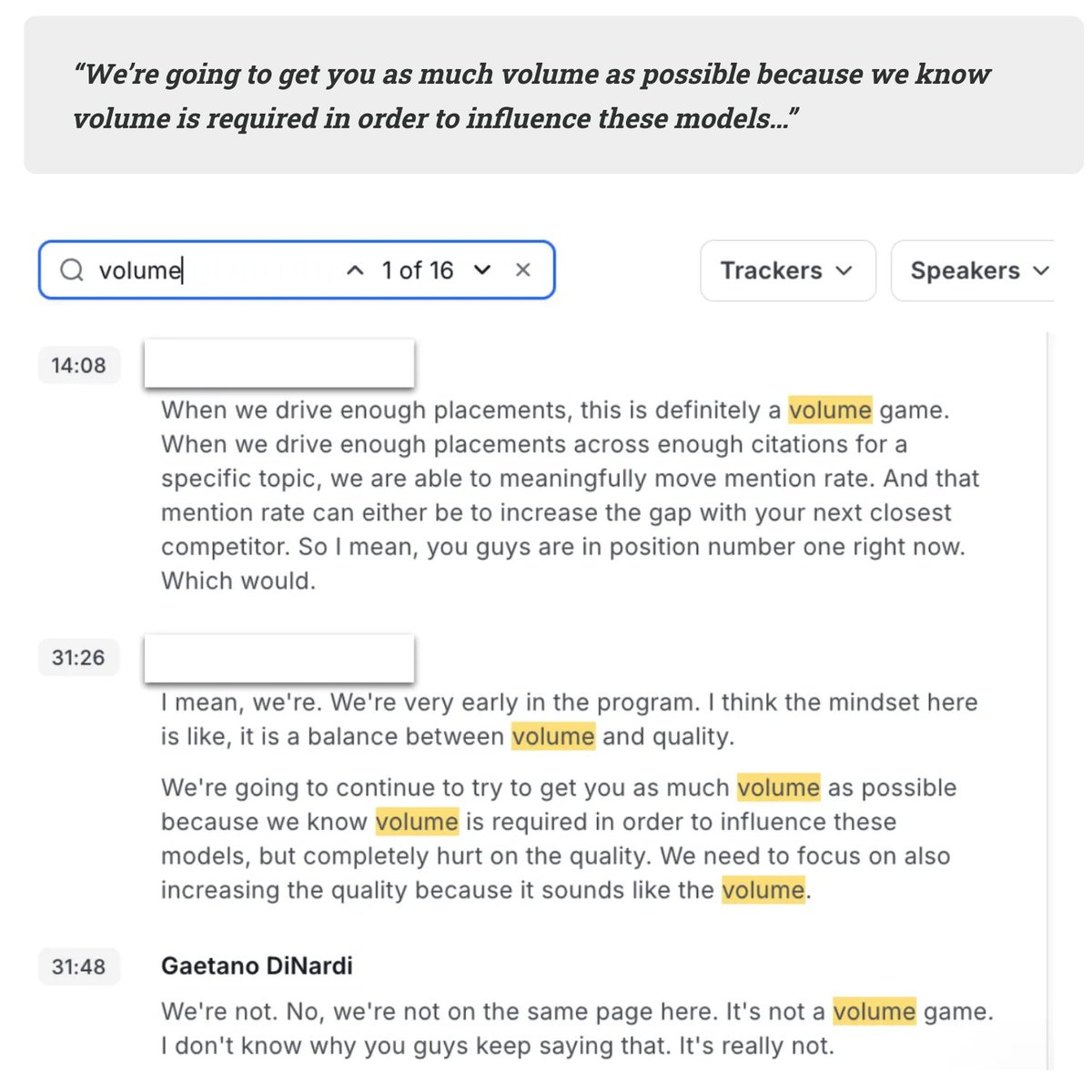
My pushback: “No, we’re not on the same page here.”
They are treating the problem as a mention-rate / citation-rate / volume game, but not factoring quality or relevance in their approach.
GEO vendors are paying for brand mentions on the same websites that sell backlinks
In the example below, there are several outgoing commercial anchors to LMS software vendors. This is the hallmark signal for paid links.
Considering that GEO is a reputation problem, I don’t think any legit brand would want to be mentioned on a page that is loaded with paid links to its competitors.

There’s a temporary window of effectiveness for inauthentic brand mention spam
The common pushback is: “Well, it works.” And sure, it might. For now.
Spammy GEO tactics might work today because LLM citation systems are immature compared to Google’s advanced spam detection.
It’s possible that LLMs may currently reward mention volume from low-quality sources that Google would typically ignore.
This creates a temporary window of effectiveness before AI platforms refine their authority and spam signals. Marketers who prioritize a high volume approach over brand safety may risk confusing LLMs about their “entity” or damaging their reputation permanently.
GEO vendors are operating under a reckless moral hazard
GEO vendors know this is a quick cash-grab. But doing so creates a reckless moral hazard.
Marketing leaders are getting duped. And they’re not just wasting time and money; they may be buying mentions that get removed, damage their brand reputation, confuse LLMs about their entity, and ultimately waste effort on useless marketing initiatives.
It may also be illegal. The FTC says paid advertisements must have transparent disclosure. But after paid or “negotiated” brand mentions are added to content pages, those websites are not updating pages to include a sponsorship disclosure after receiving payment.
How to pushback on GEO vendor claims about off-site mention building
Most GEO vendor claims are not validated
The common thread is that GEO agencies are prioritizing volume while dismissing quality.
There is no substantial evidence to support:
Paying for “25 brand placements” in order to see a “10–15% mention-rate lift” is not the right way for brands to be thinking about AI search.
Instead, brands should avoid risky placements from paid-link farms, and only drive offsite mentions that look like real category validation from real businesses, real publishers, or real communities.